
Why this topic deserves your attention even before you spend a single euro too much
There is a particular moment in the life of a self-employed person: the moment when turnover soars, clients flock in, and euphoria takes precedence over administrative vigilance. It is precisely at this point that the micro-enterprise thresholds become a critical issue. Not because they are complicated in themselves, but because they are poorly anticipated.
Every year, thousands of content creators, coaches, consultants, trainers and freelancers are surprised to discover that they have exceeded a threshold without realising it, resulting in VAT that must be collected retrospectively, a change in tax regime, or simply losing their micro-entrepreneur status. It’s never an irreversible disaster, but it’s often a source of avoidable stress.
This article has a simple aim: to give you a clear, up-to-date and practical understanding of the thresholds governing micro-enterprises in France, so that you can manage your creator business with confidence rather than simply going with the flow.
What is actually referred to as the ‘threshold’ in micro-enterprises
The term ‘threshold’ actually covers several distinct mechanisms, which are often confused. It is essential to distinguish between them in order to understand which ones actually apply to you, depending on your creator business activity.
The turnover threshold for the micro-tax scheme
This is the best-known threshold, the one that determines whether you can remain within the micro-enterprise scheme. Since the last update to the thresholds, these amounts have been periodically revised to take account of inflation, in accordance with the provisions of the General Tax Code (Articles 50-0 and 102 ter).
For the year 2026, the applicable thresholds remain divided into two main categories of activity. For the sale of goods, catering and accommodation, the threshold is set at 188,700 euros in annual turnover. For services falling under BIC (industrial and commercial profits) and for the liberal professions falling under BNC (non-commercial profits), the threshold is set at 77,700 euros.
These amounts are not arbitrary: they correspond to the limits set by the Directorate-General for Public Finances and can be viewed on the official website service-public.fr, which remains the up-to-date reference for any verification.
In practical terms, a coach who charges for one-to-one coaching sessions falls into the second category. A content creator who sells physical products via her online shop potentially falls into the first category, or a mix of both if she also offers consultancy services.
The tolerance threshold: the margin that saves a bad year
The legislator has provided for a grace period. If you exceed the threshold in a single year, you will not immediately be excluded from the micro-scheme. You must exceed the threshold two consecutive years to be automatically transferred to a real tax regime the following year.
This rule provides much-needed breathing space for the self-employed whose work experiences occasional peaks, such as a trainer who secures an exceptional contract with a large company in a given year.
The VAT threshold: the real operational pitfall
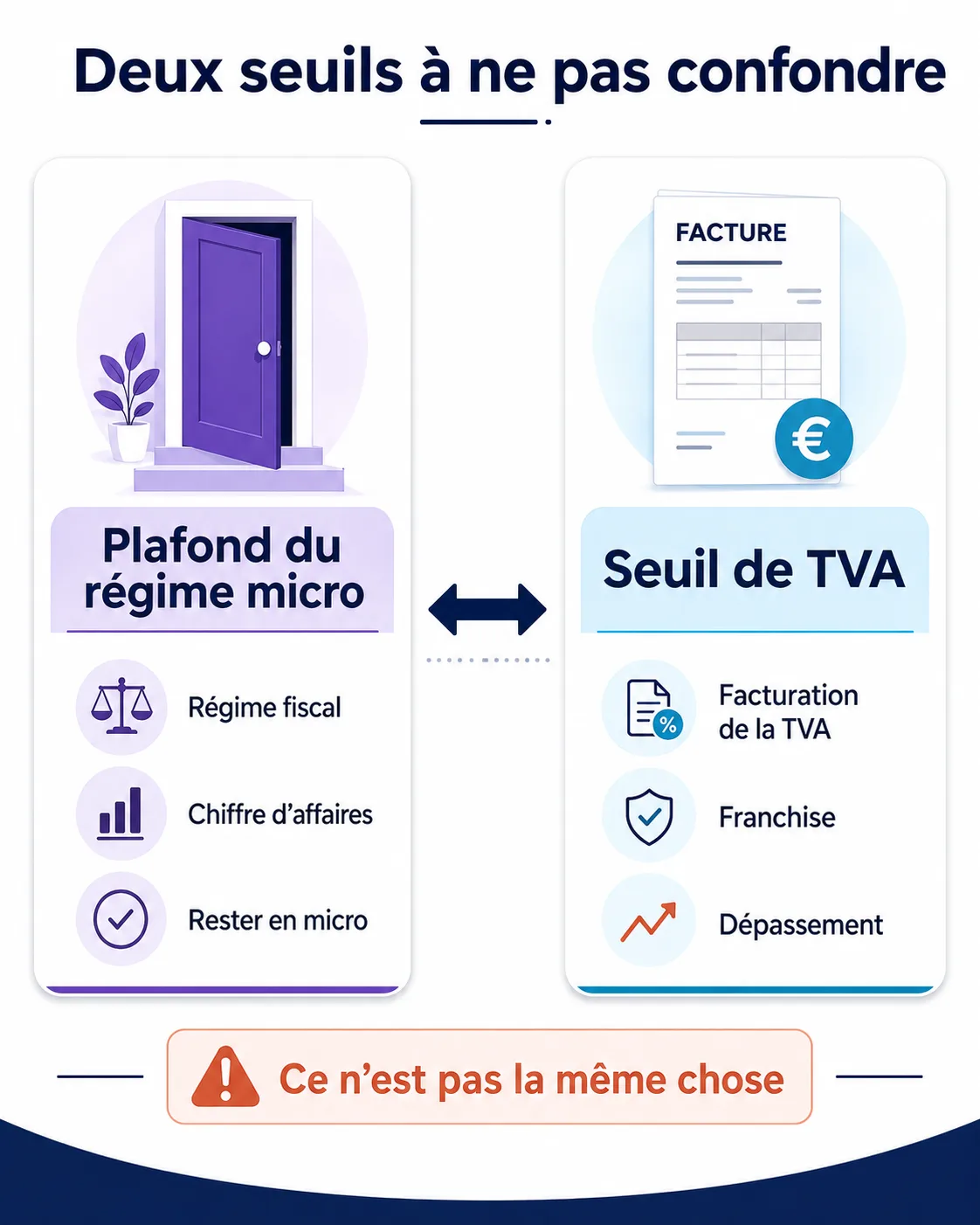
This is where most self-employed people are caught out, as this threshold is different from the turnover cap and is triggered earlier.
In 2026, the VAT exemption thresholds are set at 37,500 euros for services and liberal professions, and 85,000 euros for sales activities. There is also an increased threshold: if you exceed the basic threshold without exceeding the increased threshold (85,000 euros for services, 93,500 euros for sales), you retain the exemption until the end of the current year, before becoming liable for VAT on 1 January of the following year.
However, if you directly exceed the threshold increased during the year, you become liable for VAT from the first day of the month of exceedance, without period of tolerance. It is this mechanism, poorly anticipated, which generates the most bad administrative surprises.
Key points: the turnover limit determines whether you remain micro-entrepreneur. The basic deductible threshold determines whether you must charge VAT. These are two different logics, with different consequences.
Why these thresholds directly affect creators and freelancers who are gaining visibility
There is a direct, almost mechanical link between an independent's visibility strategy and its proximity to these thresholds. The more structured your digital presence, the more your audience converts, the faster your turnover progresses, sometimes faster than expected.
This is a phenomenon that is regularly observed among content creators who professionalize their activity: a growing audience, an offer that becomes clear, a reservation system that facilitates the transition to purchase, and suddenly, a turnover that doubles in a few months. This is excellent commercial news, but it requires more rigorous administrative control.
Example 1) A Digital Strategy Consultant:
Sarah accompanies brands on their online positioning. At the beginning of the year, it charges approximately 4 000 euros per month. After having clarified its offer and structured an appointment making system accessible directly from its social networks, its requests double.
In six months, it reaches 40 000 euros of accumulated turnover, dangerously approaching the VAT-based deductible threshold set at 37 500 euros for the provision of services. Without strict follow-up, it could have invoiced for several months without VAT when it was already subject to it.
Example 2) An Independent Trainer:
Marc runs face-to-face and online training. Its activity is seasonal, with peaks in September and January.
A particularly strong year makes it exceed the ceiling of 77 700 euros. Thanks to the two consecutive years rule, it does not immediately switch to a real regime, which gives it time to anticipate calmly, in particular by consulting an accountant to assess the value of staying on a microphone or changing structure.
Common error: many self-employed people follow their turnover in an approximate way, using an updated Excel table "from time to time". However, the monitoring must be accurate and monthly as soon as the activity exceeds 60 % of the basic franchise threshold, in order to anticipate calmly the change in tax status.
How to keep track of your thresholds without having to think about them all the time
The good news is that monitoring thresholds does not require extensive accounting expertise, but a simple discipline.
Set up a monthly monitoring table
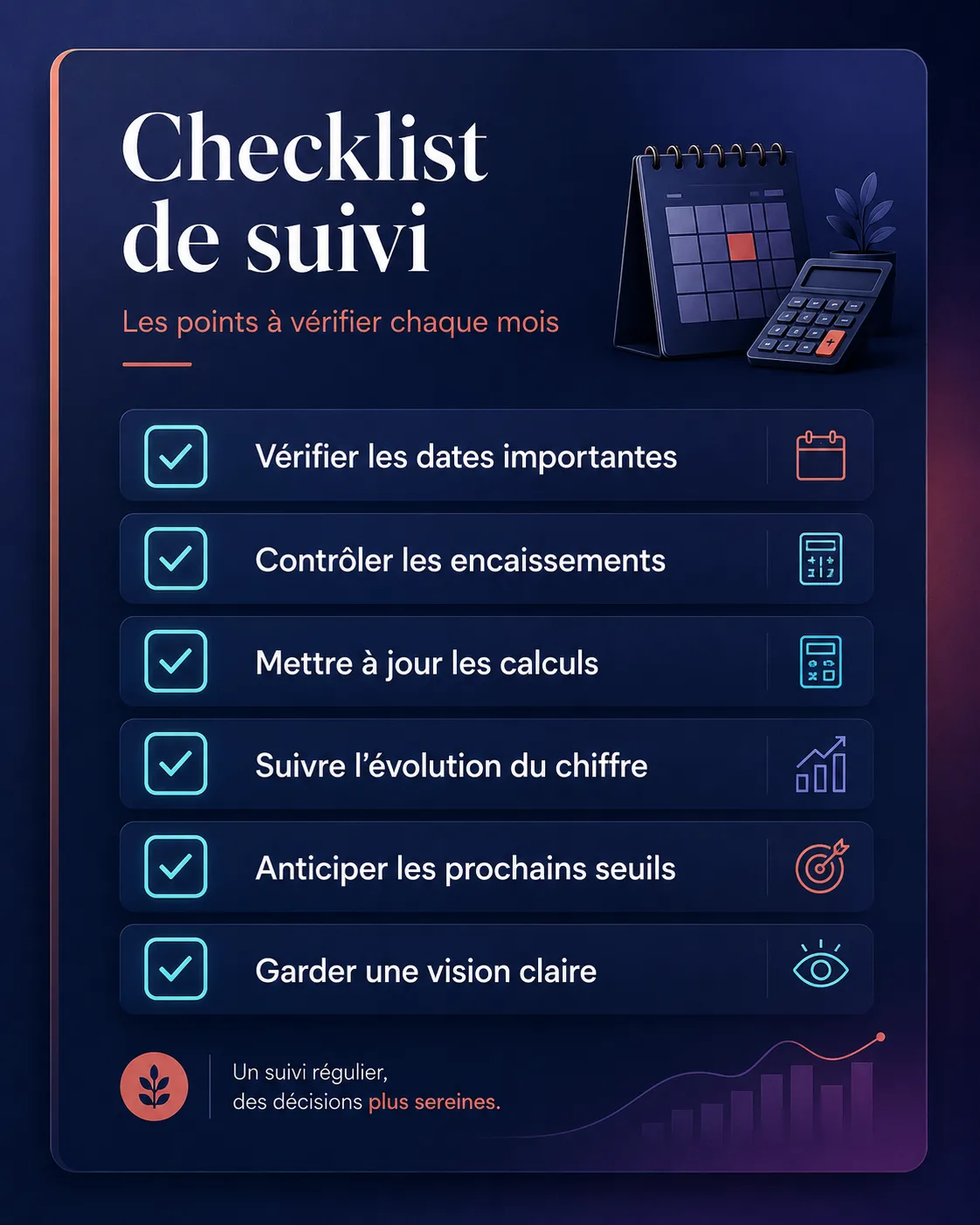
A simple table, updated each month, with the turnover received and the cumulation since January 1], is sufficient in most cases. The objective is to visualize your position in real time in relation to the thresholds applicable to your activity.
Anticipating the threshold, not only seeing it
The real skill is not to know we've crossed a threshold, but to see it coming. If you find that your growth rate leads you to exceed the VAT-based deductible threshold within two or three months, it is time to talk to an accountant to prepare your billing, inform your customers if necessary, and adjust your cash flow.
Understand the impact on your tariff positioning
Toggle in VAT is not commercially neutral. If you work with individuals not subject to VAT, an increase of 20 % in your tariffs to compensate may affect your competitiveness.
If you work with professionals who collect VAT, the impact is generally negligible. This distinction must be part of your strategic thinking well before reaching the threshold.
Action to be taken: from today, calculate your combined turnover since January and compare it to the basic deductible threshold for your creator business. If you are above 70 % the threshold, schedule an appointment with a professional number within the next four weeks.
The often underestimated link between visibility, structuring and financial management
Here is a finding that is regularly observed among the fast growing independents: those who early structure their online presence, offer and contact system are also those who reach the thresholds most quickly, and therefore those who have the greatest interest in understanding them upstream.
When your activity relies on several scattered channels an Instagram link here, a Google form there, a phone number given orally it becomes difficult to have a clear view of your real business volume and its trajectory. Conversely, when your presence is centralized, with a readable offer and a structured reservation system, you gain clarity on two levels: commercial, but also financial.
This is one of the roles played by a well-built professional presentation page like the one proposed with VIFLY by centralizing your activity, offers and professional identity in one place, you not only facilitate the conversion of your audience, but also your own ability to manage your growth with lucidity.
Similarly, a tool like the VIFLY LinkHub allows you to combine all your social network commercial contact points, offers, contact forms into a single interface, which greatly simplifies the tracking of the origin of your turnover and thus the anticipation of your tax thresholds.
Finally, for coaches, trainers and consultants whose activities are based on appointments, a system such as VIFLY Booking not only makes it easy to make appointments for your clients, but also automatically generates a clear history of your creator business, valuable when you do your threshold calculations with your accountant or accounting tool.
What actually happens when a threshold is exceeded?
Exceeding a threshold is not a sanction, but a regime change that involves new obligations.
If the VAT-based exemption threshold is exceeded
You must charge your customers VAT from the date of exceedance (immediate if you cross the increased threshold, or from 1 January following if you stay below the increased threshold). You also have to report and return this VAT according to the frequency assigned to you, usually quarterly for new taxable persons. It is recommended that you approach the Business Tax Service (BIT) on which you depend to formalize this transition.
If the turnover ceiling is exceeded two consecutive years
You get out of the micro-fiscal system and switch to a real tax system (actually simplified or normal real according to your situation), which implies a more complete accounting, with balance sheet and profit and loss account. This transition deserves to be accompanied by an accountant, in particular to assess whether the retention in an individual enterprise remains relevant or whether a corporate structure (EURL, SASU) becomes more tax-effective.
Concrete example Artist illustrator: Léa sells digital illustrations and hosts creative workshops. After two consecutive years above 80 000 euros of turnover, it automatically switches into real-world terms. Rather than undergoing this transition, she had anticipated the matter six months earlier with her accountant, which allowed her to assess the transition in society calmly and to continue her business without interruption or stress.
The most common mistakes you must avoid at all costs
Frequent error #1: to confuse the turnover received with the turnover invoiced. In micro-enterprises, it is the date of collection that counts for the calculation of thresholds, not the date of invoicing.
Frequent error #2: forget to combine all activities if you perform several services (e.g. sale of products and services). In some cases, an overall ceiling applies in addition to the activity-specific ceilings.
Frequent error #3: wait until the end of the year to do his calculations. The follow-up must be monthly as soon as your activity exceeds a stable cruise rhythm, to avoid any surprise effect.
What this means for your growth strategy
Understanding micro-enterprise thresholds is not just a matter of administrative compliance: it is a real strategic steering tool. An independent who anticipates its thresholds can adjust its pricing, choose the right time to invest in its visibility, or consciously decide to slow down certain commercial actions temporarily to stay below an advantageous threshold, if this serves its overall strategy.
On the other hand, an independent person who is suffering his or her thresholds loses his or her confidence in his or her clients, especially if he or she has to change his or her billing in full cooperation as a matter of urgency.
Financial clarity and clarity of professional presentation move hand in hand. A well-structured profile, a readable offer, a fluid booking system are not only used to convert more: they also allow you to better understand and anticipate the real trajectory of your creator business.
Conclusion: turning administrative constraints into a strategic advantage
The micro-enterprise thresholds are neither a trap nor a fatality. These are objective benchmarks that, once understood, become valuable driving tools for any growing independent. The difference between passing the threshold and anticipating it often lies in one thing: the clarity with which you follow your activity, month after month.
Whether you are a coach, consultant, trainer, content creator or artist, the best protection against bad tax surprises remains a simple organization, regular monitoring, and a structured professional presence that allows you to see clearly in your creator business as much as your customers see clearly in your offer.
If you are looking to structure your online presence to better manage your growth with confidence, find out how VIFLY can centralize your professional activity in one clear place, credible and ready to convert.
FAQ – Frequently Asked Questions
What is the turnover cap for staying in micro-enterprise in 2026?
The ceiling is 188 700 euros for sales of goods, catering and accommodation, and 77 700 euros for services and professions.
From what amount should I charge VAT in micro-enterprise?
The exemption threshold based on VAT is EUR 37 500 for services and professions, and EUR 85 000 for sales activities, with a threshold increased respectively to EUR 85 000 and EUR 93 500.
What happens if I exceed the VAT threshold during the year?
If you stay below the increased threshold, you keep the deductible until the end of the year and become liable to 1 next January. If you directly exceed the increased threshold, you become liable for VAT on the first day of the month of exceedance.
Do I need to get out of the micro-enterprise regime immediately if I exceed the ceiling for a year?
No. You must exceed the two-year limit to automatically switch to a real tax plan the following year.
How can I effectively track my thresholds without using an accountant permanently?
A simple monthly tracking of your combined turnover, compared to the thresholds applicable to your creator business, is sufficient in most cases. One-time support by an accountant is recommended as soon as you approach 70 to 80 % the relevant threshold.
Sources
- Service-public.fr — Tax scheme for micro-enterprises : https://www.service-public.fr/professionnels-entreprises/vosdroits/F23267
- Official Bulletin of Public Finance (BOFiP) — VAT-based exemption scheme: https://bofip.impots.gouv.fr
- General Tax Code, articles 50-0 and 102 ter — Legislation: https://www.legifrance.gouv.fr
- USSRAF — Self-entrepreneur, ceilings and thresholds: https://www.autoentrepreneur.urssaf.fr