Article verified and updated on 19 July 2026. It provides general information and is not a substitute for the advice of a chartered accountant or the tax authorities regarding a specific situation.
Real change starts with the bills you receive
On 1 September 2026, micro-entrepreneurs will not yet be required to send all their business invoices in a structured electronic format. For them, this obligation to issue invoices will come into force on 1 September 2027.
But waiting until 2027 would be a mistake.
From 1 September 2026, all businesses must be able to receive electronic invoices from their suppliers. This includes micro-enterprises, freelancers, paid creators, coaches and consultants, even if they are exempt from VAT.
In practical terms, your bill from your telephone operator, energy supplier or a major French service provider may be sent via an approved platform, rather than simply arriving in your email inbox. To receive it correctly, your creator business will need to have designated a platform and have an electronic billing address listed in the national directory.
The official timetable is clear: implementation for all businesses in September 2026, and issuance and e-reporting for micro-enterprises in September 2027. The Ministry of the Economy has confirmed these two deadlines.
Key points
1 September 2026 is not the date by which micro-entrepreneurs will have to issue all invoices electronically. It is the date by which they must be ready to receive them. This first step already requires them to choose a platform.
What’s changing on 1 September 2026
Receive an electronic invoice
These days, your supplier invoices can arrive in a number of ways: as an email attachment, via download from a customer portal, by post, via a banking app or through accounting software.
The reform creates a more structured process. French electronic invoices falling within its scope will be sent to your creator business via an approved platform. This platform will be able to notify you when an invoice arrives, make it accessible and transmit the necessary data to the national system.
This involves three actions before the deadline:
- choose an approved platform;
- activate the account or the necessary mandate;
- check that your creator business is correctly linked to this platform in the e-invoicing directory.
Even if you receive very few invoices or work exclusively with private individuals, the obligation to accept them still applies. The DGFiP cites, in particular, the example of energy, telephone and internet access bills sent by large companies from September 2026 onwards. The tax documentation states this explicitly.
Issue an electronic invoice
For a micro-enterprise, the general obligation to issue shares will come into force on 1 September 2027, for transactions falling within the scope of the reform.
Until that date, micro-entrepreneurs will still be able to issue invoices in accordance with the current rules. However, this does not mean they can neglect to prepare their systems: customer data, mandatory details and the connection to a platform must be ready by the time issuing invoices becomes mandatory.
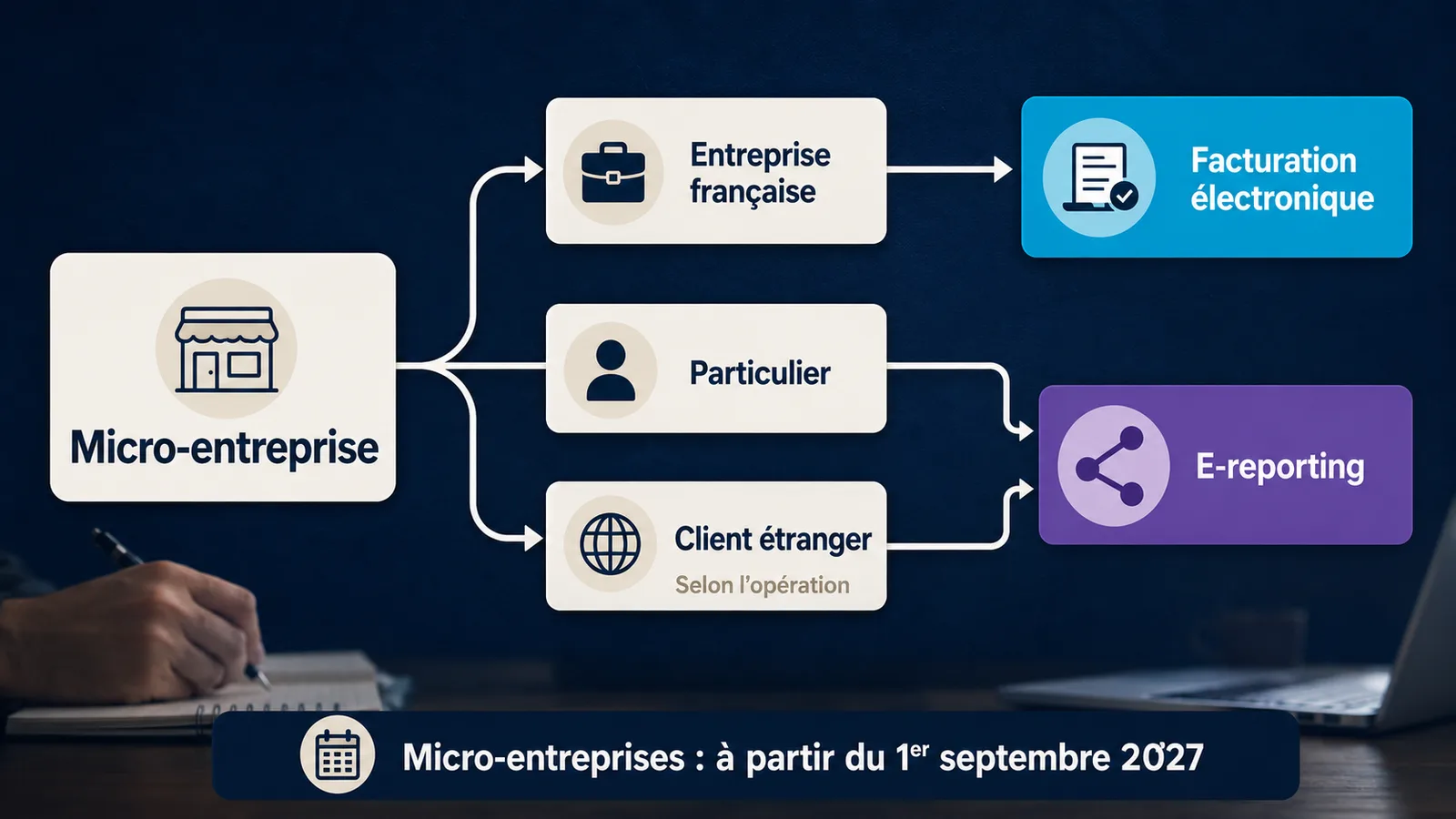
The same timetable applies to e-reporting. From September 2027, micro-enterprises will be required to submit certain data relating to transactions that do not involve B2B electronic invoicing, in particular transactions with private individuals or certain foreign customers.
Are micro-entrepreneurs affected?
VAT exemption and liability
The confusion often stems from this statement: ‘I don’t charge VAT, so the reform doesn’t affect me.’
It is incorrect in the majority of cases.
The basic exemption means that you do not charge VAT as long as you meet the conditions of the scheme. It does not mean that your creator business is not subject to VAT. A micro-entrepreneur operating under a franchise is therefore still required to receive VAT invoices and, depending on the timetable, to issue them electronically.
The Ministry states this unequivocally: franchise businesses operating on a basic basis are not liable for VAT, but remain subject to the scheme and are covered by it. This distinction is reiterated in the official guide.
Common mistake
Confusing ‘not collecting VAT’ with ‘being outside the scope of VAT’. The basic VAT threshold is not a general exemption from electronic invoicing.
However, there are different situations. Certain exempt transactions, for example in specific areas of healthcare or education, may fall outside the scope of electronic invoicing. The business must nevertheless be able to receive electronic invoices from its suppliers. A therapist, healthcare professional or trainer benefiting from a specific exemption must therefore check the exact nature of their transactions.
If you’re unsure about your creator business or your plan, start by consulting the VIFLY guide to Choosing the right career path to get started in the digital sector in 2026, then have your tax status confirmed.
Which process should you follow depending on your client or supplier?
The best practice is to identify two key factors before issuing or processing an invoice: the country in which the other party is established and their professional status. The applicable procedure varies depending on whether you are dealing with a French company, a private individual, a foreign client or a government body.
You are invoicing a company based in France
If your client is a business based in France and the transaction is subject to VAT, your invoice must be sent via the B2B electronic invoicing system from 1 September 2027.
You will need to use an approved platform, either directly or via compatible software. You will also need to have your customer’s exact details, including their SIREN number and billing address.
You are invoicing a private individual in France
An invoice addressed to a private individual does not go through the B2B electronic system. You will continue to provide the customer with the receipt or invoice in accordance with the rules applicable to your creator business.
However, certain transaction and payment details will need to be submitted to the authorities as part of the e-reporting scheme from 1 September 2027.
You are working with a business client based abroad
An invoice issued to a foreign company does not fall under the scope of domestic electronic invoicing between French businesses. You should therefore maintain an invoicing process suitable for international transactions.
However, certain information may be subject to e-reporting from September 2027. The exact treatment will depend, in particular, on the customer’s country, the nature of the service and the applicable VAT rules.
You receive an invoice from a French supplier
The invoice can be sent directly to the approved platform of your choice. The transition date will depend on the size of the supplier: September 2026 for large enterprises and mid-sized companies, followed by September 2027 for SMEs and micro-enterprises.
This is why you must be able to receive electronic invoices from 1 September 2026, even if your own obligation to issue them does not begin until 2027.
You receive an invoice from a foreign supplier
For invoices sent by suppliers based abroad, the current receipt process generally remains applicable. They may therefore continue to be received by email, via a customer portal or through the channel already in use.
This situation does not exempt you from having a platform in place to receive electronic invoices from your French suppliers.
You are invoicing a government department or public body
Invoices intended for the public sector must already be submitted and transmitted via Chorus Pro. This process remains the standard for public sector clients.
You should therefore not confuse Chorus Pro, which is used to bill public authorities, with the approved platform that you will need to choose for your dealings with private companies.
Key points
The channel depends on the recipient: electronic invoicing for French B2B, e-reporting for many B2C or international transactions, Chorus Pro for the public sector, and the current system generally retained for foreign suppliers.
B2B, B2C and international clients
International transactions may depend on the customer’s country, the type of service, the place of taxation, intra-Community VAT or any reverse charge arrangements. The matrix above is intended as a guide, not a universal tax analysis.
For creators in the overseas territories, the situation also warrants a territorial review. Businesses based in Réunion, Guadeloupe and Martinique are subject to electronic invoicing and e-reporting. French Guiana and Mayotte follow specific rules relating to the territorial application of VAT. The DGFiP’s comprehensive FAQ sets out these cases in detail.
Is a PDF invoice sent by email sufficient?
What an electronic invoice actually is
A file is not a compliant electronic invoice simply because it is in digital form.
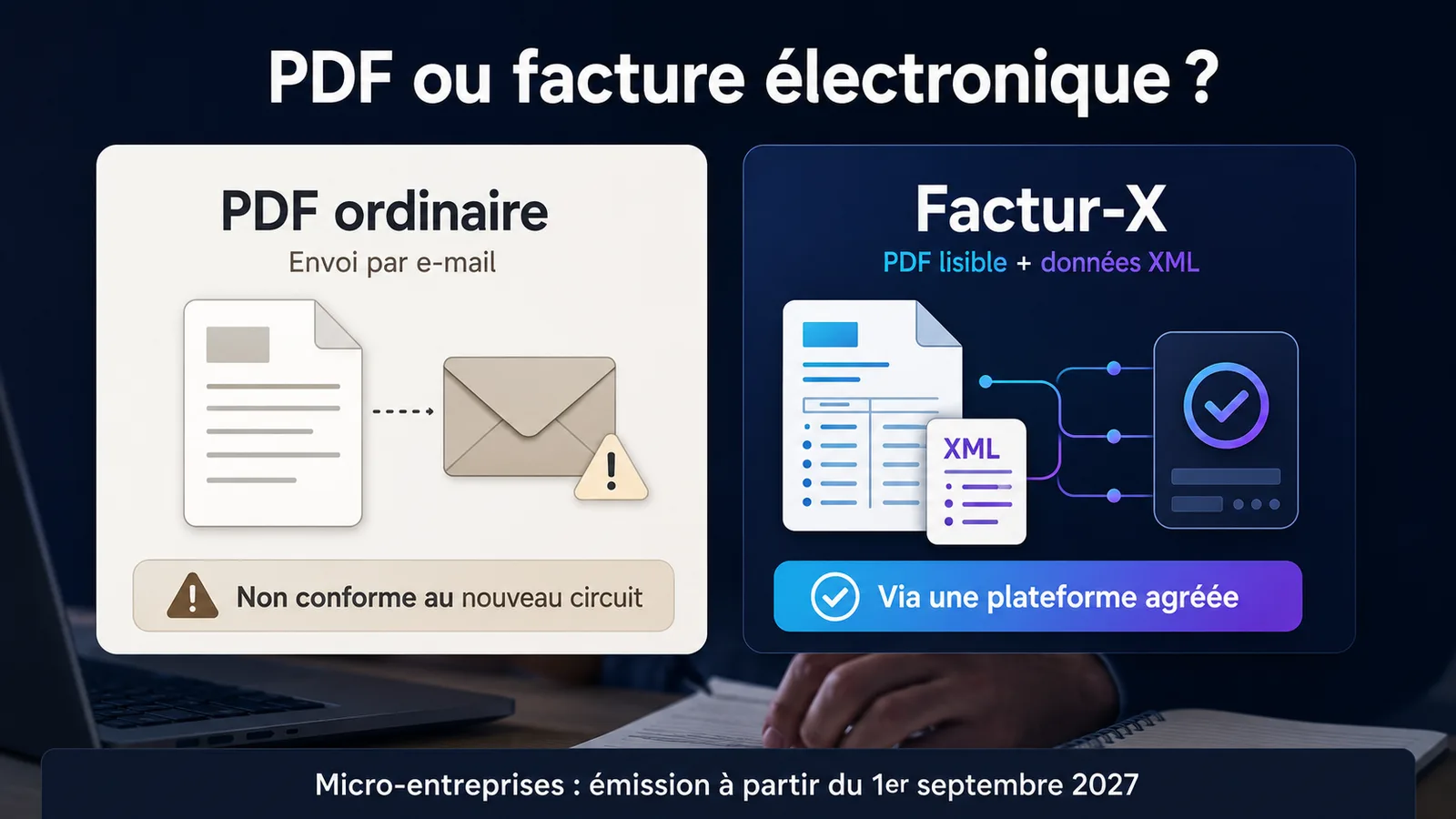
A PDF created in Word, uploaded from a spreadsheet or scanned from a paper invoice remains a document that can be read by a person. It does not necessarily contain the structured data expected by software and does not follow the secure process provided for by the reform.
A compliant electronic invoice must:
- follow an accepted format;
- contain its information in structured fields;
- be transmitted via an approved platform, either directly or via a compatible solution.
Standard formats include, in particular, UBL, CII and Factur-X. UBL and CII are structured formats. Factur-X is a hybrid format: it combines a readable PDF representation with an XML file containing the structured data.
This is the key distinction: a Factur-X may look like a PDF, but it is not an ordinary PDF sent as an attachment. It contains a layer of structured data and is transmitted via the designated system.
The DGFiP confirms that a standard PDF, a scanned invoice or a document simply sent by email will not comply with the new rules. The official definition is available at impots.gouv.fr.
The role of accredited platforms
An approved platform is an operator registered with the tax authorities. It can send and receive invoices, extract certain data, carry out e-reporting and communicate with other platforms.
A compatible solution is a different one. It could be your invoicing software, your accounting tool, a business application or a banking service. This solution can prepare the invoice and simplify your work, but it must connect to an approved platform to carry out the regulatory submissions.
The official list was updated on 17 July 2026. It now distinguishes between operators who have passed all interoperability tests and those whose final registration remains subject to these tests. Before signing, please check the official list of approved platforms.
Action to be taken
Don’t just take the phrase ‘ready for 2026’ at face value on a software sales page. Ask whether the provider is a fully authorised platform or which authorised platform their solution is connected to.
What do you need to start preparing now?
Choosing your platform
The right choice isn’t just about price. When setting up your own business, the most useful criteria are as follows:
- the operator’s inclusion in the final official list;
- reception included and clear pricing terms;
- creating invoices if you don’t have any software;
- integration with your current invoicing tool;
- management of B2C and international e-reporting;
- access to your chartered accountant;
- export invoices and data;
- availability of truly accessible support;
- management of multiple activities or establishments;
- retrieving your archives if you change service provider.
Also ask specific questions: how will you be notified of an invoice? What happens if there is a duplicate? Can you download a legible copy? Does your accountant receive the documents automatically? How is the data returned at the end of the contract?
Accreditation guarantees that the platform has the necessary regulatory authorisation. It does not guarantee that its interface, pricing or support will be suitable for your creator business.
Check your company details
An incorrectly addressed invoice may be rejected before it is even read. At the very least, check the following:
- your name or business name;
- your SIREN number;
- the establishment’s SIRET number;
- your official address;
- your intra-Community VAT number, if you have one;
- the email address used for notifications;
- your accountant’s contact details;
- the information held by your main suppliers.
The e-invoicing directory allows you to search for a company by its name, SIREN or SIRET number, and to identify its platform or receiving address. It is publicly available and free of charge. The Ministry explains how it works here.
Please also prepare the new information that will be required for your appearance on the programme in September 2027:
- the client’s SIREN number;
- the nature of the transaction: sale, provision of services or both;
- the full delivery address where this differs from the billing address;
- the reference to the option to pay VAT based on turnover, where applicable.
These requirements become mandatory in accordance with the implementation timetable applicable to each category of business. For a micro-enterprise, the deadline for compliance is therefore September 2027. The list of new entries is published by the Ministry.
Tailoring your invoicing tool
You don’t necessarily have to give up your current software. Start by writing to the software’s publisher and ask them these three questions:
- Will your tool be a compatible solution within the meaning of the reform?
- Which authorised platform will it be connected to?
- Will invoice receipt, dispatch, invoice statuses and e-reporting be included in my package?
If you are still issuing invoices using Word, Excel, Google Docs or a PDF template, 2026 should be used to organise the transition. An approved platform may allow you to create invoices directly, but you will need to check this in the service offering.
Next, try running a complete cycle:
- receipt of an invoice;
- opening the notification;
- checking their status;
- export or transfer to the accountant;
- song ranking;
- handling of any rejection.
Examples for a designer, a coach, a consultant, a trainer and a freelancer
UGC creator paid by a French brand
A UGC creator invoices an agency or a brand based in France for a campaign.
From September 2026, they must be able to receive electronic invoices from their relevant French suppliers. From September 2027, their B2B invoices falling within the scope of the reform must be processed via an approved platform.
If they also work with a foreign brand, this invoice will not necessarily follow the French B2B process. However, the transaction data may be subject to e-reporting.
Coach offering sessions to individuals and businesses
The coach devotes most of his sessions to private clients, but occasionally runs a workshop for a company.
Its sales to private individuals do not constitute B2B electronic invoices. The relevant data will be subject to e-reporting from September 2027. The workshop sold to a French company, however, may be the subject of an electronic invoice.
The coach must therefore choose a tool capable of managing both processes, and not just one that produces a nice-looking PDF.
Consultant specialising in B2B projects
A marketing consultant works exclusively with French companies. Their business will be directly affected by electronic invoicing from September 2027.
His main task is to clean up his customer database: ensuring the company name, SIREN number, billing address and accounts contact details are correct. An error in this data may delay processing or result in an invoice being rejected.
Freelance trainer
A trainer may sell a session to a business, a training course to an individual, or, for certain transactions, benefit from a VAT exemption subject to specific conditions.
The treatment therefore depends on the actual nature of each service. The same rule should not automatically be applied to all turnover. Even if certain transactions are exempt and fall outside the scope of the scheme, the company is still required to process its supplier invoices.
Freelancer working with clients in France and abroad
A designer invoices a French company and a Belgian company.
Invoices sent to French customers may be subject to B2B electronic invoicing from September 2027. Invoices sent to Belgian customers will continue to follow an international process, with data transmission possible depending on the tax situation.
The freelancer must therefore be able to identify each client’s country of establishment, professional status and VAT number.
Entrepreneur selling digital resources
An entrepreneur sells templates or resources to private individuals whilst also providing services to businesses.
B2C sales will mainly fall under e-reporting. French B2B services may fall under electronic invoicing. The payment system, the order receipt and the tax invoice are three elements that must not be confused.
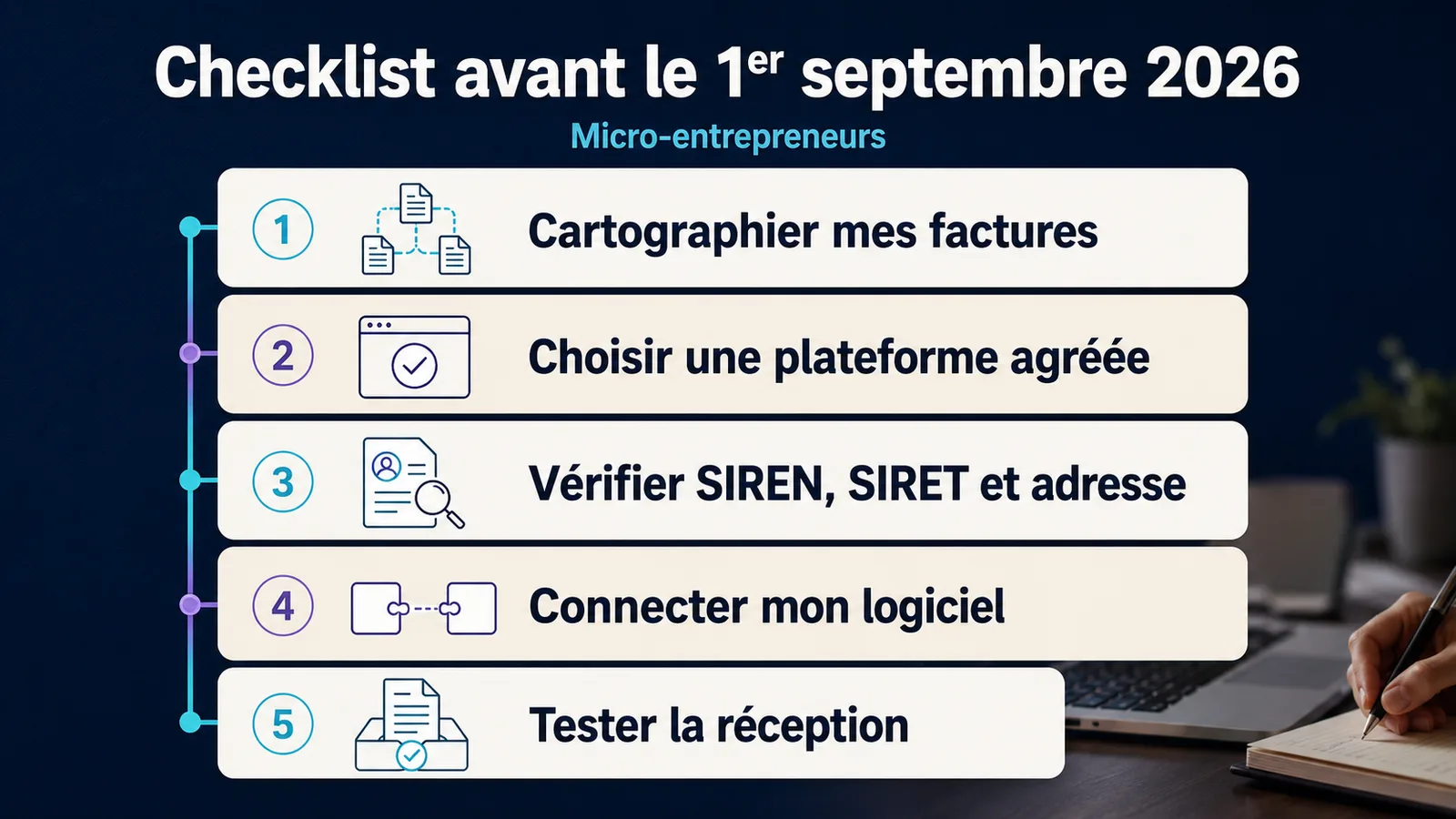
Checklist before 1 September 2026
To be done immediately
- Compile a list of your French and international suppliers.
- Identify invoices received by email or via a customer portal.
- Ask your accountant whether they recommend or already use a platform.
- Contact the publisher of your current software.
- Compare several platforms featured on the official final list.
Things to do before mid-August
- Choose and activate your platform.
- Check your SIREN, SIRET and address.
- Check your listing in the directory.
- Configure notifications.
- Decide who processes incoming invoices: you, your accountant, or both.
- Check the export and archiving options.
Please test this before 1 September
- Logging in to your account.
- Receiving alerts.
- Access from a computer and a mobile device.
- Sharing with the accountant.
- Dealing with a rejected or disputed invoice.
- Retrieving your documents if you switch tools.
To be prepared for September 2027
- Collecting the SIREN numbers of your creator business clients.
- Creating structured invoices.
- A distinct approach to B2B, B2C and international business.
- E-reporting of the relevant operations.
- Update to the mandatory legal notices.
- The gradual replacement of standalone Word, spreadsheet or PDF templates.
Don’t leave it until the last minute
The 2026 Finance Act provides that, in the event of a persistent failure to set up a reception platform following a formal notice, a fine of 500 euros will be imposed, rising to 1,000 euros if the breach continues. Non-compliant issuance and failure to submit e-reports are subject to their own penalties from the applicable deadline. A first offence that is rectified promptly may be subject to more favourable conditions, and the authorities have announced a lenient approach during the initial phase. This does not replace the need to comply with the regulations. The updated penalties are set out in detail by Entreprendre Service Public.
If you are unsure about your situation, the national helpline number is 0 806 807 807 — free service, excluding the cost of the call.
Invoicing and the customer journey: two different but complementary systems
The reform affects your administrative structure. On its own, it does not resolve issues relating to visibility, product range or conversion rates.
A prospective customer must always understand what you are offering, check that your offer meets their needs, book or purchase easily, and then receive the relevant documents. The invoice comes at the end of this process; it does not replace either the presentation of the offer or the sales experience.
VIFLY is not an approved invoicing platform and does not replace your accounting software. Its role lies further upstream: structuring your online presence, presenting your services and guiding your audience towards a clear call to action.
You can use VIFLY LinkHub to centralise your job offers and professional links, then VIFLY Booking to organise bookings for sessions, audits or coaching. Your invoicing tool and your accredited platform then handle the tax-related aspects.
This separation avoids a common source of confusion:
- VIFLY organises the discovery, booking and reservation processes;
- the payment service provider processes the payment, where applicable;
- the invoicing software prepares the documents;
- the authorised platform ensures compliance with the regulatory process.
This is also the central idea of the VIFLY guide Succeeding in online business in 2026 : simply publishing is no longer enough: a solid business is not built on a single tool, but on a coherent journey.
FAQ on electronic invoicing in 2026
Does this apply to a micro-entrepreneur who is not registered for VAT?
Yes. The basic exemption threshold exempts businesses from collecting VAT under certain conditions, but it does not remove their liability to pay VAT. Micro-entrepreneurs must be able to receive electronic invoices from September 2026 and will be required to issue the relevant B2B invoices from September 2027.
From what date will a micro-entrepreneur be required to issue their invoices electronically?
The general reporting requirement will come into force on 1 September 2027 for micro-enterprises, very small enterprises and SMEs. The requirement to receive reports begins one year earlier, on 1 September 2026.
Can I continue to send my PDF invoices by email?
A micro-enterprise may retain its current system until its expiry date. From September 2027, a standard PDF sent by email will no longer be sufficient for the relevant French B2B transactions. A hybrid format such as Factur-X remains an option provided it contains the required structured data and is processed via an approved platform.
How do you choose an accredited platform?
First, check that the provider is among the platforms that have been granted full registration following interoperability testing. Then compare prices, reception features, integration with your software, e-reporting, export options, access for accountants and the quality of support.
What happens if I work with private individuals or clients from abroad?
B2C and international transactions do not generally follow the same process as French B2B invoices. However, certain data will need to be submitted as part of e-reporting from September 2027. The precise rules depend on the nature and location of the transaction.
Conclusion: September 2026 is not a dress rehearsal
The obligation begins upon receipt, but your preparations must not stop there.
Choosing a platform without checking its accreditation, maintaining an incomplete customer database or believing that a PDF sent by email will suffice can lead to rejections, payment delays and unnecessary administrative work.
Your plan is simple: choose a platform, check your data, test reception and gradually prepare for the 2027 broadcast.
Compliance protects your creator business. A clear sales process gives it the opportunity to grow.
Would you like to organise your offers, links and bookings whilst you sort out your administration? Create your VIFLY space.
‘The process begins with receiving invoices, but improvising at this stage could already cost you dearly.’
Sources and official verifications
- Ministry of the Economy — Everything you need to know about electronic invoicing
- DGFiP — Discovering electronic invoicing
- Ministry of the Economy — Obligations of micro-entrepreneurs
- DGFiP — List of approved platforms, updated on 17 July 2026
- Ministry of the Economy — Electronic Invoicing Directory
- Ministry of the Economy — Mandatory details on an invoice
- Entreprendre Service Public — Penalties applicable in 2026
- DGFiP — In-depth FAQ on the reform
- DGFiP — Chorus Pro maintenance for the public sector