
No, using ChatGPT does not automatically require you to label each publication
A script reformulated with ChatGPT. An image created with a generator. A cloned voice. A retouched photo. An article prepared with the help of an AI.
These uses do not present the same risk, the same level of processing or the same obligations.
From 2 August 2026 certain transparency rules provided for in Article 50 of the AI Act shall become applicable in the European Union. These include deepfakes and certain texts generated or manipulated by IA when published to inform the public on matters of public interest. They do not create a general obligation for creators to add "created by IA" to any content that has received automated help.
The right question is therefore not:
Did I use an AI at any point in my process?
The right question is:
What did AI actually generate or modify, can the result deceive its authenticity and in what context is it published?
This guide allows you to respond without turning every style correction into a legal alert. It relies on the european regulation on artificial intelligence, on Code of good practice on transparency of IA-generated content published on 10 june 2026 and the official details available at the 13 july 2026.
Key points
The AI Act does not require creators to display the full history of their tools. It requires targeted transparency when content falls within a specific category, such as a deepfake or some public interest texts not subject to real human control.
Important note:
this article provides general and practical information. It does not replace a legal opinion adapted to a particular situation. The Commission's final guidelines on Article 50 were still announced before the 2 august 2026 at the time of this update; this guide should be updated if further clarification is needed.

What the AI Act really changes on August 2, 2026
The article 50 organises two levels of transparency that should not be confused.
The first concerns the suppliers of generalised AIA systems. They shall ensure that the synthetic outputs concerned can be detected as artificially generated or handled, in particular by means of machine-readable marking. It may be metadata, source mechanisms or other technical solutions. In particular, the Regulation provides for an exception where the system fulfils a support function for a standard edition or does not substantially alter the input data or their meaning.
The second concerns "deployers", i.e. persons or organisations who use an AI system under their authority in a framework other than a strictly personal and non-professional activity. A creator, company, media, trainer or independent professionally using a d的IA tool may therefore be concerned when publishing any of the content covered by the article 50.
This distinction explains why two seemingly contradictory sentences can be true at the same time: many outputs generated by IA will have to be technically identifiable, but not all IA-assisted content will have to bear a large label visible to the public.
The European Code published on 10 june 2026 is voluntary. The Commission and the European AI Committee have recognised as an appropriate tool to help its signatories to demonstrate compliance. On the other hand, the obligations laid down in Article 50 are not optional when they apply. European icons are optional: an equivalent text or label can be used if it remains clear, perceptible and suitable.
Date to be used
The transparency obligations of Article 50 shall become applicable on 2 August 2026. It is therefore preferable to prepare entries, publication templates and the internal register before this date, especially if you use realistic faces, voices or scenes generated by IA.
What the rule does not do
It does not transform a spell correction, a search for ideas or a supervised reformulation into a deepfake. Nor does it say that a publication becomes illegal as soon as an AI intervenes. Transparency is a targeted information obligation, not an automatic judgement on the quality or veracity of the content.
The content really concerned
1. Images, sounds and videos that constitute deepfakes
The IA Act defines deepfake as image, audio or video content generated or manipulated by IA that resembles existing persons, objects, places, entities or events and that may falsely appear authentic or truthful.
Three elements must therefore attract your attention:
- iIA generated or manipulated an image, sound or video;
- the result looks like an existing reality;
- a person could reasonably believe that it is a recording, a stage or an authentic element.
Typical examples:
- a realistic video making an expert say what he never said;
- a credible imitation of a leader's voice;
- a swap side giving the impression that a person has participated in a real scene;
- an authentic photograph of an artificially furnished apartment to the point of presenting a non-existent layout as real;
- a realistic reconstruction of an event presented without an indication of its synthetic nature.
A video doesn't need to be malicious to get into that definition. A humorous or artistic deepfake remains a deepfake if it reproduces in a credible way an existing person, place or event. Its disclosure regime is simply more flexible so as not to spoil the work.
Practical example
A creator publishes a very realistic fake video interview of a famous entrepreneur to humorously illustrate bad business advice. The humorous character does not remove transparency. A statement such as "Sequence satirical using image and voice generated by IA" may be placed in the description, in the credits or in the immediate vicinity of the content.
2. Some texts on subjects of public interest
The second major category concerns texts generated or manipulated by IA and then published with the aim of informing the public on matters of public interest.
This may include, depending on the context, texts on politics, public health, safety, the environment, the economy, citizens' rights or other issues with a collective impact. Not all marketing texts, social legends, sales pages or product descriptions automatically become "public interest texts".
The rule provides for an important exception: disclosure is not required when the content has been subject to a human or editorial control process and when a natural or legal person assumes editorial responsibility for its publication.
Both conditions include:
- a real review or editorial review before publication;
- a person or organization clearly responsible for the published text.
Quickly clicking on "publish" after going through two lines is not a solid method. Human control must be used to verify the meaning, facts, sources, nuances and risks of error.
Common mistake
To believe that adding its author name is enough to create a credible editorial responsibility. A name without real rereading does not correct factual errors, invented quotes, or the countersenses produced by the tool.
3. The separate case of the technical marking
Content may not require any visible mention on the part of the creator while maintaining a technical marking added by the tool supplier. It is therefore not advisable to delete metadata or source information voluntarily for no legitimate reason.
This marking does not exempt a visible mention when a deepfake or public interest text falls within the scope of the article 50. Conversely, the presence of IA metadata does not mean that a large public label is mandatory for a simple editing or correction.
![Matrix explaining the deepfakes and public interest texts involved in the requirement to mention IA content in 2026]](https://vifly.fr/storage/blog/inline/2026/07/inline_20260713_155040_2a8317fa69979775.webp)
Content not automatically affected
A script corrected with ChatGPT
No, a video should not be automatically reported because its script has been fixed, shortened or rewritten with ChatGPT.
If you wrote the idea, kept control of the word, checked each statement and recorded your own face and voice, the video is not a deepfake. The simple use of an editorial assistant does not transform recording into synthetic audiovisual content.
While the script deals with a subject of public interest, human rereading and editorial responsibility remain important. But a text actually controlled and assumed benefits from the exception provided by article 50.
This logic joins a broader good editorial practice: use the AI without losing your voice or becoming generic asks to start from his angle, his evidence and his experience before entrusting the formatting to a tool.
A fully generated but clearly illustrative image
A fully generated image must not always be labelled by the creator under the article 50(4).
An abstract illustration, a fantastic universe or a clearly stylized visual that does not seek to be the authentic recording of a person, place or event does not necessarily correspond to the definition of a deepfake.
On the other hand, a very realistic synthetic photograph representing an existing person, a real place, a supposed real event or an object presented as genuine may fall within the scope of the rule. Platform policies may also require a broader statement than the legal minimum.
The right distinction is therefore not "image generated or not". It is "content likely to appear authentic or visibly illustrative".
Minor corrections and improvements
A cropping, colour correction, noise reduction, automatic subtitling, sharpness improvement or grammatical correction alone are not the type of misleading manipulation covered by the obligation to disclose deepfakes.
Attention, however, to accumulation. A so-called "aesthetic" touch can become substantial if it changes a person's identity, creates an action that has not taken place or transforms a real place to the point of deceiving its state.
A text generated then actually reread and assumed
For a text published to inform the public on a subject of public interest, the exception is not based on the percentage of rewritten sentences. It is based on human or editorial control and responsibility.
A consultant can therefore use an AI to prepare a first version, then verify the sources, correct the facts, rewrite the analysis and assume publication. This situation is different from a site that automatically publishes hundreds of news summaries without validation.
Key points
Human editing is not a button. It is an intervention capable of detecting an error, modifying the substance and, if necessary, preventing publication.
Assisted, modified or entirely generated: what difference?
These three categories provide a practical framework. They do not replace the legal terms of the AI Act, but they allow for a publication process.
A fully generated content is therefore not automatically subject to a visible mention, while only a "partially modified" content may be allowed if the modification affects precisely the element that creates the illusion of authenticity.
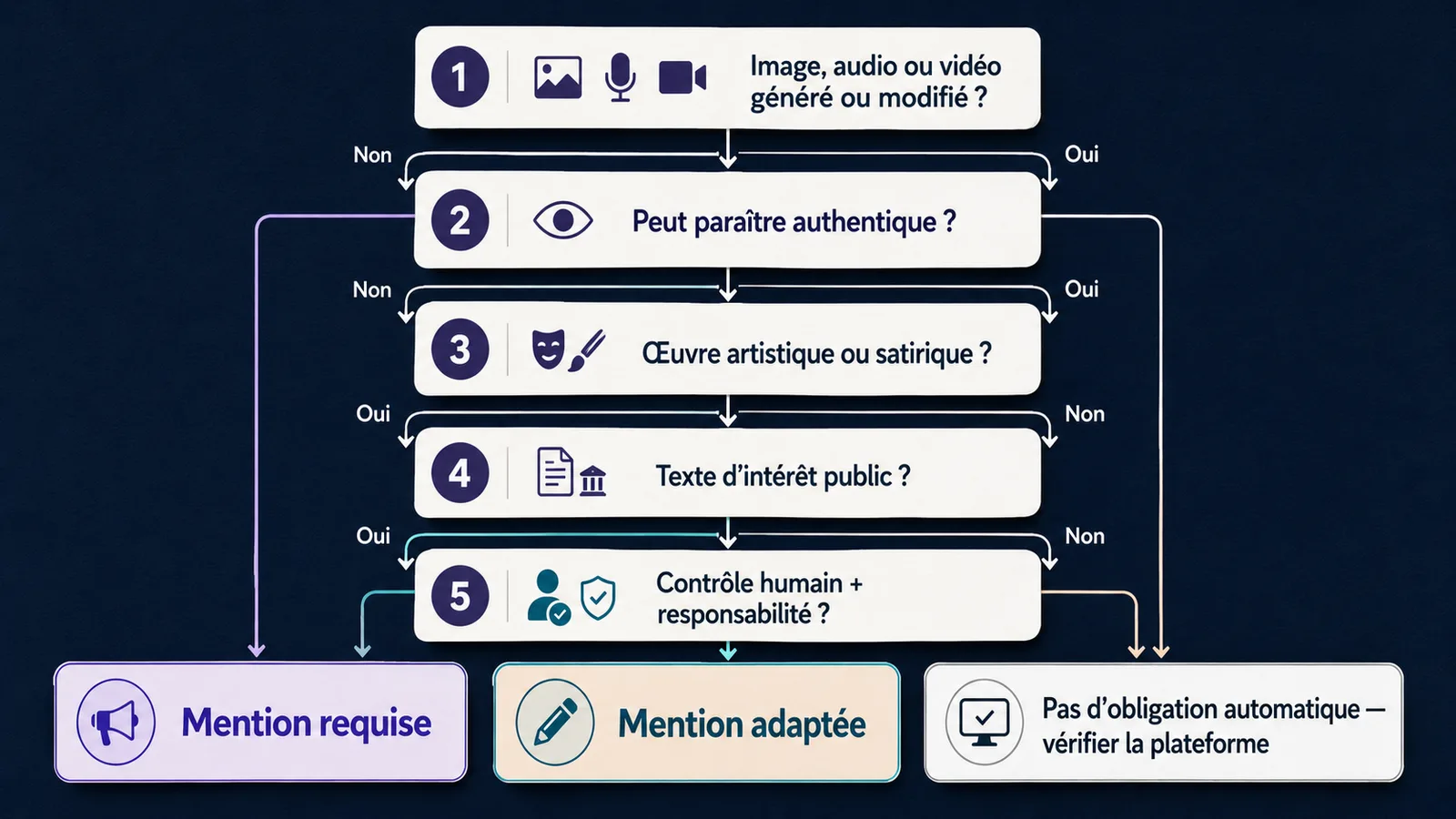
Decision tree to classify content before publication
Use these questions in order. If the content combines multiple formats, analyze each component: image, video, voice, text and thumbnail.
Question 1 — Has L?
No: go to the question 4 to examine the text.
Yes: go to the question 2.
Question 2 — Does the result look like an existing person, object, place, entity or event and could it seem authentic?
No: the content probably does not meet the definition of deepfake provided for in article 50. However, check the rules of the platform.
Yes: it is potentially a deepfake. Go to the question 3.
Question 3 — Does the deepfake belong to a clearly artistic, creative, satirical or fictional work?
No: provide a clear and perceptible statement at the latest during the first exposure to the content.
Yes: disclosure is still necessary, but it can be adapted not to interfere with experience. A note in the description, an indication in the vicinity of the content or a statement in the generic may be appropriate if it remains clear and accessible.
Question 4 — Was the text generated or manipulated by IA to inform the public about a matter of public interest?
No: the specific obligation concerning these texts probably does not apply. Continue to comply with other applicable rules, including advertising, intellectual property and consumer protection.
Yes: go to the question 5.
Question 5 — Has the text been really controlled by a human and by a natural or legal person?
Yes: the exception provided for in Article 50 may apply. Maintain a consistent control method.
No: clearly indicate that the text has been artificially generated or manipulated.
Last verified — What does the platform ask for?
Even if the analysis of the AI Act does not lead to a mention, Instagram, Facebook, TikTok or YouTube may impose their own declaration. Apply the most demanding rule that actually applies to your publication.
How to display a clear statement without damaging the content
The article 50 requires clear and recognizable information, provided at the latest during the first interaction or exposure. The European Code specifies principles of design and placement for its signatories, but a simple sentence may be more understandable than an isolated pictogram.
Ready-to-use formulation
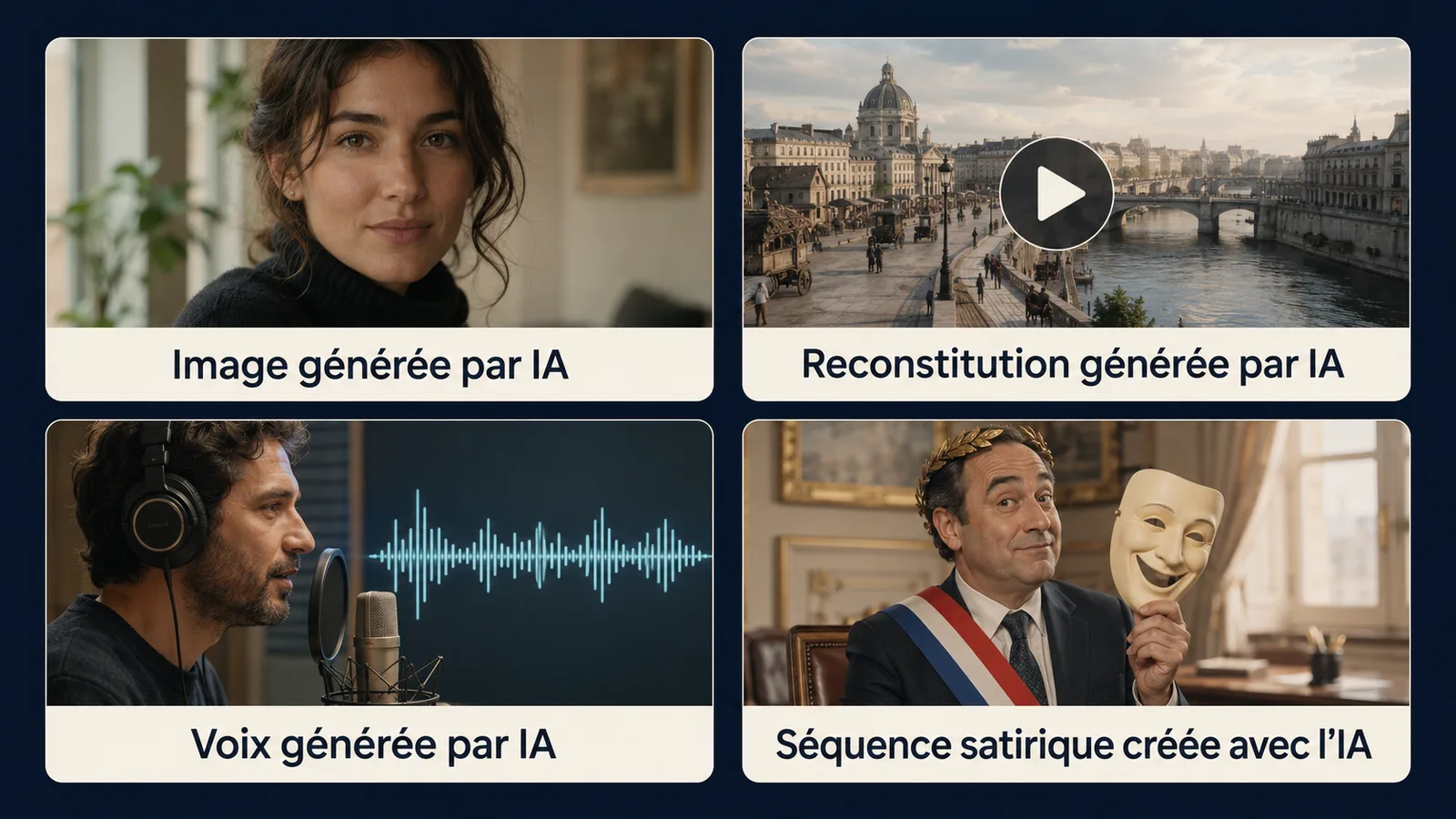
For a completely synthetic image entering the field of the rule:
Image generated by artificial intelligence.
For a substantially modified real photo:
Image partially modified by IA. The layout presented does not exist in the original photograph.
For a cloned voice:
Voice generated by IA; It is not an authentic record of that person.
For reconstitution:
Visual reconstitution generated by IA. This scene is not a capture of the real event.
For humorous content:
Satirical sequence using a voice imitation and image generated by IA.
For a public interest text published without human editorial control:
This text was generated by IA and was not subject to human editorial validation.
In practice, the best solution for a sensitive text often remains to organise a true human validation rather than to publish an unchecked first version with a warning.
Where to place the mention?
The mention must be able to be perceived without a laborious search. Depending on the format, it may appear:
- directly on the image or video;
- in an interface or label provided by the platform;
- at the beginning of audio content thanks to an audible announcement;
- in the description or notes accompanying an artistic work;
- in the beginning or end credits when it remains suitable and visible;
- near the content on a web page.
Avoid hiding information after a long series of hashtags, in a hard-to-find secondary page or behind a vague formulation as "creative visual". The public must understand what has been generated or modified.
Are European icons mandatory?
No. The Commission makes available icons "generated by IA", "modified by IA" and a generic icon. Their use is optional. Where disclosure is mandatory, the absence of an official icon does not remove the obligation: a label or equivalent wording must remain sufficiently clear.
The icon alone also does not guarantee compliance. The Commission recommends a perceptible, understandable, accessible and suitable display. When content is shared or downloaded, the mention should as far as possible remain attached to the content. The official recommendations on european icons encourage the use of simple text and solutions accessible to assistive technologies.
Do the rules of Instagram, TikTok and YouTube replace the AI Act?
No. Platform rules and the AI Act work in parallel.
The AI Act is a European regulation. Platform conditions and standards determine what you need to report to use their services. A platform may require a label in a situation where the article 50 does not necessarily require a visible mention. It can also automatically add a label from metadata or its own detection systems.
TikTok states that the activation of its label does not in itself reduce the broadcast of a video that complies with its rules. YouTube also states that the declaration does not automatically affect the hearing or eligibility for monetization. These policies can evolve: check forms and help pages when publishing.
Action to be taken
Do not choose between "law" and "platform". Ask two separate questions: "What does the article 50 require for this content?" and "What does the platform require for this format? »
Six concrete situations for creators and independents
Coach correcting his facecam script
The coach writes his advice, asks ChatGPT to shorten the sentences, checks the result and film his own face and voice.
Practical conclusion: no automatic reference for deepfake. If the subject is in the public interest, human control and editorial responsibility must be real. YouTube cites the help in writing a script among minor uses that usually do not require its declaration of synthetic content.
The creator who makes an expert speak with a false voice
The creator uses a realistic image and a cloned voice to make an expert pronounce sentences he never said.
Practical conclusion: the content has the characteristics of a deepfake. Its artificial origin must be clearly stated. A label does not address any other risks related to the right to image, privacy, defamation or misleading advertising.
The trainer who publishes an automated summary of a reform
A tool generates a synthesis of new regulation. The text is published automatically, without verification and without an identified editorial manager.
Practical conclusion: if it is intended to inform the public on a matter of public interest, disclosure is required. The best correction is to introduce human validation before publication.
Consultant who re-reads and assumes analysis produced with AI
The consultant provides the sources, requests an initial structure to the tool, verifies each fact, rewrites the conclusions and publishes under his responsibility.
Practical conclusion: the exception relating to human control and editorial responsibility may apply to the text. However, the consultant must be able to explain his process and take on the final version.
The entrepreneur who artificially transforms a photo of his premises
A real photo of an empty space is modified to show a high-end layout that does not exist, without warning.
Practical conclusion: the Commission uses precisely the case of an apartment furnished by IA as an example of partially modified content that may require disclosure. If the image is also used to sell or rent, other consumer protection rules may come into play.
The artist who creates a realistic parody
The artist publishes a clearly satirical video depicting a personality in a fictitious situation.
Practical conclusion: the artistic character does not remove the disclosure of the deepfake, but allows a presentation that does not interfere with the work. A note visible in the description or in the credits can be adapted.
Document your process without creating a gas plant
For an independent creator, a simple picture is often enough to establish a coherent method. It is not a matter of producing a legal file for each spelling correction, but of being able to explain the choices made for sensitive content.
For each major publication, note:
- the title or identifier of the content;
- the date of creation and publication;
- the AI tool used;
- the part generated or modified;
- the nature of the original elements: text, photo, voice or video;
- the level of realism and the likelihood of confusion;
- verified sources;
- the name or function of the person who performed the human validation;
- the person or organization assuming editorial responsibility;
- the chosen indication and its location;
- the label activated on each platform.
The European Code provides for an approach proportionate to the size and resources of the organisation. For an independent, the most important thing is to have a clear, repeatable and sincere rule. For a team, add a manager, a validation procedure and a channel to quickly correct mislabelled content.
This documentation also improves editorial quality. It requires checking the sources, distinguishing the facts from the reconstitution and identifying what the tool has actually brought. It is useful for compliance, but also for credibility and referencing: useful, accurate and assumed content remains at the heart of a SEO strategy adapted to Google's AI.
Checklist before publishing content created with AI
Nature of content
- Did I use the AI to assist, modify or generate content?
- Does the image, voice or video look like an existing reality?
- Could the public believe it is a capture or authentic recording?
- Does the text seek to inform on a matter of public interest?
Human control
- Has a person actually read and checked the content?
- Were the facts, figures, quotations, sources and names checked?
- Does a natural or legal person assume editorial responsibility?
- Could the content be blocked or corrected before publication in case of error?
Transparency
- Is a mention necessary for the article 50?
- Does the wording indicate what was generated or modified?
- Is the mention visible from the first exposure?
- Does it remain understandable when sharing or downloading?
- Is it accessible, readable and sufficiently contrasted?
Platform and traceability
- Have I checked the current rules of the platform?
- Have I activated his reporting tool if necessary?
- Have I avoided unnecessary deletion of source information?
- Have I noted the tool, the modifications and the human validation?

Transparency also becomes an element of credibility
A well-written statement does not necessarily reduce the value of a content. On the contrary, it can show that the creator knows how to distinguish an illustration, a reconstitution and a real proof.
This distinction becomes particularly important when content leads to an offer, subscription, training or reservation. A hearing may accept a generated visual. She accepts much less easily that a testimony, result, voice or demonstration presented as genuine were not.
Your professional profile must therefore extend the same promise of clarity: who are you, what are you proposing, what evidence do you show and what action can be taken by the person concerned?
With VIFLY LinkHub, you can centralize your content, sources, offers and important links in a more readable path. If your content leads to a call, session or accompaniment, VIFLY Booking makes the next step simpler.
The objective is not to transform a profile into a compliance register. It is to make content, evidence, offer and move to action consistent.
Conclusion: signal the risk of confusion, not every push
The AI Act does not condemn creative assistance. Most importantly, it seeks to prevent a person from taking a voice, image, video or certain publications that have been artificially produced or transformed as a true voice.
Before publishing, remember four reflexes:
- inventory content using a generated voice, face or realistic scene;
- note the tool, transformation and human validation;
- prepare a simple, visible and understandable statement when the rule applies;
- verify the specific requirements of each platform.
A script fixed with ChatGPT is not in the same situation as a realistic fake video from an expert. A fantastic illustration is not automatically treated as the synthetic photograph of a real event. A public interest text reviewed, verified and assumed is not equivalent to an automated flow published without control.
Useful transparency begins with this ability to make a difference.
And if you want to give your content a more professional career, create your VIFLY space to centralize your links, present your offers and turn your visibility into concrete opportunities.
Frequently Asked Questions
Do I need to report a video whose script was corrected with ChatGPT?
Not automatically. If ChatGPT has only corrected or rewritten a script you checked, then you have saved your own face and voice, the video is not a deepfake. However, check the nature of the subject, your editorial control and the rules of the platform.
Should a fully generated image still be labelled?
No, not systematically under the article 50(4). An image becomes primarily concerned if it looks like an existing person, object, place, entity or event and may appear falsely authentic. However, a platform can apply a broader rule.
What difference between assisted, modified and fully generated content?
Assisted content remains mainly human and receives limited help. A modified content is derived from an existing element substantially transformed by IA. Fully generated content is produced from instructions, without human element in the result apart from prompt and selection. The level of generation is not enough to decide: realism, context and human control also matter.
How do I report an artistic or humorous deepfake?
Disclosure can be adapted so as not to hinder the work, but it must remain clear and accessible. A note in the description, a statement in the vicinity of the content or an indication in the generic may indicate that an image or voice was generated by IA.
Do Instagram, TikTok or YouTube labels replace the AI Act?
No. The rules of the platforms and the AI Act apply in parallel. The integrated label can help make the information visible, but the creator remains responsible for a clear disclosure when the article 50 applies and must also comply with other relevant legal rules.
Sources
- Regulation (EU) 2024/1689 on artificial intelligence — official text, in particular articles 3 and 50
- European Commission — Code of Practice on Transparency of AI-Generated Content
- European Commission — Questions and answers on the Code of Good Practice
- European Commission — European Icons for labelling IA-generated content
- European Commission — Opinion of 9 July 2026 on the adequacy of the Code
- European Commission — Draft guidelines on Article's transparency obligations 50published on 8 may 2026
- Meta Transparency Center — policy on manipulated content and disinformation
- TikTok — About AI-generated content
- YouTube — Disclosure use of altered or synthetic content