
Posting without thinking can be costly, even for an account with 500 followers
You don’t need to be a major brand to be affected by the law. A simple Instagram post may be enough to trigger a formal notice, a complaint regarding infringement of image rights, or a report to the DGCCRF if you promote a product without specifying that it is a paid partnership.
Most creators, coaches, consultants and freelancers discover these rules at the worst possible moment: when a dissatisfied client threatens to take legal action, when someone filmed without their consent demands that the video be taken down, or when a follower accuses them of hidden advertising in the comments.
This article is not legal advice. It is a clear guide to what you need to know before posting, designed for creators, trainers, therapists and freelancers who are building their businesses on social media without legal support.

1. Image rights: the rule most often breached without realising it
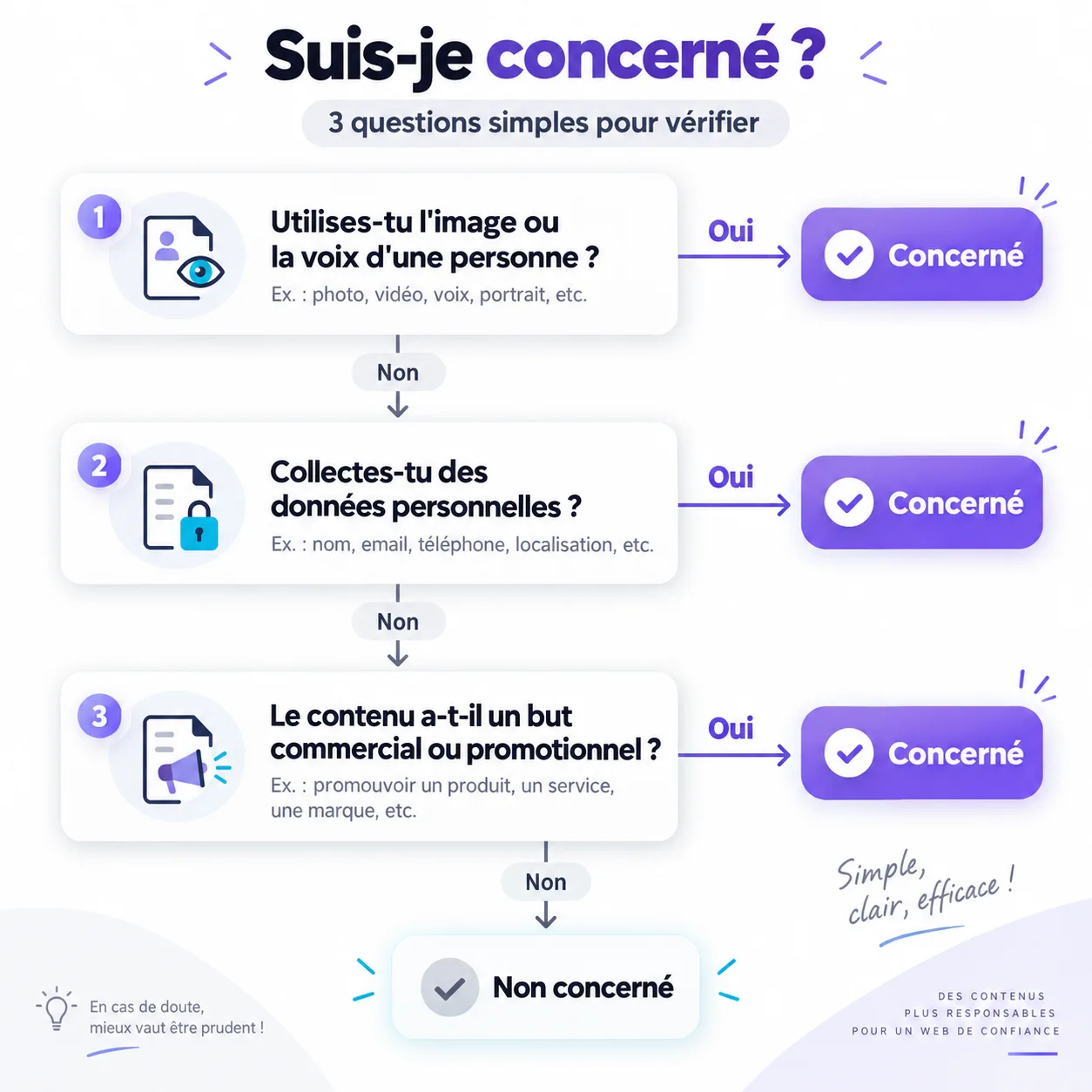
Under French law, every person has an exclusive right to their own image, based on Article 9 of the Civil Code (right to privacy). In practical terms: you may not publish a recognisable photograph or video of a person without their consent, even if you filmed them in a public place.
What this means for you in practical terms:
If you are a fitness coach and you are filming a group class for your social media channels, every participant who is visible and identifiable must have given their consent; verbal consent is not always sufficient – written consent remains the most solid evidence in the event of a dispute.
If you are a trainer and are filming a face-to-face session, ensure that your terms and conditions of enrolment include a consent clause regarding the use of images, to be signed before the event.
If you are a therapist or consultant and you publish video client testimonials, consent must be explicit, dated and, ideally, revocable at any time; the person must be aware that they can request the video to be removed at a later date.
Common mistake : Many creators believe that a public place automatically makes publication legal. This is not true: a place accessible to the public permits photography, but not necessarily the commercial publication of an image of an identifiable person, especially if they are the main subject of the image.
Action to be taken : Create a simple consent form for the capture and publication of images, to be signed as a matter of course before any filming involving a recognisable third party. A half-page document is sufficient in most cases.
2. GDPR: you’re collecting personal data, even without realising it
The General Data Protection Regulation (GDPR) applies as soon as you collect personal data, even if you are a small sole trader. The CNIL points out that this applies to any organisation, regardless of its size, provided it processes identifying data (name, email address, telephone number, questionnaire responses).
In practical terms, this applies to you if:
You collect email addresses via a contact form or a newsletter linked to your social media accounts.
You offer an online appointment booking service that collects your prospective customers’ names, telephone numbers and email addresses.
You’re using an automation tool (chatbot, lightweight CRM) linked to your social media presence.
Minimum requirements to be met:
Inform the individual about how their data will be used, via an accessible privacy policy.
Only collect data that is necessary for your creator business (principle of data minimisation).
Allow the individual to request the deletion of their data at any time.
Secure the tools used (passwords, restricted access).
These obligations, although often perceived as applying only to large companies, also apply to a freelance consultant who centralises their client enquiries. This is a good reason to organise your contact form and booking page properly, rather than scattering data collection across several unsecured tools – a clear system such as the VIFLY Booking enables appointments to be centralised within a single, controlled framework, rather than having multiple, inconsistent booking channels.
3. The 2023 Influencers Act: transparency is no longer optional
The Act of 9 June 2023, aimed at regulating commercial influence and combating abuses by influencers on social media, introduced specific obligations that apply whenever a commercial activity is carried out via social media, even on a small scale.
What the law actually requires:
Any commercial collaboration must be clearly stated, with the terms ‘advertisement’ or ‘commercial collaboration’ visible, and not hidden amongst a multitude of hashtags.
Certain sectors are subject to stricter restrictions: financial products, cosmetic surgery, healthcare products and gambling. A coach or therapist who mentions dietary supplements or treatment methods must be particularly vigilant.
A written contract becomes mandatory between the advertiser and the content creator once the collaboration exceeds a certain amount, specifically to set out each party’s responsibilities.
Practical example : A personal development coach who recommends a time-management tool in exchange for an affiliate commission must explicitly state that it is a commercial link or a paid partnership, even if it is simply an affiliate link included in their bio.
This requirement for transparency ties in with a broader principle: the clearer and more structured your online presence is, the more trust it inspires. Presenting your offerings, partnerships and services in a clear and accessible way, for example via a clear ‘About Us’ page such as LinkHub, plays a direct part in ensuring the transparency required by law and expected by your audience.
Key points: Commercial transparency isn’t just a legal requirement: it protects your credibility. An audience that can distinguish between your editorial content and your partnerships will trust you more in the long run.
4. Intellectual property: what you are allowed to use (and what you aren’t)
The music, images and videos you use in your content are protected by copyright, even on social media. Platforms have licensing agreements with certain rights holders, but this does not automatically cover you, particularly if you republish this content elsewhere (website, newsletter, paid advertising).
Things to check before publishing:
Music available in the official library of a platform such as Instagram or TikTok can be used in native videos on that platform, but cannot necessarily be reused as it is on another medium.
An image found via a search engine is not, by default, royalty-free: you must check the exact licence (Creative Commons, paid image bank with rights included, etc.).
Any content you create yourself (photos, videos, text) automatically belongs to you as soon as it is created, without the need for registration, but it is recommended that you keep evidence of authorship (dates, source files, versions).
Common error: Many creators believe that adding the phrase ‘music not used for commercial purposes’ provides them with legal protection. This is not the case if the activity behind the account is commercial, even indirectly.
5. Legal notices and terms and conditions: an oversight that can prove costly for the self-employed
Whenever a website, a booking page or a service offering is made available online, the French Law on Confidence in the Digital Economy (LCEN) requires specific legal notices: the publisher’s identity, legal status, contact details and the website host.
For any sale of services or products, clear terms and conditions of sale are also expected, setting out the payment, cancellation and refund policies – a particularly sensitive issue for coaches, therapists and trainers who sell sessions or programmes via an online booking system.
Practical example : A consultant offering paid strategic consultations via a booking link must clarify their cancellation policy: minimum notice period, refund terms, and consequences in the event of a no-show. This clarity prevents the majority of disputes before they even arise.
This is also why it is important to organise the booking of appointments with clear rules, via a system such as VIFLY Booking, helps to set out these terms and conditions at the outset, rather than having to negotiate them retrospectively with a dissatisfied client.

By profile: what matters most to you
Lifestyle or educational content creator: the right to one’s own image for people filmed, transparency regarding partnerships, and vigilance regarding the music used.
Coach or therapist: Explicit consent required for client testimonials; caution regarding claims about health or wellbeing outcomes; clear terms and conditions regarding sessions.
Trainer or consultant: written contract for paid collaborations, legal notices on the booking website, and a consent clause regarding the use of images during face-to-face or video training sessions.
Independent e-commerce site or service: GDPR compliance regarding the collection of customer data, clear terms and conditions covering deliveries or services, and transparency regarding featured customer reviews.
What this means in practical terms for your online presence
These rules are not isolated requirements: they form part of a common principle – that of clarity. A professional profile that clearly sets out its identity, services, terms and conditions, and partnerships naturally minimises legal risks whilst strengthening the trust of its audience.
This is also what distinguishes a makeshift social media account from a genuine, structured professional presence: knowing where and how to legally present your creator business, your commercial links and your mandatory disclosures, without these being scattered across ten different tools. To find out more about the overall structure of your digital presence, our guide on how to organise your online presence usefully complements this discussion.
Conclusion: compliance as the foundation of credibility, not as a constraint
Complying with these rules is not merely an administrative formality. It is what protects you in the event of a dispute, and, above all, what builds your audience’s trust over the long term. A content creator who clearly discloses their partnerships, protects the image of the people they film and presents their offers with transparent terms and conditions sends a strong signal: that of professionalism.
These legal best practices tie in with a broader requirement for clarity in your digital presence – the same requirement that drives the need to create a clear profile, a comprehensible offering and a straightforward booking process to turn your audience into concrete opportunities.
Find out how VIFLY helps you centralise your professional presence in a clear and structured way, which helps to build trust with your audience whilst ensuring your creator business remains compliant.
FAQ – Frequently Asked Questions
Do I really need to ask permission from someone I’m filming in the street?
Yes, as soon as a person is identifiable and forms a central part of the image, their consent is required for its publication, in accordance with Article 9 of the Civil Code relating to respect for privacy.
Does the 2023 Influencers Act apply to a small account with few followers?
Yes, the law does not set a minimum threshold for followers: as soon as a commercial activity is carried out via social media, the transparency obligations apply.
Does the GDPR apply if I only have a simple contact form?
Yes, as soon as a form collects identifying data such as a name or an email address, the minimum requirements of the GDPR apply, regardless of the organisation’s size.
Can I use a trending song on TikTok for my professional video?
This depends on the licences in force on the platform and the intended use: native use on the platform is generally covered, but reuse elsewhere requires a check of the rights.
What are the actual consequences of failing to comply with these rules?
The risks vary depending on the nature of the offence: a formal notice, a request to remove content, a penalty from the CNIL regarding personal data, or an inspection by the DGCCRF concerning commercial transparency.
Source block
- Légifrance, Civil Code, Article 9 (right to privacy): https://www.legifrance.gouv.fr/codes/article_lc/LEGIARTI000006419288
- Légifrance, Act No. 2023-451 of 9 June 2023 aimed at regulating commercial influence and combating abuses by influencers on social media: https://www.legifrance.gouv.fr/jorf/id/JORFTEXT000047660158
- CNIL, GDPR and small organisations: https://www.cnil.fr/fr/rgpd-quelles-obligations-pour-les-tpe-pme
- Légifrance, Law on Confidence in the Digital Economy (LCEN): https://www.legifrance.gouv.fr/loda/id/JORFTEXT000000801164