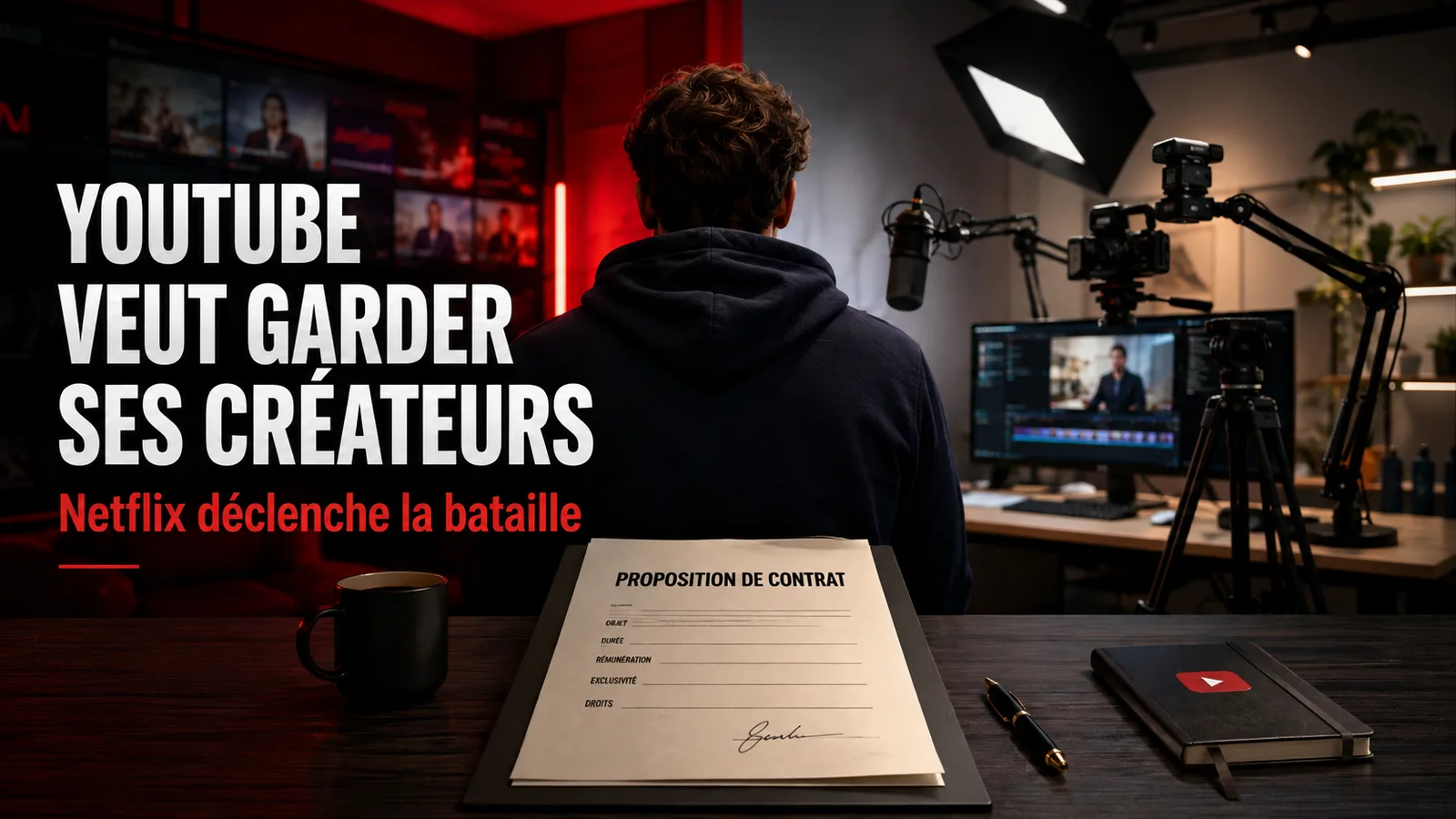
The battle for exclusivity begins
For years, creators have lived with a simple fear: becoming too dependent on a platform that could change its algorithm overnight.
Today, the balance of power is beginning to shift.
According to a Bloomberg survey published on 19 August 2026, YouTube is in talks with some of its biggest content creators regarding payments of up to several million dollars so that they keep certain content exclusively on YouTube for a specified period.
Why?
Because Netflix is also starting to want their content.
And behind this battle between two giants lies a much more significant development for all content creators, even those with 2,000 or 10,000 followers:
Platforms are no longer just competing for our attention. They are starting to compete for those who generate it.
So the question is no longer simply ‘how do you grow your YouTube channel?’.
It becomes:
When your audience starts to have value, who actually controls that value: the platform or you?
YouTube is reportedly willing to pay millions to retain certain content creators
Bloomberg reported on 19 August that YouTube was offering financial incentives to certain major content creators to keep their videos exclusively on the platform for a set period.
According to those interviewed by Bloomberg, these payments could take several forms:
- direct funding for certain productions
- participation in major brand campaigns
- commercial benefits associated with the partnership with YouTube.
Business Insider also reported that it had spoken to two people familiar with YouTube’s procedures. In one of the cases reported, the verbal offer made to a creator is said to have been ‘in the millions’ in exchange for a period of exclusivity.
As of the verification date of 24 August, however, an essential caveat must be added:
none of these agreements had yet been officially announced as having been signed.
These are therefore negotiations reported by several journalists, not a new public scheme that any creator can sign up for.
Why YouTube is worried about Netflix
The answer lies largely in a transformation of entertainment.
Netflix is no longer just competing with:
- Disney+
- Prime Video
- HBO Max
- television channels.
Its competitor for the public’s available time is also:
YouTube.
And YouTube openly champions this stance.
In his 2026 strategy letter, CEO Neal Mohan states that YouTube has been the leading streaming platform in terms of viewing time on US televisions for nearly three years, according to Nielsen.
YouTube even sums up its vision with a particularly significant statement:
“YouTube is the new TV because creators are the new prime time.”
In other words:
creators are no longer regarded as a sub-category of the Internet.
They are becoming a central part of the entertainment industry.
Netflix is therefore starting to source its content
Business Insider notably cites content from leading figures on YouTube such as Ms Rachel or Salish Matter, some of whose videos are also available on Netflix.
Netflix is also investing in video podcasts. And that’s where things get particularly interesting.
When a programme is available on both Netflix and YouTube, Netflix captures a share of the value created by an ecosystem that has historically been built on YouTube.
For YouTube, the risk is becoming clear:
why continue to fund the ecosystem that then allows a competitor to poach its biggest stars?
The creator is gradually becoming a television channel
For a long time, a television channel controlled:
- the programme
- distribution
- advertisers
- the audience.
The modern creator is gradually combining several of these functions.
He produces.
He presents.
He distributes.
It has a community.
He negotiates with brands.
They can sell their own products.
He could even set up his own production company.
This is precisely why leading designers are beginning to hold strategic value comparable to that of certain media franchises.
The platform does not fully own the programme
Let’s take a top YouTube creator.
YouTube provides:
- web hosting
- the recommendation
- monetisation
- the advertising infrastructure.
But the creator adds:
- his face
- its concept
- her world
- its community
- its intellectual property
- their ability to produce content on a regular basis.
If this person decides tomorrow to pitch a programme to Netflix, some of their audience might well follow them.
This is where power shifts.
Why this news is also relevant to small-scale creators
It would be easy to think:
“That’s about MrBeast and the massive channels, not me.”
Cheques worth several million, probably.
But the economic mechanism, on the other hand, applies to all creators.
Platforms need three things:
- content
- from the audience
- attention span.
A creator is capable of producing all three. The more identifiable and loyal your audience becomes, the more you are building an asset.
Even with a modest community.
A content creator specialising in cyber security with 8,000 followers can be of exceptional value to a B2B company.
A beauty influencer from Réunion with 12,000 followers can provide extremely targeted access to a local audience that a large-scale advertising campaign would reach less effectively.
A LinkedIn consultant with 5,000 followers can reach exactly the kind of executives that professional software is looking for.
Size is just one dimension of value.
Concentration and confidence are two others.
This is precisely why a creator must gradually learn to view their audience as a genuine professional asset.
Exclusivity can be very lucrative… but it comes at a price
Now let’s imagine that a platform offers you:
€50,000 to publish exclusively with her for a year.
Should we accept it?
It’s impossible to answer without knowing the terms of the contract. Because exclusivity is never really free.
You are exchanging money for optionality
There’s no obligation – you can decide tomorrow to:
- post elsewhere
- testing a new format
- sign up with a competitor
- sell a licence
- distribute your content across multiple channels.
Under an exclusive agreement, some of these options are temporarily unavailable.
The calculation should therefore not be:
€50,000 = a good contract.
But:
€50,000 – what opportunities am I giving up in return?
It’s exactly the same principle as an exclusivity clause in a brand licence agreement.
A platform can give you a great deal of visibility without ever giving you ownership of the relationship
This is probably the most important lesson to be learnt from this story.
Let’s say you’re building:
500,000 YouTube subscribers.
That’s extraordinary.
But you don’t have a database containing:
500,000 names,
500,000 emails,
500,000 direct connections.
You have access to an audience via YouTube.
The nuance is fundamental.
The platform always checks:
- the recommendation
- some monetisation rules
- formats
- part of the visibility
- Log in
- the advertising environment.
That doesn’t make YouTube bad.
On the contrary: the platform creates immense value for creators. But this brings to mind a basic rule of business:
A distribution channel is not your creator business.
Tomorrow’s best creator will probably be multi-channel
This YouTube/Netflix battle could create the opposite impression:
‘You have to choose a platform and commit to it exclusively.’
For a few very prominent creators on extremely lucrative contracts, perhaps.
For the majority, diversification is probably still the more sensible approach. A robust ecosystem may include:
A main platform
The place where you publish your best content.
Discovery platforms
Instagram, TikTok, LinkedIn, Shorts or others, depending on your audience.
A space you control
Your website or professional page.
A direct link
Newsletter, community or customer list.
A conversion layer
Offers, products, payments or bookings. This structure enables one essential thing:
an algorithm change doesn’t instantly destroy all your activity.
Your bio link is becoming more important than ever
This is precisely where a tool such as VIFLY LinkHub really comes into its own.
A good LinkHub isn’t just for displaying five social media icons. It should serve to bring part of the relationship out of the feed.
A designer can centralise the following here:
- its various platforms
- its key content
- her collaborations
- her media kit
- its offers
- its products
- contact details
- their booking.
Social media fosters discovery. LinkHub organises what’s happening after the discovery.
And in an economy where platforms are starting to compete to retain creators, having your own entry point becomes even more strategic.
Your audience is worth more when it can be turned into a business
There is a major difference between:
“I have 100,000 followers.”
and:
“I have a distinct audience who buy, book, sign up and come back.”
The second profile has far more levers at its disposal.
Why?
Because he can monetise it straight away:
- AdSense
- a sponsor
- a platform bonus.
It can be expanded to:
- services
- training courses
- views
- products
- premium content
- subscriptions
- affiliations
- partnerships
- events.
This is where the creator economy truly becomes an economy.
Booking helps turn your audience into business relationships
Let’s take the example of a consultant who publishes educational videos.
It has:
10,000 followers on LinkedIn,
8,000 on Instagram,
3,000 on YouTube.
Its audience is spread out.
His real goal isn’t necessarily to get 100,000 followers.
Perhaps he simply wants to get 10 new clients per month.
Its path could be:
video → profile → LinkHub → service → booking.
With VIFLY Booking, a coach, consultant, trainer or freelancer can allow their audience to select a service and an available slot directly.
This conversion layer changes the nature of the audience. It no longer generates views alone.
It can create opportunities.
The media kit must also evolve
The YouTube/Netflix war illustrates something else:
a creator’s content can have distribution value.
This is precisely what a good media kit should start to demonstrate.
Your media kit should not only contain:
Instagram: 32,500 followers
TikTok: 48,000 followers
This should help to explain:
- Who is your audience?
- what she’s looking at
- your world
- your formats
- your performance
- your previous collaborations
- your licensing options
- your rights of use
- your availability for more ambitious projects.
VIFLY has already published a comprehensive guide on this topic:
How to create a simple and professional creator media kit
A good media kit isn’t just for finding sponsors.
It is used to make your asset understandable.
Contracts for creators are likely to become more sophisticated
This is a significant development.
For a long time, many creative partnerships were based on a relatively simple exchange:
“Post a video featuring our product.”
As the value of the content increases, negotiations may incorporate further dimensions:
- exclusive
- operating window
- territory
- duration
- publication rights
- advertising reuse
- licensing
- intellectual property
- right to one’s own image
- data access
- derived formats.
And one term becomes particularly important:
Exclusivity.
Total exclusivity and limited exclusivity are not the same thing
A contract could, for example, prohibit:
any video posts on another platform for six months.
It’s extremely restrictive.
Another might simply specify:
This programme is available exclusively on YouTube for 30 days.
The strategic cost is not at all the same.
So we need to look at:
what is exclusive, where, for how long and in exchange for what.
For a major contract, it is, of course, advisable to seek the assistance of a legal professional.
Platforms want the audience that creators have built up
This is where the battle becomes almost paradoxical.
For years, the prevailing view was:
“Creators need platforms to find an audience.”
That’s right.
But the other half of the sentence is now impossible to ignore:
platforms need creators to retain this audience.
YouTube itself acknowledges that creators now take centre stage.
Netflix is taking an interest in their content. Brands are funding their productions. Agencies are seeking them out. AI search engines are even starting to make it easier to discover them. Creators are therefore no longer merely users of a platform.
It can become a provider of audience, content and intellectual property.
This is a massive shift in the balance of power.
The number of subscribers is still not the real issue
However, we mustn’t let this news become a new obsession:
“I’ll have to become a huge star before Netflix gets in touch with me.”
The vast majority of creators will never sign a contract with Netflix. And that’s not necessary to build a profitable business.
The relevant question is:
What is the current economic value of my audience?
Let’s take two accounts.
Account A
200,000 subscribers.
Very general content.
Not very confident.
No offers.
No customer base.
Account B
12,000 subscribers.
Highly targeted audience.
Clear expertise.
Newsletter.
Services.
Bookings.
Consistent partnerships.
The first one has greater reach.
The second may have a much more solid business.
Visibility alone is therefore always just one step.
The logic remains the same:
visibility → understanding → trust → action → opportunity.
How to reduce your dependence on a platform starting today
There’s no need to wait for a multi-million offer.
You can start with five simple steps.
1. Keep your original files
Never let your only copy of a piece of content depend on a social media platform.
Keep:
- videos
- photos
- subtitles
- thumbnails
- scripts
- project files.
You are gradually building up a library of intellectual property.
2. Use multiple distribution points
A format can be intelligently adapted to multiple platforms.
This doesn’t mean blindly copying and pasting everywhere.
This means not allowing a single company to be the sole gateway to your work.
3. Create your focal point
Website, business page or LinkHub VIFLY.
The visitor must be able to understand:
who you are → what you create → what you offer → how to contact you.
4. Build a direct asset
Newsletter.
Clients.
Members.
Subscriptions.
Professional contacts.
The aim is to create at least one relationship that does not depend entirely on a recommendation algorithm.
5. Measure conversion, not just reach
A million views is an excellent achievement.
But do also ask:
- How many profile views?
- how many clicks?
- How many contacts?
- How many bookings?
- how many sales?
- How many subscriptions?
It is this layer that gradually transforms a creator into an entrepreneur.
What if a platform were to offer you exclusivity one day?
Your first reaction shouldn’t be:
‘How much?’
Start by asking the right questions instead.
What content becomes exclusive?
Your entire channel?
A programme?
A series?
An episode?
For how long?
30 days?
Six months?
Two years?
On which platforms?
Netflix only?
Any competing video services?
All social media platforms?
What are you missing out on?
Advertising revenue?
Sponsors?
Discovery?
Cross-posting?
Licence options?
What do you actually earn?
Guaranteed payment?
Production funding?
Marketing?
Distribution?
Reaching new audiences?
Who owns the intellectual property?
This is probably one of the most important questions of all.
You can sell an exclusivity window without necessarily transferring ownership of your concept.
The two things are very different.
The creator economy is entering its ‘distribution rights’ phase
For a long time, the creative economy revolved around three main sources of income:
advertising, sponsorship, sales.
A fourth dimension is becoming increasingly important:
distribution rights.
Content that is strong enough could potentially be:
- sacked
- syndicated
- adapted
- temporarily available exclusively
- distributed across several markets.
This is precisely the historical logic of the audiovisual industry.
What’s the difference?
A creator can now develop this intellectual property from a bedroom, a home studio or a smartphone.
This is probably one of the most profound transformations in the entire creator economy.
VIFLY’s recommendation: above all, build something you can take with you
YouTube can be brilliant. Instagram can be brilliant. TikTok can be brilliant.
Netflix could become a fantastic opportunity tomorrow. The problem isn’t using a platform.
The challenge is to build a business that ceases to exist as soon as this platform is no longer part of the equation.
Your aim should be to build up portable assets:
- your identity
- your expertise
- your concepts
- your content catalogue
- your contacts
- your reputation
- your offers
- your clients
- your community.
Platforms, then, act as catalysts. They are not the sole foundations of your creator business.
Conclusion: whilst platforms battle for creators, creators must learn what they truly own
Just a few years ago, the idea that YouTube might consider offering cheques worth several million to prevent certain stars from distributing their programmes via a competitor would have seemed strange.
Today, it almost seems logical. Because the platforms have realised something:
The audience doesn’t just come for YouTube or Netflix. They also come for the people they enjoy watching.
This is where the real shift in power lies. But be careful not to draw the wrong conclusion.
Success for a creator does not mean replacing an addiction to YouTube with an addiction to Netflix.
It involves building up enough value to be able to choose.
Choose your platform. Choose your creator business model. Choose your partnerships. Choose what remains exclusive. Choose what remains your own.
Your next step
Take ten minutes today to take stock of your creator business.
Separate two columns:
What belongs to a platform: social media followers, algorithmic reach, revenue dependent on an affiliate programme.
What you control: original content, brand, website, offers, customers, direct contacts, intellectual property, booking system.
If the first column accounts for almost all the value of your creator business, your next priority is probably not to gain more followers.
It’s time to build the second one.
You can start simply: centralise your online presence with VIFLY LinkHub, clearly structure your offers and, if your creator business relies on appointments, turn your audience into concrete enquiries with VIFLY Booking.
A platform can help you build an audience.
A real business begins when you know what to build with it.
FAQ
Does YouTube really offer millions to content creators?
Bloomberg and Business Insider report that YouTube has been in talks with certain major content creators regarding offers worth up to several million dollars for a period of exclusivity. As at 24 August 2026, these negotiations were not being presented as a public programme or as a series of definitively announced agreements.
Why does YouTube want to stop certain creators from moving to Netflix?
Netflix is starting to distribute more content from the creator community and is also expanding its range of video podcasts. YouTube, for its part, regards creators as a central component of the new television landscape.
Will all creators be eligible for these offers?
No. The information published relates to a limited number of leading designers and individual negotiations. No general exclusivity programme open to designers has been announced.
Should you post on multiple platforms?
It depends on the business model. For most creators, diversifying their channels can reduce reliance on a single algorithm. An exclusive deal may nevertheless be worthwhile if the remuneration and benefits genuinely compensate for the opportunities foregone.
What is an exclusivity clause?
An exclusivity clause restricts the ability to distribute content, work with a competitor or carry out certain activities for a period and within a scope defined by the contract. For a significant commitment, it is prudent to have the contract reviewed by a competent professional.
How can you build a stronger connection with your audience?
A creator can complement their social media presence with their own website, a LinkHub, a newsletter, special offers, a customer database or a booking system. The aim is not to leave the platforms, but to ensure that their entire business is not dependent on just one of them.
Sources
Bloomberg News / Bloomberg Law: “YouTube Offers Creators Millions to Not Work With Netflix”, 19 August 2026. Primary journalistic source for the news. Bloomberg reports on discussions regarding payments, programme funding and benefits linked to major brand campaigns in exchange for a period of exclusivity.
Business Insider: “YouTube punches back at Netflix by offering top creators millions for exclusive deals”, 20 August 2026. Independent corroboration: two sources close to the negotiations describe talks with several creators, including a verbal offer ‘in the millions’. The media outlet states that the details vary depending on the creators and that no general deadline had been set.
YouTube: “YouTube CEO Neal Mohan’s 2026 Letter: The Future of YouTube”, 21 January 2026. Official source of context. YouTube describes creators as the ‘new prime time’ and affirms its ambition to be a major entertainment destination across all screens. It does not confirm the exclusivity negotiations reported by Bloomberg.
Netflix: official communications 2026. Used to provide context for Netflix’s strategy of working increasingly directly with creators and producers, notably through exclusive partnerships in certain markets. For example, in February Netflix announced an exclusive multi-year deal with the Japanese creator and producer MEGUMI.
VIFLY editorial decision: I’ll be publishing this post today. It avoids repeating the latest GEO/Google/ChatGPT articles and establishes a new, very strong pillar for the blog: creators as genuine media companies. The evergreen potential is also excellent, as the article can continue to rank on the basis of exclusivity, platform diversification, media kits, intellectual property and reliance on algorithms long after the news has passed.