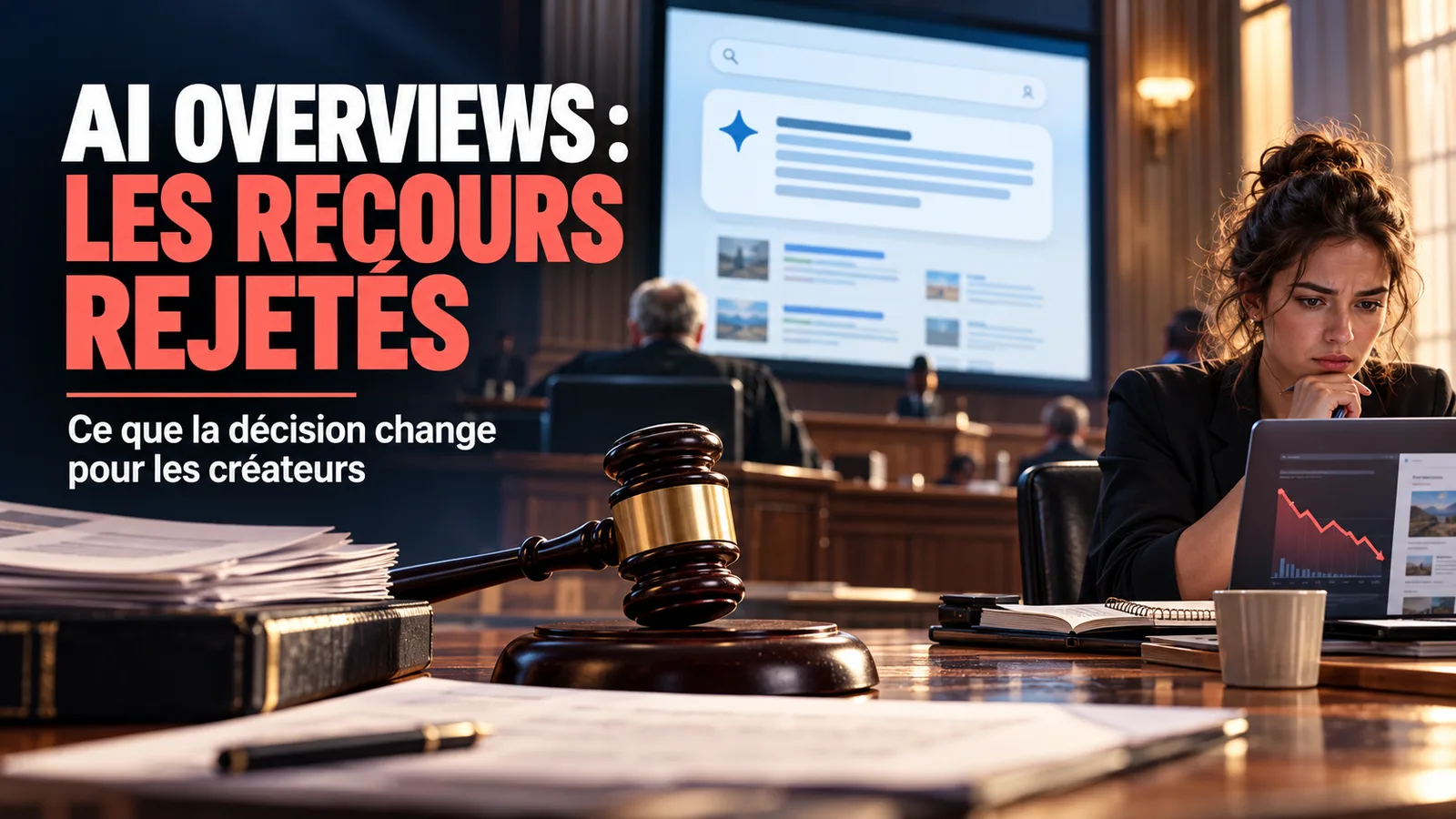
American justice has just recalled an uncomfortable reality for publishers and creators: making content accessible to Google does not in itself create a guaranteed right to receive traffic in return. On 30 September 2026, Federal Judge Amit P. Mehta dismissed the antitrust appeals of Chegg and Penske Media against Google and its AI Overviews.
The decision does not say that Google can use any content without limit. Nor does it address all the issues of copyright, remuneration or competition raised by general research. It considers that the antitrust theories presented in these two cases are not legally sufficient.
For creators, trainers, consultants and independent media, however, the practical lesson is immediate: a position in Google is a borrowed audience source, not an asset the engine owes you. SEO is still useful, but it must lead to a direct relationship, a clear offer and a destination that you control.
Information verified on 2 October 2026. This is a decision of a US federal court. It is not a French or European decision and can still be appealed.
What the court really decided
Chegg and Penske Media, including Rolling Stone, Billboard and Variety, had initiated two separate proceedings against Google. Their complaints were based on a central idea: publishers allow Google to explore their content free of charge in the hope of receiving visitors, while Google now uses these content to produce answers that can prevent the internet user from clicking.
According to the complainants, Google would use its research power to impose this operation and develop its own artificial intelligence products to the detriment of publishers.
In a 41Judge Amit Mehta granted Google's denial requests. In particular, it considers that publishers have not established the existence of a genuine agreement whereby they would supply their content in exchange for a given volume of traffic.
The court also rejected the argument that Google Search and AI Overviews are two separate products that Google allegedly illegally linked. For the judge, AI Overviews is part of how Google provides answers in its engine, not a separate product that publishers would be forced to accept.
Other federal theories, such as the monopolization of editorial markets, did not meet the necessary legal criteria. After rejecting claims under federal law, the court refused to consider claims for unjustified enrichment based on state law.
The final decision is subject to appeal. At 2 October 2026, there is no evidence that Chegg or Penske will give up any other approach.
What this decision does not say
The most dangerous shortcut would be to write: "Justice allows Google to take the content of the sites free of charge. This is not what was decided.
The court examined specific antitrust grievances based on provisions of the Sherman Act. It did not issue a general authorisation covering all uses of content by artificial intelligence. Nor did he claim that no publisher was harmed.
The judge even recognizes the economic difficulty encountered by publishers when their content is taken up in experiments that potentially reduce the need to visit the source. However, it considers that the antitrust law invoked in these cases does not solve this problem and that some of the answers are rather a matter for the legislator.
Several questions must therefore be distinguished:
This clarification is important to avoid turning a procedural and antitrust decision into a universal judgment on artificial intelligence, copyright or the remuneration of creators.
Implicit Web contract is disappearing
For two decades, many publishers organized their activity around an unwritten exchange: producing a useful page, letting Google explore, and then receiving visits when this page responds to a search.
This mechanism never guaranteed a number of clicks. But it was predictable enough to fund blogs, comparators, media, guides and part of the creator economy.
The general responses change this balance. Google can now synthesize multiple sources directly into the results page. The Internet user sometimes obtains the essential information without opening the site that made it possible to build the answer.
Google presents its AI Overviews as previews with links to explore the Web. In its documentation for site owners, the company states that classic SEO good practices remain valid and that no special optimization is necessary to appear in these experiments.
Both statements can be true at the same time: an AI response can display links to more sources, while reducing the need to click for some simple questions.
SEO therefore does not become useless. He's changing his role. There is still a way to be discovered, but it can no longer be confused with the possession of the hearing.
Two practical examples for the self-employed
A trainer publishes easy to summarize definitions
Imagine a trainer who gets most of his traffic through articles such as "What is non-violent communication?" or "What is the difference between an objective and an indicator?".
These pages can remain well positioned while generating fewer clicks, as an IA response can resume definition, main steps and some examples directly in Google.
The bad reaction would be to publish fifty almost identical variants in the hope of recovering the lost volume. The right strategy is to produce what a generic synthesis cannot easily replace: a personal method, an anonymised real case, a tool to use, an evaluation grid or a demonstration from experience.
The page must then propose a logical continuity: receive a resource, discover the training or understand the accompaniment. One LinkHub VIFLY can bring together these next steps without letting the reader look for the offer between several platforms.
A coach attracts fewer visits but more qualified applications
Let's take a coach who publishes an article on stress before a speech. Google can summarize the surface tips: breathe, prepare its introduction, repeat and slow the pace.
The content of the coach nevertheless retains value if it shows how it accompanies a specific situation, what blockages she observes, how a session takes place and for whom her method is not adapted.
She may receive fewer generalist visits, but more requests from people who understand her approach. A clear offer page and a reservation via VIFLY Booking then transform the discovery into action.
In both cases, the goal is not to abandon Google. It is to stop treating each visit as a final result. The true sequence remains the one defended by VIFLY visibility, understanding, trust, action, opportunity.
Should its content be blocked in Google's IA responses?
Google now offers in Search Console a control to exclude links and contents of a site from its general search features. According to the official documentation, this exclusion prevents the content concerned from appearing as a source and being used to anchor the responses of these features.
Google specifies that this setting does not constitute a classification signal for other parts of Search. The company usually announces a delay between one and two days, sometimes more, for the exclusion to be spread.
This possibility does not mean that it is necessary to activate by reflex. Leaving AI Overviews and other generative experiences also removes the impressions, links and traffic that they could bring.
The decision must depend on the data:
An advertising-funded media, a consultant who sells a service and an online shop do not necessarily have to make the same decision.
Technical controls such as nosnippet, max-snippet, data-nosnippet or the new exclusion proposed in Search Console also meet different objectives. An improvised modification can remove useful insights or reduce classical visibility. Any technical decision must therefore be tested on a limited perimeter prior to a general deployment.
Nuances and points to watch
First shade: this decision is American. It interprets US antitrust law and does not determine what the French authorities, the European Commission or the EU courts would decide in a comparable case.
Secondly, the procedure involved requests for rejection. The court assessed whether the complaints contained sufficient legal evidence to pursue the theories invoked. He did not organize a full trial to determine all the economic consequences of AI Overviews.
Third shade: the file does not show that a site will necessarily lose traffic. The impact varies according to the requests, the sectors, the research intention, the form of the content and the presence of a real need for deepening.
Fourth shade: visibility without clicking is not automatically useless. A quotation, name or mark visible in an answer may contribute to notoriety. But this value must be measured with caution, as it does not pay directly for production costs.
Finally, no strategy should depend on a promise that content would be "guaranteeed visible in AI". Google itself recalls that respect for good practices does not ensure exploration, indexing, or display.
Justice Mehta's decision therefore reinforces a simple rule: never build an economic model on a counterpart that the platform has not committed itself to providing.
What should you do now? The VIFLY action plan
Chegg–Penske does not sign the end of the SEO. It puts an end to an illusion: Google has never promised to return in clicks all the value it finds in the content of the Web.
The strongest professionals will continue to be visible in the research, while building something that neither an algorithm change nor a generative response can take them back: an identifiable expertise, a direct audience and a path that turns attention into a relationship.
Google AI Overviews FAQ and Chegg–Penske Decision
Did Google definitely win against Chegg and Penske?
Google obtained the rejection of the complaints examined by the federal court on 30 September 2026. An appealable final order accompanies the decision. It is, therefore, too early to state that any appeal is finally completed.
Did the judge say that AI Overviews do not harm publishers?
No. The decision rejects the antitrust theories presented, but does not conclude that publishers suffer no economic harm.
Does this decision allow Google to use all content?
No. It does not constitute a general authorization and does not address all issues of copyright, licensing, remuneration or regulation.
Does the decision apply in France?
This is a decision of a US federal court. It may influence international debate, but it does not replace French or European law.
Can its content be prevented from appearing in Google's IA responses?
Google offers an exclusion check in Search Console as well as various preview settings. An exclusion also removes links, impressions and potential visits from these features.
Is SEO still useful with AI Overviews?
Yes. Google indicates that the SEO fundamentals remain applicable. However, the strategy must measure conversions, develop non-exchangeable content and build a direct relationship with the audience.