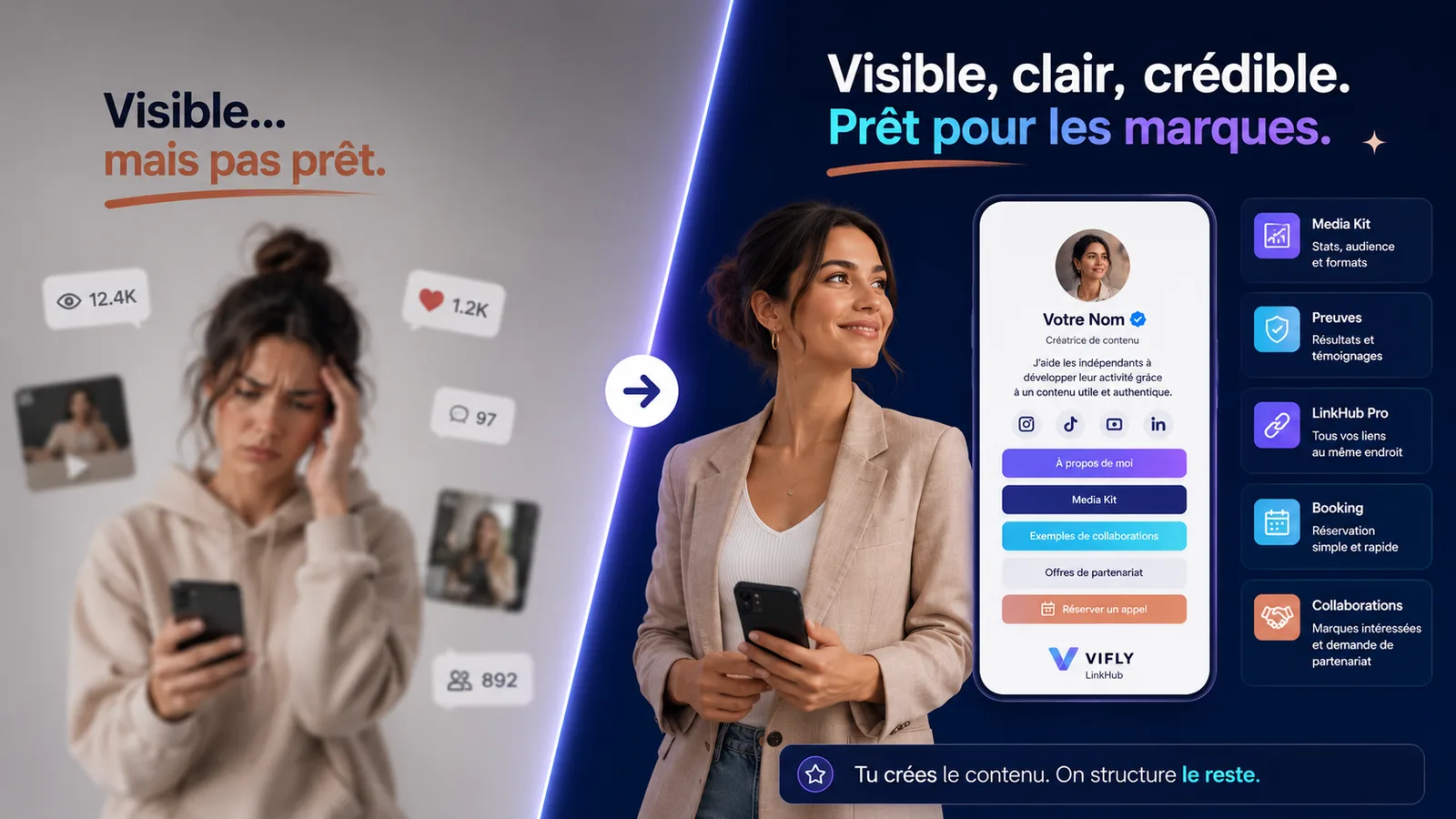
Brands are not just looking for visible creators. They're looking for reliable creators.
Obtaining a paid collaboration is not only dependent on the number of subscribers. Most of all, brands seek a credible profile, a consistent audience, a clear offer and a creator capable of presenting its value. Here's how to attract the right brands, contact them and turn a first collaboration into a sustainable partnership.
Many creators think that we have to wait until we have a big audience to start working with brands.
They await 10 000 subscribers. Then 50 000. Then a viral video. Then the right time.
But the right time doesn't always come alone.
A brand does not pay just because an account makes views. She pays because she sees a clear opportunity: touching the right audience, in the right context, with a credible creator, able to produce content that makes you want to trust.
This is where many creators lose opportunities without even realizing it.
They have a hearing. They have content. Sometimes they have commitment.
But their profile does not clearly state who they are, what they bring, what brands they can collaborate with, or why a company should invest in them.
As a result, they want to be paid by brands, but their digital presence does not yet give the impression of a creator ready to work professionally.
This article will help you understand how to find collaborations, attract brands, make you more credible and build a real path to turn your visibility into paid opportunities.
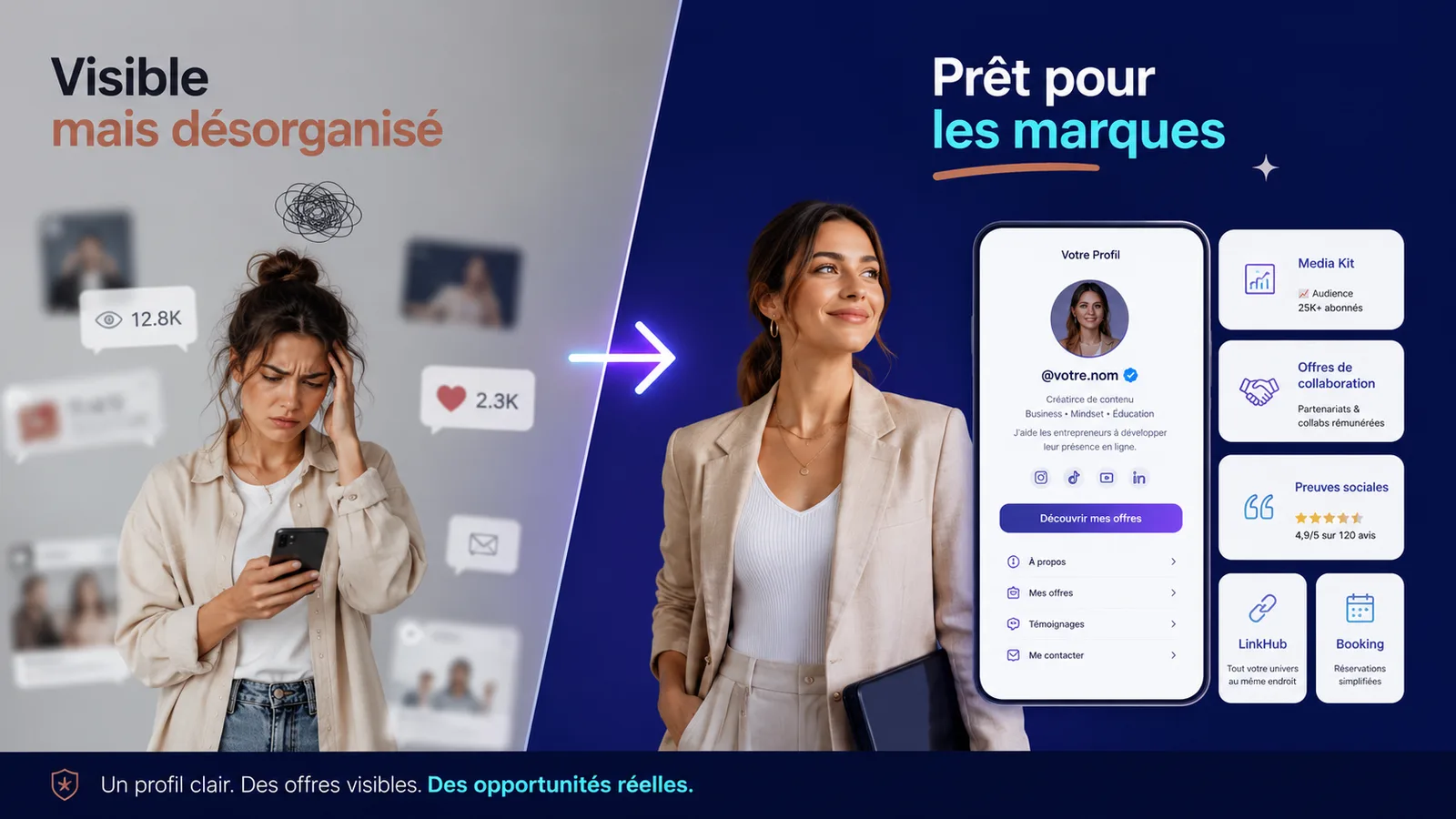
Why some brands pay creators with a small audience
The biggest mistake is to believe that brands only look at the number of subscribers.
Of course, the reach counts. An important audience can reassure a brand. But it's not enough. A smart brand isn't just asking: How many people will see this content? She wonders, "Will the right people see him?" Do they trust this creator? Does his universe match our image? Can its content cause an action
That's why a creator with 3 000 subscribers can sometimes be more interesting than an account with 80 000 subscribers.
A parental coach that is closely followed by young parents in La Réunion can be valuable for a local brand, even with a modest audience. An Instagram consultant speaking to freelancers may be interested in a SaaS B tool2B. A lifestyle designer with a community committed to well-being can be more profitable for a natural brand than a very generalist big account.
Brands don't just pay one number. They pay a context. They pay for a relationship. Credibility. An ability to recommend without breaking trust. An audience that really listens. Content that naturally integrates into a universe.
It's exactly the difference between a creator who is a post and a creator who is building a presence.
On VIFLY, this logic joins an idea already developed in the article The end of just influencers: visibility and conversion : visibility alone becomes fragile if it is not structured behind.
What brands really look at before they pay you
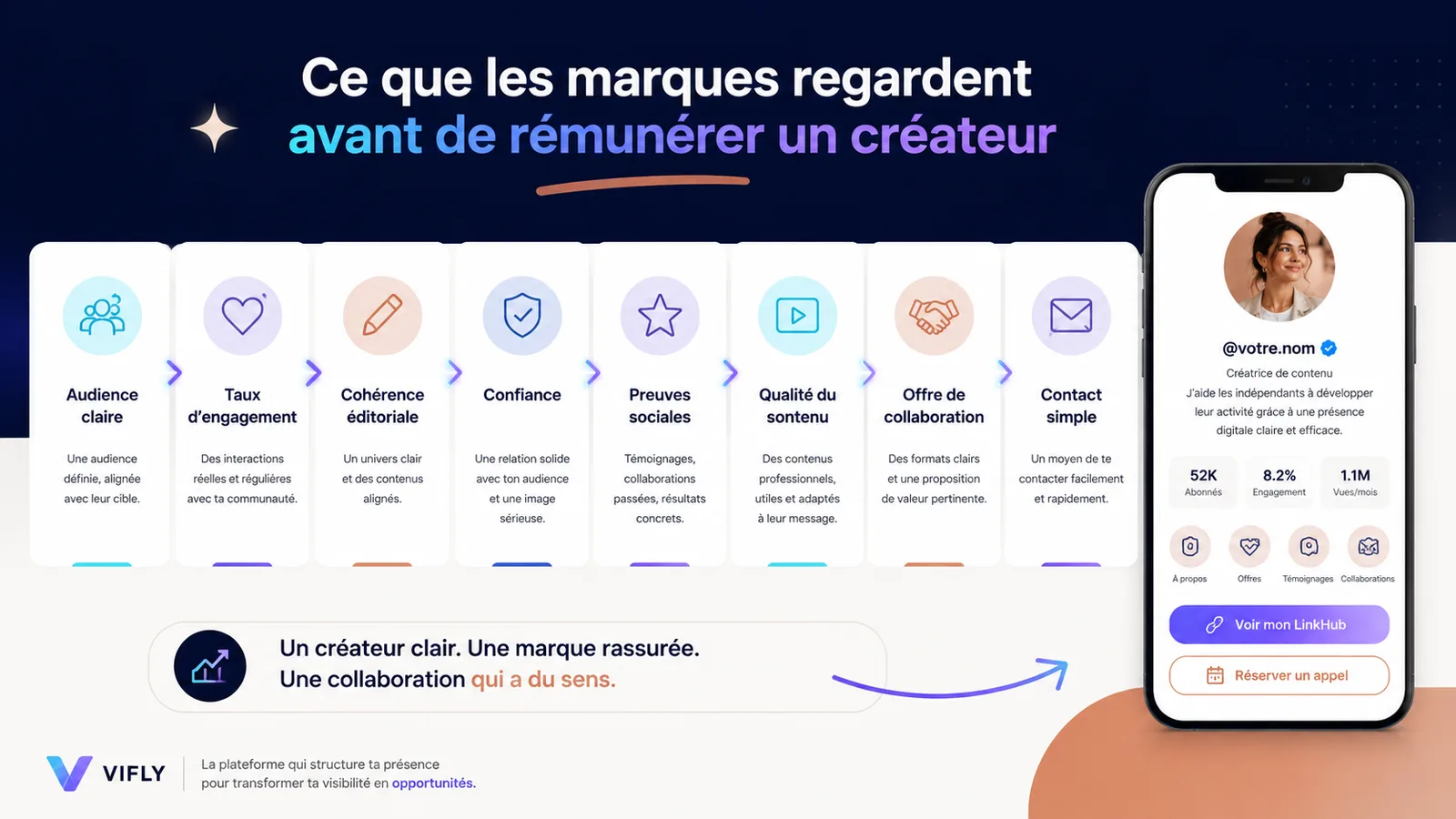
Before paying a creator, a brand analyses several signals. Some are visible in your statistics. Others are visible in your positioning. Still others feel in seconds when we get to your profile.
Is your audience clear?
A brand wants to know who she's gonna talk to through you.
If your account talks about motivation, the day after fashion, then business, then cooking, then spirituality, then travel, the brand may hesitate. Not because it is forbidden to have more than one subject, but because she has to understand very quickly which audience she will touch.
A creator may have a wide universe, but it must remain legible.
For example, it helps independents to better sell through content is clear.
I share my thoughts, my favorites, my advice and my daily life is much more difficult to sell to a brand.
The brand is looking for a simple answer:
Does your content inspire confidence?
A brand takes a risk when it associates its image with a creator.
She looks at your tone, your speeches, your consistency, your editorial quality, your way of recommending, your seriousness and your relationship with your audience.
A creator can be funny, spontaneous, human, imperfect. It's not a problem. But it must give an impression of reliability.
If you accept everything, if you recommend anything, if your partnerships look like adverts, you can lose what has the most value: trust.
And without confidence, influence becomes fragile.
Does your profile make you want to work with you?
It's often forgotten. Content can attract a brand. But it's your profile that confirms or cools interest.
When a brand arrives on your Instagram, TikTok, LinkedIn or YouTube, it must quickly understand:
Who you are. Who you're talking to. What subjects you deal with. What's your value? How to contact you. What formats you can propose. Why does your audience trust you.
If your profile is blurred, the mark has to guess. And a brand that has to guess often goes to the next profile.
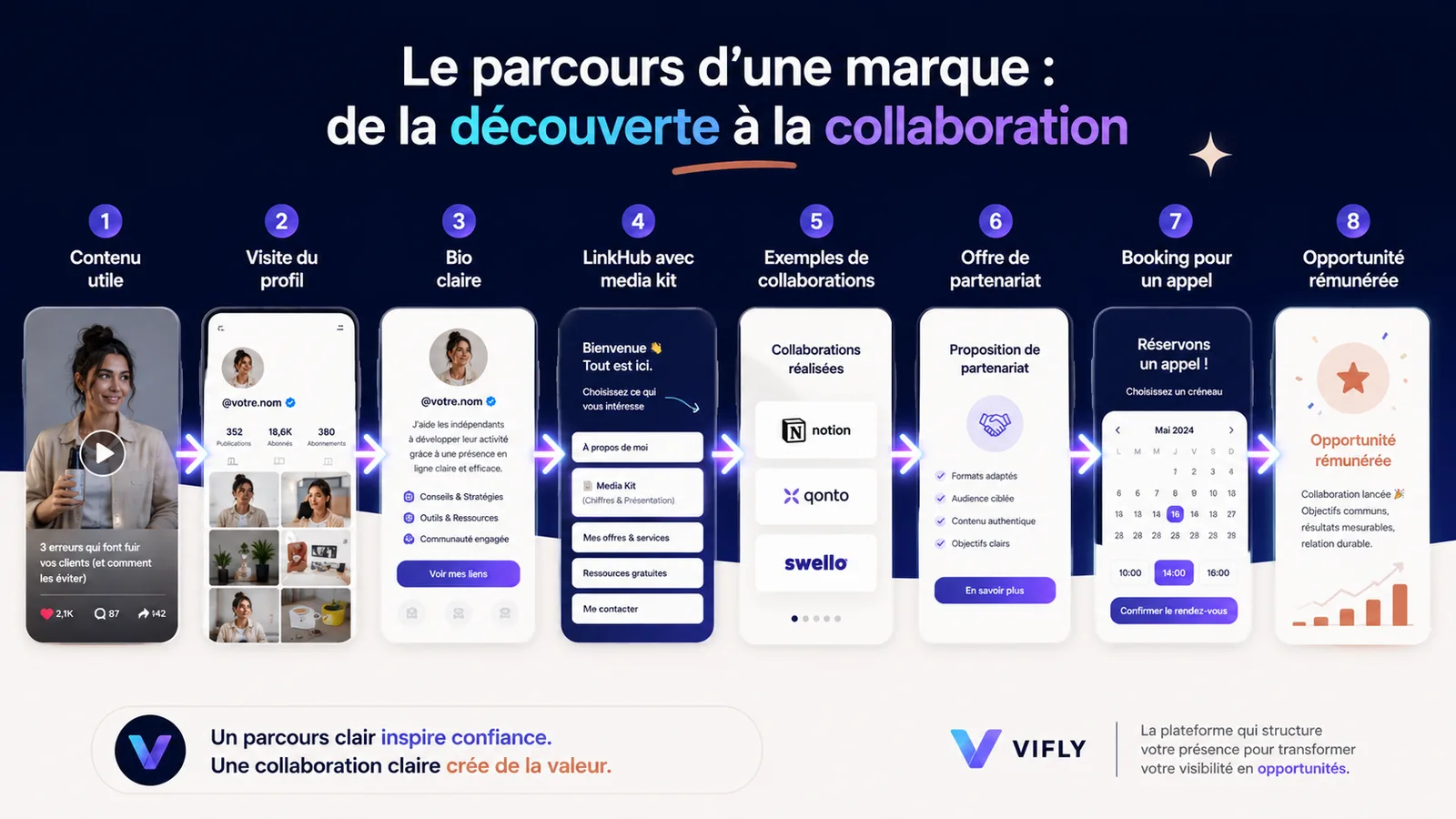
That's why your bio bond becomes strategic. You can use VIFLY LinkHub to structure a clear space with your offers, important links, media kit, examples of collaborations, strong content and contact means.
You don't just have to make you want to. You have to make it easier.
How to find collaborations with brands without waiting for them to come alone
Attracting marks is important. But waiting passively can slow your progress.
A professional creator also learns to identify the right brands, prepare a clear proposal and create the first contact without looking desperate.
Prospecting is not an admission of failure. It's a professional approach.
Start with brands that already have a reason to care about you
Don't contact marks at random. First, look for brands that have a natural connection to your audience, content and universe.
If you are a business coach, an organizational application, an appointment tool, a training platform or an entrepreneurial stationery brand can be consistent.
If you are a well-being designer, a brand of tea, natural care, yoga, newspaper or local retreat can make sense.
If you are a marketing consultant, SaaS platform, design tool, emailing solution, reservation service or productivity application may be relevant.
The right question is not: What brand could pay me
The right question is:
When alignment is obvious, your proposal becomes much stronger.
Observes brands that already collaborate with creators
A brand that has never made a partnership may be interesting, but it will often require more education.
Conversely, a brand that already works with creators understands the logic better: brief, content, rights of use, remuneration, reporting, calendar, validation.
Look at the publications with the mentions "commercial collaboration", "paid partnership", "sponsorized", "promo code", "ambassador", "gifted" or "created with".
Analyses the creators with whom the brand already works. Not to copy them, but to understand her campaign style, her level of requirement and the type of profile she likes.
Then you can propose a different angle. Not just: I want to collaborate with you. But:
Create a list of priority brands
You don't need to send 200 generic messages. Create a list of 20 to 30 consistent marks. Class them in three levels.
Very accessible brands: local, recent, small businesses, independent, online shops, growing SaaS.
Intermediate brands: brands already installed, with visible creative campaigns. Ambitious brands: bigger, more demanding, but very aligned with your audience.
For each mark, note:
Its product. His target. His positioning. His style of content. The creators she collaborates with. The angle you could propose. The benefit to her. The contact to use.
This preparation changes everything. You no longer contact a brand like someone who asks for a favor. You contact her like someone who brings an idea.
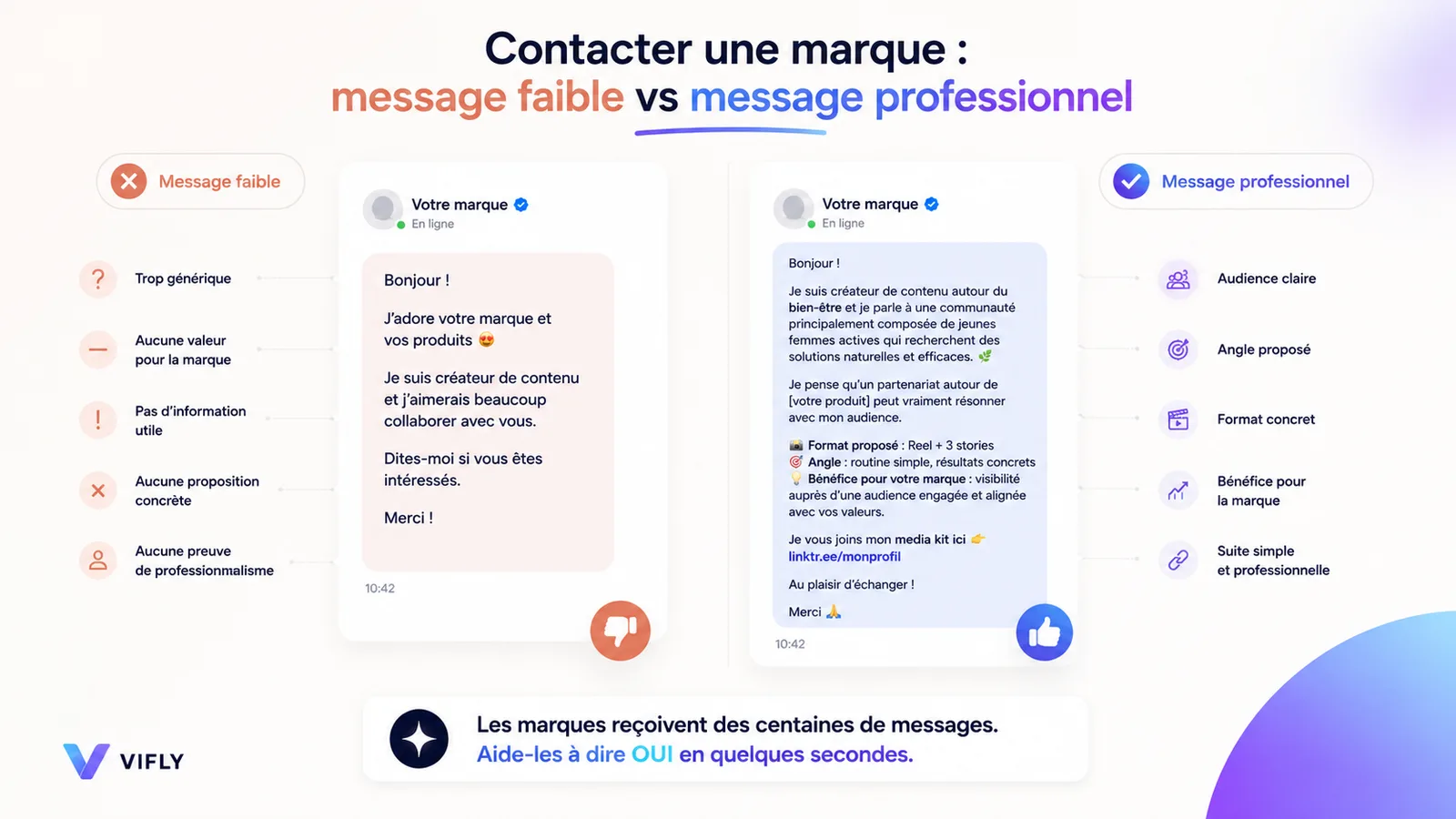
How to contact a brand for paid collaboration
A good prospecting message must be short, precise and value oriented.
The brand doesn't need to read your full story. She must quickly understand why you contact her, why your audience is relevant and what you can propose.
The wrong message
Hello, I love your brand, I am a content creator and I would like to collaborate with you very much. Do not hesitate to tell me if you are interested
This message is polite, but it is weak. He doesn't say why you, why now, why that brand, or what you're proposing.
The right message
"Hello, I am a creator of content around [your universe] and I speak to an audience composed mainly of [your target]. I noticed that your brand is helping this target to [result]. I think there's an interesting angle to create around [concrete idea of content]. I can offer you a Reel + stories format with an educational, natural and trust-oriented angle. I can send you a short proposal if you are interested
This message is stronger because he is not begging for collaboration. It opens an opportunity.
He shows you've been thinking. It gives an angle. He's talking about the target. It offers a format. He's making it easier.
You can also add a link to your professional space, media kit or LinkHub. The ideal is to have a clear page that brings together your statistics, your examples of content, your themes, your formats and your contacts.
This is exactly the role that can play a well structured LinkHub : it avoids sending a sequence of scattered links and gives the mark a simple place to understand your value.
Prepare a clear collaborative offer
Many creators want to be paid, but do not know how to present what they sell.
That's a real problem.
A brand should not have to guess if you are offering a Reel, a story, a carousel, a TikTok video, a YouTube Shorts video, an article, a live, an event presence, a newsletter, a product test or a UGC creation.
You need to turn your influence into a clear offer.
Example of simple offers
You can offer a discovery offer:
An Instagram Reel. Three stories. A traceable bond. A statistical return after seven days.
You can offer a more complete offer:
An Instagram Reel. An adapted TikTok video. Three stories. An educational carousel. A right of organic redistribution by the brand. A simple reporting.
You can offer a UGC offer:
Three short videos for the brand. No mandatory publication on your account. With a specified advertising use right. With scripts, angles and hooks included.
You can offer an expert offer:
Audit of the social presence of the brand. Creation of educational content. Participation in a campaign. Live intervention or workshop. Booking an discovered call via VIFLY Booking.
The most important thing is not to have ten offers. It's to have an understandable offer.
A clear offer reassures. A fuzzy offer slows down the decision.
That's also why the article You don't need more subscribers, you need a better course is a good complement: a brand must feel that your journey is already thought out, not improvised.
How much to charge a collaboration with a brand?
There is no universal tariff for all creators.
Your price depends on several elements: your audience, your commitment, your niche, your level of production, your expertise, the type of content, the rights of use requested, the exclusivity, the duration of the campaign, the preparation time, the validation returns and the business value for the brand.
A creator who produces a simple Reel published once does not sell the same thing as a creator who designs a strategic angle, writes the script, shoots the video, mounts the content, publishes, answers comments, provides statistics and allows the brand to reuse the video in advertising.
It's not the same job. It is therefore not the same price.
Not only does it charge for one publication
Invoice rather a set of value. Time for reflection. Creation of the concept. Quality of production. Access to your hearing.
The trust you built. Your image. Your expertise. Rights of use. Potential results. The simplicity you bring to the brand.
It's a mistake to think: I only 2 000 subscribers, so I can't ask for anything
A niche audience, engaged and well aligned can have value. Especially if the brand is looking for credibility, genuine content or more qualitative feedback than just an exhibition.
The point to remember: user fees
If a brand wants to share your story content, it's one thing.
If she wants to use it for six months in paid advertising, on Instagram, TikTok, YouTube, her website and Meta Ads campaigns, that's something else.
The user fees must be clear. Duration must be defined. Platforms must be specified. Exclusiveity must be framed.
A professional creator not only sells a video. It also sells a use.
How to attract brands without contacting them directly
Prospecting is useful, but your content can also become a collaborative magnet.
For that, he must send the right signals.
Create content that shows your value for a brand
If you want to attract brands, sometimes publish content that demonstrates your ability to help them.
For example:
How a brand can collaborate with a micro-creator without losing authenticity
Why small audiences can convert better than big accounts
“3 erreurs qui rendent un partenariat influenceur inefficace.”
“Comment présenter un produit sans faire publicité forcée.”
What I look at before I accept a collaboration
These contents show you understand the stakes of brands. You no longer present yourself as a person who wants to receive products. You present yourself as a partner capable of thinking.
And it changes perception.
Show your evidence
Brands like serious signals.
You can show examples of successful content, audience feedback, feedback captures, campaign results, testimonials, coverage statistics, click rates, generated bookings, tracked sales or simply the quality of your interaction with your community.
The evidence must not always be spectacular. She must be reassuring.
A comment of the type "J" bought thanks to your opinion" can be valuable. A story where your audience asks questions about a product can count. A niche Reel with few views but many backups may interest a brand.
You have to learn to document your value.
Make your collaborations visible without turning your profile into an advertising panel
If you've ever worked with brands, arrange that evidence.
You can create a story in front of you, Collaborating. A LinkHub page, working with me. A media kit. A section of the proposed forms. A clear contact button. A booking page for a partnership call.
An interested brand shouldn't be looking for ten minutes to contact you.
If your audience is not to be lost after content, neither is a mark. This is the same principle as in the article Views don't pay bills: how to turn your audience into customers : attention is worth only if it leads somewhere.
The media kit: your creator resume, but smarter
A media kit is not a decorative document. It's a decision-making tool.
He has to help a brand quickly understand who you are, who you are, what you can produce and why she should trust you.
What your media kit must contain
Your position in one sentence. Your main target. Your platforms. Your useful statistics. Your available formats. Your examples of content. Your old collaborations or evidence. Your values and limits. Your coordinates. A link to your profile or VIFLY space.
Avoid the media kit too pretty but empty. A brand does not need to be impressed by a complicated layout. She needs clear information.
Statistics really useful
Don't just show your number of subscribers.
Instead, add:
Your average range. Your average views. Your commitment rate. Your backups. Your clicks. Your story answers. The characteristics of your audience. Your best formats. Your punching subjects. Your results from past collaborations if you have any.
The goal is not to look bigger than you are. The aim is to be clearer.
A well-understood small audience is more reassuring than a large, poorly explained audience.
Errors that make brands leak
Some mistakes do not always see themselves as creative, but they block the marks.
Have a bio too vague
“Créateur de contenu passionné par le lifestyle, le business et les bonnes vibes” ne dit pas grand-chose.
A brand wants to understand your territory.
A stronger bio would be:
"J" helps independents to sell better thanks to a clear digital presence
“Créatrice bien-être : routines simples, produits naturels et équilibre du quotidien.”
"Coach business for freelancers who want to structure their offer and attract customers."
Your bio is not just a presentation phrase. It's a commercial signal. Article Does your Instagram bio make you lose customers? This is precisely the point.
Accepting inconsistent collaborations
Poorly aligned collaboration can cost more than it does.
If your audience follows you for welfare advice and you recommend a questionable product, you can lose credibility. If you talk about serious entrepreneurship and make an aggressive promotion unrelated to your universe, you weaken trust.
Serious brands also look at this. They want to know if you're protecting your image.
Saying no to some collaborations sometimes increases your value.
Do not clearly indicate sponsored content
Transparency is not an option. In France, when it comes to paid promotion, the mention "Publicity" or "Commercial cooperation" must be clear, legible and identifiable throughout the promotion.
But beyond the obligation, there is a stake of trust.
An audience can accept that a creator is paid. What she accepts much less is to feel deceived.
A well-announced partnership can remain credible if the content is sincere, useful and aligned with your universe.
How to transform collaboration into a long-term relationship
A brand can pay you once. But the real lever is to become a partner she wants to remember.
For this, do not just think about publication. Think about the full experience.
Prior to collaboration
Be clear on the deliverables. Clarify the deadlines. Ask for the brief. Explain your angle. Validates sensitive points. Set the limits. Confirms user rights.
During collaboration
Meet the deadlines. Simply communicate. Propose content consistent with your style. Do not copy the advertisement of the mark. Translate the message into your language.
A brand is not just looking for someone who repeats a brief. She often looks for someone who can make her message more human.
After collaboration
Send a little check.
Scope. Views. Clicks if available. Interesting comments. Reactions from the hearing. Points of improvement. Idea for a suite.
This simple balance sheet positions you as a professional creator.
Many don't. Those who do score points.
VIFLY: Structure your presence to make brands want to contact you
A brand that arrives on your profile must quickly understand that you are serious.
Not cold. Not too corporate. Not artificial. But clear, organized, credible.
That's where VIFLY can become a real lever. The platform helps creators, coaches, consultants, independents, trainers, freelancers and entrepreneurs to centralize their digital presence, organize their links, present their offers, facilitate reservations and turn their visibility into concrete opportunities.
With VIFLY LinkHub, you can create a more professional bio link: media kit, collaboration request, content examples, offers, important links, resources, social networks, contact.
With VIFLY Booking, you can allow a brand, prospect or partner to book a call without interminable exchange in DM.
This changes perception.
You don't look like someone waiting for an opportunity. You look like someone who organized his activity to receive it.
And in the spirit of a brand, this difference matters.
Simple action plan to attract your first paid collaborations
You don't need to do it again in a week.
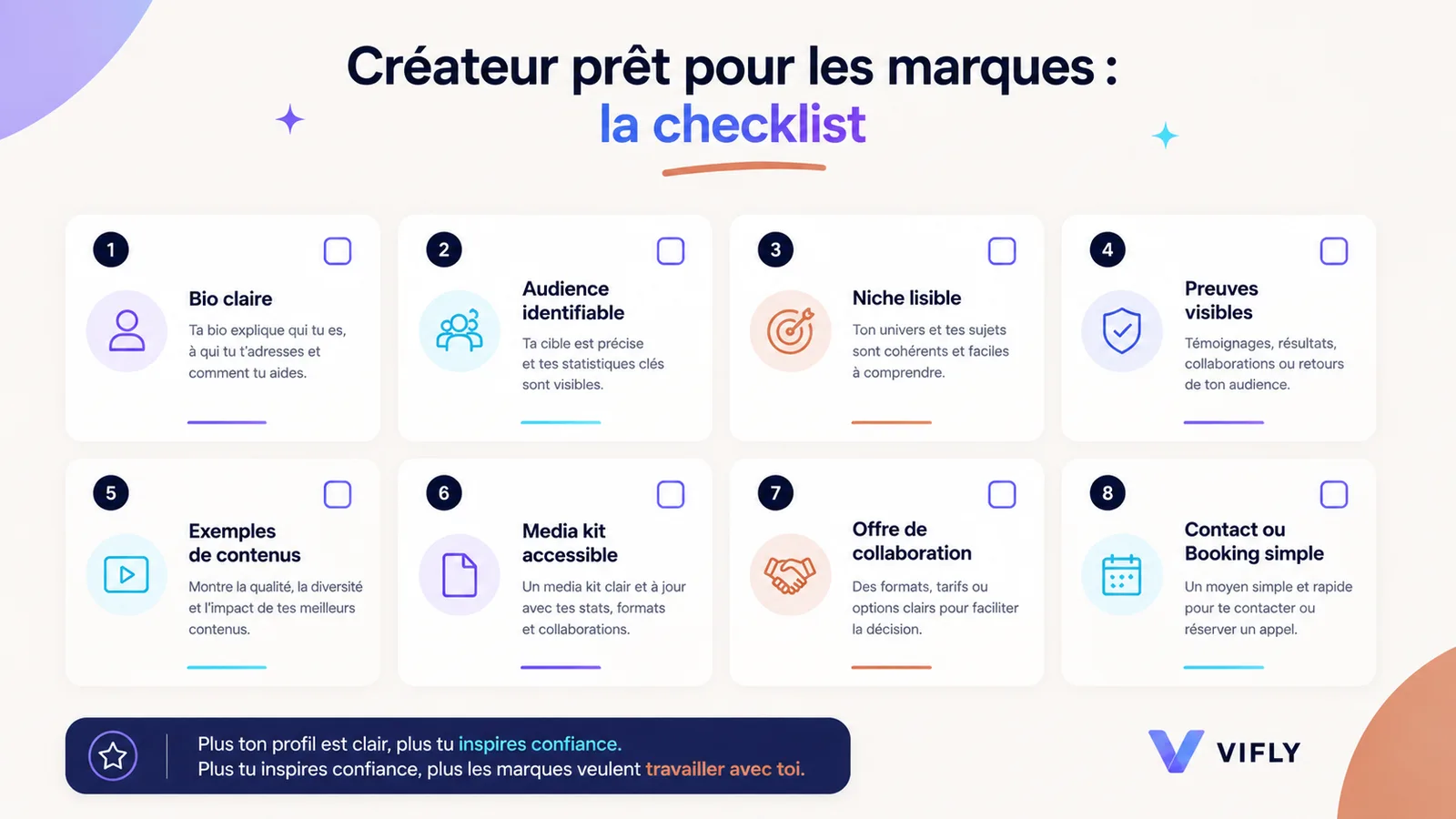
Start by making your profile clearer.
Explain who you help, what universe you embody and why your audience trusts you. Update your bio. Pin three strategic content: content that shows your expertise, content that shows your universe, content that shows proof or transformation.
Then create a clear space for brands.
A bond to work with me. A mini media kit. Three examples of formats. An email address or form. An option to book a call.
Then prepare a list of consistent marks.
Don't look for the biggest first. Look for the best aligned. The ones that already serve your audience. The ones you could talk about naturally. The ones for which you can offer a useful angle.
Finally, contact them with a specific proposal.
Not like to collaborate. Rather: Here's the angle I can create for your target
It is this passage that transforms a visible creator into a credible partner.
Conclusion: brands not only pay your visibility, they pay your ability to build confidence
Finding paid collaborations does not mean waiting for a brand to finally notice your talent.
It's a work of clarity.
Clarity of your audience. Clarity of your positioning. Clarity of your content. Clarity of your collaborative offer. Clarity of your journey after the discovery.
Brands need creators. But they're not just looking for public accounts. They are looking for reliable, legible, aligned profiles that can speak to a specific audience with real credibility.
Before approaching a brand, gather your essential information in a clear and professional creative media kit positioning, audience, statistics, formats and proof of your work.
You don't need to be the greatest creator of your market to start.
But you must become understandable. Reassuring. Professional. Easy to contact. And clear enough for a brand to say:
Your content attracts attention. Your profile reassures. Your LinkHub guides. Your Booking facilitates the exchange. Your journey turns interest into opportunity.
Finally!
You want to give brands, prospects and partners a clear reason to contact you?
Create your space VIFLY, structure tone Professional LinkHub, present your offers, add your proof and facilitate requests for collaboration or reservation with VIFLY Booking.
Your audience must not only see you.
Brands must understand why they should work with you.
Key points
A good strategy isn’t just about publishing more. It’s about guiding your audience towards a clear call to action.
Frequently Asked Questions
How to find collaborations with brands when you're a small creator?
Start by identifying the marks that already speak at the same audience as you. Then prepare a clear proposal: who you are touching, what problem you can help the brand solve, what format you are proposing and why your audience is relevant.
Does it take a lot of subscribers to be paid by a brand?
No. A large audience may help, but a small, focused, committed and consistent audience may also be of interest to a brand. The clarity of positioning, trust and alignment with the brand are important.
What to put in a creative media kit?
A media kit must present your positioning, audience, platforms, useful statistics, collaboration formats, examples of content, evidence, past collaborations and means of contact.
How to contact a brand for a paid collaboration?
Avoid generic messages. Proposes a concrete angle, explains why your audience is relevant to the brand and clearly indicates the format you can create: Reel, stories, carousel, UGC, product test, live or sponsored content.
How can VIFLY help a designer attract brands?
VIFLY allows you to centralize important links, present your offers, add a media kit, organize your proofs, guide brands to a collaboration request and facilitate booking a call with VIFLY Booking.