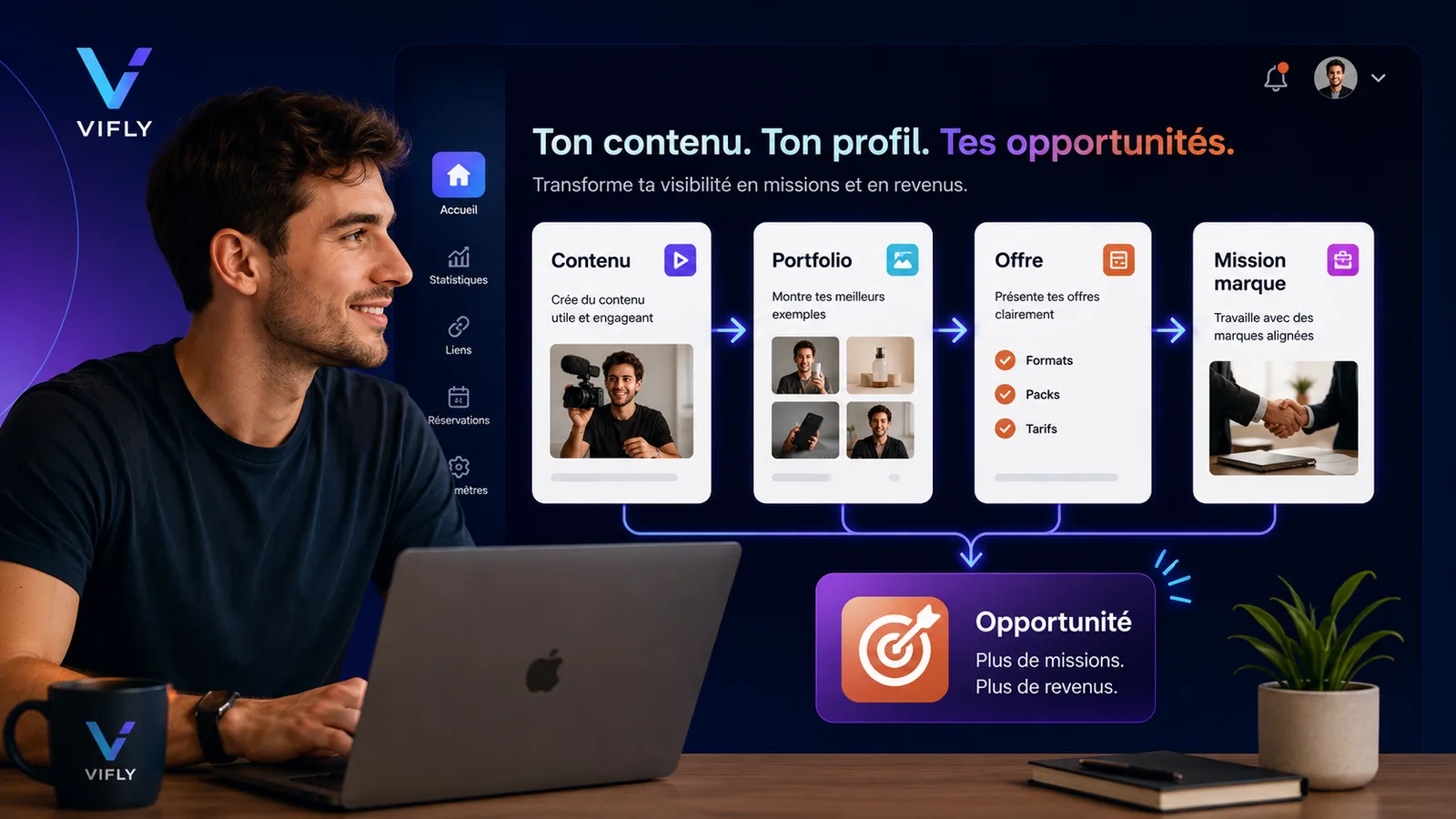
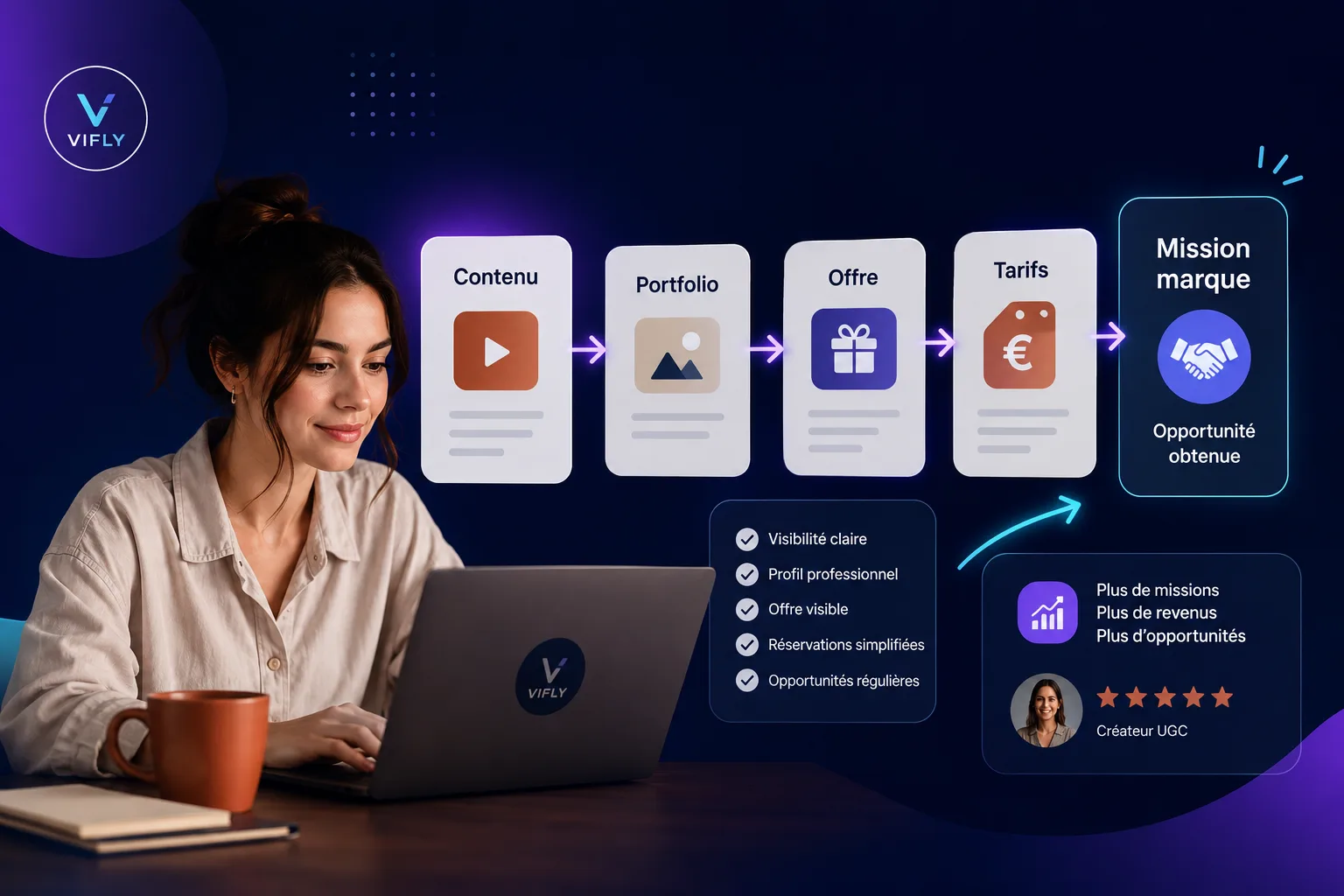
Being a UGC creator is not enough. It is necessary to become understandable for brands
Many creators discover the UGC with a simple idea: create content for brands without necessarily having a big audience.
The idea is attractive. You don't need to be an Instagram star. You don't need millions of views. You can produce videos, photos, reviews, demonstrations, native content that brands can use in their communication.
But there is a nuance that many discover too late.
A brand doesn't pay just because you know how to make a nice video.
It pays because it quickly understands what you can produce, for what purpose, with what level of quality, under what conditions, with what rights of use and with what degree of reliability.
In other words, the UGC is not just a matter of creativity. It is also a matter of clarity.
You can have good content and not receive any missions if your profile makes you feel improvised. You can have a small audience and get opportunities if your portfolio, offer and course are legible. You can be talented, but lose a brand because she doesn't find your contact, your examples, your conditions or the next step.
This is where many UGC creators block: they work their content, but not their system.
This article will help build this system.
What is a UGC creator?
A UGC creator produces content for brands, usually in the form of videos, photos, testimonials, product demonstrations, short formats, TikTok, Reels, Shorts, stories or native visuals.
UGC stands for User Generated Content, i.e. user-generated content. In current marketing, the term often refers to content that looks like natural content from creators or customers, but is produced in a professional setting for a brand.
The difference with conventional advertising is simple: the UGC seeks to appear closer to real use. It shows a product in a concrete context. He explains, tests, tells, demonstrates or stages an experiment.
Good UGC content does not necessarily resemble a highly produced advertisement (like a classic media). Rather, it looks like content that the audience could really watch on TikTok, Instagram, YouTube Shorts or LinkedIn without immediately wanting to pass.
But this does not mean that the UGC must be amateur. On the contrary.
Content may look natural, but the creator must work professionally.
Creator UGC or influencer: what difference?
An influencer is often paid to broadcast content to his own audience. The brand therefore buys a combination: creation, visibility, trust and access to a community.
A UGC creator can be paid primarily to produce the content. The brand can then use this content on its own networks, advertisements, product pages, emails or website, depending on the rights provided.
The difference is important.
If you're an influencer, the brand looks a lot at your audience. If you're a UGC creator, the brand looks at your ability to produce useful, credible and exploitable content.
That doesn't mean your hearing doesn't matter. She can reassure. She can show you know how to create content that interests real people. But she is not always the heart of the mission.
Key points
A UGC creator not only sells a video. It sells an ability to understand a brand, product, audience and communication goal.
Why is the UGC attracting so many creators today?
The UGC attracts because it seems more accessible than the classical influence.
Many creators say, "I don't have a huge audience, but I know how to create content. Maybe I can monetize that skill
And this intuition is good.
A person who can write a good short script, film properly, explain a product, give credible advice, create a natural format and respect a brief can have real value for a brand.
But the mistake would be to believe that the UGC is a quick or magical solution.
The market is becoming more demanding. Trademarks are receiving more and more proposals. They see portfolios, packs, prices, TikTok profiles, Notion pages, Google Drives, bio links and very similar designer messages.
To get out of here, you have to be clearer, not just more creative.
You must be able to quickly answer these questions:
Who are you? What formats do you control? What types of brands are you relevant to? What examples can you show? What's your offer? How do you work? What are your prices or your packs? How can a brand contact you or book an exchange? What rights of use are included or not?
If these answers are scattered in your DMs, in a missing PDF or in a confused bio link, you add friction.
And friction costs opportunities.
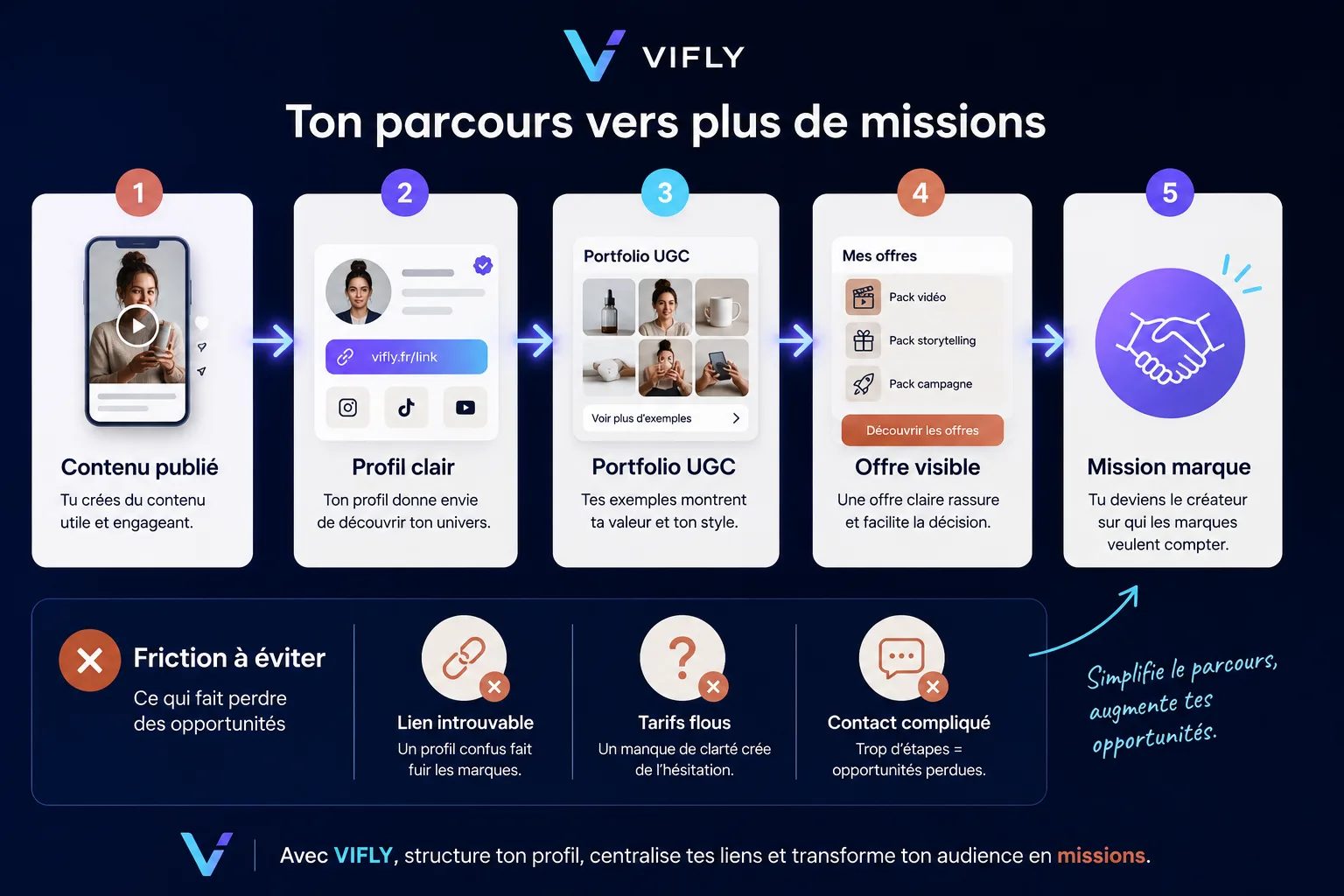
What a brand looks at before entrusting a UGC mission
A brand doesn't just look at your content as nice. She sees if working with you looks simple, serious and aligned.
It's a huge difference.
A creator may have talent, but give a blurred impression. Another may have less experience, but present such a clear approach that the brand projects more easily.
1. Your universe
The brand wants to understand your style. Are you rather educational, lifestyle, humoristic, expert, facecam, product demonstration, storytelling, before-after, sincere review, tutorial?
A clear universe reassures. He helps the mark see where you can help him.
If you create a little bit of everything without consistency, it's not necessarily bad. But you have to organize your examples so that the brand doesn't get lost.
2. Your examples of content
Your UGC portfolio must show what you can produce. Not only your favorite content, but your most useful formats.
For example:
A short facecam video. A product demonstration. A typical problem-solution content. A natural unboxing. A video with voice off. A voiceless video. One before. A native commercial script. An educational video. A video testimony.
The objective is not to put fifty. The goal is to show that you can meet several brand needs.
3. Your understanding of business
A brand is not just looking for someone who makes videos. She's looking for someone who understands a goal.
Should the content reassure? Explain? Demonstrate? Make you want to? Answer an objection? Create social proof? Feed an advertisement? Improve a product page? Serving a TikTok campaign? To be reused in Reels?
The more you show that you understand the context, the more credible you become.
4. Your professionalism
Professionalism doesn't mean having a studio. He means to be clear.
Time limits. Liquid. Number of returns included. Rights of use. Formats provided. Payment conditions. Contact. Availability. Process.
A mark must feel that it will not have to explain everything from scratch.
5. Your contact path
If a brand likes your profile but doesn't know what to do next, you can lose the opportunity.
She must be able to easily access your portfolio, offer, email, form or booking page.
This is exactly the role of a structured link in bio. A tool like VIFLY LinkHub allows you to centralize your examples, offers, networks and calls to action on a page that is clearer than just a list of links.
Why your UGC portfolio isn't always enough
Many creators think their portfolio is their main sales tool.
That's true, but only in part.
A portfolio shows what you can do. He doesn't always say what you're proposing, how you work, how much it costs, what's included, what's not, or how to take action.
This is where many UGC pages become frustrating for brands.
They show nice videos, but they do not answer practical questions.
Common mistake
Link to a folder with videos, without context, without explanation, without offer and without next step.
The brand looks at a few examples, finds it interesting, and then asks:
If she needs to search for your email, guess your rates, understand your formats alone and write a vague message, you added too much effort.
A good UGC portfolio must be accompanied by a course.
It may contain:
A positioning phrase. Three to six well-selected examples. An explanation of the formats proposed. A clear indication of the types of missions accepted. A section on user fees. A contact or booking page. A link to your rates or packages if you choose to display them.
The portfolio makes you want it. The journey turns this desire into demand.
To work on this part, you can also use the article VIFLY dedicated to paid collaborations with brands. It shows why a brand not only responds to your message, but also to what it understands from your profile.
How to present your UGC offers clearly
A clear UGC offer must avoid two pitfalls.
The first is to be too vague.
The second is to be too complicated.
If you're just writing, I'm doing UGC, contact me, the brand doesn't know what it can buy.
But if you present fifteen packs, ten options, five conditions and an unreadable grid, it can also give up.
The right balance is to present some simple formats.
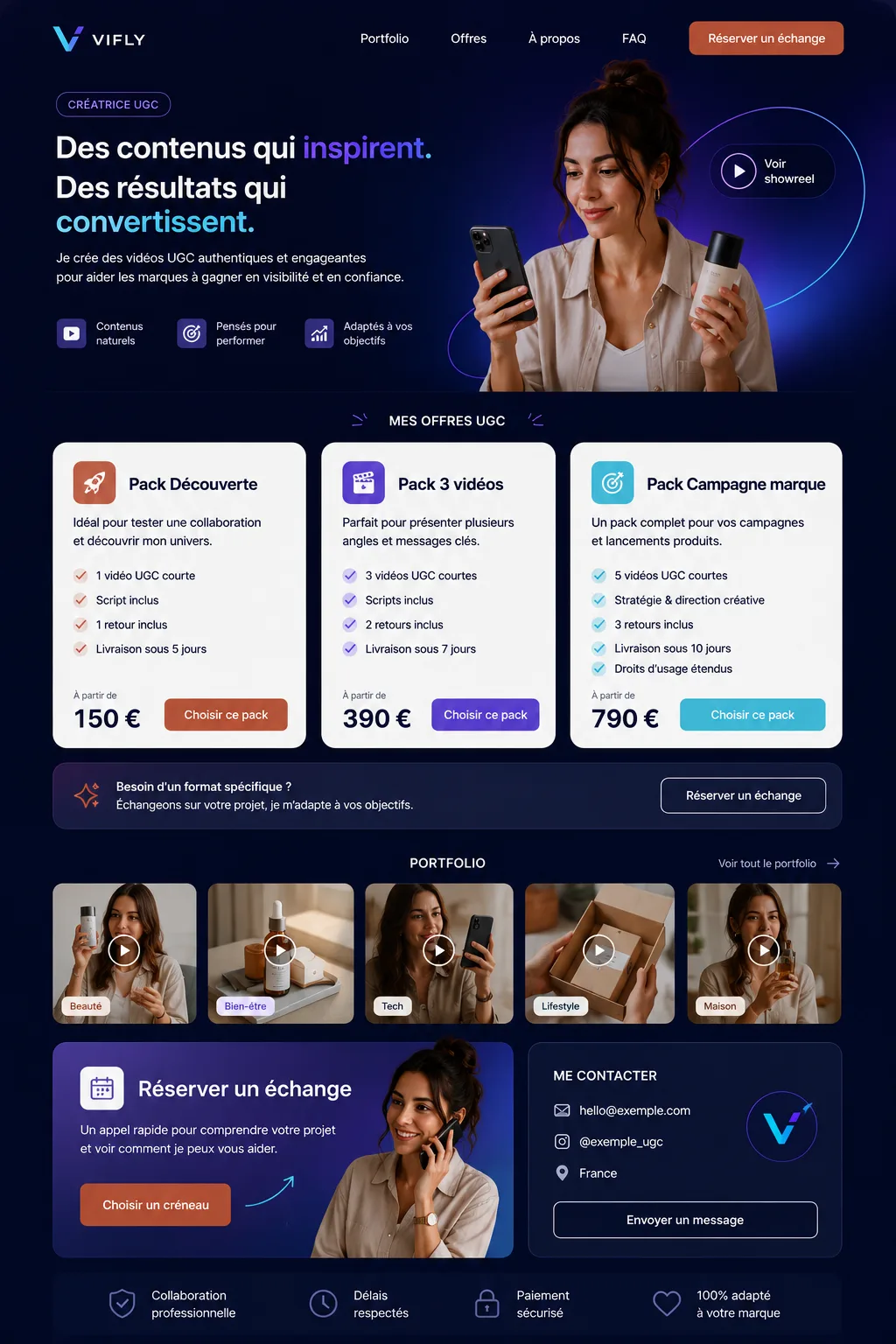
Example of a simple offer for a beginner UGC creator
You can structure your offer like this:
Discovery package: 1 short UGC video, single script, shooting, editing, 1 return included.
Content Pack: 3 short UGC videos around the same product or campaign.
Test Pack: 1 video demo + 1 video testimonial + 1 video problem-solution.
Native advertising package: video designed for advertising use, with user rights to be defined separately.
It's not a mandatory grid. It's a base.
The important thing is that the brand quickly understands what you deliver.
Example for a coach or consultant
A coach can offer educational UGC for brands related to well-being, sport, productivity, training or personal development.
The offer may be:
An educational video. A demonstration of usage. A feedback. A mini-series of content tips. Expert content that explains a problem that the product helps solve.
The value is not just from the image. She's from the expertise.
Example for a trainer
A trainer can create UGC content around educational tools, platforms, software, learning methods or professional resources.
Its advantage is clarity. He can explain. His offer must therefore highlight:
The ability to popularize. The script structure. The credibility of the speech. Compatibility with short formats.
Example for an independent or entrepreneur
An independent can produce UGC B2B content around SaaS tools, organization, business, productivity, customer relationship or sales.
In this case, the brand often expects more serious, more demonstrative, less influence.
The offer must show you know how to talk to a professional target.
Do you have to display your prices when you're a UGC creator?
There's not one good answer.
Displaying prices can reassure and filter requests. This avoids unnecessary exchanges with brands that do not have the budget.
But not displaying them may also be relevant if your missions vary greatly depending on the usage rights, the number of videos, the level of production, returns, exclusivity or the duration of operation.
The real question is not: Do I have to show my rates
The real question is: Does my system allow the brand to understand how I charge
You can display:
"Prices from." Indicative packs. A fork. A statement of the value of the goods according to the right of use. A form to qualify the application. A booking page to discuss the need.
What matters is not to leave the total blur.
If you want to structure this part, article VIFLY How much to charge for a collaboration? can help to think rights of use, deliverables, value and negotiation.
You can also return the marks to a clear page of conditions, if you want to show that your ecosystem is structured and transparent.
What you need to prepare for UGC missions
Seeking unprepared missions often means sending messages that fall into a vacuum.
Before contacting a brand or responding to an opportunity, prepare your base.
Your positioning
You must be able to say in one sentence what you create and for whom.
Examples:
I create natural UGC videos for wellness brands who want to show their products in a realistic routine
Helps SaaS tools explain their features with short, clear and educational videos
I produce UGC lifestyle content for brands that want simple, human and credible TikTok formats
A vague sentence creates doubt. A precise sentence creates an image.
Your formats
Don't just say, "I make videos.".
Say what you can produce:
Facecam. Voice over. Product demonstration. Tutorial. Unboxing. Testimony. Video problem-solution. Advertising script. Storyboard. Short series. Vertical content. Photo product lifestyle.
The more legible your formats, the more a brand can project.
Your portfolio
Your portfolio must be organized.
Separate your examples by content type, not just by date.
For example:
Demonstrations. Opinions. Lifestyle products. Educational contents. Facecam videos. Faceless videos. Test products. Contents B2B.
Each example can be accompanied by a short note:
Content objective. Format. Platform planned. Type of mark. Role played: script, shooting, editing, voice off.
Your offer
A brand can't guess what you're selling. Presents some simple options.
Even if you then adapt each quote, the brand must understand your frame.
Your journey
A clear next step. This can be:
See my portfolio. Request a quote. To reserve an exchange. Send a brief. Discover my packs. Contact me by email.
If you offer calls, audits or scoping exchanges, VIFLY Booking can help make booking easier and more professional.
How to get your first UGC missions without looking amateur
The first missions are often the most difficult, because you have to prove your worth before you have a lot of references.
But you can already create evidence.
Creates fictional but professional content
You can choose products you already know and create non-sponsored examples.
The aim is not to make a collaboration seem. The goal is to show what you can do.
You can create:
A product demonstration. A structured opinion. A routine video. Problem-solution content. A comparison. A short video thought for a native advertising.
Be transparent: these are portfolio examples.
Prepare three angles per mark
Before contacting a brand, not only does it offer a collaboration.
Propose an angle. For example:
For a brand of tea:3 videos about a simple and realistic evening routine
For a productivity application: A short video that shows how to save time on a specific task
For a sports brand:
For a SaaS tool: 30 seconds of a problem that the tool solves
A mark responds more easily to a concrete idea than to a vague demand.
Prepare a short message
Your message must show you understood the mark.
Simple structure:
A personalized sentence. Your universe. Proposed angle. The benefit to the brand. The link to your portfolio. A next step.
You can learn from the method developed in the article Attracting brands and getting paidespecially if you want to avoid selling only views.
Action to be taken
Before sending your next message to a brand, open your bio link as if you were responsible for marketing. Ask yourself this question: Do I understand in less than thirty seconds why I should work with this person
If the answer is no, it is not your message that needs to be improved first. It's your journey.
Errors that prevent a UGC creator from picking up opportunities
Some mistakes come back very often.
They don't come from a lack of talent. They come from a lack of structure.
Error 1: presenting as a UGC-creator
Saying I'm a UGC designer is not enough. It's like saying, "I do content.".
What kind of content? For what marks? What style? For what purpose? On which platforms? With what added value?
Your angle must help the brand rank you mentally.
Error 2: Hide best examples
If your portfolio is at the bottom of a file, behind a loose link, or mixed with all your social networks, you lose impact.
Your best examples must be easy to find.
Error 3: Confound natural and neglected
UGC content can be natural. He must not be sloppy.
Sound, light, framing, rhythm, script, product understanding, message clarity: everything counts.
Error 4: not talking about user fees
A brand may want to publish your content on its networks, use it in advertising, integrate it into a product page or reuse it in a campaign.
These uses are not all worth the same.
You don't need to become a lawyer to start with, but you need to understand that rights of use need to be clarified.
Error 5: Failure to respect commercial transparency
When content is produced through commercial collaboration, transparency is not a detail. It protects the audience, the brand and the creator.
Platforms have rules or tools around paid partnerships. In France, the framework of commercial influence also imposes obligations, in particular with regard to transparency and contractualisation in different situations.
It's not the glamorous part of the job. But it's a part that shows your seriousness.
Error 6: Manage everything in DM
DMs can create the first contact. But they must not contain all your creator business.
If your offers, examples, indicative rates, contact and calendar are only explained by hand in each conversation, you will waste time.
Article VIFLY on DMs that cause customers to lose explains why conversations must lead to a clearer system.
How to use a LinkHub to become more credible to brands
Your bio link can be a simple list. Or it can become a professional presentation page.
The difference is huge.
A UGC creator should use its link in bio as a clear commercial mini-page. Not aggressive. Not advertising. But structured.
It may contain:
A short introduction. Your portfolio. Your UGC formats. Your offers or packs. Your media kit. Your professional email. Your networks. A button to ask for a quote. A button to book an exchange. Examples of content. Evidence of seriousness.
With VIFLY LinkHub, the goal is not just to add buttons. The aim is to guide the brand towards the right action.
A mark that arrives on your profile should not wonder where to click.
It must include:
Here's his universe
Here are his examples
This is what he or she proposes
Here's how to move on
It is this passage between visibility and action that makes the difference between an interesting profile and a profile that generates opportunities.
How to use Booking to simplify serious requests
Not all UGC missions require a call. But some requests deserve a quick exchange.
For example:
A brand wants a series of videos. An agency wants to discuss user fees. A customer wants a quote in several formats. Collaboration involves a technical product. A campaign requires precise framing.
In these cases, proposing a clear appointment can reassure.
A Booking avoids endless exchanges:
"When are you available?" "You can Tuesday?" "And Wednesday?" "You have a connection?"
With a cooking or a VIFLY booking page, you can offer a niche, present the subject of the exchange and qualify the application.
Even if you're not a coach, the logic is the same: make the next step simpler.
For a UGC creator, this can become:
“Réserver un échange collaboration.”
To discuss a UGC mission
Present your brief
Request a quote
The reservation is not there to make pretty. It is used to turn intent into action.
How VIFLY can help a UGC creator without replacing his talent
VIFLY don't create talent for you.
You must always work your style, content quality, brand understanding, scripts, posture and reliability.
But VIFLY can help on a often neglected part: structure.
Because many creators do not lose opportunities because of their content. They lose them because their journey is blurred.
With VIFLY, you can build a clearer space for:
Centralize your important ties. Present your portfolio. Put your offers forward. Orient to a booking page. Provide professional contact. Follow the clicks according to the sources. Connect your free content to concrete opportunities.
This is not an automatic mission promise. It's a way to reduce friction.
And in a market where brands compare quickly, this clarity can weigh heavily.
If you want to go further on the logic of monetization, read also the VIFLY guide on creative monetization. The UGC is a possible path, but it is part of a broader reflection: how to turn a audience, expertise or content competence into structured revenues.
Concrete examples according to your profile
Creator lifestyle
You create content around routines, products, beauty, food, home, parenting, well-being or daily.
Your advantage is proximity. Your risk is to look like many other profiles.
To differentiate yourself, show examples of very concrete content:
Routine morning. Test product. Before afterwards.3 ways to use it. Unboxing. Honest opinion. Comparison. Storytelling use.
Tone LinkHub must highlight your portfolio and your formats.
Coach
You create content around transformation, method, sport, mind, organization, nutrition, career or business.
Your advantage is credibility. Your risk is too promotional.
Your UGC must remain useful. A brand may want to work with you if you can integrate its product or service into a clear explanation.
You can also use Booking to offer qualified exchanges with brands or partners.
Consultant
You create B2B content, analysis, strategy, tool, productivity or professional expertise.
Your advantage is business understanding. Your risk is being too technical.
Your UGC content can be very useful for software, SaaS, professional tools, training, B2B services or organizational solutions.
Highlight your ability to explain a value quickly.
Trainer
You know how to popularize. It's a huge force.
A brand can entrust you with teaching content: tutorials, mini-trainings, demos, explanations, onboarding, videos how to do it.
Your portfolio must show your clarity, not just your image.
Independent or entrepreneur
You can create UGC content with a real understanding of the terrain.
For example, if you are a photographer, graphic designer, community manager, therapist, craftsman, restorer, consultant or freelancer, you can produce more incarnate and credible content in your niche.
Your advantage is real experience. Your journey must show you're not just a creator. You also understand the problems of professionals.
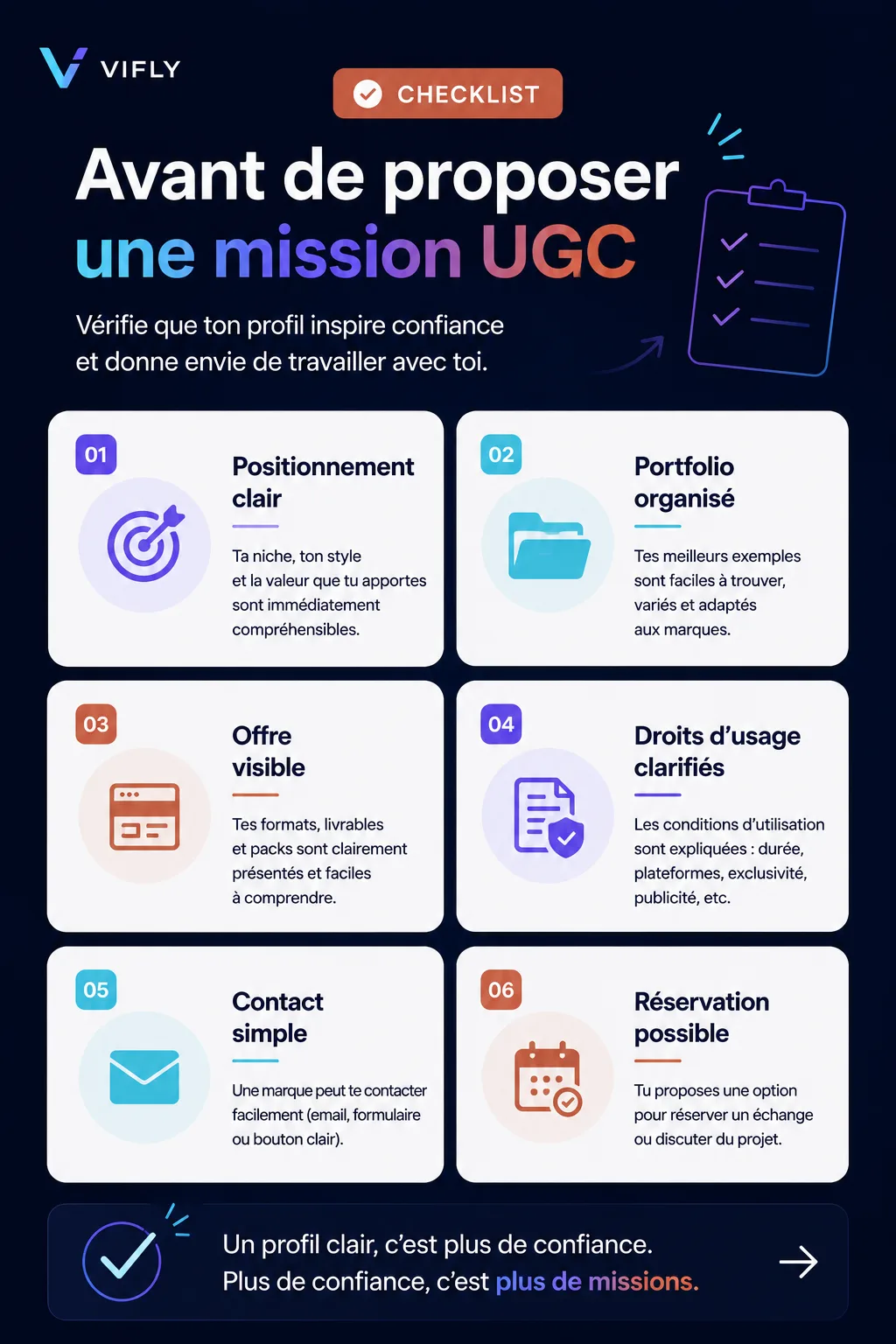
Checklist before proposing a UGC mission
Before contacting a brand or responding to an ad, check this:
Your positioning is clear. Your portfolio contains legible examples. Your formats are explained. Your offer is understandable.
Your rates or conditions are set. Your rights of use are not left in the blur. Your bio link leads to a career path.
Your contact is easy to find. You can propose a simple next step. You've planned a way to follow your requests.
If several points are missing, don't panic. But don't just compensate for more messages.
First improve your system.
Conclusion: the UGC is not only an opportunity for content, it is an opportunity for positioning
Become a UGC creator can be a real opportunity. But not if you're running like everybody else.
Not if your portfolio is hard to understand. Not if your offer is fuzzy. Not if your bio bond disperses the marks instead of guiding them. Not if everything rests on improvised DMs.
The UGC creator who advances is not necessarily the one who has the most subscribers. It is often the one that makes its value easier to understand.
He shows what he can do. He explains what he proposes. He reassures on how he works. It facilitates contact. It turns its content into a journey.
And that's exactly what can make the difference between creating content and building opportunities.
If you want to structure your profile, centralize your examples, present your offers and guide brands towards a clear next step, start by creating your space on VIFLY.
Frequently Asked Questions
What is a UGC creator?
A UGC creator produces content for brands: short videos, demonstrations, reviews, photos, scripts, testimonials or native content for social networks. It can be paid to produce content, even without broadcasting the campaign to its own audience.
Does it take a lot of subscribers to become a UGC creator?
Not necessarily. A hearing may reassure, but the UGC is mainly based on the ability to produce usable content for a brand. The quality of the portfolio, the clarity of the offer and the professionalism of the journey are important.
What difference between UGC creator and influencer?
An influencer is often paid to create and disseminate content to his audience. A UGC creator is often paid to produce content that the brand can use on its own channels, according to the rights provided.
How to find his first UGC missions?
Start by creating a few portfolio examples, clarify your positioning, prepare a simple offer, target aligned brands and propose concrete angles. Avoid vague messages. A brand must quickly understand what you can produce and why it can help.
Should a site be created to present its UGC portfolio?
A complete site is not mandatory at the start, but you need a clear page. A professional LinkHub can be enough to centralize your portfolio, offers, networks, contact and possibly your Booking.