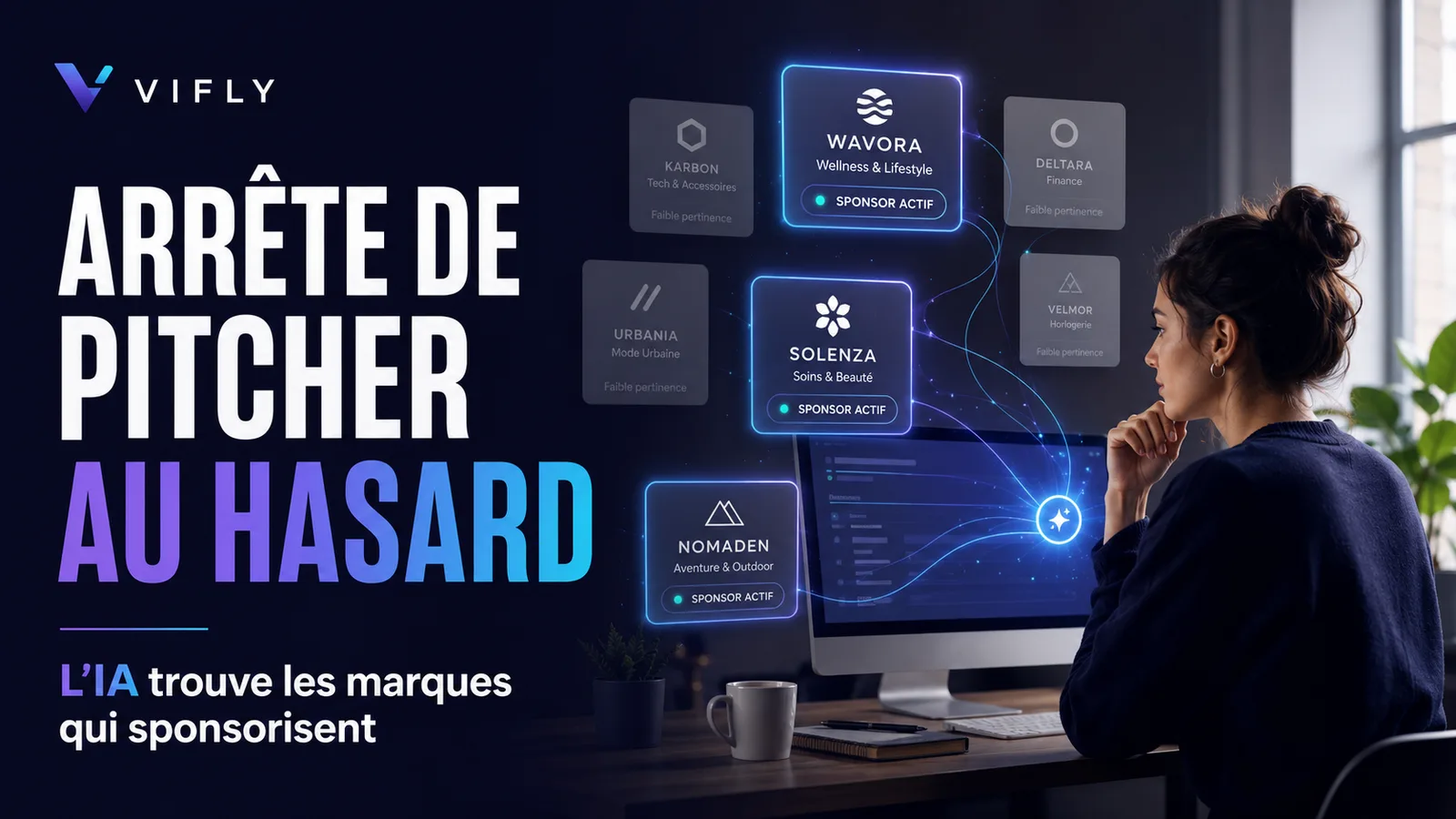
AI can now identify the brands that sponsor creators: stop cold-calling at random
You’ve put together your media kit. Your profile is in order. Your content is starting to perform well.
You’re now looking to secure paid collaborations.
And this is usually the point at which many designers make the same mistake:
they start contacting brands almost at random.
A list of 100 companies. A copy-and-paste email. A few Instagram DMs.
Then there’s a long silence. The problem isn’t necessarily the number of followers you have.
You may simply be contacting companies that currently have no intention of investing in creators.
A new generation of tools is just beginning to tackle this problem. On 27 August 2026, CreatorsJet announced an AI-powered system capable of analysing public content to identify brands already associated with sponsored or affiliate content, and then enabling creators to research these companies before approaching them. Yahoo Finance
The strategic implication is far more interesting than the technical innovation:
creator prospecting can start to function just like proper sales prospecting.
We’re no longer just asking, ‘Which brands fit my niche?’
We’re looking for:
‘Which brands fit my niche AND have already shown that they’re open to this sort of partnership?’
And this difference can save you a great deal of time.
What’s changed recently in the search for sponsors
Until now, CreatorsJet had mainly focused on media kits and the commercial management of creators.
His new tool adds a layer of sponsorship discovery.
According to the press release published on 27 August, its system uses AI to analyse public content and detect, in particular:
- sponsored partnerships
- collaborations with brands
- affiliate operations
The creator can then search for businesses and view their recent activity with other creators before deciding whether to contact them. Yahoo Finance
CreatorsJet also claims to have more than 16,000 creators which now uses its platform for media kits and collaborations. This figure comes directly from the company and should therefore be regarded as self-reported data. Yahoo Finance
The real change isn’t AI
The most important thing is not:
“A new tool uses artificial intelligence.”
We’ve moved beyond that stage. The change is actually:
the search for creators is starting to be based on signals.
This is exactly how a B2B sales representative already works. They do not necessarily contact every existing business.
It looks for signals such as:
- recruitment
- growth
- new investment
- new product
- change of tool
- recent activity
For a developer, the code might look like this:
“This brand already pays designers like me.”
Why sending out 100 random pitches doesn’t work
Let’s take a content creator specialising in fitness. They’re compiling a list of 100 brands:
- clothing
- drinks
- additions
- applications
- gyms
- accessories
He then sends more or less the same message:
Hello, I’m a fitness creator and I’d love to collaborate with your brand.
The message isn’t a disaster. But several problems have arisen.
Some brands may not purchase any designer partnerships
Your proposal may well be excellent. It’s simply being submitted to a company whose marketing budget is focused elsewhere.
Some work exclusively with existing brand ambassadors
They are not currently looking for new candidates.
Some buy content without buying an audience
They might prefer UGC rather than a sponsored post.
Some women are specifically looking for someone like you
But you’re using the same message as for the other 99. That’s probably the biggest missed opportunity.
The quality of a pitch depends very much on what you know before you send it.
The best sign: a brand is already working with creators in your niche
Let’s now consider another approach.
You discover that a software brand has recently sponsored:
- a LinkedIn consultant
- a designer specialising in productivity
- a trainer for freelancers
You yourself are a pioneer in productivity for freelancers. This information changes your message.
You no longer say:
“Hello, I’d like to collaborate.”
You can start by:
“I’ve seen your latest collaborations on productivity for the self-employed. My audience consists precisely of freelancers and consultants, and I have an idea for a complementary format focusing on…”
You now have:
context + relevance + proposal.
The prospect immediately understands why you are contacting them.
AI is gradually transforming both sides of the market
What is particularly interesting is that automation isn’t just for creators looking for brands.
Brands, too, are increasingly using AI to find creators.
YouTube has made it official with Creator Partnerships, the successor to BrandConnect.
The platform states that it uses Gemini to help advertisers identify profiles that match a campaign. YouTube claims to have more than 3 million creators have joined the YouTube Partner Programme within its search environment and plans to utilise signals such as:
- audience similarity
- organic brand mentions
- subscriber growth
- campaign identity. blog.youtube
YouTube also states that creators who have chosen to share more channel data with advertisers have been 60 % more often displayed in search results in its U.S. data from October to December 2025. blog.youtube
Attention: this is a YouTube data on its own system, not a universal rule of marketing influence.
But the direction is clear.
Creators use the AI to find buyers. Brands use the AI to find creators.
The market environment is becoming increasingly automated. So your job is to be extremely clear on both sides.
The number of followers is no longer your only defining feature
In this new system, a profile must be easy to evaluate. A brand quickly wants to know:
Who you are
Creator lifestyle?
Consultant?
Expert IA?
Sports coach?
Photographer?
Who you're talking to
Entrepreneurs?
Parents?
Travelers?
Health professionals?
Small businesses?
What formats you produce
Facecam.
Demonstration.
UGC.
Tutorial.
Interview.
Story.
Long video.
What Your Hearing Does
Look.
Click.
Buy.
Reservation.
Sign up.
How to work with you
This is where many profiles fail.
One bio says:
DM collab
But no offer. No media kit. No professional examples. No structured contact.
Discovery exists. Commercial conversion does not exist.
Your media kit becomes the sales page for your creative business
The more the matching tools become effective, the more the moment after discovery becomes important.
A brand identifies your profile. She clicks.
Your media kit should quickly answer five questions:
Who are you?
What audience are you touching?
What results produce your content?
What formats do you propose?
How do we work together?
It's not a brochure to impress.
It's a decision-making tool.
A good media kit can include:
- positioning
- platforms
- recent statistics
- audience
- examples
- past collaborations
- proposed formats
- rates where relevant
- contact
CreatorsJet himself insists on this logic: an effective media kit must make the niche, metrics, examples and contact path immediately visible.
VIFLY also dedicated a comprehensive guide to this stage: How to create a professional creative media kit.
Effective prospecting starts with three filters
You do not need IA software to apply this method immediately.
Before contacting a company, evaluate three dimensions.
Filter 1: Compatibility
Does the product really fit your audience?
A brand can sponsor a lot of creators and remain completely useless for your community.
Filter 2: Purchase signal
Are there recent signs that it is investing in this channel?
For example:
- sponsored publications
- ambassadors
- affiliation
- uGC campaigns
- Creator Partnerships
- competition with influencers
- pages dedicated to partners
Filter 3: Angle differentient
Why you rather than someone else?
This is where the pitch has to start.
Not with:
"I have always been passionate about your brand. »
But with:
a problem or opportunity that your content can solve.
How to find brands that are already investing in designers
Even without a specialized tool, you can build your own watch.
Search for commercials
On Instagram, TikTok, YouTube or LinkedIn, search:
- brand name + collaboration
- brand name + partner
- brand name + sponsor
- brand name + affiliation
- brand name + UGC
Analyze creators close to your positioning
Look at recent partnerships of five to ten profiles comparable to yours. Not just the huge accounts.
Profiles having:
- a close audience
- a similar niche
- a similar region
are often much more informative.
Watch active ads
A company currently spending on creator-produced content can be much more interesting than a company that has been inactive for twelve months.
Notice the recurrence
An ad hoc collaboration does not have the same meaning as a brand working with fifteen different creators in three months.
The more the signal is repeated, the more interesting it becomes.
Under no circumstances should you copy another creator’s partnerships
There is a fundamental difference between:
using a partnership as a signal
and
copy a competitor's strategy.
If a designer specializing in vegan cooking works with a household appliance brand, it may mean that the brand invests in creators.
This does not mean:
"I have to make exactly the same video. »
Your goal is to discover:
a commercial opportunity.
Then bring your own idea.
This is precisely what prevents creative campaigns from becoming a succession of clones.
A pitch should now resemble a proposal rather than a job application
Many creative emails still look like:
"Hello, here are my statistics. Would you be interested in a collaboration? »
The problem?
You ask the brand to do almost all the work.
She must imagine:
- format
- the concept
- the hearing
- objective
- the campaign
Reverse logic.
A more striking example
"I saw your recent collaborations around the organization of the independents. My audience is composed mainly of freelancers and consultants. I offer you a video facecam 3 tasks that I stopped handling manually, with your integrated solution in the second case of use. »
The brand already sees the content. Your proposal becomes concrete.
Use AI to prepare your pitch, not to send 500 generic messages
It's probably the best use of AI here. Suppose you identified a mark.
You can give your assistant IA:
- your positioning
- your audience
- recent brand content
- collaborations observed
- your formats
- some examples of your performance
Then ask:
"Give me three angles of collaboration specific to this brand and explain why each fits my audience. »
Then:
"Challenge these proposals from the point of view of the brand marketing manager. »
Then:
"Remove any too generic angle. »
This method is totally different from:
"Write me 100 prospecting emails. »
VIFLY AI can be used in this logic of assistance: research, structuring, comparison and criticism rather than automated production without context.
You also need to make it easy for brands to find you
The trend works in both directions. An intelligent creator prospect.
But he also prepares the inbound:
the possibility that a brand will discover it itself.
YouTube recommends, for example, that eligible creators activate channel insights sharing to provide more context for advertisers looking for partners. The creators remain discoverable even without this sharing, but the additional information can enrich their profile with the brands. Google Help
In France, YouTube Creator Partnerships is currently available to eligible creators, subject in particular to being a major YPP member and without active warning to the Community Guidelines. Google Help
This principle goes beyond YouTube:
the clearer your activity, the easier it is for a potential buyer to qualify you.
Your LinkHub should be designed as a professional page
The link in your bio should not look like a drawer full of links. He's got to steer.
For a creator seeking partnerships, a VIFLY LinkHub can, for example, organize:
Work with me
View my media kit
My best content
My UGC offers
My collaborations
Contact me
Then only your different networks. Why?
Because when a brand arrives on your profile, its question is not:
"Where's his TikTok? »
She probably already found it.
His question is:
"How can I work with this person? »
The LinkHub must answer this question immediately.
For a consultant, the “sponsor” may also be a client
This strategy is not just about influencers. Let's take a marketing consultant.
He sees that a company:
- invests in LinkedIn
- sponsors B2B creators
- regularly publishes about a problem that he manages
They are also commercial signals.
The mechanics are exactly the same:
observe → qualify → propose.
The creator is looking for a campaign.
The consultant is looking for a mission.
In both cases, the objective is to avoid:
100 random prospects
to give priority to:
20 prospects with a visible need.
And when the person concerned wishes to take action, VIFLY Booking can reduce friction by directly transforming interest into an appointment.
An active brand isn’t automatically the right brand for you
Watch out for an obvious trap.
A platform tells you:
This company works a lot with creators.
Excellent.
But this does not answer several key questions.
Is it consistent with your values?
Is its product really useful to your audience?
Are its business practices correct?
Are his contracts balanced?
Are creators properly paid?
What rights does it demand?
What's his reputation?
The AI can detect activity.
It must not make the final decision.
A commercial signal is not a moral or contractual validation.
Please also be aware of usage rights
This week's VIFLY topics converge on an important point: collaborations are becoming more professional.
A partnership must not only specify:
"1 Reel = X €.".
We must also understand:
- organic diffusion
- advertising use
- duration
- territory
- exclusive
- whitelisting
- retail
- external display
- modification of content
A very active brand among creators may want to reuse content on a large scale.
This reuse has value.
Your pitch should therefore allow you to open a commercial discussion, not immediately lock yourself in an incomplete tariff.
The creator economy is becoming a real commercial powerhouse
Evolution is much wider than CreatorsJet.
Deloitte notes that advertisers are gradually moving from experimental logic around creators to "must-buy" logic. In its recent analysis, Deloitte cites an American creative economy advertising market estimated at 37 billion dollars in 2025, as well as its own State of Social 2025 where creators represented 24 % of the annual social media budget priority. Deloitte
Deloitte also points out that creators remain highly dependent on brand partnerships for their income and seek to diversify their business models. Deloitte
As budgets increase, the ecosystem becomes more professional.
We see:
- discovery engines
- iA matching
- scoring
- media dynamic kits
- Creative CRM
- performance measurement
- contract automation
- monitoring of campaigns
What still recently looked like:
"A brand sent a DM"
gradually becomes a real sales process B2B.
The VIFLY method: Signal → Fit → Proof → Pitch → Conversion
Instead of blind prospecting, this is the workflow I recommend.
1. Signal
Does the brand really invest in creators?
2. Fit
Does its product match your audience and your positioning?
3. Evidence
Can you show why your profile is relevant?
For example:
- performance of similar content
- corresponding hearing
- expertise
- former collaboration
- format already controlled
4. Pitch
Propose an idea.
Not just your application.
5. Conversion
Make the suite extremely simple:
- media kit
- tariff
- title
- proposal
- contract
That's exactly the logic VIFLY :
visibility → understanding → trust → action → opportunity.
Prospecting begins just a little earlier:
signal → relevance → opportunity.
Action plan: find five eligible brands today
Do not wait for a new tool to apply the method.
Step 1: Choose your main niche
One.
For example:
freelance marketing.
Step 2: Identify ten comparable creators
Look at the partnerships made in the last few months.
Step 3: Note recurring marks
Look for those appearing several times.
Step 4: Analyze their campaign
What format do they buy?
UGC?
Sponsored Reel?
Tutorial?
Test?
Affiliation?
Step 5: Find an angle you can improve
Don't reproduce.
Complete.
Step 6: Prepare your infrastructure
Before sending anything, check that your profile contains:
- a clear bio
- professional contact
- a media kit
- your best examples
- a central link
You can centralize this part with VIFLY LinkHub.
Step 7: Send five custom proposals
Five. Not fifty.
Then measure:
- answers
- media kit requests
- calls
- proposals
- contracts
You'll learn a lot faster.
Conclusion: the next advantage for creators will not be sending out more pitches, but knowing who to contact
Artificial intelligence will probably make prospecting much easier.
She can scan. Sort. Detect. Compare.
Identify that a brand has already made fifteen collaborations in your niche. But it does not solve the essential problem:
why should this brand work with you?
That's where your advantage begins.
Your expertise. Your audience. Your style. Your idea. Your ability to understand the product. Your professionalism.
The launch of new sponsorship discovery tools is therefore interesting not because it allows "to find brands automatically".
It reveals above all an evolution:
the creator economy gradually moves from hunting to opportunities to commercial qualification.
Your next step
Today, do not look for a hundred new brands.
Search five brands that already demonstrate three things :
- they actually invest in creators
- their product actually fits your audience
- you can offer them an angle that they have not yet exploited
Then prepare your profile before sending the first email. Your bio must explain your positioning.
Your LinkHub VIFLY must show your best content and media kit.
Your offer must be clear.
And if your activity is also based on delivery or advice, add a direct passage to VIFLY Booking.
Because in prospecting, the volume gives the impression of working.
Relevance creates answers.
FAQ
How to find brands that already work with creators?
You can analyze recent partnerships of profiles close to yours, search for sponsored and affiliated mentions of a brand, or use specialized tools to detect public collaborations.
Does CreatorsJet automatically find sponsors?
The new tool announced by CreatorsJet uses the AI to detect publicly visible partnerships and help creators search for active brands. This does not mean that these brands will automatically accept collaboration. Yahoo Finance
Can a small audience interest a brand?
Yes. Hearing size is only one criterion among others. The relevance of the niche, the quality of the content, the confidence of the audience and the format sought by the brand can be decisive.
What should a good pitch contain to a mark?
It must quickly show why your audience fits the product and ideally suggest a concrete angle or format. Avoid generic messages that force the advertiser to imagine the entire campaign itself.
Should his media kit be attached to the first email?
This is not mandatory, but it must be immediately available. A link to an updated media kit allows the brand to quickly evaluate your audience, content and previous collaborations.
Can we use ChatGPT to write its pitch?
Yes, especially to structure and challenge a proposal. The best method, however, is to provide real information about the brand, your audience and your idea rather than asking for a generic message.
Does YouTube also help brands find creators?
Yes. YouTube Creator Partnerships uses Gemini to improve the discovery of creators by advertisers, and functionality is available to eligible creators in several countries, including France.
Sources
CreatorsJet / GlobeNewswire , 27 august 2026. Primary reporting source of launch. It describes the analysis of public content, the detection of sponsored and affiliated partnerships, the search for brands and the declared number of 16 000 creators using the platform. Yahoo Finance
CreatorsJet — Find Sponsors — official product page dedicated to the new sponsor search feature. CreatorsJet
YouTube , 23 march 2026. Official source showing the reverse movement: Gemini helps advertisers find creators in YouTube Creator Partnerships, including audience, organic and growth signals. blog.youtube
View the YouTube Creator Partnerships announcement
YouTube Help Creator Partnerships, documentation accessed on 28 August 2026. Confirms the eligibility conditions and the current availability of the scheme for eligible creators, particularly in France. Google Help
Deloitte 2026. Source of context: Deloitte cites its State of Social Research 2025 where creators represented 24 % annual social budget media priorities and highlights the shift from creative marketing to a more structured performance logic. Deloitte
Deloitte2026 Media & Entertainment Industry Outlook. Complementary source on the economy of creators: Deloitte notes that brand partnerships account for a significant portion of creative revenues and that many seek to diversify their sources of revenue and their direct relationship to their audience.