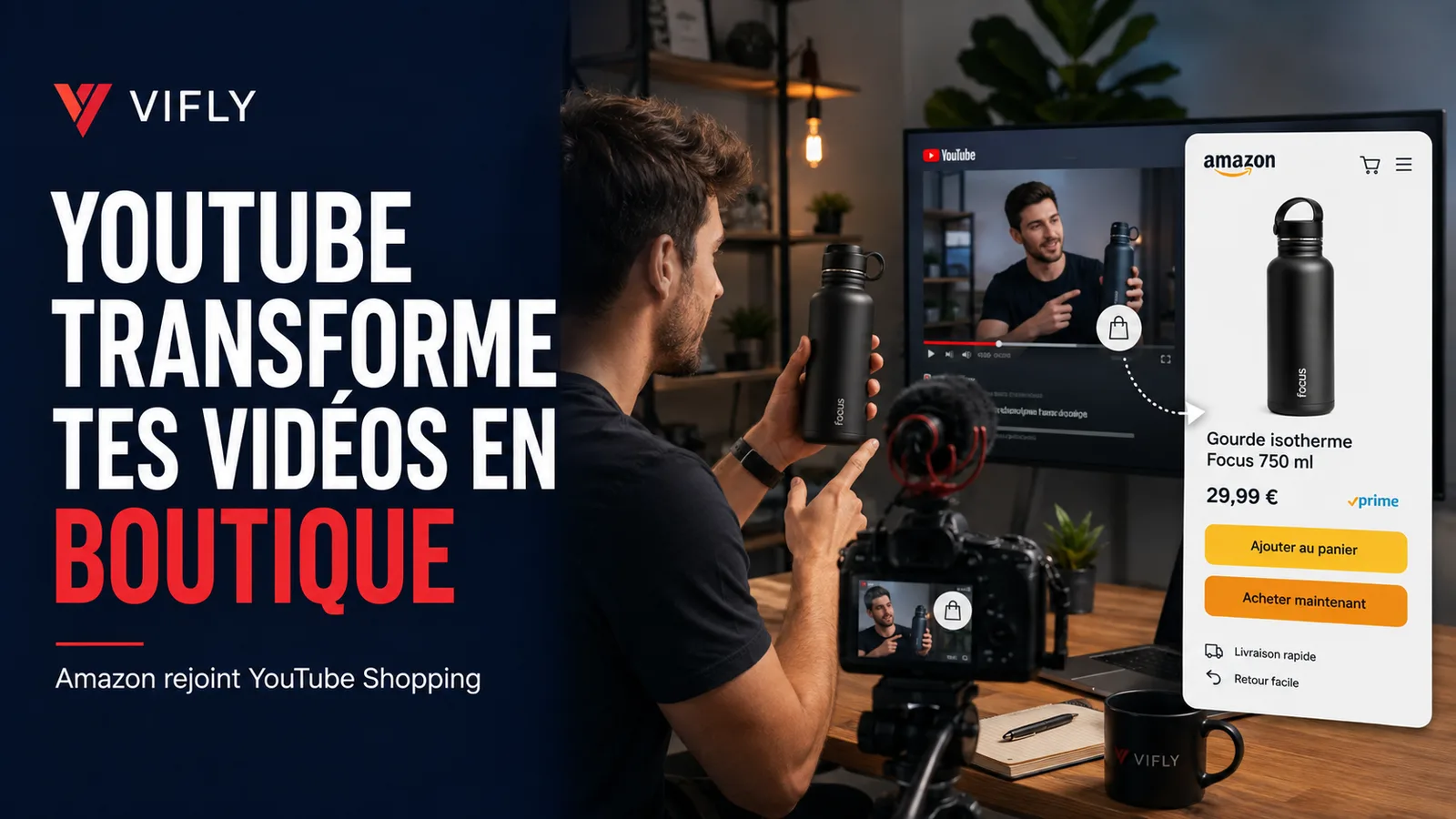
YouTube is integrating Amazon directly into videos: is the traditional affiliate link on its way out?
You’re recommending a product in a video. Your viewer is interested.
But to buy it, he still has to:
open the description, find the right link, leave YouTube, find the product, and then possibly come back to finish your video.
Every step creates a potential point of drop-off.
YouTube has, in fact, just reduced this friction.
Since 27 August 2026, Amazon is now officially part of the YouTube Shopping Affiliate Programme. Eligible US creators can now tag Amazon products directly in their Shorts, long-form videos and livestreams.
For the viewer, the product then appears directly within the YouTube experience. For the creator, this potentially means a commission when an eligible purchase is made.
But the real evolution goes far beyond Amazon.
YouTube is gradually transforming video into a commercial interface.
And for all creators, even those who are not yet eligible in France, this is a very important sign of the direction the creator economy is taking.
Amazon officially joins YouTube Shopping
YouTube announced the partnership on 27 August 2026.
American creators eligible for the programme can now link their Amazon Influencer Programme or Amazon Associates account and tag Amazon products directly within their content.
The system applies to:
- Shorts
- long videos
- live streams
This allows the viewer to view a recommended product without having to manually search for the relevant link in a description.
Creators must meet several conditions
For this specific Amazon integration, YouTube requires, amongst other things:
- to be a member of the YouTube Partner Programme
- be enrolled in the YouTube Shopping Affiliate Programme in the United States
- have an active and valid Amazon Influencer Programme or Amazon Associates account
- to link their YouTube channel to the relevant Amazon account
In other words:
No retailer can simply start tagging Amazon products.
And in France?
This is where you need to be extremely precise.
At 31 August 2026, the official YouTube documentation regarding its Shopping affiliate programme for third-party products lists, amongst other things:
- United States
- Argentina
- Brazil
- India
- Indonesia
- Japan
- Korea
- Malaysia
- Mexico
- Philippines
- Singapore
- Taiwan
- Thailand
- Vietnam
France does not currently appear on this list.
This means that a French designer should not read the advert as:
“I can now link Amazon.fr to my channel and earn commissions via YouTube Shopping.”
That’s not what YouTube is announcing today.
However, the tags can still be viewed outside the United States
YouTube states that a product tagged by a US-based creator may be visible internationally.
The platform may sometimes automatically link the product to an offer from a local retailer to enable a purchase in the viewer’s country. If no match is found, the link may redirect to Amazon US or to a local Amazon shop, depending on the context.
It’s an interesting mechanism:
The creator may be American, but the intention to buy may be international.
Why this development is far more significant than a simple Amazon partnership
At first glance, the advert could be summarised as follows:
“YouTube adds Amazon to its affiliate programme.”
But that would be missing the point. For several years now, YouTube has been seeking to bring together four stages:
discovery → trust → recommendation → purchase.
Traditionally, these steps were spread across several platforms.
You were watching a video. Then you opened Google. Then Amazon. Then, eventually, a price comparison site.
YouTube is gradually trying to keep more of this journey within its own ecosystem.
The content is gradually becoming an invisible shop
The word ‘shop’ can be misleading.
Obviously, the video shouldn’t look like a thirty-minute product listing. The most powerful experience is precisely one where the purchase is seamlessly integrated into the content.
For example:
“This is the microphone I’ve been using for the past six months.”
The viewer can view the product straight away.
Or:
“Here are the three lights I use in my studio.”
Each entry can be tagged.
Or alternatively:
“I’m testing five coffee machines to see which one is really worth the money.”
The content remains a comparison.
But every commercial intention can now be identified much more easily.
YouTube claims that product tags generate far more clicks than links in the description
In an internal trial conducted from 14 to 29 July 2026, YouTube states that videos using only YouTube Shopping tags have generated more 110 %] additional product clicks relative to the use of links only described.
This data must be interpreted correctly.
These are:
- of an internal YouTube experiment
- for a limited period
- in its own environment
So it's not:
"add tags will multiply your sales by two".
YouTube talks about clicks on products, not automatically sales. But the result illustrates something logical:
the shorter the path to action, the greater the chances of interaction.
And this rule goes well beyond YouTube.
The problem for creators is often not visibility: it’s the friction that follows visibility
Imagine a video that generates:
100,000 views.
The creator mentions:
"The link is in my bio. »
The viewer must then:
- open profile
- search the link
- open a page
- find the product
- click
- buy
Each step eliminates people.
Now let's imagine:
video → product directly accessible.
The route is shorter. This is exactly what YouTube is trying to optimize.
And this logic should be applied to all creative activities.
A coach should think in exactly the same way
The product sold may not be a camera. This can be a consultation.
One person looks at your Reel:
"Here are three signs that your LinkedIn strategy attracts views but no prospect. »
She realizes that she has exactly this problem.
What should she do next?
If your system is:
"Send me STRATEGY in DM."
later:
"Hello, yes I am interested. »
later:
"Here are my rates. »
later:
"What are your availabilities? »
you've recreated a lot of friction. The product is no different in its commercial logic.
The best experience could be:
content → profile → service → niche → booking.
This is precisely the type of route that a system like VIFLY Booking can be simplified.
Creative commerce is built first and foremost on trust
YouTube itself formulates its announcement around an interesting principle:
the spectators buy the products they like to the creators they trust.
This is the economic basis of affiliation. A single link has almost no value.
What creates the sale is usually:
- the experience
- demonstration
- comparison
- context
- credibility
- trust
In other words:
the link doesn't sell. The content located before the link sells.
Why creators should avoid turning every video into a catalogue
The new model obviously has a risk. If each visible object becomes:
"Buy Here"
confidence gradually disappears.
Let's take a tech chain. She's testing a smartphone. Then a computer. Then a microphone.
If each conclusion looks like:
" That's great, affiliate link below! »
in the end, the audience asks:
is the product recommended because it is good, or because it generates a commission?
The affiliation therefore works much better when the creator retains the ability to say:
" This product is not suitable for everyone. »
Or:
" For this budget, I prefer the following alternative. »
Credibility builds long-term conversion.
YouTube Shopping now allows you to monetise much earlier
Another important development has passed relatively discreetly this year.
In March 2026, YouTube lowered access to its Shopping Affiliate program to allow creators eligible for the expanded YPP to participate as soon as possible 500 subscribers, subject to compliance with the conditions of the programme and to be based in an eligible country.
It's a change of philosophy. Affiliation is no longer solely thought of for huge chains.
A small, highly specialized audience can be extremely profitable
Let's take a chain:
4 000 subscribers.
Subject:
silver photography.
His audience regularly buys:
- film
- objectives
- scanners
- bags
- accessories
This small audience has an extremely clear commercial intent. Compare with an entertainment channel:
200,000 subscribers.
But almost no natural relationship with a specific product. The number of subscribers is therefore only one dimension.
The second is:
the commercial relevance of the hearing.
Shorts, long-form videos and live streams do not serve the same commercial purpose
Amazon's arrival on all three formats is particularly interesting.
Shorts : discovery
A Short can show:
" This small accessory to 20 € solves this problem. »
The product is immediately accessible. The behavior is impulsive and fast.
Long video: conviction
A fifteen-minute video allows you to:
- test
- comparison
- context
- demo
- objections
The product can generate more confidence.
Live: decision in real time
The live adds:
- questions
- demonstrations
- immediate objections
- interactions
The creator can answer:
"Is it compatible with such a device? »
Then the viewer can immediately consult the tagged product.
The combination of the three formats gradually transforms YouTube into editorial business machine.
Above all, Amazon brings a vast catalogue to YouTube
YouTube Shopping already had many brands and merchants. But Amazon has an obvious advantage:
the depth of its catalogue.
A creator can talk about:
- tech
- books
- kitchen
- fitness
- house
- accessories
- beauty
- photo
- gaming
- office
- diy
It therefore becomes much more likely that the product naturally mentioned in a video is also available in the system.
YouTube, however, specifies that Amazon provides a selected catalogue popular and sought after products. All Amazon products are therefore not necessarily available automatically.
YouTube can even automatically tag certain products
Another interesting detail.
If the creator activates auto-taging, YouTube indicates that its systems can review recent videos in order to identify certain eligible Amazon products and tag them automatically.
This shows how far the platform wants to reduce friction.
Before:
film → find product → copy URL → generate affiliation → paste link.
Tomorrow:
film → recognized product → proposed tag.
The creator intervenes mainly to verify.
Affiliate marketing should become a layer of the content, not its sole purpose
A common mistake is from the commission.
" This product pays 12 %, make a video. »
The logic should generally be reversed.
Audience problem → useful content → relevant product → possible affiliation.
Why?
Because the commission can change.
The program can close.
The product may disappear.
Trust must stay.
Example
Wrong angle:
"10 Amazon products that you absolutely must buy. »
Better angle:
"I'm doing my setup facecam again with less 200 €: here's what really changes the quality and what's useless. »
Then the really useful products are tagged. Content has a value even if no one buys.
It's an excellent test.
France: what should creators do now?
The right reaction is not:
"Unfortunately, it's not available, so I'm not doing anything. »
The right response is to prepare the infrastructure.
1. Work with natural commercial content
Tests. Comparisons. Tutorials. Setup.
"What I'm using.".
Practical cases.
2. Measure your clicks already
Even with a classic affiliation, observe:
- content
- clicks
- conversion
- income
3. Create your own recommendation architecture
A platform should never be your only channel.
You can use a VIFLY LinkHub to centralize:
- recommended products
- content
- offers
- affiliation
- social media
- resources
The principle is exactly the same as YouTube Shopping:
reduce the number of steps between interest and action.
The creator economy is evolving into a “performance economy”
For a long time, a creative campaign was measured mainly with:
- views
- likes
- scope
- engagement
Trade integration adds another metric:
sale.
The creator can gradually be paid:
- for its content
- for its scope
- committee
- for sales
- for a combination of several models
It's much closer to a real business media.
Affiliation and sponsorship are not the same thing
This is important.
Sponsoring
The brand usually pays the creator to produce or disseminate content. Payment may exist even if no sale is made.
Membership
The creator usually receives a commission related to a share or sale. Its income therefore depends more on the result.
Hybrid model
The combination can be very interesting:
fee fixed + commission.
The creator is paid for:
- his work
- production
- its distribution
then rewarded in addition when the campaign converts. Creators must therefore learn to distinguish their different sources of value.
VIFLY Partner responds to the same independent creative side logic
This evolution YouTube/Amazon reminds something very interesting for creators who sell their own products, training or content.
Affiliate is not reserved for e-commerce giants.
A creator may also allow other people to recommend their offers in exchange for a commission.
This is precisely the logic of a program like VIFLY Partner : turning partners into sales providers rather than relying solely on its own audience.
The strategic difference is important.
With Amazon:
you recommend someone else's product.
With your own affiliate program:
other people recommend your product.
Both use the same economic mechanism:
trust → recommendation → conversion → commission.
An audience becomes much more valuable when it can generate multiple sources of revenue
The modern creator can gradually combine:
Platform advertising
YouTube Ads.
Sponsoring
Marks.
Membership
Third party products.
Own products
Training, guide, resource.
Services
Coaching, consulting, performance.
Subscription
Recurrent content.
Booking
Consultation or appointment.
The danger is to depend entirely on one of these levers. The robust strategy is to create several consistent sources.
The real challenge is always what comes after the content
You may have:
100,000 views.
Then no action.
Or:
10 000 views.
500 clicks.
80 prospects.
10 sales.
Which content actually has the most value for your creator business?
The answer obviously depends on your objective. But for a professional, VIFLY logic remains particularly useful:
visibility → understanding → trust → action → opportunity.
YouTube Shopping simply brings the last two steps closer together.
How to adapt your LinkHub to this new e-commerce approach
Your bio link should start by answering a question:
what does the person probably want to do after seeing my contents?
If your hearing comes for recommendations:
My favorite tools
My equipment
My resources
If you sell:
Discover my offers
If you propose appointments:
Book with me
If you are a professional creator:
Work with me
A VIFLY LinkHub can bring together these different paths.
The goal is not to present twenty buttons.
The aim is to reduce hesitation.
Booking applies exactly the same principle to the sale of services
Amazon + YouTube reduced:
video → product → purchase.
For a consultant, the equivalent is:
content → performance → booking.
With VIFLY Booking, a professional can directly turn interest into an appointment rather than multiply manual exchanges.
The commercial logic is the same:
remove steps that do not add any value.
Using AI to select products rather than spamming links
It can also help in this strategy.
Not to automatically generate a hundred Amazon videos.
But to analyze:
- your best content
- recurring issues
- products already mentioned
- the problems of your audience
For example, you can use VIFLY AI with a question like:
"Here are my 20 top-performing videos and their comments. Identify issues for which my audience regularly requests a tool or product. »
Then:
"Classifies these opportunities according to their natural relevance, without seeking to force a commercial recommendation. »
You're leaving the application.
Not the commission.
The risk: turning creators into permanent teleshopping presenters
YouTube Shopping is a great opportunity. But it has an obvious limit.
When each video becomes:
DOWNLOAD
the user eventually resists.
The sustainable model remains:
content first, then trade.
An excellent recommendation can perfectly generate sales for months.
A trusted catalogue may sell nothing at all.
Trust is therefore becoming the main currency of creator commerce
This is probably the most important conclusion.
YouTube has the technology. Amazon owns the products.
But the creator has something that neither company can automatically manufacture:
a relationship with his audience.
If this hearing believes your judgment, a recommendation has value. If it believes that each opinion depends on the commission rate, this value collapses.
Monetization therefore becomes paradoxical.
To sell more in the longer term, you may need:
recommend less.
But better.
Conclusion: YouTube doesn’t simply turn videos into shops; it turns trust into a commercial infrastructure
Amazon's arrival in YouTube Shopping may seem to be a small feature reserved for American creators.
In the short term, for a French creator, it is indeed an important limitation.
You cannot yet use this Amazon partnership as an eligible American creator.
But looking only at geographical availability would miss the strategic signal.
YouTube invests in a future where:
look → understand → trust → buy
takes place almost without rupture.
And when platforms remove friction, creators must do exactly the same in their own business.
Your next step
Take today your 10 Top Performance Content.
For each, ask:
1. What intention exists behind this video?
Learn?
Buy?
Reserve?
Compare?
2. What is the next logical action?
Product?
Guide?
Service?
Reservation?
3. How many steps currently separate the viewer from this action?
Then delete at least one.
If you recommend multiple resources, centralize them with your VIFLY LinkHub.
If you sell a service, create a direct path to VIFLY Booking.
If you sell your own content or services, also consider how to other people could recommend them via an affiliate program.
Because the creator trade does not ultimately consist of linking everywhere. It consists of building the most natural path between:
"i trust you"
and
"i take action.".
FAQ
Is Amazon now available in YouTube Shopping?
Yes, since 27 August 2026] for the eligible american creators with an active Amazon Influencer or Amazon Associates account.
Can we tag Amazon products in a Short?
Yes. YouTube says Amazon products can be tagged in Shorts, long videos and livestreams for eligible American creators.
Is YouTube Shopping Affiliate available in France?
France is not currently included in the official list of countries eligible for the programme allowing creators to promote products from other brands.
How many subscribers do you need for YouTube Shopping?
Since March 2026, YouTube has extended access to the program to creators eligible for the expanded YPP from 500 subscribers, subject to compliance with the other criteria and being situated in an eligible country.
Can YouTube automatically tag products?
Yes, for some creators and products when self-tagging is activated. YouTube can analyze some recent content and associate eligible Amazon products.
Do product tags increase sales?
YouTube reports an internal experience showing more clicks produced with tags than with description links alone. However, this does not guarantee more sales or income for each creator.
SOURCES
YouTube Official Blog : , 27 august 2026. Primary source. Confirms Amazon's official integration into the program and its use in Shorts, long videos and livestreams for eligible American creators.
Read the official YouTube announcement
TeamYouTube : , 27 august 2026. Official operational documentation: Amazon connection, catalog, auto-taging, payments, returns, international visibility and internal experimentation showing more 110 %] additional product clicks compared to description links only.
YouTube Help : 31 august 2026. Official reference for eligible countries. France currently does not appear in the YouTube Shopping affiliate program list for products from other brands.
YouTube Official Blog : 500+ subscribers, 25 march 2026. Official source of context regarding the opening of the program to eligible creators of the expanded YPP from 500 subscribers.
YouTube Help: . Official documentation on product display, integration with videos and tracking of Shopping performance in YouTube Studio.