
Imagine you're on an illustrator's account. His videos show very well his way of drawing. You have a project in mind, but you don't know if she works for companies, if she accepts orders and where to write to her. A good audit report makes this problem visible and indicates what to change first.
Here is a fictitious example that you can adapt to your account. The data are invented to show the method.
Page 1 of the report — Objective and starting figures
Nora creates illustrations for training materials. She wants to receive requests for quotations that specify the support, subject and date desired. On 30 days of the example, his account shows 240 profile visits, 12 clicks to his portfolio and two qualified requests received through his contact channels.
These figures give three measurement points. The ratio of clicks reported to profile visits is 5 %. The origin of both applications is unknown in this example. To better understand the route, Nora can ask how the new prospects discovered and identify the provenance they indicate.
Page 2 of the Report — Three Observations Related to a Decision
| What the visitor sees | What Nora verifies | Proposed decision |
|---|---|---|
| The bio displays "Illustrations and Creative Projects". | Can someone who finds out who Nora works for? | Name training materials and target audience. |
| The pinned publications show his drawings, with little context. | Does a demonstration show an illustration used in a medium? | Pin a training module for the demonstration. |
| The link opens a portfolio with various styles. | Does the first screen allow you to understand the offer and contact Nora? | Include two relevant examples and a request button. |
Page 3 of the report — Ready-to-use correction
Bio example
I'll illustrate your training materials.
Diagrams, characters and practical cases.
See two examples and ask for a quote
Title of pinned publication
How I illustrate a training step, from the brief to the final diagram.
Priority button of the bio link
Present my illustration project.
Ask someone who doesn't know what you're proposing to open your profile on the phone. Let him describe out loud what he thinks you're selling and click where he's making a request. Note the first hesitation. This observation helps choose the first change.
Page 4 of the report — The plan for the next thirty days
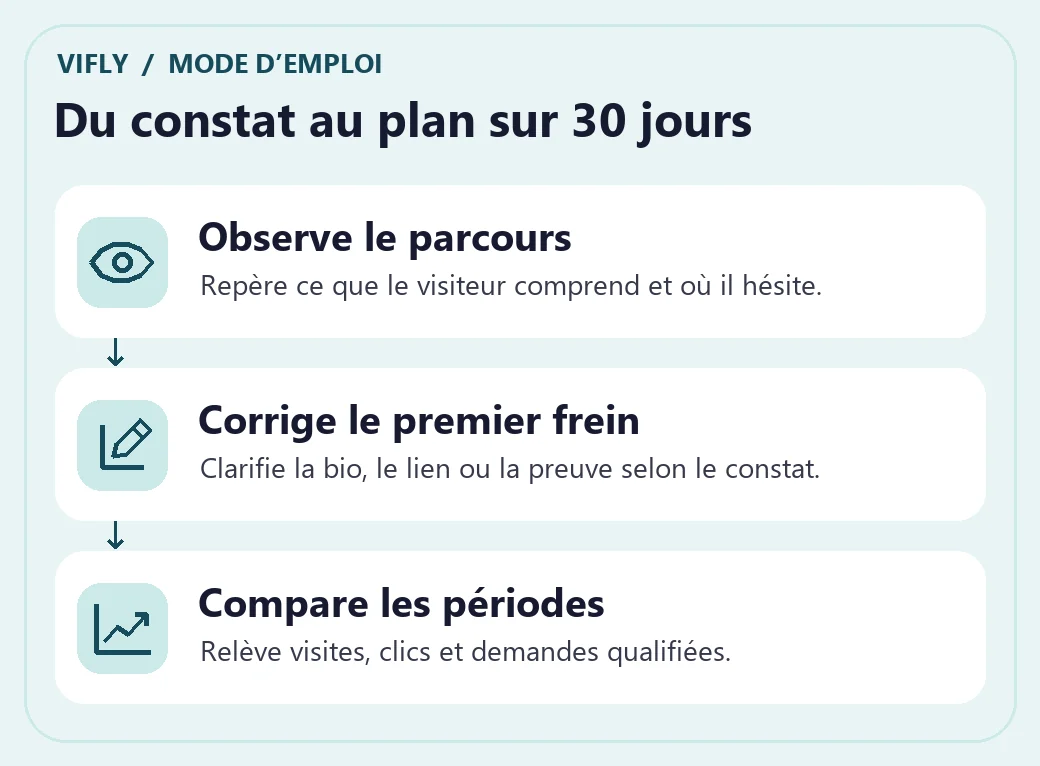
Week 1. Update the bio and main button. Saves the date of the change and records the number of profile visits and clicks to the offer.
Week 2. Adds a pinned publication that shows the work in context. Clearly identifies an example created for the demonstration.
Weeks 3 and 4. Observe what visitors are asking for and what information is still missing. Maintains a stable definition of qualified demand, such as a message that specifies the medium, subject and desired date. Compares periods of the same duration and identifies events that may have caused traffic to vary, such as a widely distributed campaign or publication.
The frame to copy for your profile
| Note | Your answer |
|---|---|
| An action that the visitor must be able to do | … |
| An obstacle found by testing the course | … |
| A capture or a digit that documents the obstacle | … |
| The first modification you're going to try | … |
| An indicator and a date to repeat the point | … |
You can prepare your diagnosis with the Instagram audit guide, then ask for an outside look if you want to have your profile reviewed and clarify the next priorities. Do your Instagram audit with theIA · See VIFLY audit deliverables (in French)