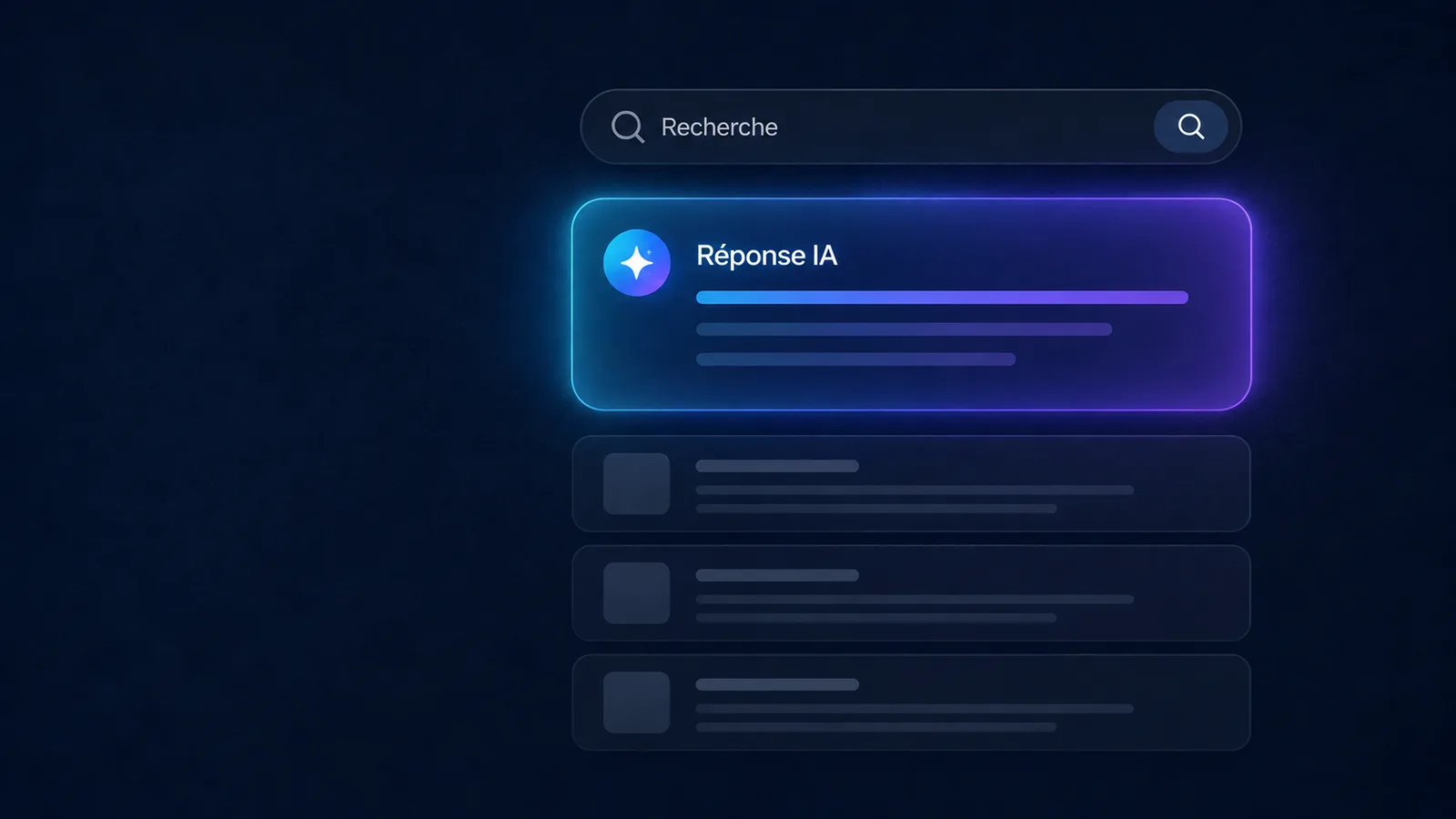
Google’s AI-powered answers: what will really change for your visibility in 2026
Since 22 July 2026, some French users have been seeing an answer generated directly by artificial intelligence displayed above the usual links. A conversational tab, ‘AI Mode’, is also starting to appear on certain searches. In practical terms, some internet users no longer need to click on a website to get their answer.
If you’re a content creator, coach, consultant or freelancer, you’ve probably noticed something odd over the last few weeks: your Google ranking hasn’t changed, but your traffic seems a little lower than before. It’s not necessarily just in your head.
The story received widespread coverage in the French press in early August, notably by Le Monde, which reports that several SEO professionals are already seeing a drop in clicks in certain markets, even though Google disputes the idea of a general decline in traffic to websites.
This article isn’t intended to alarm you unnecessarily. It aims to explain clearly what’s happening, what remains true in SEO, and what you can do today to stay visible not only on Google, but also in the AI-generated responses that your future customers are already using.
What has actually changed since 22 July
Google is gradually rolling out two features in France: AI Overviews, AI-generated summaries that appear at the top of certain results pages, and AI Mode, a tab that transforms a standard search into a conversation with an AI.
These features do not apply to all searches. They tend to appear mainly in informational queries – such as questions, definitions and comparisons – rather than in highly commercial or very local searches.
The principle is simple to understand: if the AI can summarise the answer directly from several sources, the user no longer systematically needs to visit a website to obtain it. This does not eliminate the need to click, but it does reduce the number of situations where a click is necessary.
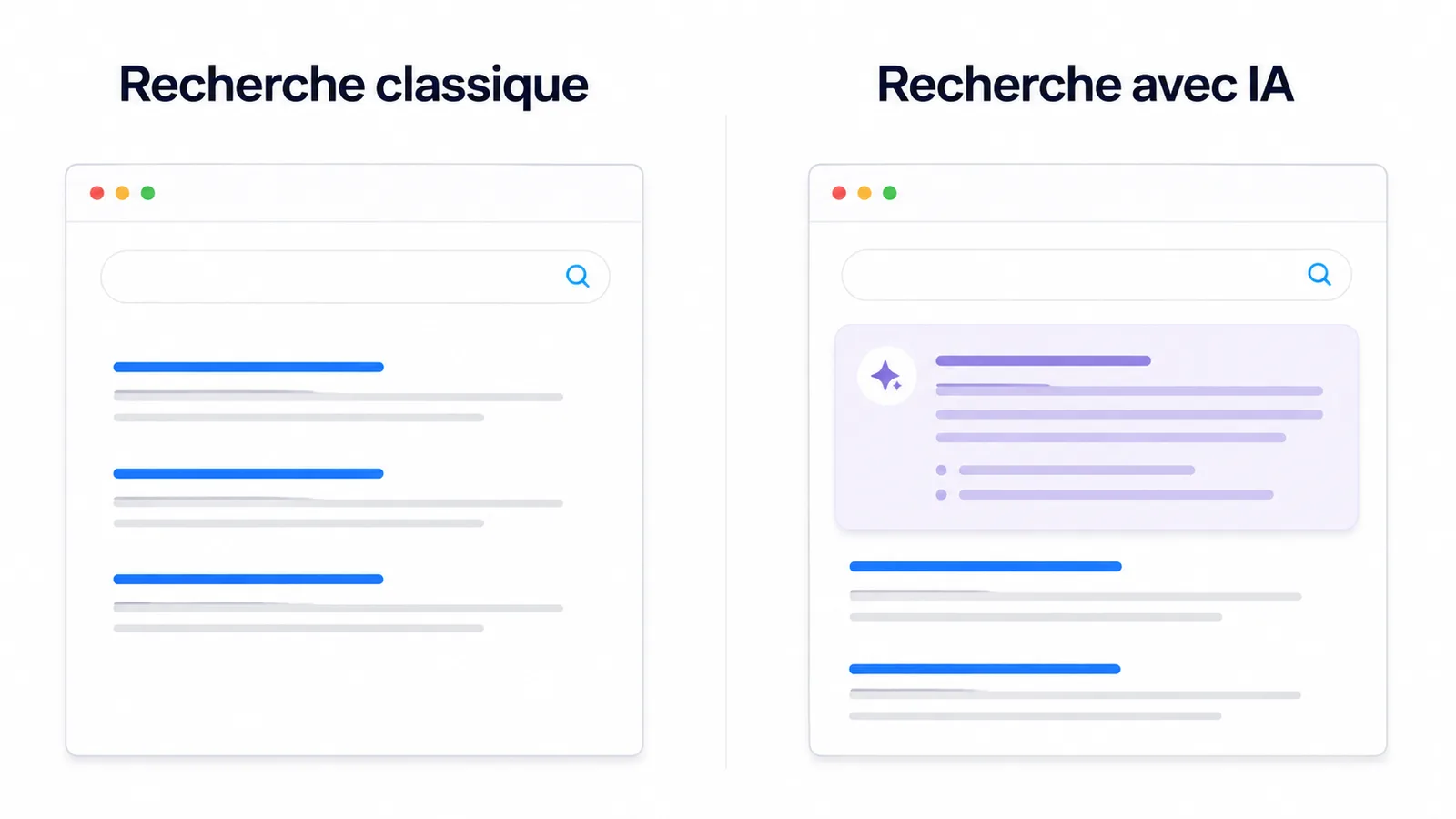
Why this is a cause for concern amongst SEO professionals
The question on everyone’s mind is simple: if AI responds on the website’s behalf, who’s going to click anymore?
The reality is more nuanced. Google claims that the overall volume of traffic sent to the web remains stable, arguing that users are asking more questions and carrying out more searches than before. However, some industry professionals have observed a decline in click-through rates for specific queries, particularly informational ones, although this does not necessarily represent a uniform trend across all sectors.
The key point to remember is that the situation varies greatly depending on the type of search query, the sector and the nature of the content. A website that answers very general questions is more vulnerable than one that offers content requiring a deeper understanding – such as a product, a service or specialist expertise.
Key points: A drop in traffic for an informational query does not mean that your creator business is losing value. It means that Google is providing a superficial answer, but that the person with a genuine need (to book a coaching session, purchase a training course, make an appointment) continues to search for a solution beyond the general answer.
From SEO to GEO: what are we actually talking about?
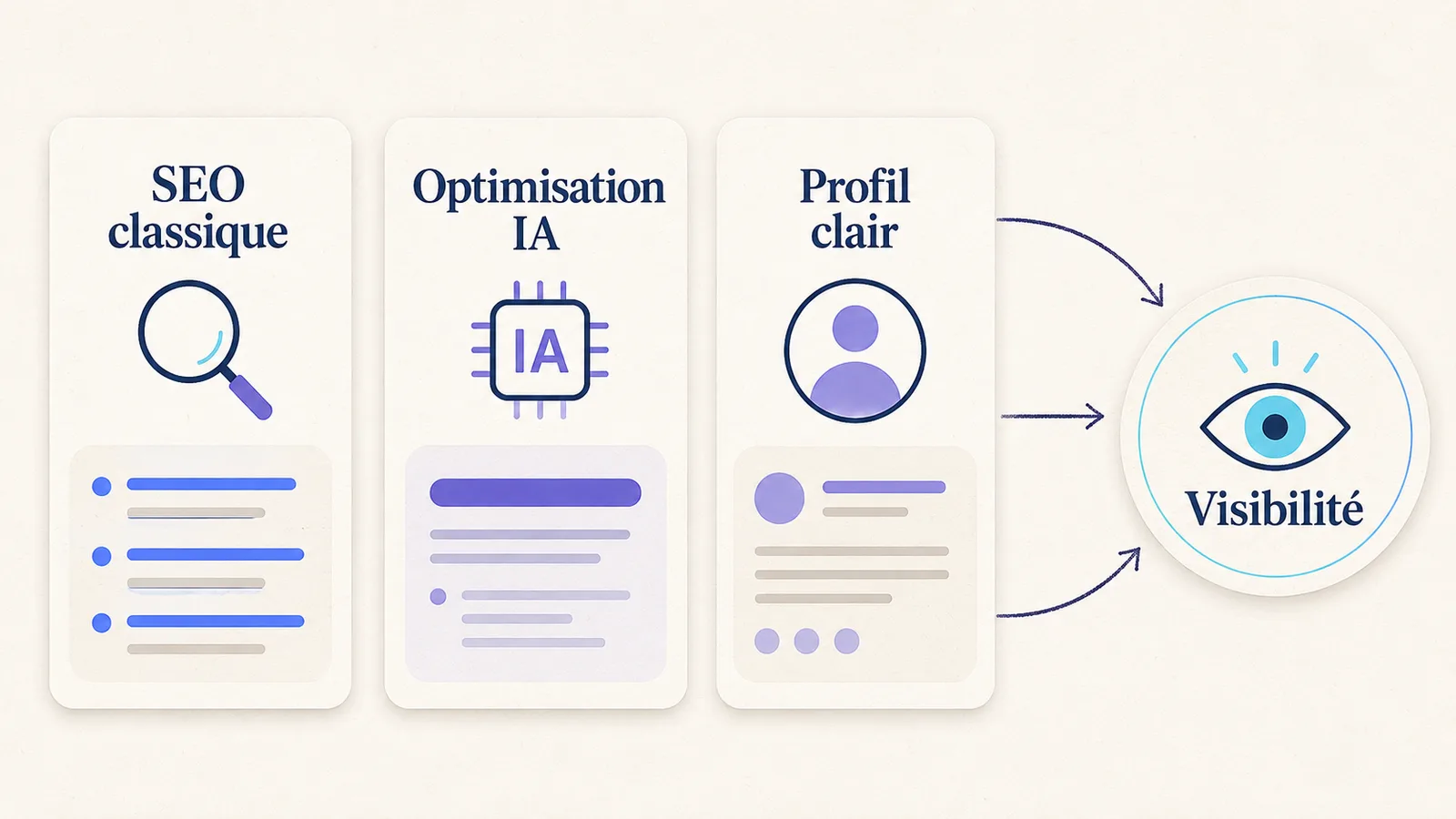
The term GEO (Generative Engine Optimisation) refers to the set of practices aimed at making content identifiable and citable by generative AIs such as Google AI, ChatGPT, Gemini and Claude, rather than simply ensuring it ranks highly in a list of traditional links.
It is important not to turn GEO into some sort of magic discipline. At present, there is no official guarantee of appearing in an AI response, nor is there a certified method for ‘forcing’ a citation. This is confirmed by the recommendations of Google Search Central The basics remain the same: producing useful, reliable content, written for people, backed by genuine expertise.
GEO is not a substitute for SEO. It is based on the same fundamentals, with an added focus on clarity, structure and the accuracy of the information.
What this actually means for you
Let’s look at three different profiles to understand the real impact.
The coach or consultant
who has written a generic article on ‘how to manage stress before an interview’ may find their answer summarised by the AI without anyone visiting their website. On the other hand, if they offer content that goes beyond the basic answer – such as a personal method, examples drawn from their own experience, or a link to a clear coaching offer – someone looking for a real solution will continue to search beyond the summary.
The trainer
which publishes purely informative and interchangeable content (definitions, generic lists) is more vulnerable than one that documents its expertise with real-life examples, feedback or original data drawn from its own business activities.
The freelancer or the entrepreneur
who do not have a blog but rely solely on social media are not directly affected by AI Overviews, but are still affected by the broader issue of discoverability: do their name, expertise and offering appear clearly when someone is searching for a solution in their field?
The most common mistake when dealing with this change
Common mistake : Many creators believe that the solution lies in writing ‘for AI’ by using lots of short definitions and formatted sentences. This is a red herring. Generative AI systems prioritise citing sources deemed reliable and authoritative, not artificially optimised content.
Writing for an algorithm rather than for a reader has, historically, been a strategy that ultimately backfires on the author.
The best approach is still to produce content that genuinely answers a question, with a clear structure, concrete examples and recognisable expertise.
This is exactly what Google has been recommending for several years in its guidelines on ‘helpful content’, and the advent of generative AI does nothing to call this principle into question.
What you can do right now, without changing your strategy overnight
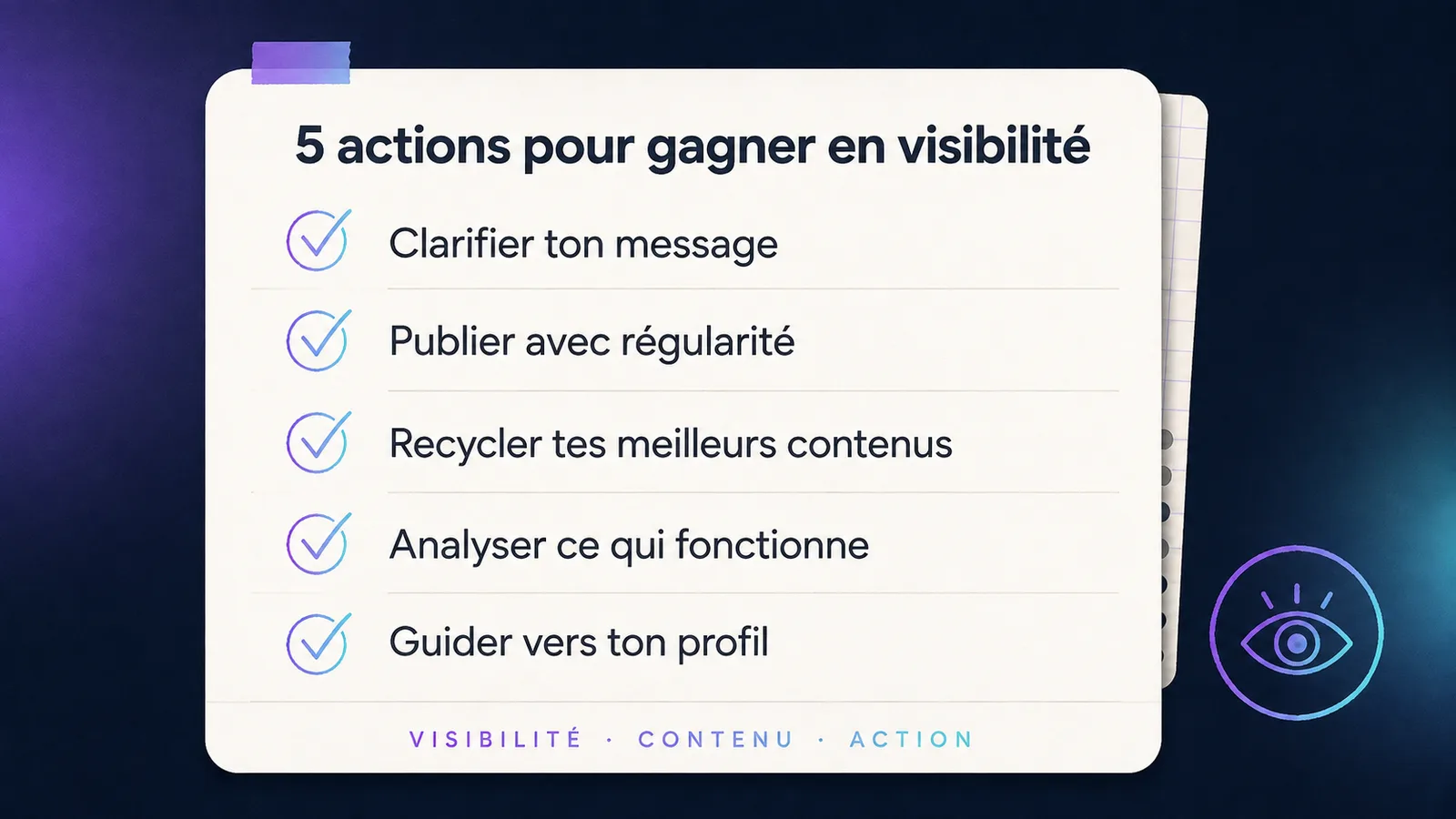
There’s no magic button to ensure you appear in an AI response. But there are sensible steps you can take that will boost both your traditional SEO and your chances of being recognised as a reliable source.
Structure your content around specific questions
Rather than a vague article on ‘marketing for coaches’, opt for content that answers a specific question your target audience is asking, with a clear answer right from the very first lines.
Showcase your expertise with unique elements
Feedback from real-world experience, client case studies (with their consent), and data drawn from your own practice. It is this type of content that sets itself apart from a generic response that any AI could produce on its own.
Make it clear what you’re proposing, not just what you’re explaining
An article that provides information without ever clearly presenting your offer leaves the reader to work out the path to you for themselves.
Many give up before they get there.
Action to be taken: Summarise your most-viewed content. Ask yourself honestly: “If an AI were to summarise this article in three sentences, what would still be interesting enough to make someone visit my site afterwards?”
If the answer is ‘nothing’, that’s a sign that you need to enrich this content with something that only you can provide.
Why the structure of your online presence matters more than ever
This change highlights a reality that already existed before the advent of generative AI: being visible is not enough if the path forward after discovery is unclear.
A well-written article that attracts a curious reader is of no use if that person then lands on a vague profile, a vague bio or a jumble of links with no clear structure. This is a problem that many content creators encounter without always recognising it clearly, as discussed in our article on Why does your content attract views but not customers?.
That is precisely the aim of a tool such as the VIFLY LinkHub : bring your links, content and offers together in a clear space, so that anyone discovering you via Google, a generative AI or social media can immediately understand who you are and what you have to offer.
If your creator business relies on appointments, sessions or consultations, the next logical step is to simplify this call to action. VIFLY Booking enables you to turn an audience that has just discovered you into a concrete meeting, without endless back-and-forth messaging.
We’d already covered this concept in our article on how to structure your offer so that it is finally understood, which remains relevant regardless of changes made by Google.
The limits of what we know today
It would be disingenuous to claim that everything is fully documented. The roll-out of AI Mode and AI Overviews in France is still recent and gradual, and Google does not provide precise, publicly available data on the actual impact by sector.
Feedback from SEO professionals reported in the press remains anecdotal rather than based on comprehensive studies. It is therefore sensible to keep a close eye on developments in this area over the coming months, without giving in to panic or making a series of hasty changes to strategy.
One thing remains true, whether or not generative AI features in search results: useful content, genuine expertise and a clear online presence continue to be the most solid foundations for building lasting visibility.
In summary, to conclude
The arrival of AI-generated answers in Google does not spell the end of SEO, nor the end of organic visibility. It shifts some of the focus towards the quality and clarity of what you publish, and towards how your expertise stands out from a generic answer.
The real question you should be asking yourself isn’t ‘how can I trick the algorithm?’, but ‘what do I offer that neither Google nor an AI can summarise for me?’. It is this answer that will continue to turn curious readers into customers, bookings or tangible opportunities.
If you want to organise this page clearly, include your profile, your services, your links and your bookings Find out how VIFLY can help you centralise all of this.
source
- Le Monde, article on the roll-out of Google’s AI responses in France, accessed in early August 2026 — https://www.lemonde.fr
- Google Search Central, official documentation on useful content and search guidelines — https://developers.google.com/search
FAQ – Frequently Asked Questions
Are AI Overviews available for all searches in France? No. The roll-out is gradual and mainly affects certain informational searches. Not all queries are affected at this stage.
Will my traffic inevitably drop because of generative AI in Google? Not necessarily. The impact varies depending on the type of content, the sector and the nature of the search query. Purely informational and generic content is more vulnerable than content that demonstrates genuine expertise.
Is traditional SEO still of any use? Yes. The fundamentals of SEO (useful content, clear structure, expertise, user experience) remain the foundation, with or without generative AI in search results.
Is there a guaranteed way to appear in a Google AI response? No. There is no known method that guarantees a citation in an AI-generated response. The recommendations remain the same as for good traditional SEO: produce reliable, useful and expert content.
What is GEO and how does it differ from SEO? GEO (Generative Engine Optimisation) refers to practices aimed at making content identifiable by generative AI. It is based on the same principles as SEO, with a greater emphasis on the clarity and structure of the information.