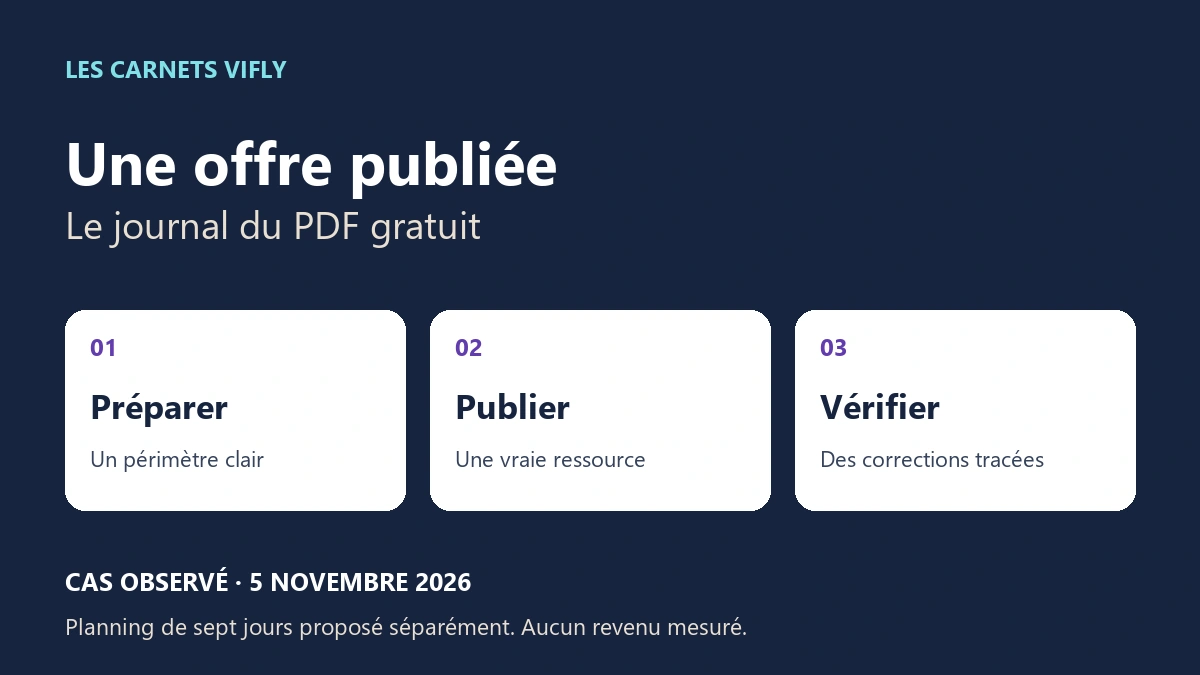
To publish a first offer in a week, choose a limited scope: a defined reader, a need, a deliverable, a clear page and a verified next action. The deadline organises the work; it predicts neither sales nor income.
This journal draws on a case actually published: the free mini-guide Clarifying an offer page and its demonstration listing. The observed stages took place on 5 November 2026, within a single day. The seven-day schedule below is an adaptation for the reader, not a record of seven days actually experienced.
Contents
Journal 01: a free PDF and an explicit listing
The intended reader is an independent professional struggling to explain an offer. The selected scope: a 4-page PDF in French with a listing structure, a worked example and a checklist. It includes no individual advice, personalised correction or page creation for the reader.
The complete file is available free here (in French). Its demonstration listing (in French) shows a fictional price of €19 including tax to explain a sales journey. No purchase is possible on this listing: it collects no contact details and its buttons simulate states within the page. This case documents a free resource and an educational journey, not a paid offer brought to market.
The stages actually observed
| Time or stage | Observed record | Decision or correction |
|---|---|---|
| Preparation, before publication | Selection of a 4-page PDF, a one-page preview and a listing with inclusions and exclusions | Limit the scope to clarifying an offer page |
| Initial checks, from 22 h 16 | A link validator treated an HTML resource as an application route; new article links also required appropriate validation | Check static files and articles according to their actual destination, without ignoring broken links |
| 22 h 27 | Focused preflight passed in the test environment | Proceed to complete checks; this success did not yet prove publication |
| Complete checks, before release | Failures concerned an old expected date, styles detected as translatable text and a date propagated to unchanged pages | Correct dated references, separate styles from text and preserve the dates of untouched pages |
| 23 h 09 min 25 s | First archived public check confirming availability of the PDF and relevant pages | Check the served page; this time is not presented as the exact second of first publication |
| 23 h 17 then visual review | The journey passed browser checks; screenshot inspection still revealed low-contrast text in some tables | Correct the component colours, then version its stylesheet for caching |
| 23 h 48 min 01 s | Another check on the pages actually served, at four screen widths | Keep the corrected version; no messages were sent and no payments were created during these trials |
These times come from archived checks, not timed writing sessions. They do not establish total production time, hours worked or the time another person would need. Preparation stages without a precise time remain untimed.
What you can examine yourself
- The preview: first page of the PDF (in French), to understand what is shown before full access.
- The complete 4-page file (in French), to verify that the deliverable exists and matches the stated scope.
- The demonstration listing and its simulated states (in French), to read the fictional price, exclusions and summary.
- The screenshot of the page actually served, taken during the final check (in French) : a complete mobile view showing a simulated payment refusal. It is neither a customer receipt nor evidence of a sale.
- The dated journal record (in French), which separates observations from the proposed schedule.

The screenshot corresponds to the version checked on 5 November. The live page may evolve later. Pending, validated and refused payment trials are local to the demonstration; they do not prove that a real payment or protected post-purchase access works.
The changes that actually mattered
Make the promise specific. “Clarifying an offer page” identifies a bounded task. The listing specifies format, language, length and exclusions. Readers can decide whether the resource addresses their need before opening the file.
Separate preview and deliverable. The first page serves as a preview; the complete file remains accessible. No button implies that an actual payment is necessary. The fictional price is disclosed before the summary.
Correct after looking. An automated check passing was insufficient: screenshots revealed a contrast problem in tables on associated pages. The colour fix and its new cache version belong in the journal alongside the first result.
Limit the conclusion. The observed result is a published resource with a readable listing and a verified educational journey. No sale, commercial enquiry, registration or conversion improvement is measured in this case. The topic's relevance to an audience and its willingness to pay remain separate questions.
Your proposed seven-day schedule
| Day | Limited action | Record to keep | Condition for continuing |
|---|---|---|---|
| Day 1 | Define the audience, problem and next action | A scope statement and its exclusions | You can state who it concerns and what they will receive |
| Day 2 | Prepare the outline and a well-understood example | A contents list and an example labelled real or fictional | Every section serves the stated need |
| Day 3 | Produce a first version of the deliverable | A versioned file, even if imperfect | The promised content exists; gaps are recorded |
| Day 4 | Write the listing: content, any price, terms and exclusions | A page and preview consistent with the file | The listing describes the available version |
| Day 5 | Prepare access and the next step | A demonstration or test journey appropriate to your offer | You know what happens before and after the action |
| Day 6 | Review, test on mobile, check links and files | A checklist, identified defects and their resolution | No known blocker makes the promise misleading or the journey unusable |
| Day 7 | Publish when conditions are met, then check the public page | A URL, date, screenshot and list of limits | The served version matches the reviewed version; otherwise postpone and correct |
This framework does not require publication on the seventh day if the file, terms or checks are not ready. A service, paid content or regulated activity may require other checks. Do not turn a chosen date into a promise to the reader.
A format to reuse for each new offer
For each stage, record the actual date, what you intended to do, what was produced, any blocker, the change and the next test. Mark each line “observed”, “planned” or “unknown”. Keep previous versions; a correction should be explainable.
The journal to complete and print (in French) provides this framework with a line for each stage. Use it for a resource, session or workshop. Schedule examples remain proposals until you execute them.
To continue through existing journeys, begin by choosing your VIFLY journey, then see preparing your first digital product and the sales listing to complete (in French). The methods for organising a session (in French) and reviewing progress (in French) help you keep a useful record.
A future journal must document another case actually prepared, with its own dates and limits. To examine tool selection for part of the work, also read the AI cover trial and its protocol.
VIFLY case observed on 5 November 2026; journal written on 6 November 2026. Sources: public files, check records and the retained journey screenshot. Commercial results are outside this episode's observations.