
Online training in 2026: market saturated or real opportunity for creators?
Online training is no longer a novelty.
A few years ago, creating digital training was almost enough to give an expert image. Today, this is no longer the case. The audience saw too much promise, too aggressive tunnels, recycled content, endless masterclasses, PDFs sold as revolutionary methods and trainings generated too quickly.
As a result, many creators, coaches, consultants, trainers and independents ask themselves the same question.
Is it still worth selling online training in 2026?
The short answer: Yeah, but not like before.
The market is not dead. He even keeps growing. Several market studies estimate that e-learning services already amount to several hundred billion dollars and are expected to continue to grow strongly in the coming years. Grand View Research estimates for example the global market for e-learning services to 417,1 billion dollars in 2026, with a projection at 1 485 billion dollars in 2033.
But this growth does not mean that everything is easily sold.
So the real subject is not: is the market saturated
The real subject is: is your offer clear enough, credible and specific to be chosen in a much more demanding market?

Is online training really saturated in 2026?
Yes and no.
Yes, the market is saturated if we talk about generic training: 的become more productive!", These themes are not bad, but they are often treated interchangeably. When everyone promises the same transformation with the same words, the reader no longer knows who to believe.
No, the market is not saturated if one speaks of precise, located, incarnate formations built around a real problem.
Training to learn Canva.
A training to create 30 readable Instagram visuals in less than 2 hours when you're a therapist and you don't like a designer is much clearer.
Training to better sell its services is vague.
A training course to structure an accompanying offer for 90 minutes, presenting it in its link in bio and receiving its first reservations is much more actionable.
The market does not lack training. There is a lack of training that quickly gives the right audience the following feeling: this is exactly my problem, in my situation, with my current level
Key points
The e-learning market is not saturated by demand. It is saturated by the too blurred offers.
Why online training is less easy to sell than before
Buyers have become more lucid.
They have already purchased training that they have not completed. They have already attended masterclasses that sold more than they did. They have already downloaded resources that seemed useful but did not change their daily lives.
In 2026, selling online training therefore requires more than a nice sales page.
We need to be reassured faster. Prove more clearly. Show a more concrete transformation. Reduce friction when taking action.
This is exactly what Google also recommends on the content side: creating useful, reliable content, thought first for people, and not to manipulate search engines.
This logic also applies to training.
A training created to have a digital product for sale is feeling fast.
A training created to solve a real problem is immediately visible.
IIA made creation easier, but differentiation more difficult
The market for online training has changed.
It allows to generate plans, scripts, slides, exercises, modules and supports much faster. It's not a problem in itself. Google also states that the use of content generated with the AI is not automatically contrary to its rules, as long as the content remains useful, reliable and respects quality policies.
The problem begins when the AI is used to produce training without experience, no angle, no terrain, no nuance and no real pedagogy.
Clearly, the AI can help a good trainer structure his knowledge better. But it can also make visible the weaknesses of a creator who has not yet clarified his expertise.
That's why an existing article from the VIFLY blog on the AI already reminds that the average content becomes easier to produce, but that the real difference comes from voice, positioning, trust and the journey.
Common mistake
To believe that the AI will allow to start training faster, while the real blockage is elsewhere: no one clearly understands why this training exists, for whom it is done and what it changes in practice.
What still sells very well: the specific transformation
Online training does not just sell information.
Information is everywhere. Free tutorials are everywhere. Advice is everywhere. LinkedIn posts, TikTok videos, YouTube Shorts, Instagram carousels and IA responses already give free explanations on almost all topics.
What people still buy is something else.
They're buying a selection. A method. An order. Shortcut. Clarity. A progression. A frame. Trust. Accompaniment. A realistic promise they understand.
The blog VIFLY has already addressed this idea in the article Why successful creators not only sell content what matters is not just the file, the video or the content, but the perceived transformation.
Good online training answers four simple questions:
- What specific problem does it solve?
- Who is it really made for?
- What situation does it help to overcome?
- What realistic result can it achieve?
If these four responses are blurred, the market will seem saturated. If they are clear, the market becomes more legible.
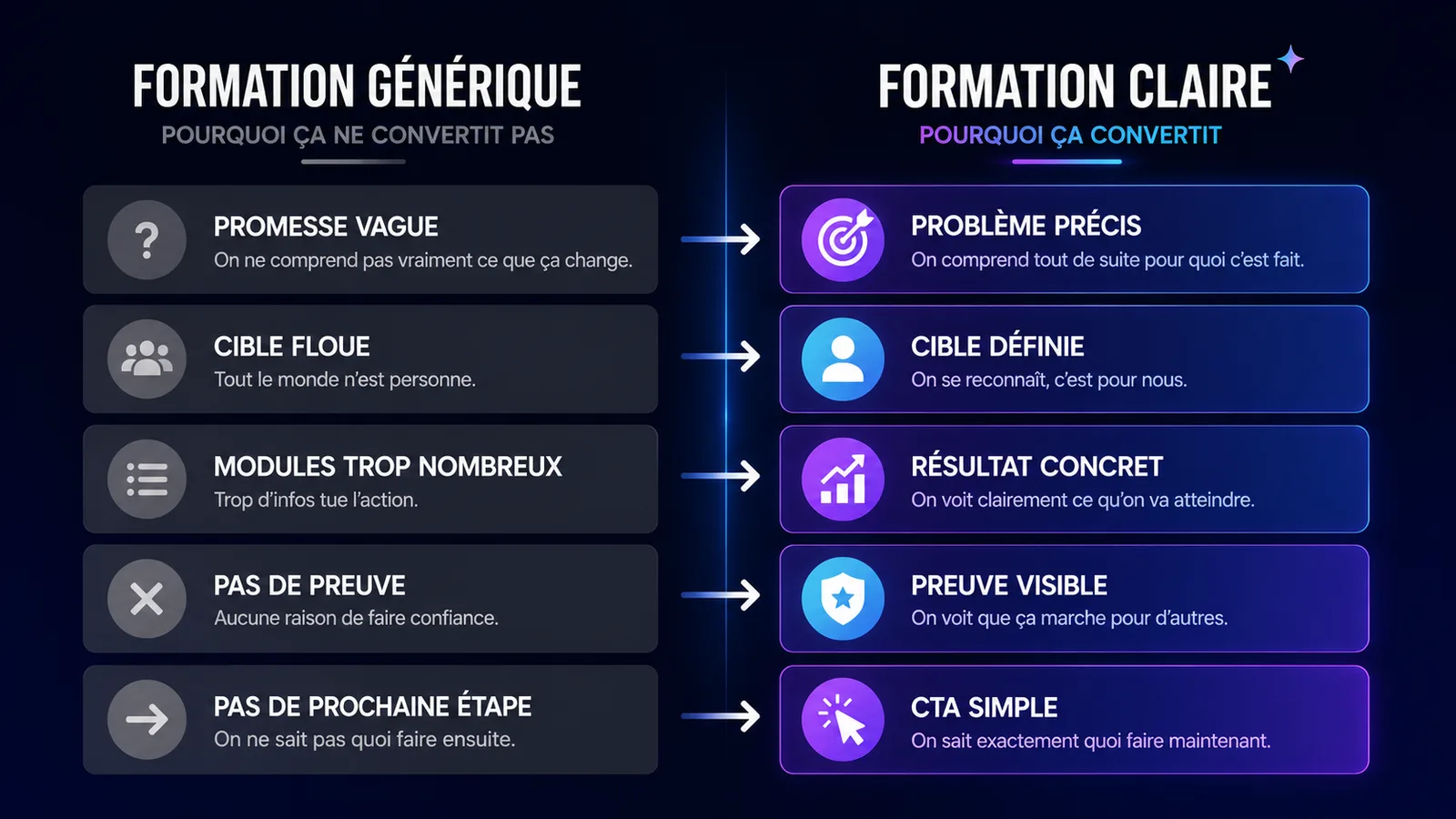
The 5 signs that online training may not sell
1. The promise is too broad
Learning to create content is too broad.
Create 10 short videos to present your expertise when you are a coach or consultant is clearer.
The wider the promise, the more the buyer must make a mental effort to understand if it is made for him. And the more he has to think, the more likely he'll be to postpone.
2. Target not visible
A training that targets everyone, rarely reassures someone.
A coach, therapist, freelancer, trainer, artist or consultant do not have the same barriers. They may all want to sell an offer, but their context, language, fear and purchasing path are different.
That's why VIFLY often talks about clear paths: your audience must quickly understand where it is and what next step it is.
3. The offer is hidden behind too much free content
Publishing a lot is not enough. The blog VIFLY has already shown in More views doesn't mean more customers : visibility attracts attention, but does not automatically create customers.
If your audience consumes your content but doesn't know you're offering training, it can't buy it.
The problem is not always the quality of training. Sometimes it's just her lack of visibility in your journey.
4. The transition to action is too complicated
An interested person should not have to search your bio, send a vague DM, wait for your answer, ask for the program, ask for the price, and then restart to know how to pay or book.
Every friction can lose a sale.
With a LinkHub clear, you can organize your course: training, free resource, discovery call, testimonials, waiting list, premium content. With VIFLY Booking, you can also make it easier to make appointments if your training sells better after a call, audit or strategic session.
5. Evidence is missing
In 2026, training without evidence inspires less confidence. The evidence does not necessarily mean to have 500 testimony.
This can be:
- one before/after;
- a case study;
- a demonstration;
- a module extract;
- a free mini-lesson;
- a capture of a result;
- a customer return;
- an explanation of your method;
- a credible personal story.
Evidence makes the promise less abstract.
Concrete examples according to your profile
Content creator
A creator who talks about productivity could create a training called 0 to 30 content ready to publish without spending your days on Canva.
But to sell it, it is not enough to publish productivity tips.
It must show the result, explain for whom it is made, display the offer in its link in bio and propose a simple action: buy, join a waiting list or book a call if the offer is premium.
Coach
A business coach who sells training to develop his business may drown in a very competitive market.
A stronger angle would be: 300 € in 7 and clearly present it on his profile.
The promise is shorter. Target understands better. The result is more visible.
Consultant
A marketing consultant can sell a complete training course on digital strategy. But it can also start with a simpler offer: .
In this case, training can become a step after the audit. Booking serves to qualify. The LinkHub serves as a guide. The content is used to attract.
Trainer
A trainer often has a lot of knowledge. His danger is to put everything in his training.
Too dense a formation can be scary.
In 2026, a saleable formation is not necessarily the most complete. It is the one that gives the right audience the clearest progress.
Independent or entrepreneur
An independent can transform his expertise into mini-training, workshop, premium resource or short accompaniment.
Example: a graphic designer can sell a mini-training .
Positioning is more important than the volume of modules.
The real question: complete training, mini-training or coaching?
Not all creators are interested in having a big training.
Sometimes, a mini-training sold at an accessible price is more efficient to validate an application. Sometimes an individual session sells better than a recorded program. Sometimes a premium resource is enough. Sometimes, a complete training only made sense after several weeks of content, evidence and feedback.
Here's a simple logic.
If your audience doesn't know your expertise yet, start with a clear resource or mini-training.
If your audience already trusts you but hesitates to take action, suggest a workshop or strategic call.
If your audience has a recurring, urgent and costly problem, you can build more structured training.
If the problem requires a lot of adaptation, instead offers a support or a hybrid format.
Action to be taken
Before you create your training, write this sentence:
“J’aide [cible précise] à passer de [situation bloquée] à [résultat concret] sans [frein principal].”
If this sentence is hard to write, this is not yet the time to record 30 videos.
It's time to clarify the offer!
How to sell online training without giving the impression of forcing
Sales become heavy when the route is blurred.
When the person does not understand what you sell, you have to repeat, insist, justify, convince.
When the course is clear, you don't need to force. You're educating. You show. You're rest assured. You guide.
A good course can look like this:
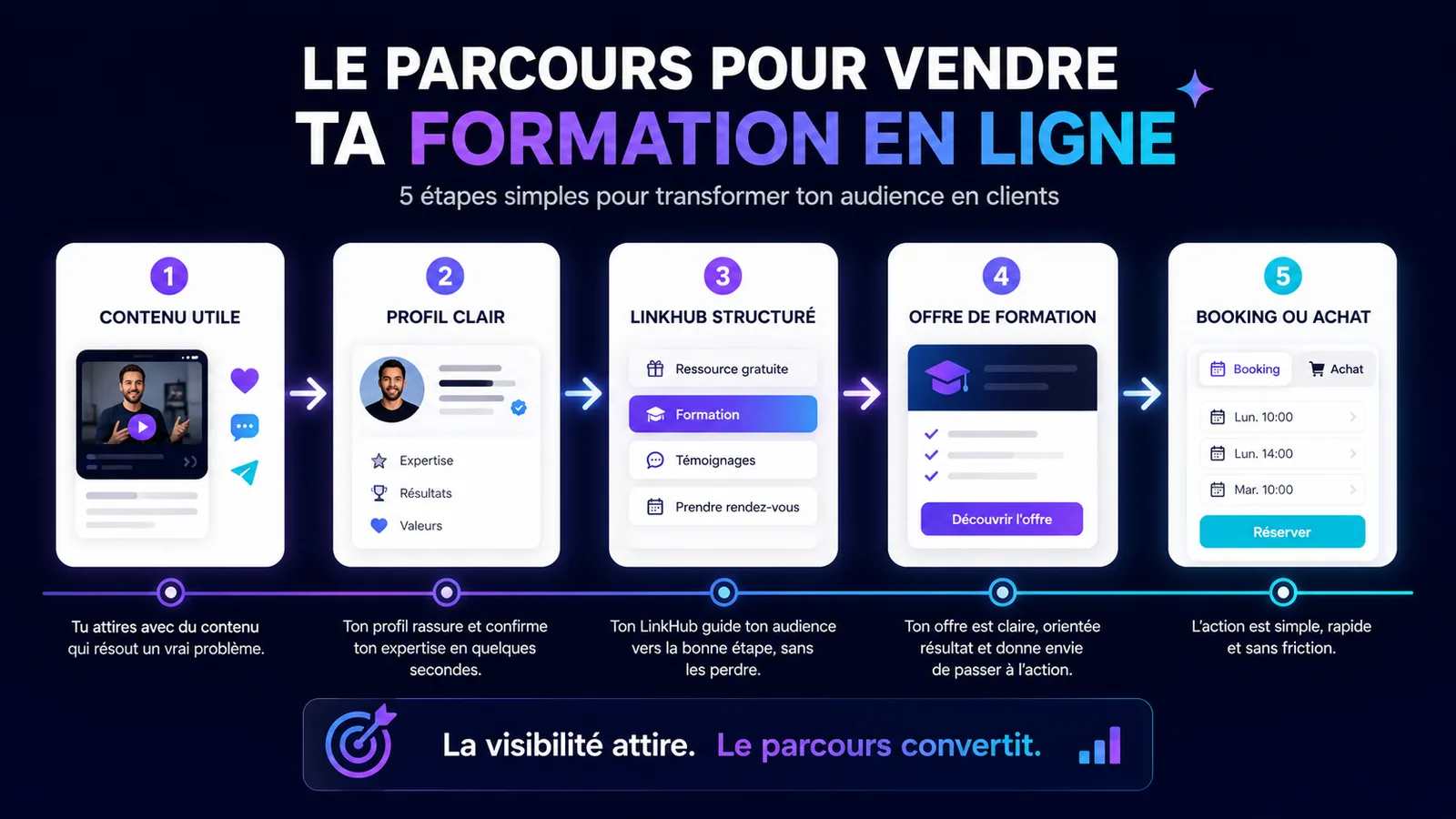
You publish content that answers a specific problem. Your profile confirms your expertise. Your bio link points to a clear page. Your offer explains the transformation. Your evidence reassures. Your Booking or shopping button reduces friction.
It's exactly the spirit of VIFLY : help creators and independents not to let their audience get lost after content. A person who has just discovered you must be able to understand who you are helping, what you are proposing and how to proceed to the next stage.
The role of SEO content and social networks in selling training
Training is not only available on the day of launch. She's getting ready a long time before.
Blog posts can capture an active demand: how to create training, how to sell training, profitable online training, and online training.
Social networks can create trust: mini-lessons, frequent mistakes, behind the scenes, customer cases, method extracts, comparatives, before/after.
The two channels do not play the same role.
The SEO receives people who are already looking for an answer. Social networks create familiarity and evidence over time.
This is why the article Google changes SEO with the AI: what creators need to understand is a good complement: with AI in research, generic content may be less different. We must produce useful, incarnate, structured answers that can really help the reader.
Google also recalls that core updates are generally aimed at presenting useful and reliable results, without targeting a specific page or site.
Should we start an online training course again in 2026?
Yeah, if you don't leave the wrong question.
The wrong question: What training could I sell
The right question:
Yes, if you accept that the market no longer rewards only information.
Yes, if you build a more specific offer.
Yeah, if you show evidence.
Yes, if your profile gives confidence.
Yes, if your LinkHub clearly organizes the sequel.
Yes, if your Booking facilitates the exchange when the purchase requires reinsurance.
No, if you just want to stack modules to create one more digital product.
No, if your offer looks like everyone else.
No, if you only count on a viral video to sell.
No, if your audience doesn't understand what you're proposing.
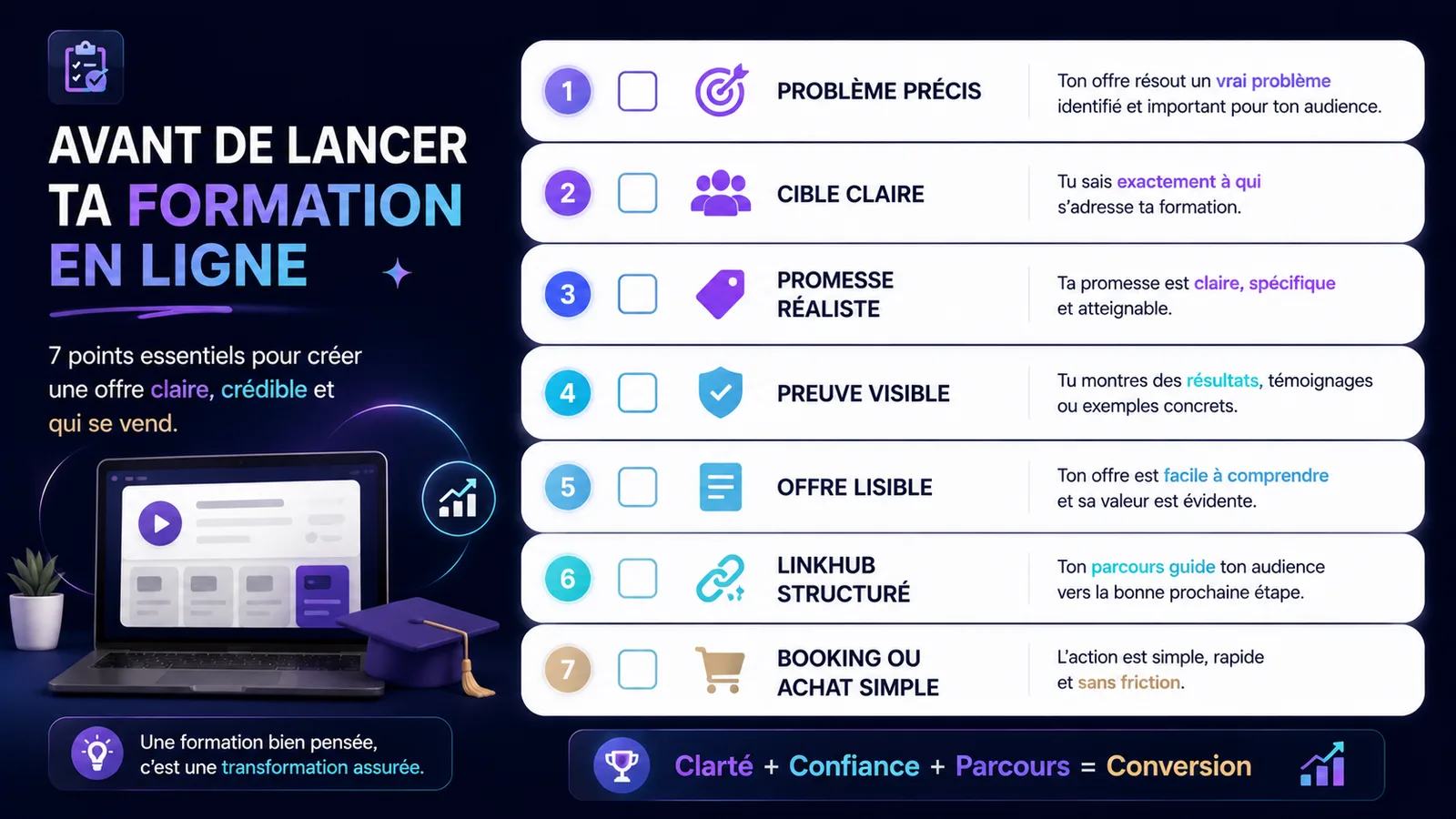
Conclusion: the market is not saturated, it has become more demanding
Online training in 2026 is not an easy opportunity.
It's a more mature opportunity.
Buyers want less promise and more clarity. Less stacked content and more progression. Less aggressive tunnels and more confidence. Less generic training and more responses tailored to their reality.
The good news is that this requirement can become an advantage.
If you are a creator, coach, consultant, trainer, independent or entrepreneur, you don't need to create the most massive training on the market. You need to create the clearest offer for the right people.
Your content attracts.
Your profile reassures.
Your LinkHub guides.
Your Booking makes it easier.
Your journey is changing.
Create a clear course with VIFLY
If you want to sell a training, resource, workshop, accompaniment or a strategic call, start by making your journey easier.
With VIFLY, you can centralize your ties, present your universe, highlight your offers, structure your LinkHub and facilitate appointments with VIFLY Booking.
The market does not need further training. It needs clearer, more useful and easier to understand offers.
Frequently Asked Questions
Is online training saturated with 2026?
The market is saturated for generic, blurred or interchangeable formations. It remains a carrier for precise, credible, well-positioned offers linked to a real problem.
Can we still sell online training when we have a small audience?
Yes, if the hearing is qualified and the offer meets a clear need. A small audience can convert if the profile, the bio link, the evidence and the move to action are well structured.
What is the best training to sell online?
The best training is not necessarily the longest. It is the one that helps a specific target solve a concrete problem with a clear progression and a realistic promise.
Should we sell training or accompaniment?
If the problem is standardizable, training may suffice. If the problem requires a lot of adaptation, support, audit or strategic session can convert better.
How can VIFLY help sell online training?
VIFLY helps structure the course around the training: clear profile, organized LinkHub, visible offer, central important links and simple Booking for calls, audits or reservations.
Transforming its expertise into premium content
If the training market seems saturated, an alternative is to offer more targeted resources: Private modules, guides, audios, videos or content reserved. Consult our guide for selling private content online.