Bad status doesn't always ruin an activity. But he can complicate it very quickly.
When you start in digital, you often think about content, customers, logo, website, Instagram, TikTok, LinkedIn, offer, tunnel, bio link.
Then a question comes up quite quickly:
How do I declare myself
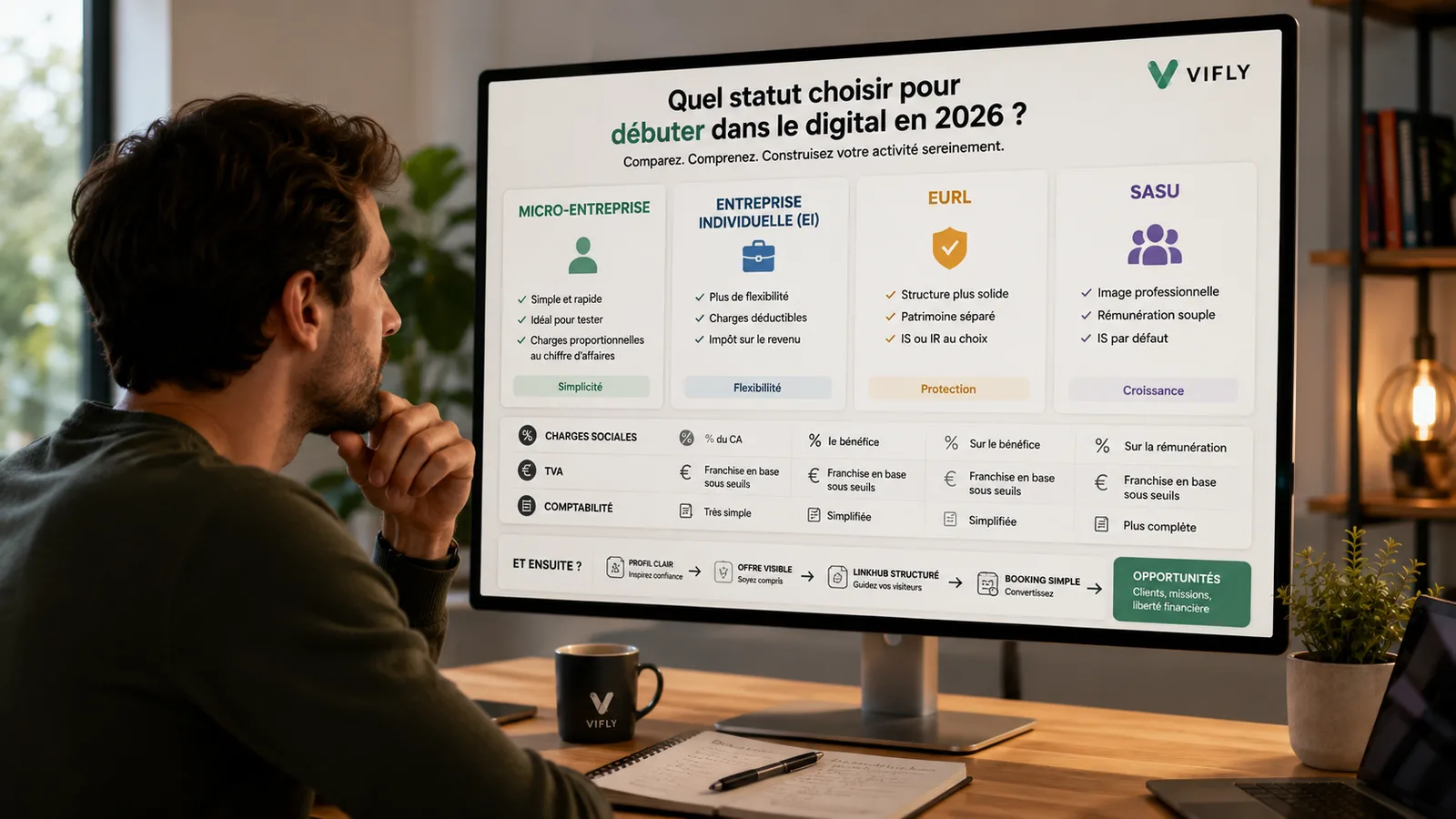
Micro-enterprise? Individual enterprise? EURL? SASU? Portage salary? Association? Artist-author?
And behind this question, there is another, much more concrete one:
How much will I really keep after charges and taxes
This is where many creators, coaches, consultants, freelancers and trainers are wrong. They choose a status because it looks simple, because a friend chose it, because they saw a video that said make a SASU, or because they want to avoid paying too much expense.
But a good status is not only the one that costs the least at the start.
It is the one that corresponds to your actual activity, your level of turnover, your costs, your risk, your need for credibility and your way of cashing.
In 2026, micro-enterprises often remain the simplest starting point for testing digital activity, but this is not always the best choice in the long term. Thresholds, rates and rules change according to the nature of the activity: sale, provision of BIC services, BNC liberal activity, company to the IS, remuneration of the officer or dividends. The 2026 thresholds of the micro scheme amount in particular to €203,100 for sales activities and €83,600 for the provision of services, with specific rules in case of mixed activity.
Key points
The status must not be chosen to pay as little as possible. It must be chosen to build a clear, declared, profitable and able to grow without locking you in.

Before choosing a status, set what you really sell
Digital has very different activities.
A UGC creator who sells videos to brands has not exactly the same reality as a coach who sells sessions, a consultant who bills missions, a trainer who sells a training, or a creator who sells templates, premium content or subscriptions.
Before we even look at the statutes, we have to answer a simple question:
Is your activity primarily in terms of delivery, sale, creation, advice or training?
This distinction is important because it affects your tax category, your contributions, your thresholds and sometimes your obligations. In micro-enterprises, for example, social contributions 2026 are not the same for a sale of goods, a supply of BIC services, an unregulated professional profession or a profession under the jurisdiction of the Cipav.
Simple example
A creator who sells a community management service, marketing support or advisory mission will often be in a logic of service delivery.
A coach, consultant, independent trainer or expert who sells his time, expertise or accompaniment often comes into a liberal or service logic.
A creator who sells physical products, merchandising or certain goods may be a sales logic.
A creator who sells digital content, templates, training or subscriptions must verify precisely the qualification of his activity, as the boundary between delivery, sale of content, copyright, training or service can become technical.
Common mistake
Choosing micro-enterprises without understanding whether the activity falls under BIC, BNC, sale or other regime. The status may be simple, but the nature of the activity must remain correct.
The main statutes to know when you start in digital
There are many legal forms, but for a single person who starts a digital activity, the most frequent choices are generally: micro-enterprise, individual enterprise in real life, EURL, SASU, sometimes salary portage or artist-author depending on the case.
The micro-enterprise: simple, fast, ideal for testing
Micro-enterprise is often the most accessible status to start with. It makes it possible to declare its turnover simply, to pay its contributions at a flat rate applied to the turnover received, and not to pay social contributions if the turnover is zero. In 2026, micro-social contributions are calculated on receipts actually received, with flat rates depending on the activity.
For many creators, freelancers, coaches or consultants who start, this is the most legible status.
But it has an important limit: your actual expenses are not deducted to calculate your contributions and your micro tax. Even if you pay for a camera, a computer, a software subscription, a camera, a mounting tool, a hosting or travel, the micro regime applies a standard system. The official simulator Mon-Entreprise recalls that in self-business, professional expenses are not used to calculate contributions and taxes, even if they must be taken into account to verify the economic viability of the activity.
Individual enterprise in real terms: useful when costs become important
The individual company in real life can become interesting if you have a lot of professional expenses: video hardware, computer, software, outsourcing, advertising, travel, coworking, storage, professional services.
Unlike the micro-enterprise, the real way to reason about the result: turnover less professional expenses, then social contributions and tax according to the applicable regime. My business Urssaf sums up the logic of the individual enterprise as follows: net income = turnover - professional expenditure - social contributions.
This status requires more management, often accounting support, but it can be more consistent as soon as your expenses are no longer anecdotal.
EURL: more structured, often chosen to professionalize
EURL is a company with only one partner. It may be relevant if you want to separate your activity more clearly from your person, build a more professional structure, or prepare an evolution. If the sole partner is a natural person, the EURL may raise income tax or opt for corporate tax.
EURL's sole partner manager is usually self-employed. It is therefore part of the social security of the self-employed and has to pay compulsory minimum social contributions even without remuneration, making the status less lighter than a micro-enterprise in the test phase.
EURL can be interesting for a consultant, trainer, freelancer or entrepreneur who already has a validated activity, regular income and a willingness to structure his activity.
SASU: more flexible for image, but often more costly for remuneration
SASU is often perceived as either premium or more professional. It can be interesting if you want to bring in partners later, pay you as employee president, work with certain partners or structure an ambitious activity.
But it's not necessarily ideal to start small.
The chairman of the paid SAS or SASU falls under the general scheme as an employee. The social security contributions represent approximately 60 % of his gross remuneration, and if he does not pay, no social security contributions are due, but neither does he benefit from unemployment insurance under his mandate.
In SAS, dividends are not regarded as remuneration and are not subject to social contributions, but a director paid only in dividends does not contribute and therefore does not receive any social protection related to such remuneration.
Salary porting: Reassuring, but less free and more expensive
Salary porting can be suitable for certain consultants, trainers or digital experts who want to bill missions without immediately creating their structure, while keeping a logic close to the wage earner.
Its advantage is administrative simplicity and social protection closer to the employee. Its disadvantage is the overall cost and dependence on a carrier company. This is not always suitable for creators who sell digital offers, content, reservations, UGC or several small services.
The artist-author regime: only for certain specific cases
Some creators may fall under the artist-author regime, but only for eligible activities related to the creation of original works. This is not a tote diet for all content creators.
A UGC video maker, a TikTok creator who sells services to a brand, coach, consultant or trainer, does not automatically fall under this scheme. The exact nature of the income must be verified: copyright, assignment of work, provision of service, production of content, accompaniment, training or advertising.
Charges and taxes in 2026: what needs to be understood without getting lost
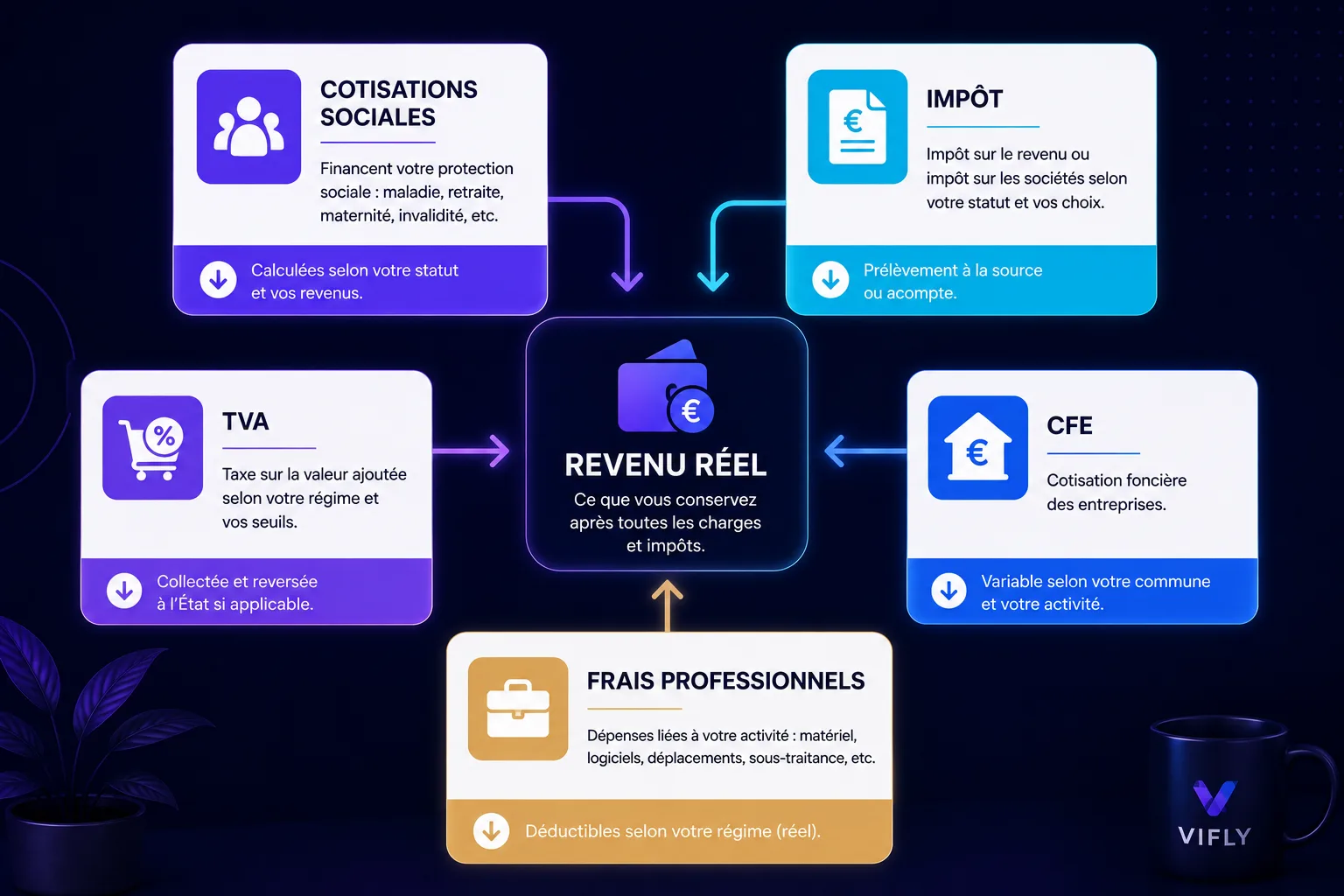
The word "charges" is often used to mix everything: social contributions, income tax, corporate tax, VAT, CFE, professional fees, online payment commission, bank fees, software.
To make a good decision, it is necessary to distinguish several layers.
Social contributions
They finance part of your social protection: sickness, maternity, retirement, disability-death, family allowances, CSG/CRDS and other contributions according to the scheme. In micro-social, the rates 2026 include compulsory social protection contributions and contributions, but the contribution to vocational training adds to the micro-social contributions.
Tax
In micro-business, your taxable income is calculated with a flat-rate discount depending on the activity: 71 % for sales, 50 % for BIC services, 34 % for BNCs and liberal activities.
Subject to conditions, you can also opt for the final income tax payment scheme. In 2026, the rates listed by Service Public are 1 % for certain trading activities, 1.7 % for BIC services and 2.2 % for BNC activities.
VAT
The VAT-based exemption allows VAT not to be charged until certain thresholds are exceeded. In 2026, the thresholds indicated by the tax administration are 85 000 € with increased threshold to 93 500 € for sales, and 37 500 € with increased threshold to 41 250 € for services.
It's a crucial point in digital. A freelancer who sells to individuals can see its final price change if it has to add VAT. Conversely, a freelancer who sells mainly to VAT-paying companies can sometimes better absorb this change, as its customers often recover VAT according to their situation.
The CFE
Business property taxes can happen even if you work from home. In micro-enterprises, the first year of activity is exempt from CFE, then a reduction of 50 % from the tax base applies the following year; The company may also be exempt if the annual turnover did not exceed 5 000 €] over the reference period.
The amount depends in particular on the municipality, which explains why two independents with a similar activity can pay different amounts.
Micro-enterprise: the simplest choice to start, but not always the most profitable
For many people who start in digital, micro-enterprise is the best starting point.
It allows you to quickly test an offer, legally cash, issue invoices, measure whether the market is responding, and keep management relatively simple.
This is particularly suitable if you start with:
community management services; coaching; consulting; audits; UGC; content creation for brands; sessions; short courses; online services; individual accompaniments.
But the micro-enterprise becomes less comfortable if your costs increase sharply.
Concrete example: creator UGC
You charge 2 000 € per month in UGC creation. You have little fee at the start: smartphone, light, microphone, mounting software, some accessories. The micro-enterprise can be consistent to test.
But if you start investing in expensive hardware, decors, travel, outsourcing, advertisements and premium tools, you'll have to check if the real diet becomes more suitable.
Article VIFLY on the creator UGC, his missions and his professional profile completes this logic well: before you even speak status, you must understand what you sell to, to whom, and how you present your value.
Concrete example: coach or consultant
You sell discovery calls, sessions, audits or accompaniments. Micro-business can be simple to start with, especially if your fees are low.
But your main issue will not be just taxation. It will also be commercial: clearly present your offer, reassure, facilitate booking.
This is where a tool like VIFLY Booking can complete your status: you not only choose how to report, you also structure how customers take action.
Beware of the trap of the I don't win enough to declare me
It's a common phrase.
I'm going to wait for more customers
The problem is that in digital, revenues can arrive quickly and irregularly: collaboration, mission, audit, training, content sales, reservation, affiliation.
If you start selling, you have to think about your legal framework. The status is not only used to pay expenses. It also serves to invoice properly, reassure customers, work with brands, protect your creator business and build a professional image.
This is even more true if you want to contact brands, sell services or charge for collaborations. A serious mark does not only look at your audience; It also looks at your seriousness, your media kit, your ability to bill and the clarity of your journey. Article VIFLY on how to create a simple and professional creative media kit in this sense, credibility comes not only from figures, but also from the way you present your activity.
Which status to choose according to your digital profile?
You test an activity with little expense
Often relevant choices: micro-enterprise.
This is the case if you launch your first content creation missions, your first audits, your first sessions, your first social media services or your first digital offers.
Your goal is not to build an administrative factory. Your goal is to validate an offer, get customers, understand your market and cash properly.
You have a lot of professional fees
Choice to study: individual enterprise in real terms, EURL or SASU.
If you spend a lot on hardware, advertising, providers, software, travel, premises or production, the micro-enterprise can become less advantageous because it does not allow you to deduct your actual costs to calculate the contributions and the micro-tax. My company points out that expenses must be taken into account to verify economic viability, even if they do not reduce contributions and self-employment tax.
You want to build a real structure
Choice to study: EURL or SASU.
These statutes require more management, but they may be more consistent if your creator business becomes stable, if you work with important partners, if you want to separate your personal and professional activity further, or if you want to prepare for an evolution.
You want to pay regularly
Choices to compare: EURL vs SASU.
EURL with associate manager is often associated with the self-employed scheme. The SASU, on the other hand, places the paid president in a similar position, with contributions closer to an executive employee but without unemployment insurance linked to the mandate.
The right answer depends on your income, your need for social protection, how you pay, your personal taxation and your tolerance to administrative management.
Above all, you want to charge consultancy assignments
Possible choice: micro-enterprise at the beginning, then EI/EURL/SASU according to the evolution.
For a digital consultant, a SEO freelancer, a social media expert or a business coach, the micro-enterprise often allows you to start quickly. But as soon as missions grow, costs increase or credibility becomes central, we must compare.
Article VIFLY on how to build a clear offer when you are independent is important here: a status will never compensate for a fuzzy offer.
The real calculation: turnover, fees, contributions, taxes, cash
Many beginners reason only in turnover.
I've been cashed 2 000 €.”, “J’ai fait 5 000 € this month 1 200 €.”
But this number is not your money available. You have to think in several stages:
turnover; Social security contributions; tax; possible VAT; CFE; Professional fees; security savings; investments; cash flow.
Simplified example in micro-enterprise BNC
Imagine an online digital consultant or coach who cashes 3 000 € over a month in unregulated BNC activity.
In 2026, the unregulated BNC micro-social rate is 25,6 % of the turnover received, excluding contributions to vocational training.
This already gives 768 € social contributions on 3 000 € collected. Then you have to consider tax, your professional fees, your subscriptions, your tools and your cash flow.
It's not to discourage. This is to avoid confusing cash flow with real income.
Action to be taken
Before setting your prices, calculate your target income after expenses. Many self-employed are not too expensive. They are simply billing without including their contributions, taxes, fees and unbilled time.
VAT: when your creator business becomes more serious
VAT scares many micro-entrepreneurs, but it is not necessarily bad news. It often indicates that your activity is growing.
In 2026, the VAT exemption remains possible up to certain thresholds: 85 000 € for sales with increased threshold to 93 500 €, and 37 500 € for services with increased threshold to 41 250 €. If the increased threshold is exceeded, VAT must be charged from the day of the exceedance.
The real problem is not just VAT. The real problem is not to anticipate it.
If you sell to individuals, switching to VAT may require you to increase your prices or reduce your margin. If you sell to businesses, VAT may be less blocking depending on their situation.
This is one more reason to structure your offer and your positioning. When your prices are clear, your value is visible and your journey is professional, you can better pay your rates.
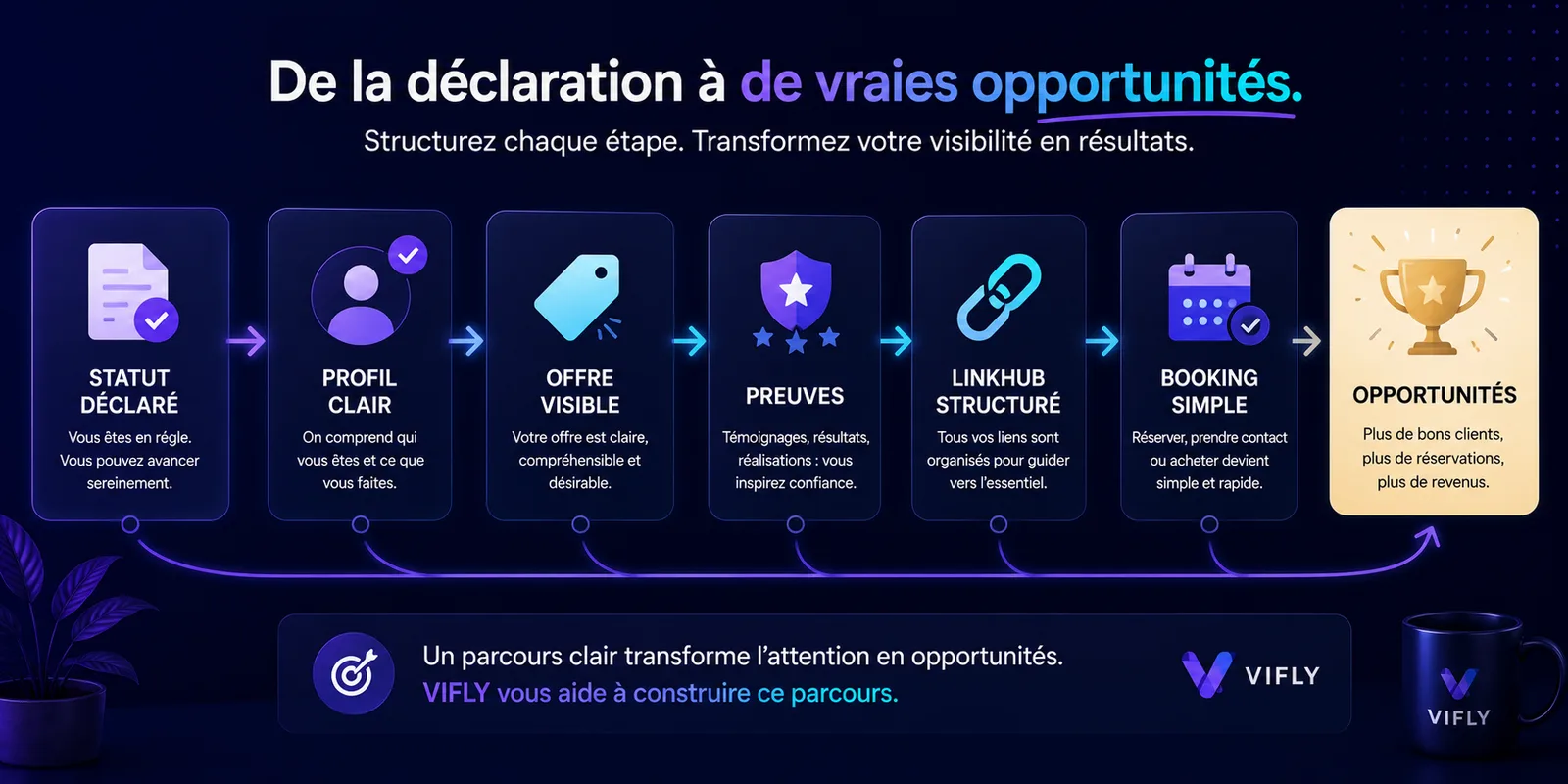
Choosing a status is not enough: you must also look professional
A statute gives you a legal framework. But this frame doesn't sell for you.
You can be perfectly stated and yet lose opportunities because your profile is blurred, your offer is invisible, your biodisperse link or your booking is complicated.
This is where many creators are wrong: they think that declaring themselves is enough to become professional.
No. Being professional is also understandable.
A prospect must quickly include:
who you are; what you propose; for whom; with what result; how to see your evidence; how to contact you; how to book; how to buy.
That's exactly the connection between this subject and VIFLY.
With VIFLY, you can structure your digital presence to make your activity more readable. With VIFLY LinkHub, you can organize your links, offers, proofs and calls to action. With VIFLY Booking, you can simplify the reservation of meetings, calls, audits or consultations.
It's not a matter of making pretty.
It is a question of reducing doubt.
Errors to avoid when starting
Choosing a SASU too early to be serious
A SASU may be relevant, but it is not automatically the best choice at startup. If you do not pay, you do not pay social contributions on your mandate, but you do not build social protection related to this remuneration. If you pay yourself, the social cost can be high. Public Service indicates that the social security contributions of the president of SAS/SASU represent approximately 60 % of gross remuneration.
Stay on a microphone while the costs explode
The micro-enterprise is simple, but it does not allow you to deduct your actual costs from the micro calculation. If you invest a lot, do a simulation to the real.
Forget VAT
VAT must not be discovered when you exceed the thresholds. It must be anticipated in your prices, quotes, offer pages and cash flow.
Mix turnover and wages
What you cash is not what you can spend. Part must be reserved for contributions, taxes, taxes, fees, investments and contingencies.
Neglecting commercial clarity
A clean status does not serve much if no one understands what you sell. This is also recalled in Article VIFLY More views don't mean more customers : visibility attracts, but it is the route that transforms.
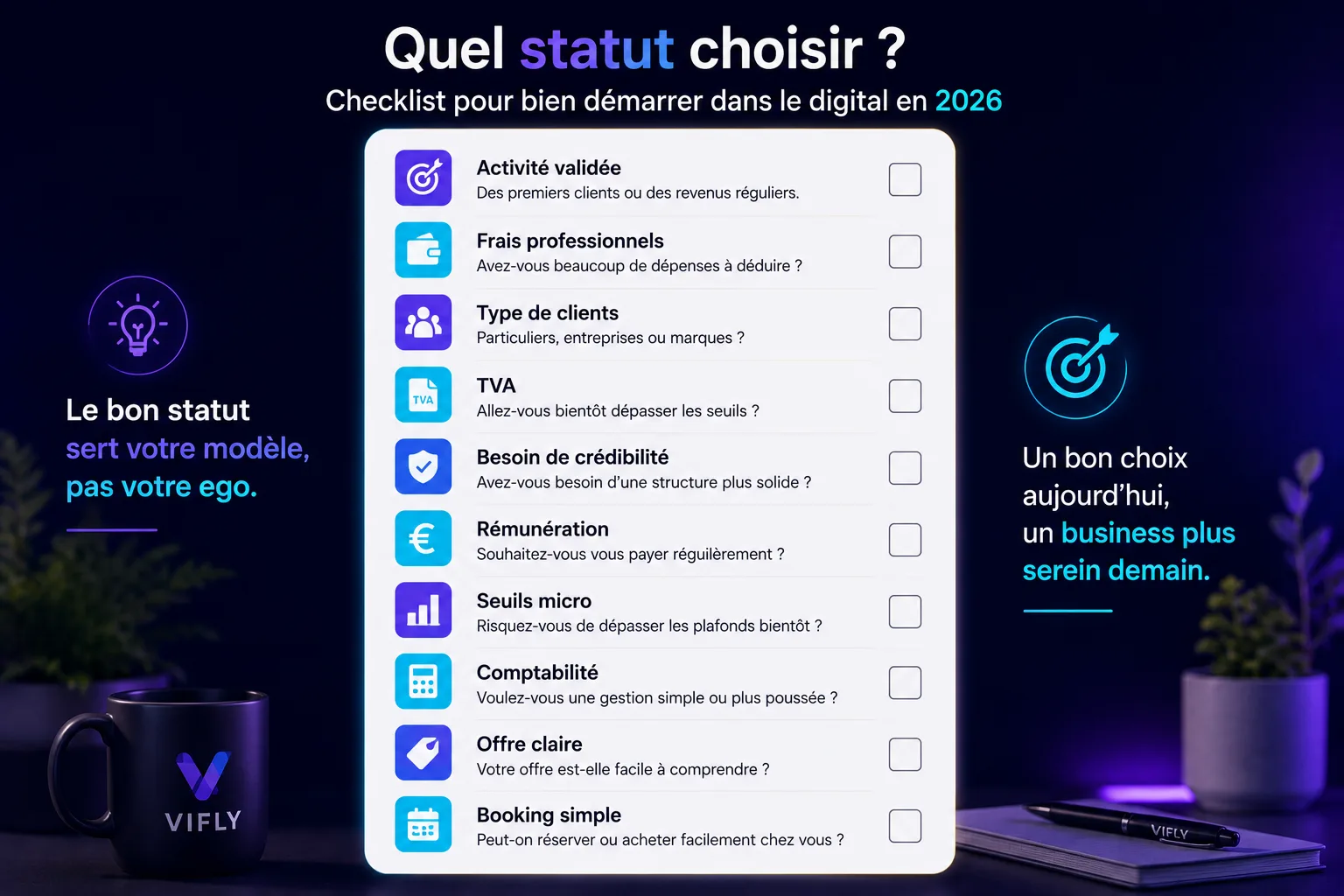
Checklist: Which status to choose to start in digital?
Before choosing, answer these questions.
Is your activity already validated by paying customers? Do you have a lot of professional fees? Do you sell services, advice, products, content or training? Are your customers individuals, companies or brands?
Do you need to charge VAT soon? Do you want to pay each month? Do you need a very structured image for your partners? Do you want to keep management very simple?
Do you need to deduct your actual expenses? Can your activity exceed micro thresholds quickly? Do you have an accountant or do you want to manage alone? Is your offer clear enough to sell regularly?
If you start, your fees are low and you test your market, micro-business is often the easiest solution.
If your fees are high, if your turnover becomes regular or if you want to structure your creator business, you must compare the EI to the real, the EURL and the SASU.
If you are not sure, use the official Urssaf simulators and then confirm with a professional. My company offers simulators to compare self-entrepreneur, EI/EURL or SASU according to income differences, retirement and sickness benefits.
Conclusion: the best status is the one that serves your model, not your ego
Starting in digital does not only require publishing content.
We have to sell clearly. Bill clean. Anticipate the charges. Understand taxes. Arrange his course. Reassuring customers. Facilitate action.
The micro-enterprise can be perfect for testing. The individual enterprise in real life can become useful when the costs rise. EURL can structure a more stable activity. The SASU may be suitable for a more ambitious project, but it is not always the best start.
The real trap is to choose a status without understanding your model.
You don't just create an administrative account. You're creating an activity.
And a strong digital business is based on two pillars: a clean legal framework and a clear business path.
Create a more professional career with VIFLY
Once your activity is declared, do not let your prospects guess what you are proposing.
With VIFLYyou can centralize your links, present your offers, organize your LinkHub, facilitate your bookings and turn your visibility into more concrete opportunities.
Discover VIFLY, structure your LinkHub and simplify your reservations with VIFLY Booking.
A status allows you to legally exist. A clear course helps you to be chosen.
FAQ - Frequently Asked Questions
What is the best status to start in digital in 2026?
For many beginners with little cost, the micro-enterprise often remains the simplest starting point. But if you have a lot of spending, an already stable activity or a strong need for structure, you have to compare the individual enterprise to the real, EURL and SASU.
What are the expenses of a micro-entrepreneur in 2026?
In 2026, the micro-social rates include 12,3 % for sales, 21,2 % for BIC services, 25,6 % for unregulated BNC services and 23,2 % for certain professions covered by the Cipav. The contribution to vocational training is added by activity.
When should we leave the micro-enterprise?
Consideration should be given to leaving the micro-enterprise if your fees become significant, if you exceed the thresholds, if you need to deduct your actual expenses, if you want to structure your remuneration differently, or if your activity requires a more professional form.
Is SASU better than micro-enterprise?
Not necessarily. The SASU may be relevant to structuring an ambitious project, but it requires more management and the social charges on the president's remuneration can be high. To test a simple digital activity, the micro-enterprise can be more suitable.
Should VAT be charged when we start?
Not always. The basic deductible may apply under certain thresholds. In 2026, the thresholds are 85 000 € for sales and 37 500 € for service provision, with respective increased thresholds of 93 500 € and 41 250 €.