
The click gives hope. Silence behind hurts.
There is frustration that many creators, coaches, consultants and independents know very well.
You're launching an advertisement. You choose a beautiful image. You write a correct text. You put in a budget. Then the first results come.
Impressions. Clicks. A cost per click that seems acceptable. Sometimes even visits to your profile or page.
But behind, nothing. No request. No reservation. No serious messages. No customer.
It is at that time that many conclude too quickly:
In reality, advertising does not always fail. Very often, she does exactly what she is asked: she draws attention and sends people somewhere.
The real problem starts after.
An advertisement does not sell alone. She opens a door. If behind this door, the visitor falls on a fuzzy offer, an incomplete profile, a disorganized bio link or a page that doesn't give confidence, the click turns into an output.
And that's where the money disappears!
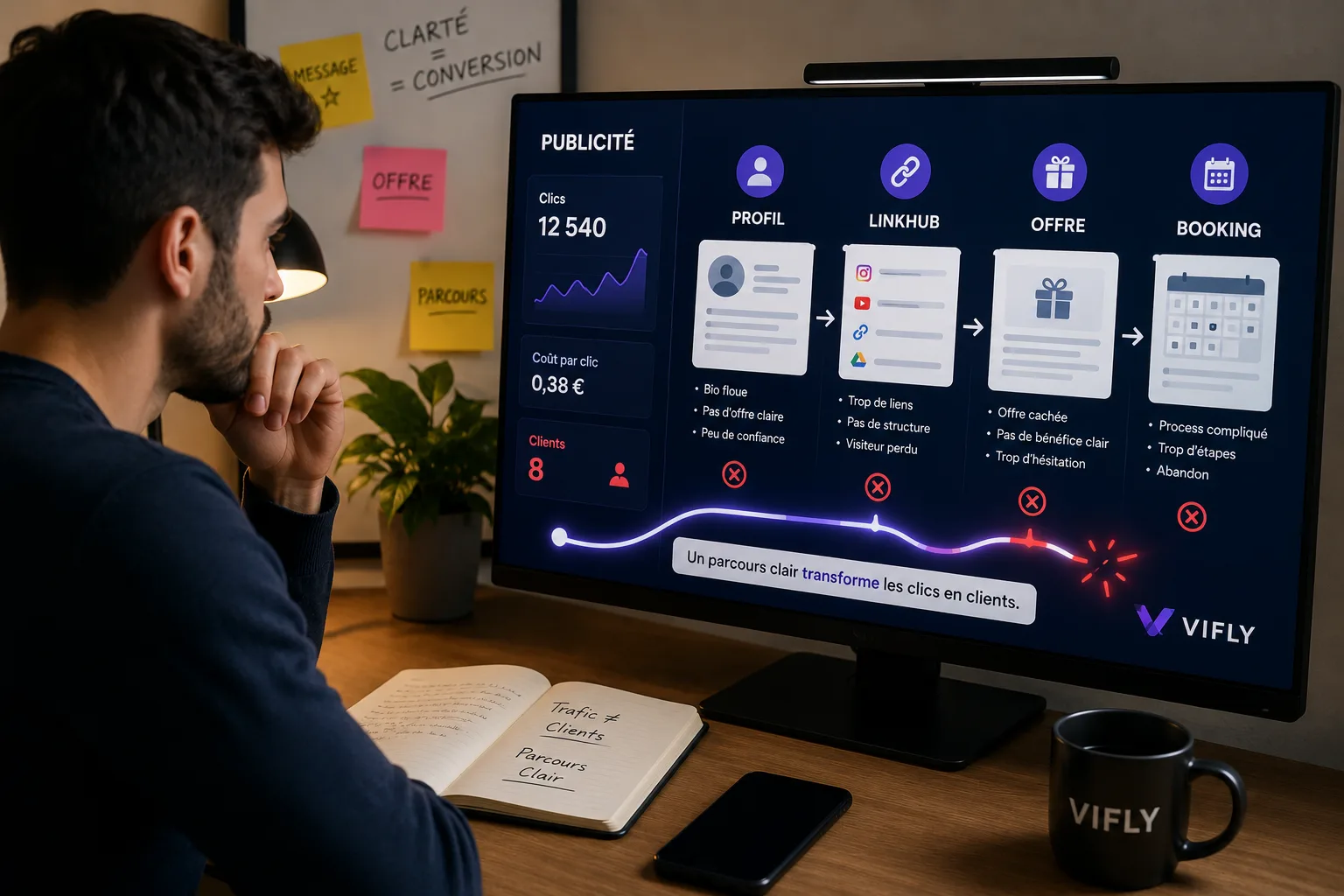
An advertisement does not correct a blurred path
Advertising is an accelerator. Not a repairer.
If your message is clear, your offer is legible and your journey simple, advertising can amplify what already works. But if your profile doesn't clearly say who you're helping, if your offer is hard to understand, or if your bio link looks like a messy list, advertising will increase the confusion.
Google Ads explains that the destination page experience depends in particular on the relevance of the information, the ease of navigation and the consistency between what the advertisement promises and what the user finds after the click. This also applies to Meta Ads, TikTok Ads or LinkedIn Ads: the click is just one step. What counts next is your destination's ability to reassure, explain and guide.
In other words, good publicity can attract an interested person. But she can't understand your offer in her place.
Key points
An advertisement can create a visit. It does not automatically create trust, clarity or desire to buy.
Trap: Confound clicks and customers
A click is a signal of interest. Not proof of purchase.
Someone can click because your hook is strong, because the visual intrigues, because the subject concerns him or simply because he wants to see what it is. But between I click and I reserve, there are several invisible steps.
The visitor will check your credibility. He'll try to understand what you're proposing. He'll look for the price, the method, the evidence, the possible results, the format, the next step. He'll wonder if you're serious. He will mentally compare with other options.
If your journey does not respond to these questions quickly, the click evaporates.
That's why Article VIFLY on views that do not pay invoices very well complete this topic: visibility attracts attention, but it only becomes useful when it leads to a clear action.
The 7 reasons why an advertisement makes clicks but no customers
1. The ad attracts curiosity, but not the right intention
Not everyone who clicks is ready to buy.
An advertisement can be very clickable without being qualified. Too wide a title, too vague a promise or too sensational a visual can attract many curious people. But these people are not necessarily those who have the problem you solve, the budget to move forward or the desire to take action.
This is often the case when an ad seeks to maximize attention rather than filter the right people.
Example:
Get visible on Instagram is a lot of people.
“Structurez votre profil pour transformer vos vues en demandes de coaching” attire moins de personnes, mais probablement de meilleures personnes.
Volume isn't always your friend. A profitable advertisement is not the one that attracts the most clicks. It is the one that attracts the most coherent clicks with your offer.
2. The promise of advertising is not found after the click
The visitor clicks for a specific reason.
If he clicks on an advertisement that talks about online booking, he must arrive on a page that clearly speaks about booking. If he clicks on an advertisement that promises an audit, he must quickly understand how to request this audit. If it clicks to discover an offer, it must not fall on a generalist page where the offer is hidden.
Every break between the ad and the destination creates a loss of confidence.
Google also insists that it is important to test its destination page and tracking settings to make sure that the ad is leading users in the right place.
Common mistake
Launch an advertisement to the home page as the ad talks about a specific offer.
The home page may be useful, but it is not always the best destination to convert a clear intention.
3. Your profile doesn't reassure enough
Many visitors do not pass directly from advertising to purchase. They're watching who you are first.
They open your Instagram, LinkedIn, TikTok profile or public page. They read your bio. They're watching your recent content. They're looking for proof that you're active, credible and consistent.
If your profile is blurred, they hesitate.
This is exactly the problem addressed in Article VIFLY on instagram bios that make customers lose. A bio must not only be pretty. It must quickly explain who you are, who you help, what you propose and what action to do next.
An advertisement may make you want to watch. Your profile must make you want to continue.
4. Your offer is too difficult to understand
A confusing offer is expensive in advertising.
If a person has to read three times to figure out what you're selling, they probably won't buy. If she doesn't know if your service is for her, she probably won't book. If she doesn't understand the difference between your three formulas, she'll postpone her decision.
And in advertising, reporter often means leaving.
A clear offer simply answers four questions:
Who's concerned? What problem is being addressed? What result or transformation is targeted? What's the next step?
If these answers are not quickly visible, your advertising budget finances hesitation.
5. Your bio-link disperses instead of guiding
The bio link is often the crossroads after an advertisement.
The problem is that many designers use it as a closet. There is everything: social media, old PDF, shop, agenda, newsletter, forgotten page, secondary offer, personal link, form, free content, YouTube link, TikTok link, LinkedIn link.
Too many choices can kill the action.
A good bio link must not only be grouped together. He's got to steer.
This is precisely the role of a LinkHub structured with VIFLY. It allows you to centralise your links, but above all to organize them around a journey: discover, understand, trust, act.
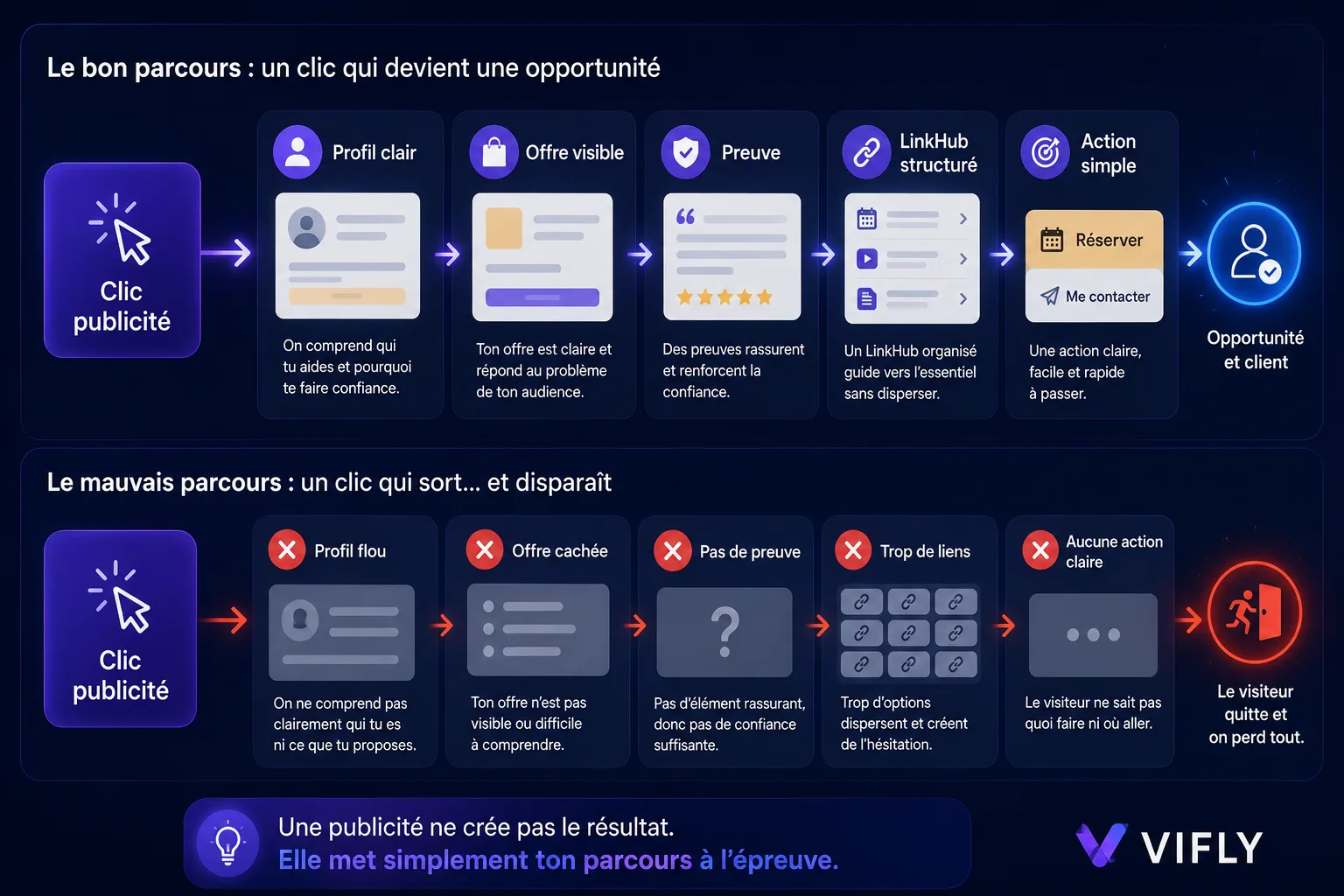
6. Contact requires too much effort
Send me a private message may work at first. But as soon as you send paid traffic, every friction counts.
If the visitor has to write a DM, ask for rates, wait for your answer, explain his/her need, offer schedules, restart, receive a payment link and confirm manually, you increase the chances of losing the person at each step.
For a coach, consultant, therapist, trainer or independent, a clear booking page can reduce this friction. With VIFLY Booking, the idea is not to strengthen the appointment making. The idea is to make the next step obvious when a person is already interested.
An advertisement costs money. Each unnecessary step after the click increases the risk of wasting this budget.
7. You don't measure the right conversions
An advertising account can display good numbers and remain misleading.
A click, page visit or content view may not be worth a quote request, reservation, registration or purchase. Advertising platforms need signals to understand what really matters to you. Google defines a conversion as an action that you consider useful, such as a purchase, registration or other important action, and its tracking helps to understand which ads actually create value.
Meta also offers diagnostics of relevance to understand underperforming advertisements, and its auction system takes into account an estimate of the likelihood of interaction or conversion. TikTok explains that its Pixel allows to measure traffic, advertising performance and optimize campaigns from web events.
The important point is not to install tools to do just like everyone else. The important point is to measure the right actions.
For VIFLY, for example:
an account creation; a creation of LinkHub; a contact request; Booking; a purchase; registration to a resource; a click to a priority offer.
Action to be taken today
List the three actions that actually have value for your creator business. Then check if your ads measure these actions, not just clicks.
Advertising tests your clarity more than it creates it
An advertisement reveals what happens when new people discover your universe.
If they quickly understand your value, they move forward. If they hesitate, they slow down. If they don't understand, they're leaving.
It's brutal, but useful.
A campaign that does not convert does not necessarily mean that your project is bad. It can simply show that there is a missing step in your journey: a better page, a clearer offer, more visible proof, a more direct CTA, a better organized LinkHub or a simpler reservation.
This is why Article VIFLY More subscribers? Create a path that converts is directly related to advertising. Before looking for more visibility, you must prepare what will accommodate this visibility.
Practical examples tailored to your creator business
Content creator
You launch an advertisement to promote a content or page. People click, but don't subscribe, don't download anything and don't contact you.
The problem may come from a clear absence of action. Your content attracts, but your profile does not say what you propose. Your bio link contains too many options. Your main offer is not visible.
What needs to be corrected: a clear sentence at the top of the profile, a priority link, a resource or an offer put forward, a simple CTA.
The article on micro-influence and monetization of a small audience goes in the same direction: a small audience can become useful if it understands what to do next.
Coach or consultant
You pay for requests for open calls. People click, but don't book.
The problem may come from a lack of confidence. Your page may explain your services, but not enough about the problem, the process, the benefits, the limits, the evidence or the next step.
What needs to be corrected: a clearly named offer, an example of customer situation, a precise format, a duration, a realistic promise, a visible booking button.
Trainer
You advertise for training. Clicks are coming, but registration remains low.
The problem can come from too general an offer. Digital marketing training is less clear than learning how to structure an offer and a simple sales page to sell its services online. The first informs. The second one talks to a pain.
What needs to be corrected: target audience, level, expected outcome, content, evidence, format, price or call for action.
Freelance or independent
You advertise for your services. Visitors arrive, but don't ask for a quote.
The problem may come from a path that is too passive. If the visitor has to guess your rates, your services, your availability or your way of working, he can leave even before writing to you.
What needs to be corrected: short service pages, examples, specialties, simple form, appointment making or quotation request clearly visible.
Entrepreneur
You send traffic to a page or offer. Clicks exist, but sales do not follow.
The problem may come from a gap between the advertising promise and the page. Advertising promises a simple solution, but the page has too many details, too many options or not enough evidence.
What needs to be corrected: aligned message, priority offer, reduction in number of choices, visible evidence, repeated CTA without aggressiveness.
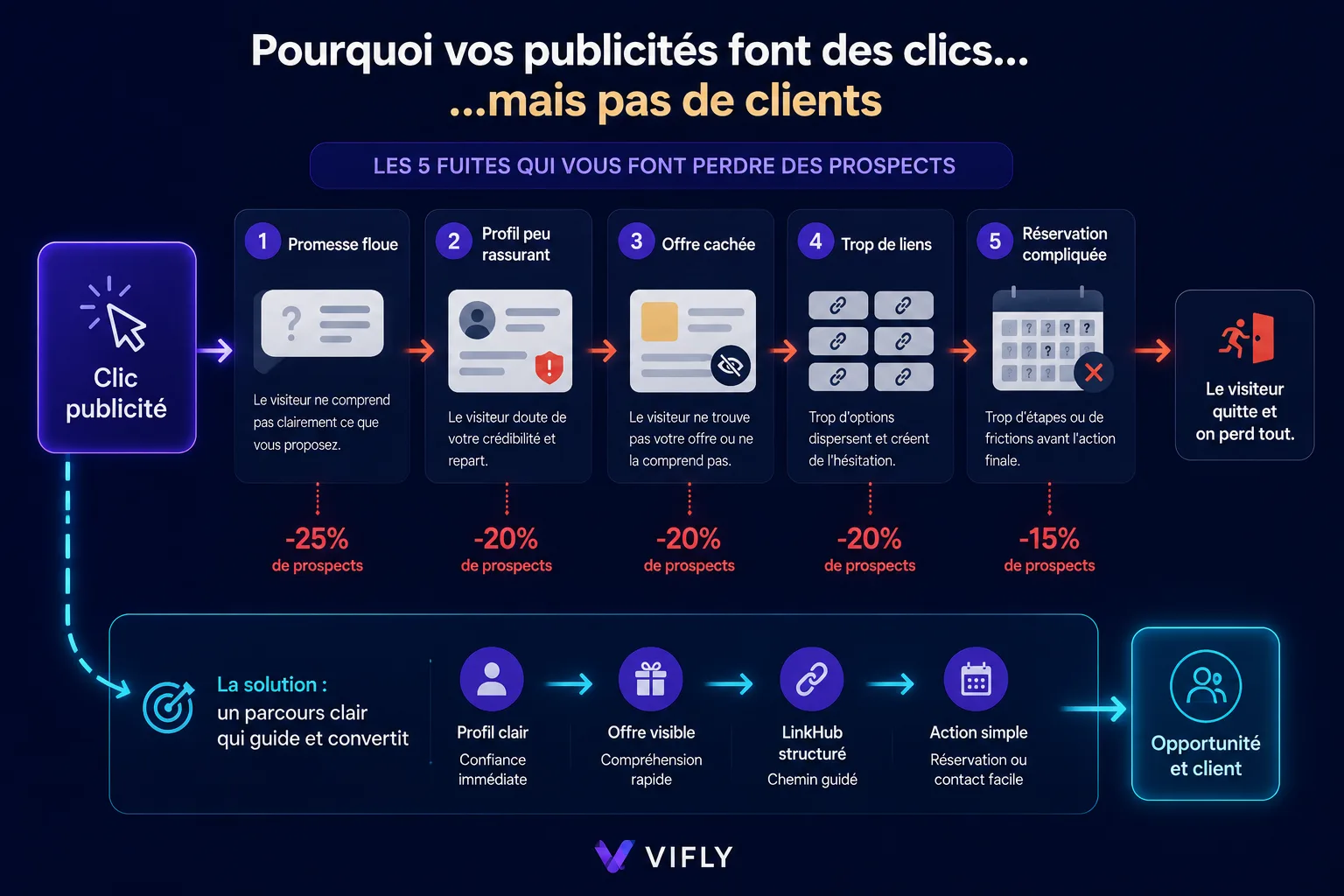
The right question isn't how to get more clicks
The right question is: What happens after the click
A creator or independent can easily spend hours optimizing a hook, miniature, budget or targeting. These things matter. But they're not enough.
If the destination does not reassure, traffic does not become an opportunity.
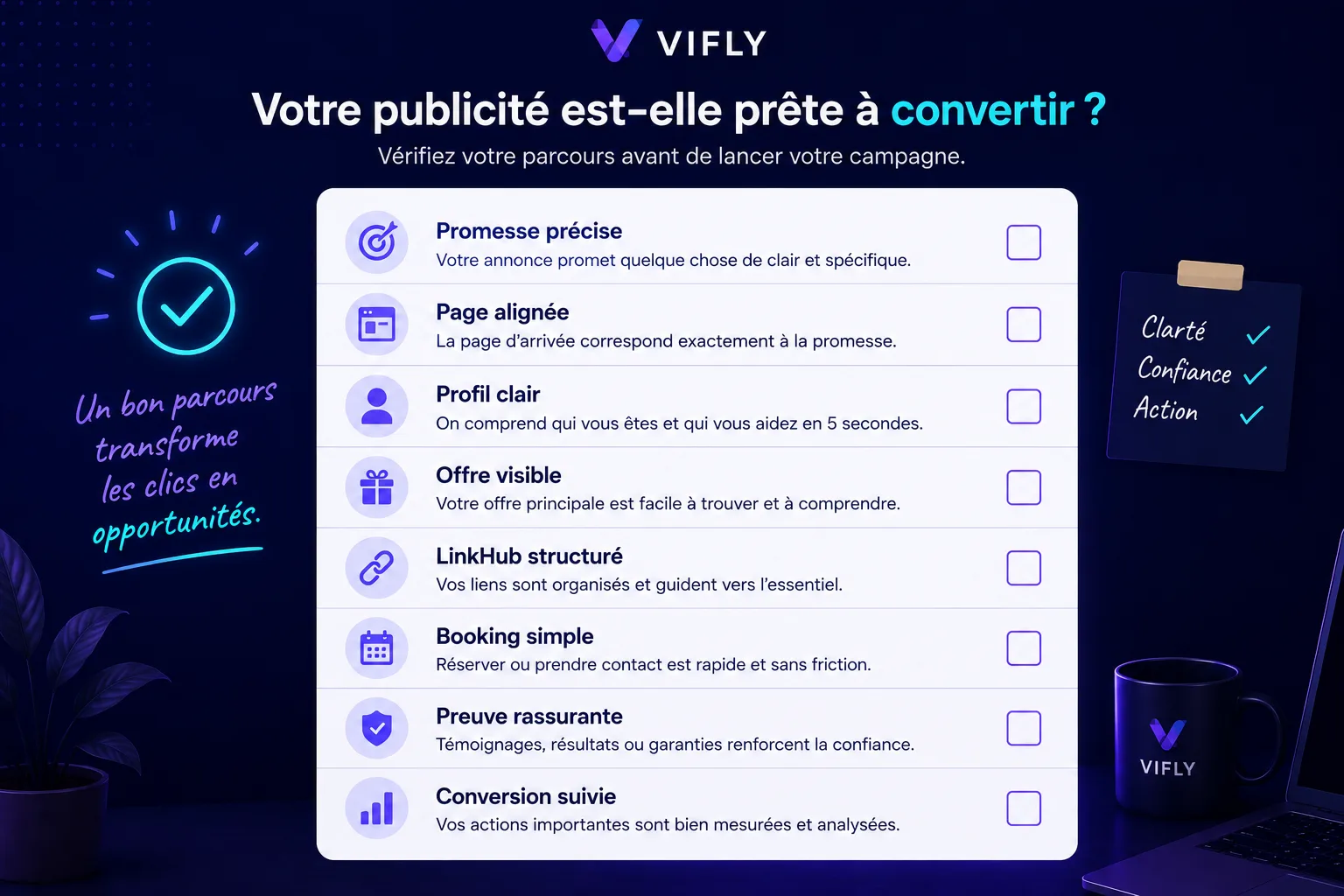
Before launching or restarting an advertisement, check these points:
Does your announcement promise anything specific? Does the arrival page repeat this promise? Does your profile clearly explain who you are helping? Is your offer visible without looking? Does your main link guide to priority action? Is your reservation or contact simple? Are your important conversions followed? Is your page fast, readable and mobile?
Profitable advertising often starts before the campaign. It begins with the clarity of the course.
The simple model: Attention, confidence, action
Most campaigns fail because they want to go too fast.
They seek action before building trust. Or they seek trust without giving a next step. Or they draw attention to a page that doesn't know what to do with this attention.
A better course is based on three levels.
Attention
Advertising must attract the right people, not just a lot of people.
She must speak to a specific pain, with a promise understandable and consistent with your offer.
Trust
The destination must reassure.
This requires a clear profile, evidence, examples, a professional tone, a readable offer, consistency between your content and your page.
Action
The visitor must know what to do.
Settle. Discover the offer. Download. Ask for a quote. Sign up. Buy. Contact.
If he has to guess, you lose.
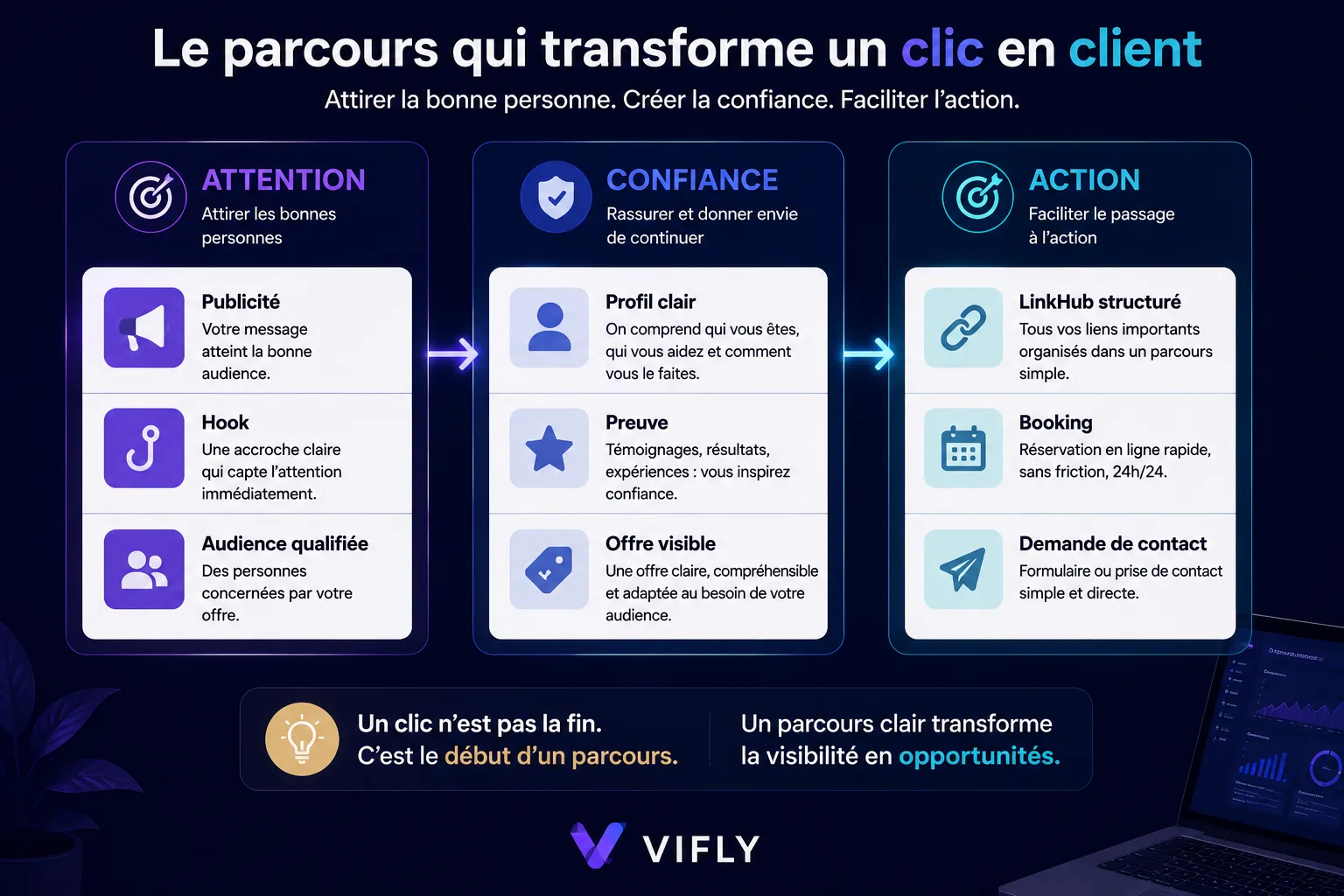
How VIFLY integrates naturally into this journey
VIFLY is not meant to replace your advertisements. Advertising remains an acquisition channel. It allows you to reach new people, test a message, highlight an offer or restart an audience.
But VIFLY can help you better receive this attention.
With VIFLY, you can structure a clearer digital presence: a profile, offers, content, important links and a simpler way to action.
With VIFLY LinkHub, you can avoid sending visitors to a confusing list of links. You create a page that prioritizes what really matters: your offer, your resource, your reservation, your contact, your important content.
With VIFLY Booking, you can simplify the appointment making. This is particularly useful if your advertisement is intended to generate qualified calls, audits, sessions, consultations, coaching or requests.
The goal isn't to make a nicer one. The goal is to reduce friction. An interested person should not have to look for your offer.
She shouldn't have to guess how to contact you. She shouldn't have to search your DMs to book. It should quickly understand the next step.
Checklist before launching an advertisement
Before you put a euro in a campaign, take a few minutes to check your course.
Does your advertisement speak to a specific pain? Is your promise realistic and consistent? Does your destination match the announcement exactly? Does your page load quickly on mobile? Does your profile inspire confidence in less than 5 seconds? Is your main offer visible? Is your CTA clear? Is your bio link organized? Is your reservation or form simple? Are your important conversions followed? Do you have proof, an example or a resource that reassures you? Do you know what you're going to measure after the campaign?
If more than one answer is "no", your priority may not be to increase the budget. Your priority is to clarify the path.
Missed advertising can be good news
Yes, it is frustrating to pay for clicks that do not become customers.
But a campaign that does not convert can also give you valuable information: something blocks in the course.
Maybe your promise attracts the wrong people. Maybe your page doesn't reassure you enough. Maybe your offer isn't clear enough. Maybe your bio bond disperses. Maybe your booking system is taking too much effort. Maybe you're measuring the wrong signals.
The worst reaction would be to conclude: The best reaction is to ask: Where do we lose those interested
It is this question that turns advertising expenditure into useful learning.
Conclusion: clicks are not the problem. The vacuum after the click, yes.
An advertisement can make you visible faster.
But it does not replace a clear message. It does not replace a legible offer. It does not replace proof of trust. It does not replace a structured link. It does not replace a simple reservation. It does not replace a course.
If your ads make clicks but no customers, don't just look at your campaign. Look what happens next.
The advertising attracts attention. Your profile must reassure you. Your offer must be clarified. Your LinkHub must guide. Your Booking must be easy.
That's where the click can become a real opportunity.
Create a clearer course with VIFLY
You want to stop sending your visitors to a blurred route?
With VIFLY, you can centralize your links, present your offers, structure your profile, facilitate your bookings and give a real follow-up to your visibility.
Discover VIFLY, structure your LinkHub and simplify your appointments with VIFLY Booking.
Do not pay to lose opportunities after the click. Build a clear path.
FAQ - Frequently Asked Questions
Why do my ads make clicks but not customers?
Because the click does not guarantee the intention to buy. The problem can come from targeting, promise, arrival page, profile, offer, bio link, lack of confidence or too complicated a route after the click.
Can good advertising sell a bad offer?
It can generate curiosity, but it cannot make a clear offer in place of the visitor. If the offer is blurred, too broad or poorly presented, advertising may mainly send more people to a hesitation.
Should an advertisement be sent to your website, profile or bio link?
It depends on the objective. A specific offer often deserves a dedicated page. A larger discovery can lead to a well-structured LinkHub or profile. The important thing is that the destination corresponds to the promise of the announcement.
What indicators should be given priority?
The cost per click may be useful, but it is not enough. You must also look at important conversions: requests, reservations, registrations, purchases, forms, clicks to the offer or account creations according to your objective.
How to improve an ad that does not convert?
Before increasing the budget, check the consistency between the ad and the destination, clarify your offer, simplify your CTA, reduce unnecessary choices, add evidence and measure the right conversions.