
When technology swallows culture
In late 2025, court documents revealed the existence of Project Panama, a secret programme by Anthropic, the company behind the AI Claude. The aim? “To destructively digitise every book in the world” to train artificial intelligence models.
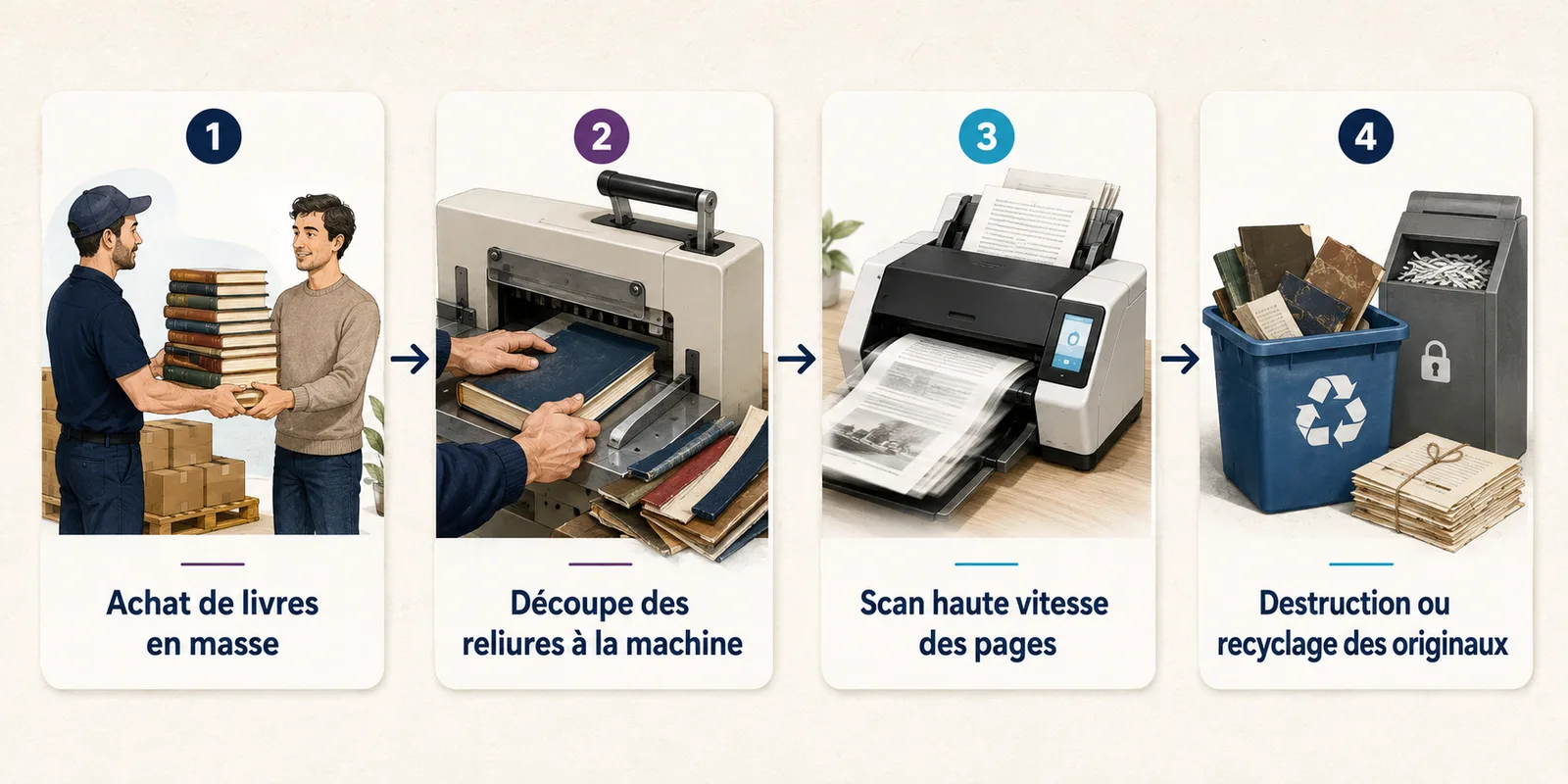
In practical terms : millions of second-hand books bought, spines cut by a hydraulic machine, pages scanned en masse, then the originals destroyed or recycled.
Why ‘destructive’? Because it is quicker and cheaper to cut the binding and scan the pages in batches than to digitise a book page by page whilst preserving it.
Result : knowledge extracted, models fed, and originals lost forever.
Why AI companies do this
Massive amounts of ‘clean’ data
AI models require astronomical amounts of text to learn. Books, particularly those published before 2022, are considered ‘clean’ sources: they do not yet contain any AI-generated text, which prevents the phenomenon of ‘model collapse’ (where the AI trains on its own outputs and loses quality).
A contested but validated legal framework
In June 2025, a US federal judge ruled that the destructive digitisation of books legally purchased by Anthropic constituted “fair use" (fair use), provided that the digital copies were not redistributed.
However, downloading pirated books to train AIs has been ruled illegal.
A practice that is becoming more widespread
Second-hand booksellers in Europe and the United States are reporting massive and unusual orders for rare or obscure books, potentially intended to be scanned and then destroyed.
What this says about the value of your content
Your content is just data like any other
If companies are prepared to destroy entire books just to extract text, then your online content – articles, posts, videos and training courses – is also potential data that can be used to train models.
The question is not whether this is right or wrong. The question is: Is your content clear, well-structured and relevant to your offering, so that it’s not just free information, but a tool to drive conversions?
How to protect and promote your content in 2026
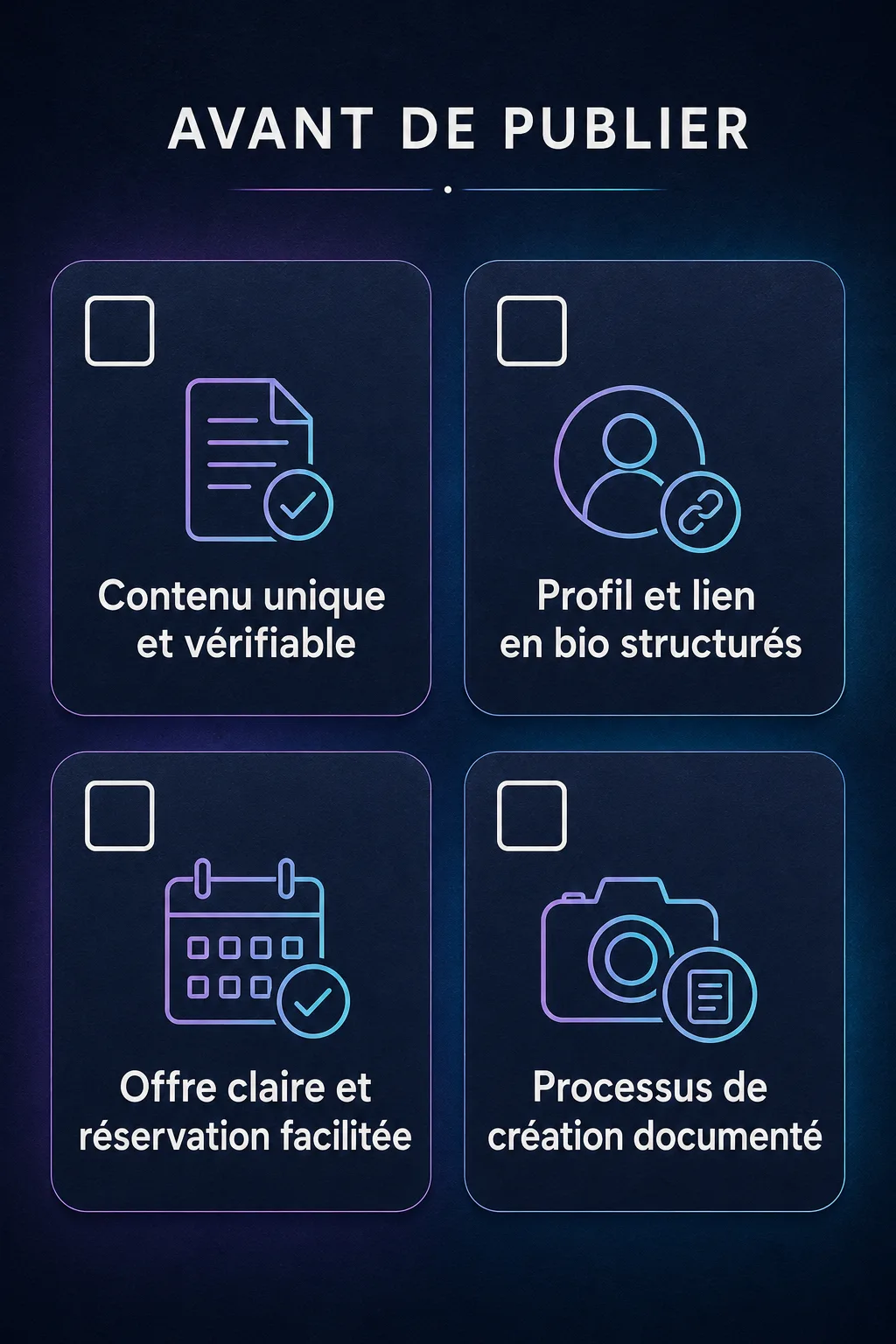
1. Make your content unique and verifiable
Google and other search engines are increasingly prioritising content that provides human added value : experience, expertise, practical examples, case studies, original data.
Action to be taken:
- Add personal examples, feedback from your own experience and figures that only you can provide.
- Cite your sources, show your methods, and explain your reasoning.
- Avoid generic content that is too similar to what any AI could generate.
2. Structure your profile and your bio link
A clear profile, a well-organised link in your bio and visible offers turn your visibility into opportunities.
Common error: Having a link in your bio that looks like a “graveyard of links”: too many links, no hierarchy, no clear call to action.
Action to be taken:
- Use a tool such as VIFLY LinkHub to centralise your links, highlight your main offers and guide your audience towards a clear call to action (book, buy, sign up).
- Add a visible CTA to your bio: “Book a call”, “Discover my offer”, “Download my guide”.
3. Clarify your offer and make booking easier
If your audience doesn’t understand what you’re selling, or if it’s too complicated for them to get in touch, you’ll miss out on opportunities.
Action to be taken:
- Use VIFLY Booking to create a simple booking page, featuring your services, prices, availability and a contact form.
- Add testimonials, case studies and guarantees to build trust.
4. Document your creative process
Google recommends specifying how your content is created, especially if you’re using AI tools.
Action to be taken:
- Adds the note “Content written with the help of AI tools, validated and enriched by a human expert” if applicable.
- Showcase your expertise: who you are, why you’re a credible authority, and how you work.
Where does VIFLY fit into all this?
Turning your visibility into a clear journey
VIFLY isn’t just another tool. It’s a platform designed to help you structure your digital presence, centralise your links, showcase your offers, manage your bookings and turn your audience into customers or leads.
In practice:
- VIFLY LinkHub : to organise your links, highlight your offers and guide your audience towards a clear call to action.
- VIFLY Booking : to create a simple booking page, featuring your services, prices and availability.
- VIFLY Profile Roast : to analyse your profile and identify areas for improvement.
If you want to take it a step further, you can find out more how to structure your bio link to convert or how to create a clear and convertible offer.
Key points
- Project Panama reveals that AI companies are destroying books to extract text and train their models.
- Your content is just data like any other : if it is not structured, clear and linked to an offer, it risks remaining nothing more than free data.
- Visibility is no longer enough : you need a clear profile, a well-organised link in your bio, a clear offer and a straightforward booking process.
- VIFLY helps you turn your visibility into a clear journey : LinkHub to centralise your links, Booking to make bookings easier, Profile Roast to analyse your profile.
Conclusion
AI destroys books to feed itself. But you’re not a book. You’re a creator, a coach, a consultant, a self-employed person, a trainer, a freelancer, an entrepreneur.
Your content has value. But that value only translates into opportunities if your profile, your offering and your background are clear.
Don’t let your visibility be just free data. Structure it, clarify it, convert it.
Follow VIFLY to turn your visibility into a clear journey.
FAQ – Questions relating to this topic!
Q1: What is Project Panama?
R1: Project Panama is a secret programme run by Anthropic (the company behind the AI Claude) which aims to destructively digitise millions of books to train AI models.
Q2: Why are AI companies destroying books?
R2: To quickly and cost-effectively extract ‘clean’ text (without AI-generated content) to train their models.
Q3: Is it legal to destroy books to train an AI?
R3: In 2025, a US federal judge ruled that the destructive digitisation of legally purchased books constituted fair use, provided that the digital copies were not redistributed.
Q4: How can I protect my online content from AI?
R4: Make your content unique and verifiable, structure your profile and the link in your bio, clarify what you offer and make it easy to book, and document your creative process.
Q5: How can VIFLY help me make the most of my content?
R5: VIFLY LinkHub centralises your links, VIFLY Booking makes bookings easier, and VIFLY Profile Roast analyses your profile to turn your visibility into opportunities.
Source block
- Le Figaro, “‘We don’t want anyone to know’: Anthropic destroyed millions of books to train its AI”, 30 July 2026.lefigaro
- 20 Minutes, “FACT CHECK – Have AI giants bought up the rarest books to scan them before destroying them?”, 30 July 2026.tf1info
- The Verge, “Anthropic Destroyed Millions of Books to Train Claude”, 29 July 2026.yahoo
- The Washington Post, “Inside an AI start-up’s plan to scan and dispose of millions of books”, 27 January 2026.washingtonpost
- Usbek & Rica, “Project Panama: how US AI stripped down millions of books”, 9 February 2026.news
- France Info, “Why is Anthropic destroying books to train its AI?”, 28 July 2026.
- Le Monde, “AI scandal: thousands of antique books bought, digitised and then destroyed”, 1 July 2026.clubic
- Numerama, “Project Panama: this company is destroying millions of books to train its AI”, 30 July 2026.
- The Atlantic, “Artificial intelligence systems operate using thousands of pirated books”, 2 October 2023.ladn
- Google Search Central, “Google Search’s Guidance on Generative AI Content on Your Site”, 10 December 2025.
- VIFLY Blog, “Tips for creators: visibility and monetisation”, 2026.