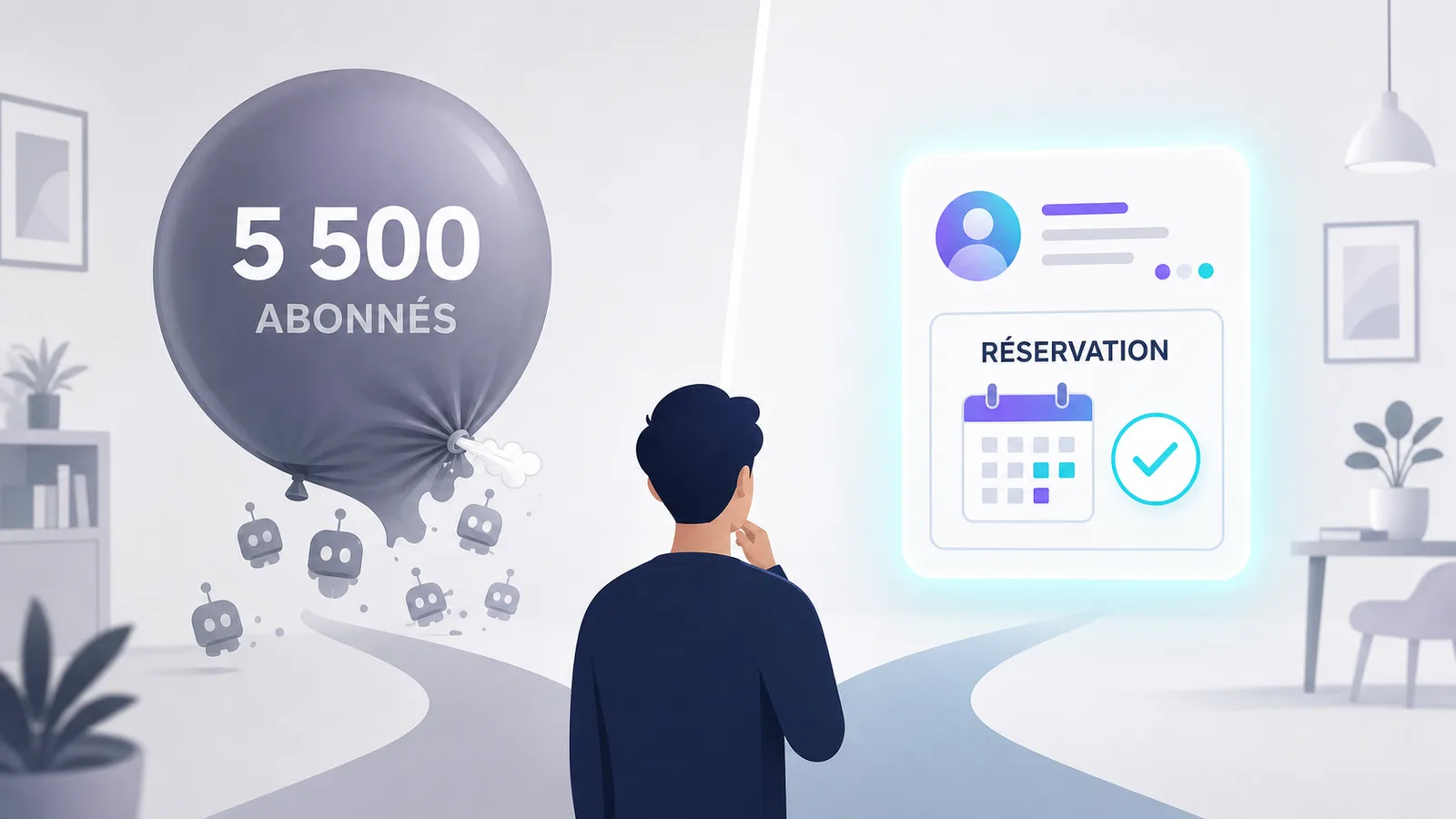
The temptation is understandable. The trap is very real.
You have 340 followers. Your competitor has 12,000. An advert promises you 5,000 ‘real and active’ followers for 29 euros, delivered within 48 hours. At first glance, the equation seems simple: more followers equals greater credibility, and therefore more customers.
This equation is wrong. And it’s all the more so for you as a creator, coach, consultant or freelancer, as your creator business model isn’t based on the number of followers, but on what those followers do next: book a call, buy a course, sign up for a workshop.
This article isn’t going to lecture you. It’s going to show you, step by step, what buying followers actually does to your visibility, your credibility and your turnover. And then what works instead.
The short answer: no, and here’s why, in three points
Buying followers is a bad idea for three reasons that reinforce one another.
First reason: it’s prohibited by the platforms
The terms of use for Instagram, TikTok and YouTube explicitly prohibit the purchase of fake engagement. Instagram regularly removes inauthentic accounts and may restrict accounts that benefit from such practices. This is not a grey area: it is set out in black and white in their rules.
Second reason: it destroys your organic reach
This is the least understood aspect, and the most costly. We’ll come back to this in detail.
Third reason: it doesn’t sell anything
A purchased subscriber never books a coaching session. They never click on your link. They never become a client. Yet if you’re reading this article, it’s probably because you want to sell something.
Key points : buying followers inflates view figures whilst undermining the only two metrics that matter to a professional: actual reach and conversion rate.
The mechanism nobody explains to you: the ‘poison’ effect on the algorithm
How platforms measure your content
The algorithms used by Instagram, TikTok and LinkedIn do not distribute your content based on the number of followers you have. They distribute it based on relative engagement: of the people who see your post, how many interact with it (likes, comments, shares, viewing time)?
An account with 1,000 followers and 80 interactions per post is considered more valuable than one with 10,000 followers and 90 interactions. The latter has an engagement rate ten times lower, and the algorithm interprets this as a sign of low-relevance content.
The killer calculation
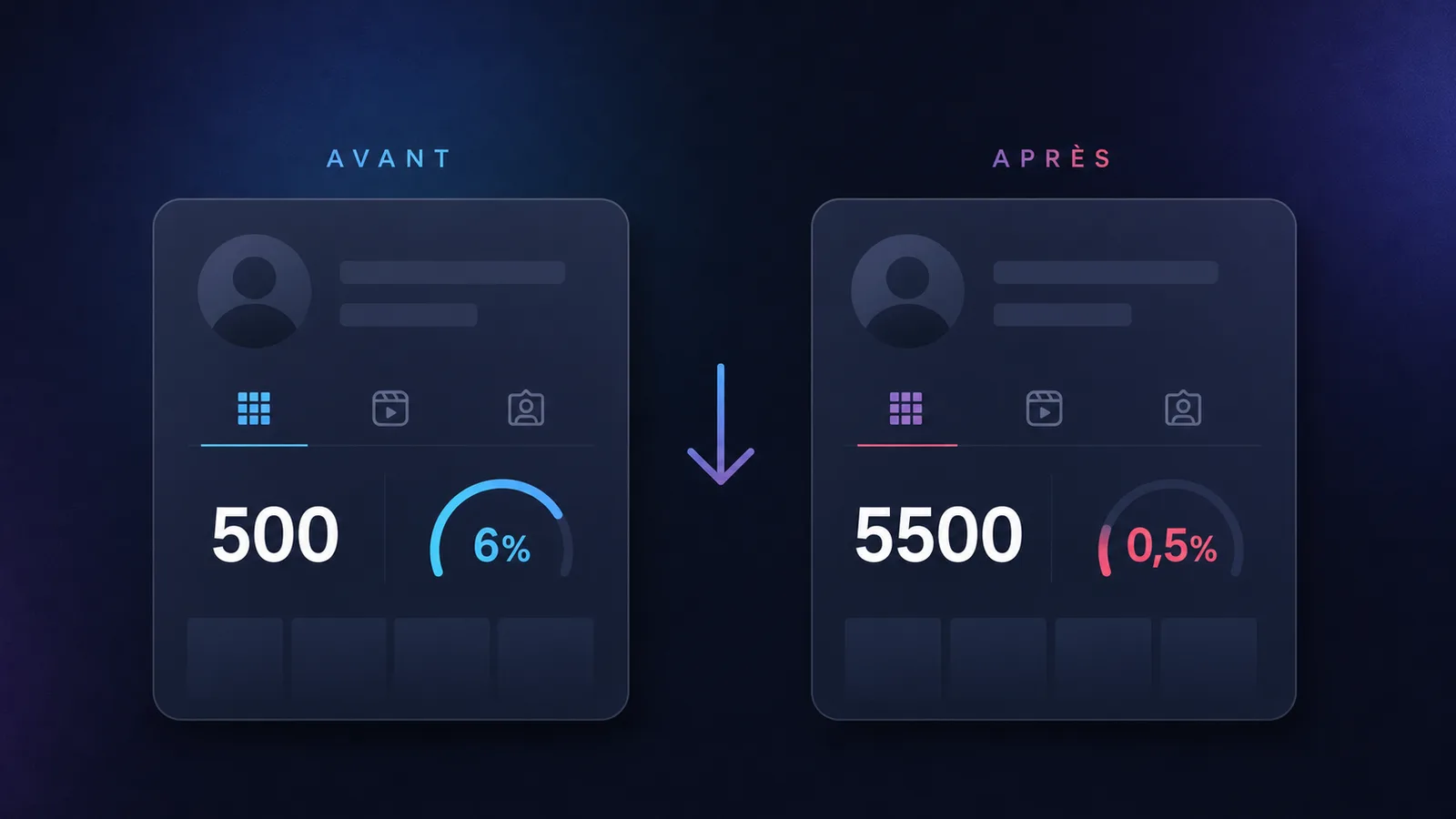
Let's do the math. You have 500 actual subscribers and a commitment rate of 6 %, or about 30 post interactions. You buy 5 000 subscribers. Your account now displays 5 500 subscribers, but your interactions remain at 30] false accounts do not interact, or in a robotic and detectable way.
Your commitment rate drops to 0,5 %. For the algorithm, your content has just become ten times less interesting. Result: your 500 real subscribers see your publications less often. You paid to reduce your own visibility.
And that's not all: future delivreability
Platforms keep a history of your account. Waves of inactive or deleted subscribers, peaks of abnormal growth followed by massive unsubscribes: these signals remain attached to your profile. Even after you stop buying, you can drag a degraded "trust score". Recovering takes months sometimes longer than building cleanly since the start.
“But social proof matters, doesn’t it?”
Yes. Social evidence is very important. That's precisely why fake subscribers are so dangerous: they ape the social proof without having the substance, and people who matter to your creator business know how to make a difference.
The test everyone does in ten seconds
A prospect that hesitates to book with you almost always does the same thing: it opens your profile, looks at your number of subscribers, and then your last three posts. 15 000 subscribers and 12 likes by photo? The verdict falls instantly, and it is worse than a small account assumed: "this person buys his credibility.".
For a coach, therapist or consultant, whose job is based entirely on trust, this verdict is repudiatory. You sell your credibility. You can't afford it to be visibly rigged.
What brands and partners check
If you are aiming for collaborations, know that brands use audit tools (audience quality analysis, detection of false followers) before any partnership. An artificially swollen audience is detectable in a few clicks. The market for influence marketing has become more professional: vanity metrics have not been enough for a long time.
Common mistake believe that "everyone does this." No: Accounts that last and sell have hearings consistent with their commitment. The others end up paying it, in range or reputation.
Is that legal, by the way?
The question often comes back, and the answer has two floors.
Buying subscribers is not a criminal offence per se
in France. You can't sue for the purchase itself.
But using it in a commercial context can be a problem
If you are a professional and your inflated audience numbers are used to obtain contracts, partnerships or mislead clients, you enter the territory with misleading business practices. In the United States, the FTC has already sanctioned the sale of false indicators of influence. In France, the law of 9 June 2023 governing commercial influence has reinforced the transparency obligations of professional creators the regulatory climate is clearly moving towards more control over the authenticity of hearings, no less.
In other words: the legal risk today is moderate, but the trajectory is unfavourable, and the contractual risk (a brand that discovers and breaks the partnership) is real.
The three scenarios where buying followers causes the most damage
Coach or therapist
Your client buys a trust relationship before buying a service. A profile to 20 000 subscribers with empty comments ("Nice pic!" accounts without photo) destroys exactly what you sell. Better 400 subscribers including 40 who really comment.
The content trainer or creator
Your sales argument is your visible expertise. However, the training launches work on the commitment: answers to stories, free workshop registrations, clicks on the link. A dead audience doesn't launch anything. Worse: it distorts your statistics and prevents you from understanding what actually works.
Consultant or freelance B2B
Your prospects are professionals. They're auditing. A director who discovers you on LinkedIn or Instagram will check the consistency of your presence before booking a call. Incoherence/engagement is the easiest warning signal to detect.
Practical example : a communication consultant changes from 800 to 6 800 subscribers in one week via a purchase. A prospect, before signing a mission at 3 000 €, consults his profile: 11 likes on average per post. He chooses a competitor to 1 200 subscribers but to highly commented posts. The purchase not only cost 39 € it cost a mission.
What really works for growth (and conversions)
If the purchase of subscribers tries to solve a real problem seem credible and get customers faster then let's tackle this problem directly.
1. Credibility comes not from the meter, but from clarity
A visitor decides in seconds if you are legitimate. What convinces him: a bio that says exactly who you work for and what result you bring, posts that demonstrate your expertise, and a clear path to action. Not a five-zero number.
2. Content that answers a real question beats an inflated account
Publish less, but publish what your ideal clients are really looking for. A post that specifically responds to an objection or a frequent question from your prospects will continue to work for you for months in Google search as in platform recommendations.
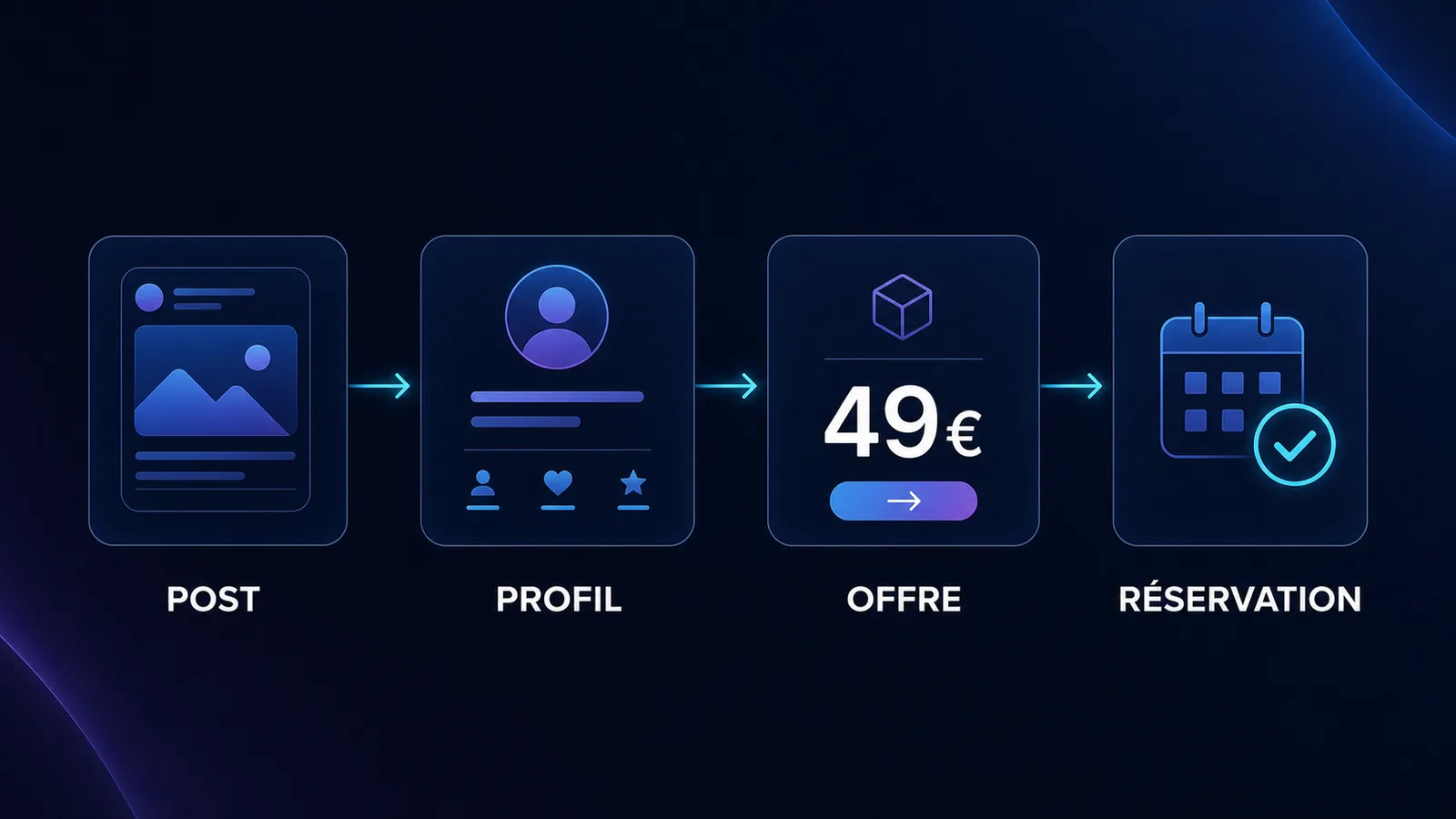
3. Structure the path from discovery to reservation
That is the point that most creators are completely neglecting. They fight for subscribers, then send their visitors to a confused profile where we don't know what they sell or how to book them.
An effective professional profile does three things: it presents your offer in one sentence, it centralizes your important links (content, testimonials, appointment making) and it allows you to book without friction. This is exactly the logic of a LinkHub well built coupled with an online booking system: each profile visitor becomes a potential customer in two clicks, instead of getting lost.
4. Measure what brings, not what flatters
Replace the number of subscribers by three metrics: the commitment rate, the clicks on your bio link, and the reservations or requests generated. An account that stagnates at 900 subscribers but generates 15 reservations per month is in excellent health. An account at 50 000 subscribers that don't generate any is a set.
Action to be taken this week : Open your statistics and write down your average commitment rate on your last ten posts, then the number of clicks to your booking page. These two numbers are your real compass not the subscriber counter.
The link with VIFLY: turning a real audience into real customers
All of the above converges on a simple idea: your problem is probably not the number of subscribers, but the lack of structure between your visibility and your revenues.
With VIFLY, you build this structure : a LinkHub which centralizes your content, offers and real social evidence (testimony, case studies), and a module of online booking which allows a convinced visitor to block a niche immediately, without exchanging messages.
As a result, you no longer need to look fat. You need to be clear and every real subscriber really counts.
Conclusion: the only shortcut that exists
Buying subscribers promises a shortcut to credibility. It delivers the opposite: a degraded range, a damaged confidence, unusable statistics and a risk of sanctioning platforms.
The real shortcut is less spectacular and much more profitable: even a small but real audience, content that answers the real questions of your customers, and a path of conversion without friction between your profile and your calendar. It is a shortcut which is built in a few weeks and which, however, lasts.
Ready to convert your actual audience into customers? Create your VIFLY profile and structure in one afternoon the path that leads from your content to your reservations.
FAQ – Useful frequently asked questions
Buying subscribers is illegal in France?
The purchase itself is not a crime, but it violates the conditions of use of all major platforms. Used in a commercial setting to obtain contracts, it can be found in misleading commercial practices.
Can platforms detect fake subscribers?
Yes. Instagram, TikTok and YouTube have inauthentic account detection systems and regularly remove fake subscribers. Abnormal growth peaks are an easily detectable signal.
How long does it take to recover after a subscriber purchase?
There is no official term. Once false accounts have been removed, it usually takes several months of regular publication and actual commitment to standardize the commitment rate and scope.
Should we have few subscribers or many false subscribers?
Few real subscribers, without hesitation. A small, committed account has a better relative scope, credibility and conversion potential than a large, swollen account.
How to win subscribers quickly without buying one?
Publish content that answers your ideal customer's specific questions, collaborate with your niche accounts, be active in your community's comments, and structure your profile to convert each visit.
Sources
- Instagram — Conditions of use and Community rules (prohibition of inauthentic activity): https://help.instagram.com/581066165581870 and https://help.instagram.com/477434105621119
- Meta Transparency Center — Community Standards, spam and false engagement: https://transparency.meta.com/policies/community-standards/spam/
- TikTok — Terms of Use and Community Guidelines: https://www.tiktok.com/community-guidelines/fr/
- YouTube — Fake Engagement Regulations: https://support.google.com/youtube/answer/3399767
- FTC (Federal Trade Commission) — Actions against the sale of false indicators of influence: https://www.ftc.gov/news-events/news/press-releases/2019/10/ftc-prohibits-company-selling-fake-social-media-indicators
- Law No 2023-451 of the 9 june 2023 to regulate commercial influence: https://www.legifrance.gouv.fr/jorf/id/JORFTEXT000047663185