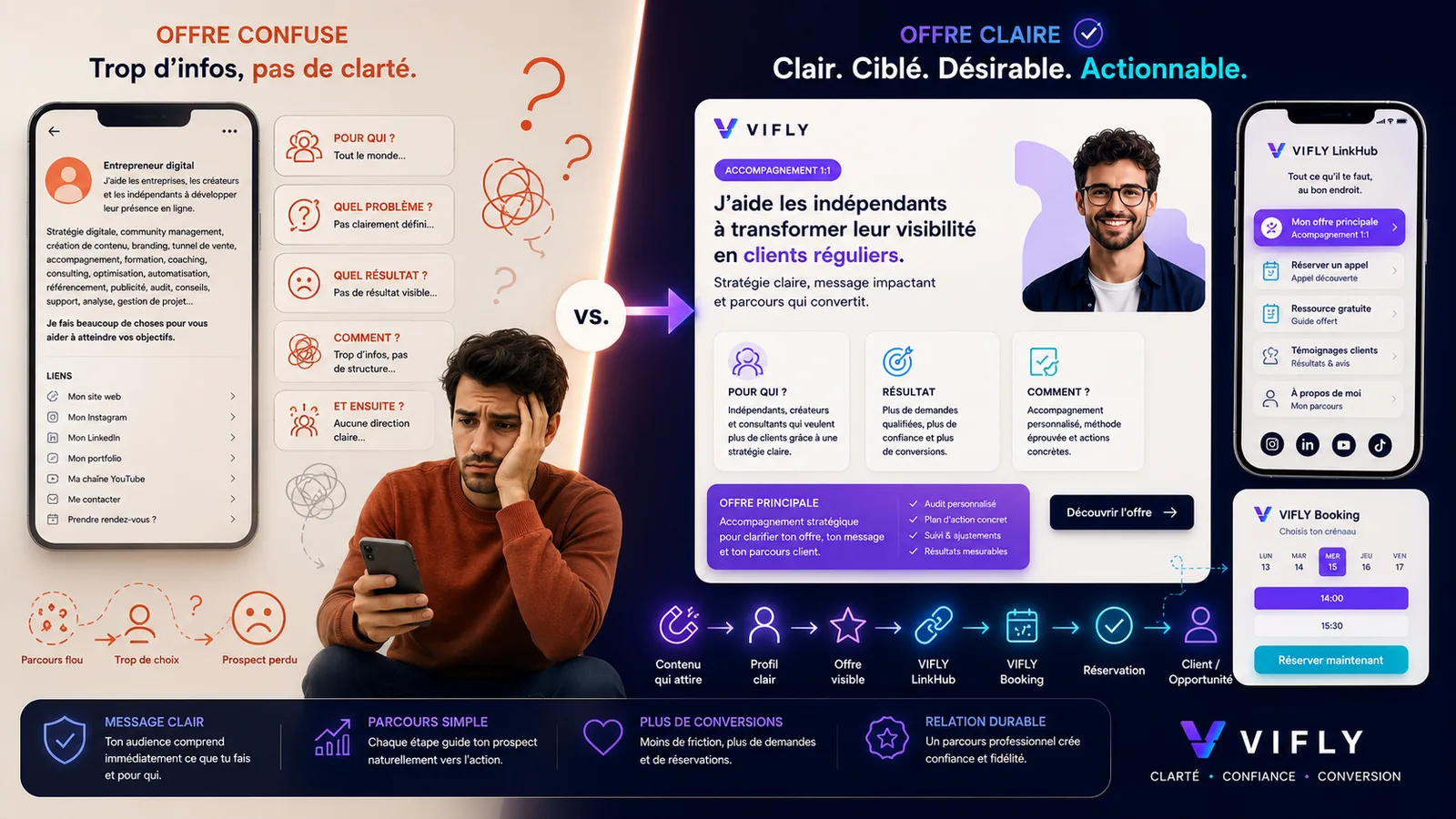
A confused offer doesn't sell. Even when it's good.
Many independents think they have a visibility problem.
They say they don't have enough subscribers, not enough views, not enough scope, not enough requests. Then they publish more. They're improving their visuals. They're changing their bio. They test Reels, LinkedIn posts, carousels, stories.
But sometimes the real problem isn't that people don't see them.
The real problem is that people don't understand quickly enough what they're proposing.
An offer can be serious, useful, well thought out, even very valuable... And yet not to sell. Not because it lacks value, but because it lacks clarity.
A prospect that arrives on your profile doesn't want to guess. He wants to quickly understand what you're doing, who you're doing it for, what problem you're helping solve, what he gets, how it's going, how much it can cost, and what action he needs to do next.
If these answers are not visible, he hesitates.
And on the internet, hesitation often makes the opportunity disappear.
Building a clear offer, therefore, is not just a nice commercial phrase. It's creating a bridge between what you know how to do and what your client understands immediately.
This is where many self-employed people, coaches, consultants, trainers, therapists, freelancers and creators can make huge progress.
Not by yelling louder.
By becoming more legible.
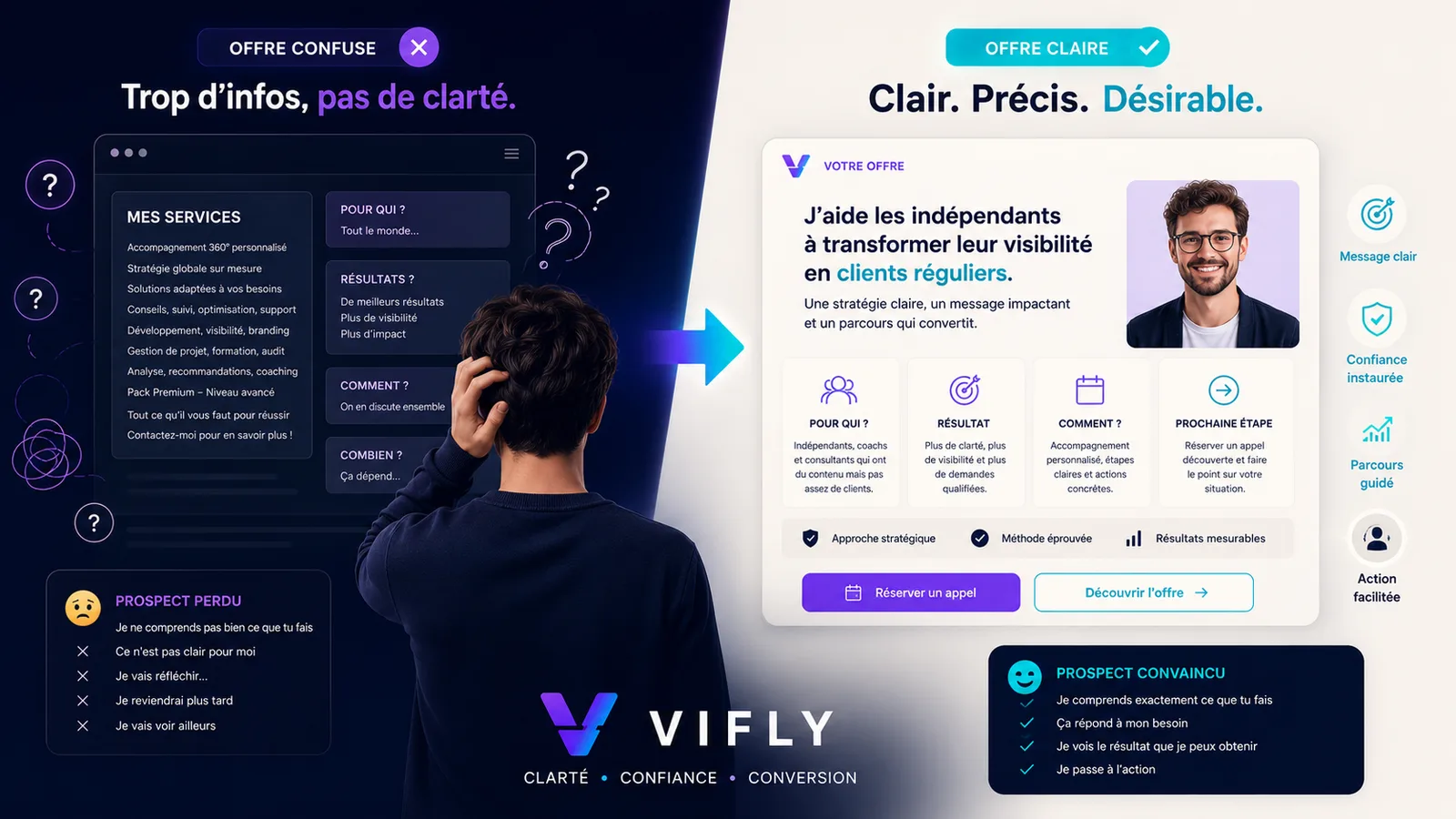
Why a fuzzy offer loses customers
A fuzzy offer doesn't necessarily run away because it's bad. She runs away because she demands too much mental effort.
When someone doesn't understand what you're proposing, they won't always ask you a question. She's not necessarily gonna take the time to reread your bio, search your old posts, open up all your storytelling or write in a private message.
She's moving on.
It's brutal, but that's often how opportunities disappear.
A coach can issue very relevant advice, but never clearly explain his or her support. A consultant can demonstrate real expertise, but not make his offer visible. A freelancer can show great achievements, but let his prospect guess his services. A trainer can give a lot of value, but never indicate how to work with him.
Result: the audience appreciates, but does not take action.
This is exactly the logic explained in the article Why do your subscribers like to... But don't buy anything. A person may like your content, recognize your talent, follow your account, and yet never become a customer if they do not clearly understand what you are selling.
Clarity is not a detail. It's a lever of trust.
And trust often begins with a simple sentence:
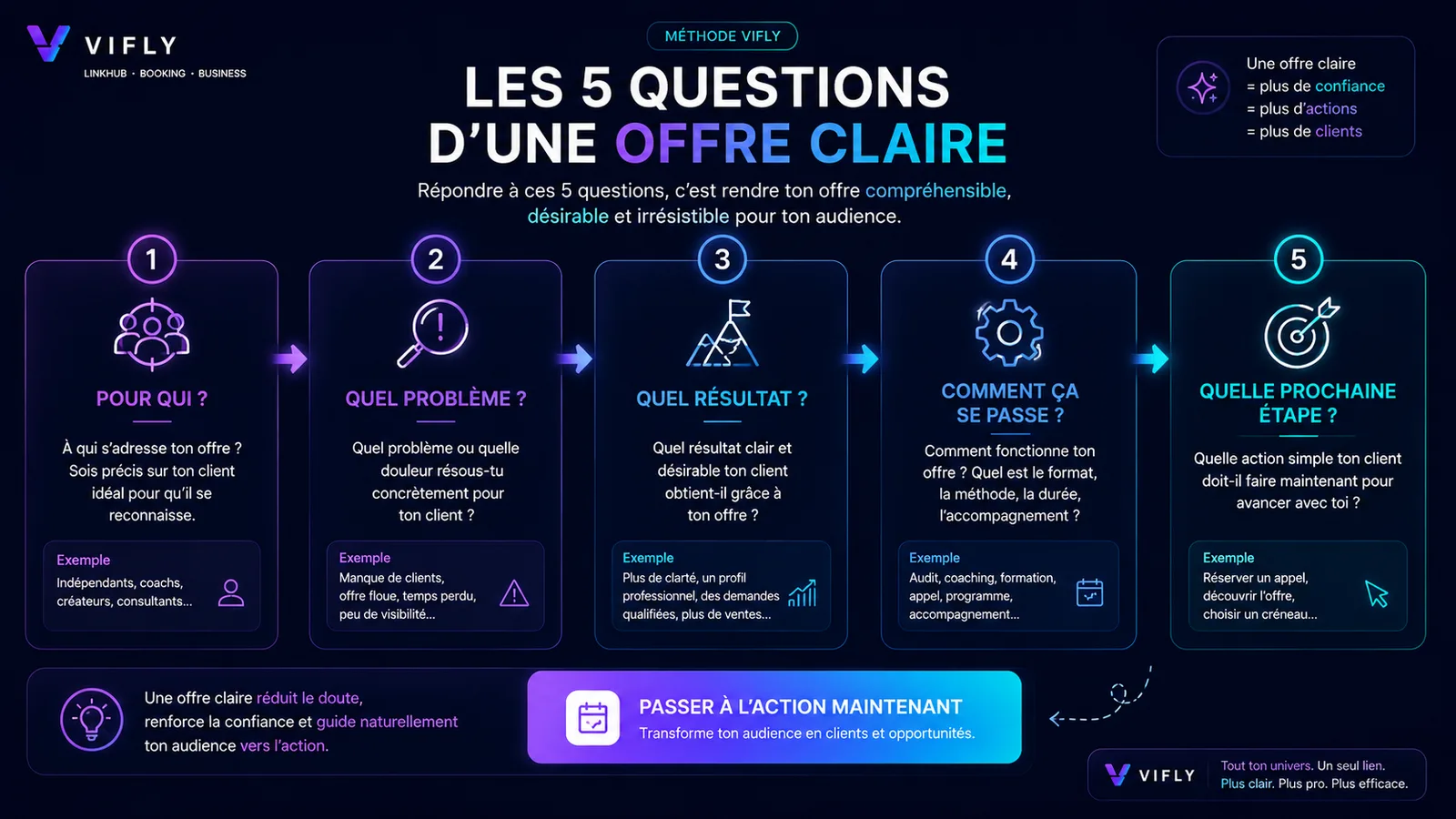
A clear offer answers five questions
A clear offer does not need to be complicated. Above all, she must answer the right questions.
The first question is: who is the offer?
If you're saying, go with entrepreneurs, it's wide. If you say, "J" helps independents who have an audience but few customers to clarify their offer and sales path, it's much more precise.
The second question is: what problem does the offer solve?
Your prospect must recognize a concrete pain. He's not just looking for an accompaniment. It seeks to solve something: lack of customers, blurred profile, poorly presented offers, difficulty selling, fear of posting, appointments that do not fill, content that does not convert.
The third question is: what result can he hope for?
The result must not be an exaggerated promise. It must be tangible, understandable, desirable. For example: clarify your offer, structure your presentation page, get a simpler booking route, improve your bio, create a more coherent content strategy.
The fourth question is: how's it going?
The prospect wants to know whether it is a call, audit, accompaniment, a session, a training, a service delivered, a subscription or a programme. The clearer the operation, the less friction.
The fifth question is: what's the next step?
Book a call. Discover the offer. Send a request. Download a resource. Create your space. Choose a niche. Ask for a quote.
A clear offer does not leave prospect in the middle of the way.
She shows him the rest.
Most common error: sell what you do instead of selling what the client understands
Many independents describe their offer from their own perspective.
They talk about their method, their expertise, their approach, their tools, their experience. All this may be useful, but it's not always what the prospect understands first.
Prospects are not looking for a list of skills.
He's looking for an answer to his problem.
A community manager can say: I manage your social networks. It's clear, but still very broad. A stronger version would be:
A coach can say: I offer a personalized accompaniment. It's vague. A clearer version would be:
A consultant can say, "I do digital strategy." It's professional, but not concrete. A more readable version would be:
A clear offer isn't just saying what you're doing.
She explains why it matters to the person who reads you.
The right question isn't: is my offer complete
The right question is: Does my prospect quickly understand why this offer can help
The simple formula for building a clear offer
You can use a very simple structure:
Help [target] to [result desired] without [main friction], using [method or format].
For example:
"J" helps coaches clarify their offer and Instagram profile to make it easier to turn their subscribers into open calls, without spending hours explaining everything in DM
Or:
“J’aide les freelances à structurer une offre de service claire, lisible et prête à présenter en ligne, grâce à un audit stratégique et une page d’offre complète.”
Or alternatively:
"J" helps trainers present their accompaniments, resources and reservations in a simple way, so that their audience quickly understands how to take action
This formula is not intended for mechanical copying. It serves to clarify your thinking.
Once you know how to say your offer simply, you can adapt it to your bio, your VIFLY page, your LinkHub, your posts, your stories, your booking page and your commercial messages.
Clarity must be found everywhere.
If your offer changes language at each channel, your audience may never really remember it.
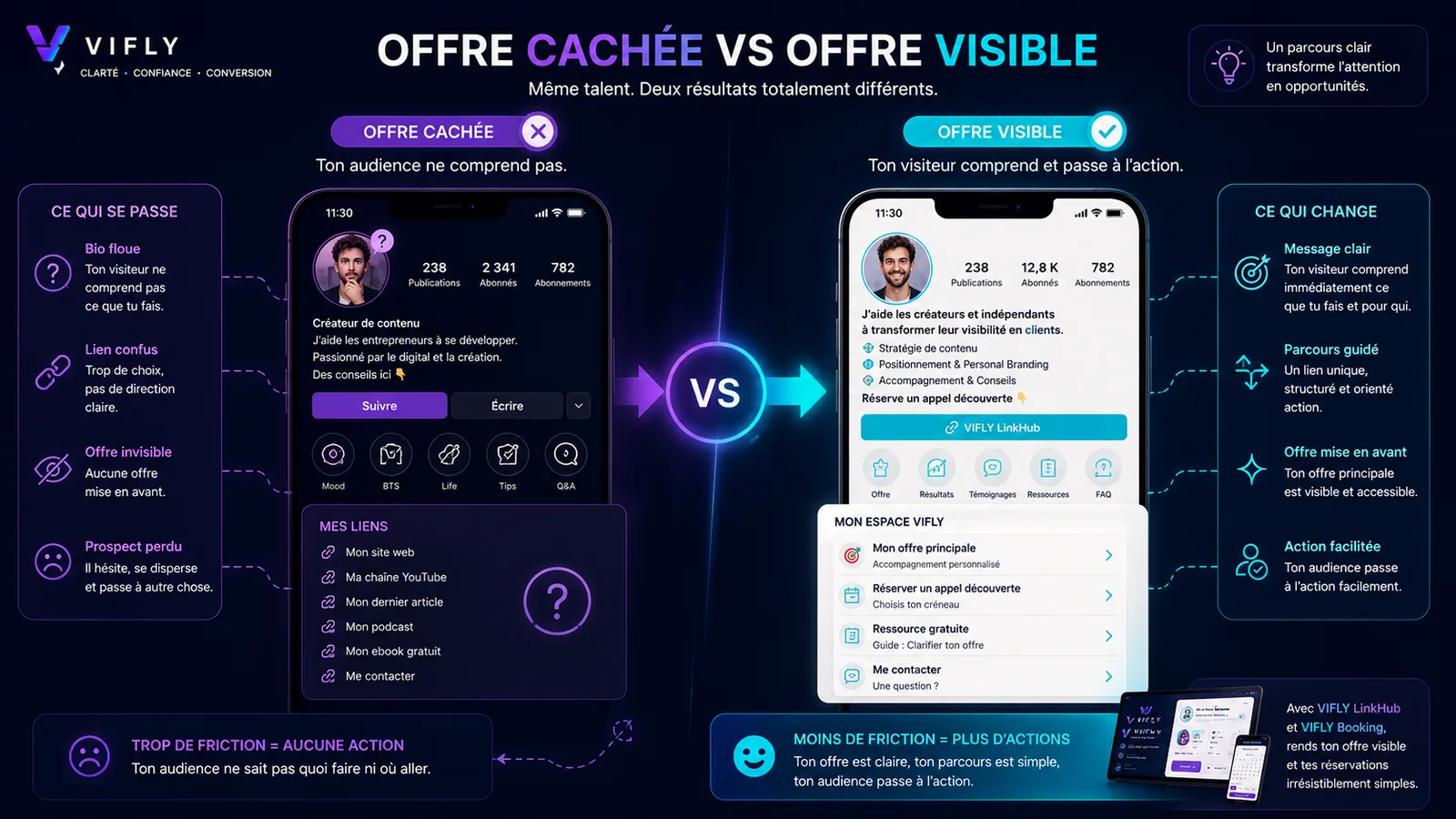
Your offer must be visible before being detailed
Another common mistake is to hide the offer behind too much content.
You publish tips. You share thoughts. You're showing behind the scenes. You value it. All this is important.
But if your offer never appears clear, your audience can follow you for a long time without knowing how to work with you.
It is not about selling heavily every day. It's about making your offer available, understandable and accessible.
On your profile, your offer must be visible in your bio, in your bio link, in your recurring content, in your featured stories, in your call to action and ideally in a dedicated page.
That's why VIFLY LinkHub is particularly useful for independents and creators. Your audience must not reach a cold list of unpriority links. She must quickly understand who you are, what you propose and what action to do next.
A clear bio link can highlight your main offer, a free resource, a booking page, a useful item or a contact request.
Your offer must not fight to be found.
She must guide naturally.
A good offer not only says what you sell, it reduces the doubt
A person may be interested and not buy.
Not because she doesn't want to. But because she doubts.
She wonders if it's for her. If she has the level. If she has the budget. If she gets a result. If you're serious. If you really understand his problem. If she can trust you. If she has to wait. If she needs more information.
A clear offer must reduce these doubts.
For this, it must specify the context. To whom she addresses. She's not speaking to. Which is included. Which is not. The format. Duration. The target result. The level of support. Next step.
An example:
Strategic session of 60 minutes for independents who want to clarify their main offer, reformulate their message and know how to present it on their profile, their bio link and their content
This sentence reassures much more than:
Custom strategy call
She gives a frame.
And a framework reassures.
On the web, what is blurred often seems risky. What is clear seems more professional.
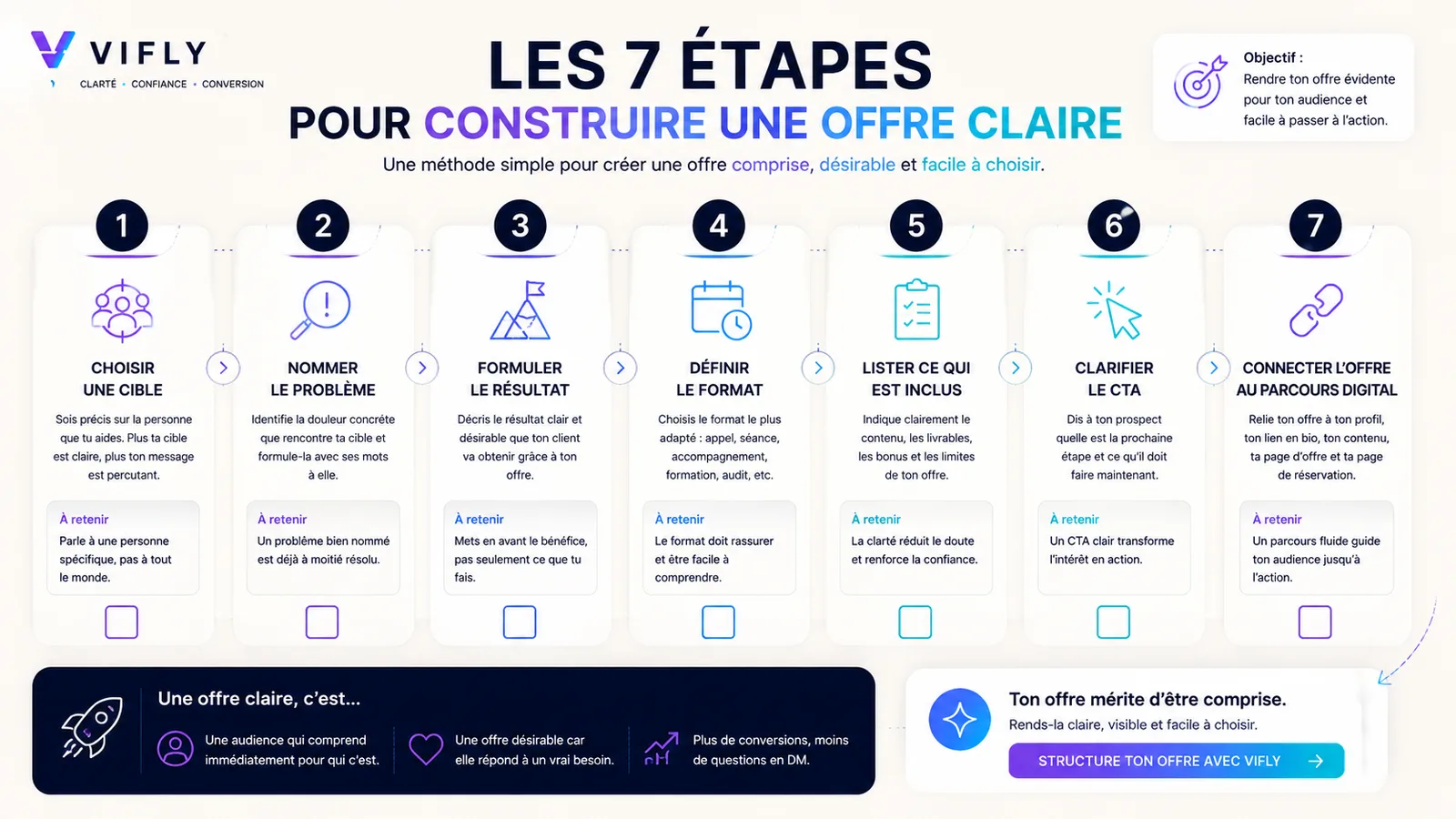
Build a clear offer in 7 steps
The first step is to select a specific target. Not necessarily ultra-nested forever, but clear enough for the person to recognize himself. Independents can work. A beginner coach who wants to sell his first accompaniment is even stronger. Freelance, which receives requests but does not know how to present its offers, is very concrete.
The second step is to name the problem. A good problem is often a phrase that your client could say himself. I publish but no one reserves. "People always ask me for my DM rates.""My offer is clear in my head, but not on my profile."
The third step is to formulate the result. What will the person win? More clarity, a page of offer, a simpler message, a better presentation, a booking route, an offer ready to publish, a more professional profile.
The fourth step is to define the format. Audit, call, session, accompaniment, training, coaching, delivery, subscription, workshop, resource. The format must be simple to understand.
The fifth step is to make the content of the offer visible. What is included? An analysis? A plan of action? Document? A session? A page? Any recommendations? Follow-up?
The sixth step is to clarify the next action. Discover, book, ask, create a space, download, choose a niche. A weak CTA creates hesitation. A clear CTA creates movement.
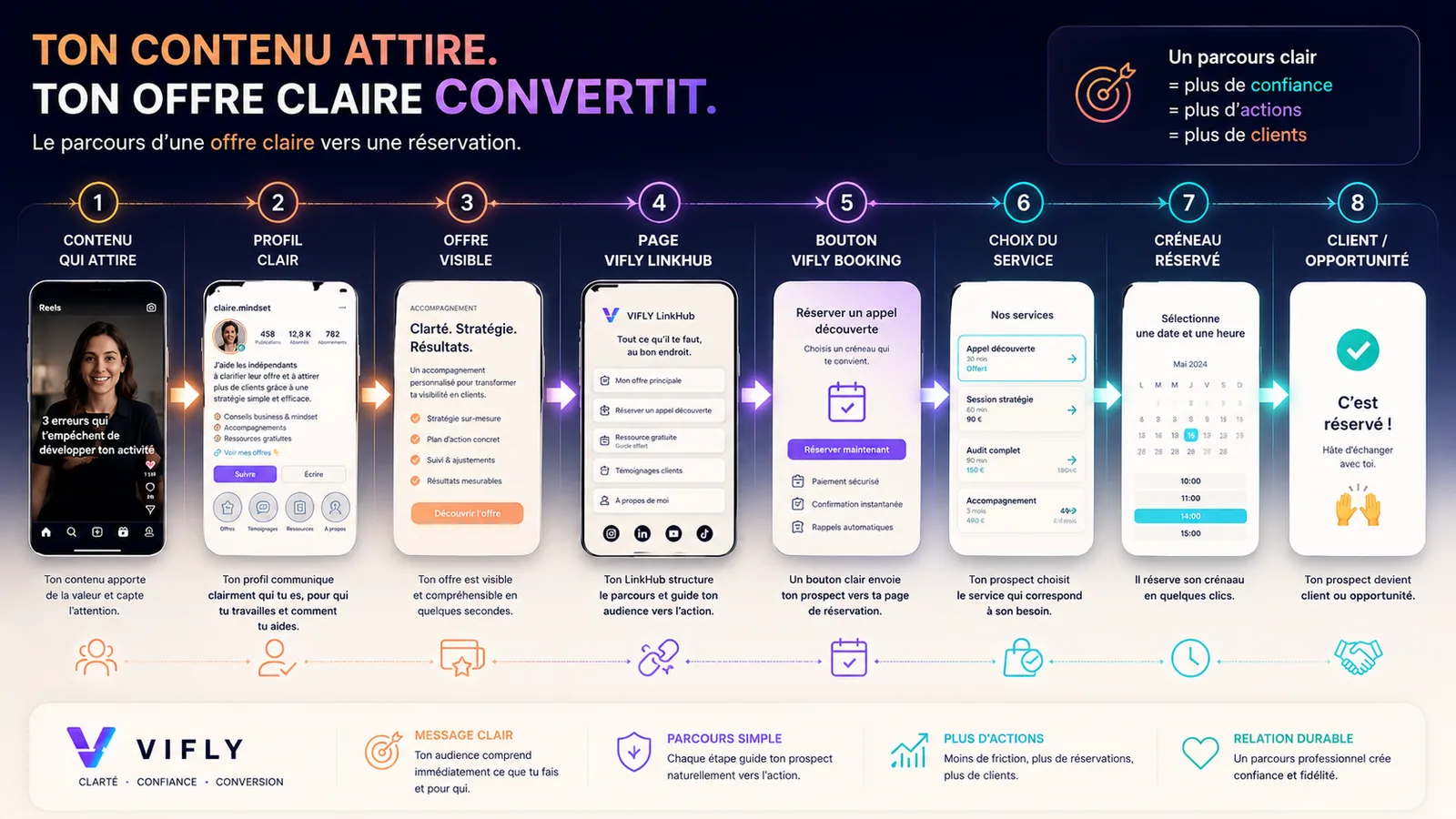
The seventh step is to connect the offer to your digital journey. Your content must be able to lead to your profile. Your profile to your link. Your link to your offer. Your offer for action.
This is the difference between a dispersed digital presence and a structured digital presence.
Concrete example: before / after
Let us take a simple example.
Before:
“J’accompagne les entrepreneurs dans leur communication digitale.”
That's correct, but too broad. We don't really know for whom, for what problem, with what result, or how.
After:
Helps independents who already publish on Instagram but do not generate enough requests to clarify their offer, bio and bio link to transform their visibility into qualified prospects
The second version is stronger because it specifies the target, context, problem, levers and result.
Another example.
Before:
Custom Wellness Coaching
After:
Individual session of 60 minutes for women entrepreneurs who want to regain clarity, reduce mental overload and put in place a routine more aligned with their professional rhythm
The second version not only sells one session. She sells a situation that is understood.
Another example.
Before:
Social media audit
After:
“Audit de profil Instagram pour créateurs et coachs qui veulent comprendre pourquoi leur contenu attire mais ne convertit pas, avec une checklist concrète pour améliorer bio, offre, lien en bio et CTA.”
This version speaks directly to pain. She wants to go further.
And it fits perfectly into a course: educational content, profile, offer page, reservation.
If you want to deepen this logic, the article Views don't pay bills: how to turn your audience into customers explains why visibility alone is not enough if the course behind is not clear.
How to present your offer on your profile
Your profile must play the role of an ultra-condensed first sales page.
He doesn't have to say anything. But it must make you want to go further.
Your bio must clearly express your positioning. Your name or title must help understand your universe. Your recent content must strengthen your expertise. Your bio link must lead to priority action. Your featured stories can answer frequently asked questions: offers, results, reviews, how it works, booking.
The trick is to think your audience already knows.
She doesn't necessarily know.
Maybe she finds you today. Maybe she saw one video. She didn't follow your evolution. She doesn't know your old offer. She didn't read all your posts.
Your profile must be understandable to someone who's coming now.
This is also what is developing in the article Does your Instagram bio make you lose customers?. A bio can attract, but it can also create doubt if it does not quickly give a clear direction.
How to connect your offer to a simple booking
If your offer involves an appointment, a call, a session, an audit, a diagnosis or a performance, you must minimize friction.
Many independents lose time because everything goes through private messages.
Prospect demands price. Then availability. Then the format. Then the duration. Then how to pay. Then he forgets. Then the exchange gets lost. Then envy drops.
This is not always a problem of interest. Sometimes it's a journey problem.
With VIFLY Booking, you can make your services bookable more easily: booking page, visible services, slots, payments if necessary, reminders and tracking. This is particularly useful if you offer coaching, consultations, sessions, audits, discovery calls or personalized services.
A clear offer must be able to lead to clear action.
If the person is ready to move forward, they should not have to look into how to do it.
A clear offer must also be repeated
You can have a very clear offer on a page, but if you never mention it in your content, it will remain invisible.
Repeating is not a problem when it is useful.
You can talk about your offer from different angles: a mistake that your audience often makes, a frequent objection, a before/after, a question received, a client case, a backstage, a method, a reminder, a mini-analysis.
For example, if you propose a profile audit, you can create content like:
“3 signes que ton profil ne donne pas confiance.”
Why your subscribers like your posts but don't book
What I look at first in an Instagram audit
Before you refeed, clarify your offer
Does your bio link really guide your main service
These contents do not sell frontally. They're educating. They set up the problem. They make the offer logical.
This is exactly the idea developed in You don't need more subscribers, you need a better route. A larger audience is not enough if the path between attention and action remains unclear.
The simple test: Does an unknown understand your offer in 10 seconds?
Here is a very concrete exercise.
Show your profile, bio link or page to someone who doesn't know your activity. Don't explain anything to him. Let him look for a few seconds. Then ask him:
What do I propose
Who am I addressing
What problem does I help solve
What action would you do if you were interested
If the person hesitates, reformulates.
If she answers you with vague words, clarify.
If it understands the subject but not the offer, make the offer more visible.
If she understands the offer but not the next step, improve your CTA.
If she understands everything, you probably have a solid foundation.
Clarity is being tested.
She doesn't guess.
How VIFLY helps make your offer clearer
VIFLY was designed for creators and independents who want to stop letting their audience get lost after the content.
Because publishing isn't enough.
Content can attract attention. But if your profile is blurred, if your bio link disperses, if your offer is hidden or if the reservation is complicated, some of this attention disappears.
With VIFLY, you can structure your universe online. You can centralize your links, present your offers, highlight your resources, add your calls to the action and make it easier to book your services.
With VIFLY LinkHub, your organic link becomes more than just a list. It becomes a space that helps your audience understand what to do next.
With VIFLY Booking, you can turn a service offer into concrete action: choose a service, book a niche, pay if necessary, receive a confirmation.
The idea is not to make your activity more complicated.
The idea is to make it more readable.
Because a clear, well presented and easy to book offer is much more likely to become an opportunity.
Conclusion: a clear offer makes you easier to choose
Building a clear offer is not just improving a sentence.
It's improving the way your audience understands you.
It's going from I'm doing a lot of things to this problem that I'm helping solve. It's going from contact me in DM to this offer, here for whom it is made, here's how to book it. It's going from an interesting presence to a professional presence.
You don't need a perfect offer to start with.
You need an offer that is clear enough to be understood, retained and chosen.
Clarity doesn't limit your expertise. It makes it accessible.
And in a market where many creators, coaches, consultants, freelancers and independents already publish a lot of content, those who will be chosen will not only be the most visible.
These will be those whose offer is the easiest to understand.
If you want to structure your profile, centralize your links, present your offers and facilitate your reservations, discover VIFLY.
Key points
A good strategy isn’t just about publishing more. It’s about guiding your audience towards a clear call to action.
A clear offer makes private content easier to sell
Before selling premium content, your audience must understand what it gets, why it helps. and how to access it. To structure this course, read the guide selling private content online.