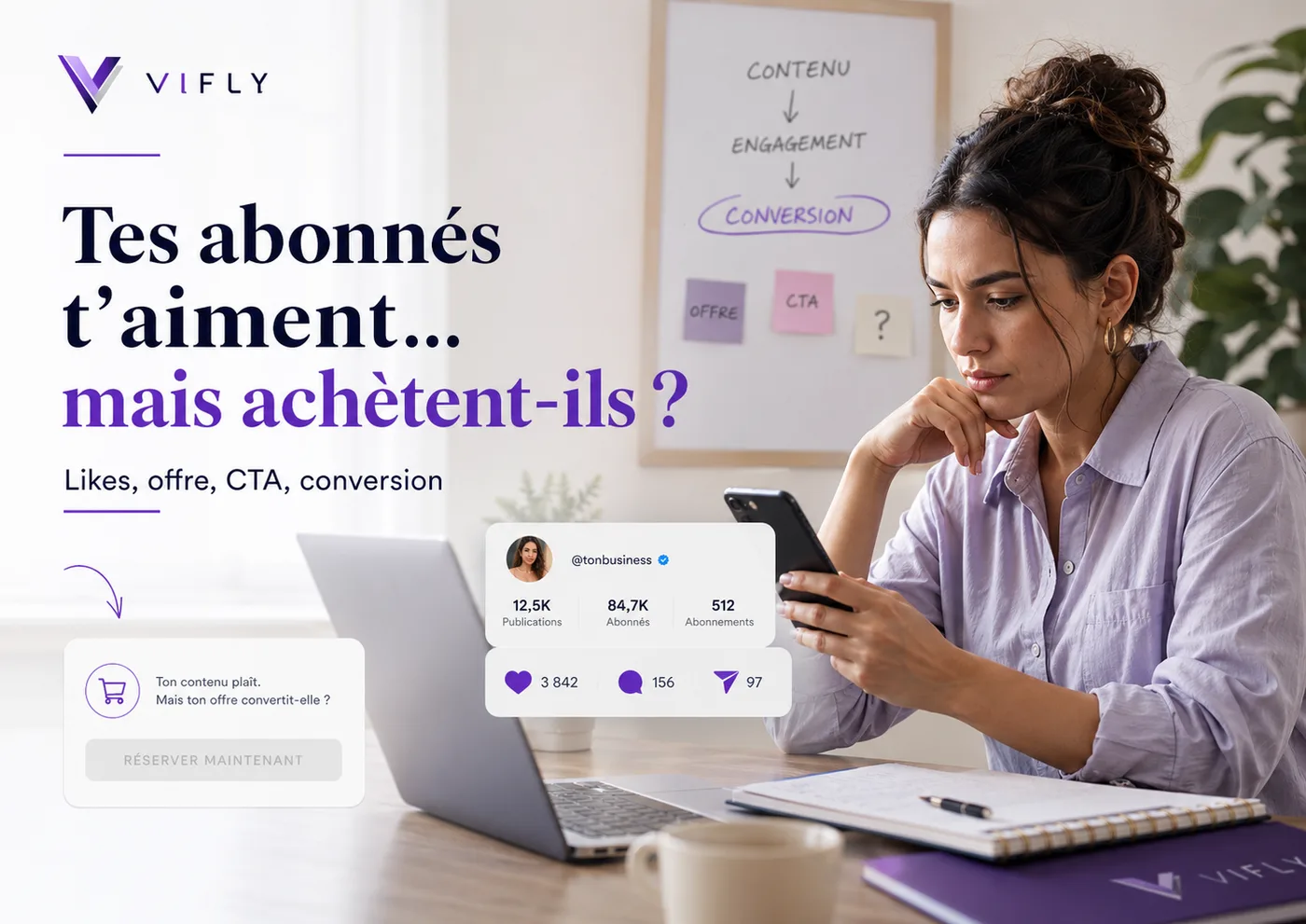
Why do your subscribers like to... but don't buy anything
Having subscribers who like your content is nice.
They're watching your stories. They're reacting to your posts. They like your Reels. They sometimes comment enthusiastically. Some have been following you for months. You have the impression that a real relationship exists, that trust is beginning to build, that your audience is present.
And yet, when you offer an offer, service, reservation, accompaniment or product... There's almost nothing going on.
Few clicks. Few requests. Few reservations. Little shopping.
It is a frustrating situation, but very common among creators, coaches, consultants, freelancers, trainers, artists, therapists and entrepreneurs who develop their online presence.
They have a hearing. They have attention. Sometimes they even have a committed community.
But this attention does not turn into action.
And this is where one must understand one essential thing: being appreciated is not enough to sell.
A person may like your content without understanding your offer. She can appreciate your personality without knowing how to work with you. She can be touched by your message without identifying the next step. She can follow you with interest, but never click if your journey is not clear.
So the problem is not necessarily your audience. The problem is often the path between interest and action.
Error: believing that commitment is enough
On social networks, success is often measured with visible signs: likes, views, comments, shares, subscriptions, reactions to stories. These signals give the impression that the content is working. And to some extent, that's true.
Content that generates commitment shows that it attracts attention.
But attention is not a sale.
A like is not an intention to buy. A comment is not a reservation. A story view is not a quote request. One more subscriber is not automatically a customer.
This is where many creators are wrong. They confuse interest with conversion.
Interest is when a person likes what you do. Conversion is when that person understands your value enough to take action.
In between, there is a course. And if this path is unclear, even an audience can remain passive.
Your audience can love you without knowing what you're selling
This is one of the most common problems.
Your audience may like your way of speaking. She may like your advice, style, values, energy, humour, vision or sensitivity. It can even recognize itself in your contents.
But that doesn't mean she knows exactly what you're proposing.
Many creators regularly publish but do not clearly present their offer. They give value, share ideas, educate their audience, tell their stories, show their universe... But the offer remains discreet, sometimes too discreet.
She's mentioned in a past story. It's hidden in a secondary page. It is explained only in DM. She is drowned among too many bonds. It does not appear clearly in the bio. It is not related to published content.
The audience appreciates the content, but does not understand how to go further. And an offer that is not understood does not sell.
Your audience can't guess what you're doing. It must not investigate, search, search or interpret. She needs to quickly understand what you're proposing, who it is and why it can help.
Being appreciated is not the same as being chosen
There is an important difference between being loved and being chosen.
To be loved is to create a good impression. It produces pleasant, useful or inspiring content. It's making people want to stay in your universe.
Being chosen is something else. It's inspiring enough confidence for someone to decide to go further with you.
To be chosen, your audience must perceive a clear value.
She must understand your positioning. She must see your offer. She must feel you can meet her need. She must be reassured. She needs to know what to do now.
A creator can be very appreciated, but not clear enough to be chosen. This often explains the gap between likes and sales. People like your content, but they don't see clearly the bridge between what you publish and what you propose.
Maybe they say:
I like what he does
She looks interesting
Its content is useful
I'll keep this for later
But they don't necessarily say:
That's exactly what I need
I understand his offer
I know how to book
I'll click now
Sales don't start when you post your price. It starts when your audience clearly understands your value.
The real brake is not always the price
When people don't buy, many creators immediately think of the price.
They wonder if they're too expensive. They hesitate to lower their rates. They think their audience can't afford it. They say they have to wait until they have more subscribers before selling.
Sometimes the price can be a brake. But this is not always the first problem. Very often, the real brake is confusion.
A person does not buy if they do not understand what they will get. It does not reserve if it does not understand how it works. It does not click if CTA is not clear. It does not take action if the offer is not visible. She does not engage if the journey seems complicated.
Before you lower your price, ask yourself these questions:
Is my offer easy to understand? Is it visible quickly from my profile? Does my audience know who she's addressing? Is the benefit clear? Is the action button obvious? Does my bio link really lead to the right step? Does my journey reassure or does it create hesitation?
Often creators do not need to sell cheaper. They need to sell more clearly.
Your CTA may be too weak
An CTA is a call to action. That's what tells your audience what to do next. And yet, many creators neglect him.
They publish excellent content, then finish with a vague sentence:
Tell me what you think
Organic link
Contact me if necessary
My DMs are open
These sentences may work in certain contexts, but they are not always enough to guide a hearing towards specific action.
A good CTA must be clear, direct and aligned with the content objective. If you want your audience to reserve, tell him where to book. If you want her to discover your offer, give her a reason to click. If you want her to read an article, explain what she'll find there. If you want her to create her space, show her the immediate benefit.
An effective CTA does not force, it guides. It transforms a vague intention into concrete action.
For example, instead of saying biolink, you can say:
“Découvre mes accompagnements et choisis celui qui correspond à ton besoin.”
“Réserve ton créneau en quelques clics.”
Consult my services and move on to the next step
Create your page to centralize your links and make your profile clearer
Accuracy reassures. And what reassures makes action easier.
Your bio link can block your sales
The organic link is often the place where everything is played.
Someone sees your content, cares about you, clicks on your profile, reads your bio, then opens your link. At that time, she is already in a position of interest. She wants to know more.
But if she arrives on a confused page, too busy or badly organized, she can go back. It's a common problem.
Too many creators use their organic link as a simple storage. They put everything: site, shop, newsletter, YouTube, form, old link, offer, blog, calendar, contact, PDF, secondary network.
It's all there. But nothing is prioritized.
As a result, the audience does not know where to start.
Too many choices can create hesitation. And hesitantness hinders action. A good bio link should not only list links. He has to guide your audience.
It must highlight the main action. He must make your offer visible. He has to explain clearly what we can do with you. He must give a professional impression. He's got to help your visitor move from like to like to want to go further.
It's exactly the role of a well-thought-out LinkHub: turning a simple link into a bio into a real journey.
A visible offer reassures more than a hidden offer
Many creators hide their offer because they do not want to appear too commercial.
They're afraid to be insistent. Afraid to disturb. Fear of losing their authenticity. Afraid their audience thinks they only publish for sale.
This fear is understandable. But hiding your offer doesn't help your audience.
If you propose something useful, your audience must be able to see it. Not aggressively, but clearly. A visible offer does not mean an imposed offer. This means that the right person can find her at the right time.
Someone who needs your service should not have to search your old stories, send a message to understand or guess what you are proposing. Your offer must be presented as a possible help.
It must explain:
to whom she addresses;
what problem it helps to solve;
what the person will get;
how it works;
what's the next step.
A clear offer gives confidence.
A hidden offer creates uncertainty.
And uncertainty often pushes to do nothing.
A committed audience can remain passive if the course is not reassuring
Commitment shows your audience is here.
But to buy or book, she needs a higher level of trust.
She must feel that your offer is serious. She must understand the process. She must see you're professional. She must be reassured about the next step.
It's even more true if you sell a service, a session, an accompaniment, a coaching, a training, a performance or a personalized offer.
The more confidence the purchase implies, the clearer the journey must be. A person may hesitate for several reasons:
she doesn't really understand what you're proposing;
she does not know if it is suitable for her need;
she doesn't see your availability;
it does not know how it works;
it does not find the right link;
it sees no reassuring element;
she doesn't know what to do after she clicks.
These aren't necessarily big problems. But every little doubt can slow down the action. And too many small doubts eventually create a great hesitation.
DMs must not replace your sales system
Private messages are useful. They allow to exchange, create a link, answer a specific question or humanize the relationship.
But they must not become your only system to sell or book.
If each prospect has to write down to find out your rates, services, slots or details of your offer, you add an additional step.
And every additional step can cause people to lose. Some do not dare to ask for the price. Some forget to answer. Some are interested in the moment, then move on. Some are waiting too long for an answer. Some disappear in the conversation.
The problem is not the DM itself.
The problem is when DM becomes mandatory to understand basic information. A good course must allow your audience to understand, choose and act more easily.
DMs should be used to create a link, not to compensate for a blurred profile.
Your profile must do the job before you
A good profile does not sell in your place in the mechanical sense of the term. But he's setting the stage. It gives a clear first impression. He explains your universe. It shows your worth. It makes your offer visible. It points to the right link. He reassures before the person contacts you.
That's exactly what many creators underestimate.
They think their content does all the work. But the content only attracts attention. Then the profile must confirm the interest.
If your profile isn't clear, attention goes down. If your bond is confused, envy disperses. If your offer is hidden, the decision is not built. If your CTA is weak, the action will not start.
Your profile must be thought of as a bridge between your content and your offer.
Not just like a window.
How to transform an audience that loves into an audience that acts
To turn an audience engaged into customers, prospects or reservations, you don't need to become aggressive commercially.
You need to clarify.
Start with your bio. In seconds, we need to understand who you're helping, what you're proposing and why your content deserves to be followed.
Then look at your offer. Is it visible? Is it simple to understand? Is it presented as a concrete solution or as vague information?
Then look at your bio bond. Does he guide to a specific action or does he scatter your audience with too many choices?
I mean, look at your CTA. Does it really make you want to click, book, read, buy or discover your offer?
The point is not to push your audience. The aim is to remove obstacles. The clearer your journey, the more natural the action becomes.
The role of VIFLY: turning interest into action
VIFLY was designed for creators, coaches, consultants, trainers, therapists, artists, freelancers and entrepreneurs who want to stop losing opportunities because of a blurred path.
Because today, having a hearing is no longer enough. We need a clear space.
A place where your audience can understand what you are proposing, discover your offers, access your important links, consult your services and take action easily.
With VIFLY LinkHub, you can centralize your ties while giving real direction to your audience. Your bio link does not become an unorganized list, but a simple and professional one.
With VIFLY Booking, you can present your services, display your slots and facilitate bookings, without relying solely on DM exchanges.
The goal is simple: to help your audience move from interest to action. Because someone who likes you can stay passive.
But a person who clearly understands your offer, your course and the next step is much more likely to act.
Why subscribers like but don't buy
Having likes, comments or subscribers can give the impression that everything works.
But commitment does not always mean intention to buy.
A person may like your content because it is interesting, inspiring or entertaining, without understanding what you actually sell.
This is often where the problem begins. Your audience appreciates you.
She's following you. She reacts sometimes.
But it does not take action because the way between your content and your offer is not clear enough.
Concrete example: a lot of commitment, zero sale
Imagine a coach, consultant or creator who regularly publishes useful content.
Its subscribers comment.
They say his advice is interesting. They record his publications. But when he offers an offer, almost nobody buys.
The problem is not necessarily the price. This is not necessarily the quality of the offer.
Often the real problem is elsewhere: the audience did not understand precisely why it should buy now, what it will get, for whom the offer is made and what transformation it can expect.
The real problem: the audience likes the content, but does not understand the offer
Content can create sympathy without creating a decision.
To sell, it is not enough to be appreciated. You have to be understood.
Your hearing must include three things quickly:
- the problem you solve;
- the offer you offer;
- next step.
If these three elements are blurred, your subscribers can continue to love your content without ever becoming customers.
1. Clarify the specific problem
Saying that helps people to grow is too vague. Saying, "J" helps coaches turn their Instagram subscribers into appointment requests is much clearer.
The more precise the problem, the more the audience can recognize itself. And the more she recognizes herself, the more she can consider buying.
2. Making the offer visible
Many creators talk a lot about content, but very little about their offer.
Result: audience consumes, but does not know what to buy.
Your offer must be visible in your bio, in your content, in your call to action and in your journey after the click.
A clear offer does not need to be aggressive. It must simply be understandable.
3. Add a simple next step
If an interested person needs to search for your link, send you a private message, wait for an answer, ask the price, and then understand how to book, you lose some of the potential buyers.
The transition to action must be simple.
For example, you can guide your audience to a clear page which brings together your links, offers, content and calls to action.
How to transform engagement into a real opportunity
1. Connect your content to business intent
Each content does not have to sell. But each content must be able to reinforce a useful perception: your expertise, your method, your difference or the value of your offer.
Content that informs may prepare a sale. Content that explains an error can create awareness. Content that shows an example may trigger a need.
The purpose is not to sell to each publication. The goal is to build a logical path between what you publish and what you propose.
2. Show real situations
Subscribers buy more easily when they recognize themselves. Instead of staying in general counsel, give examples.
For example:
You have 3 000 subscribers, your publications make likes, but no one reserves a call? Maybe the problem isn't your audience. Maybe it's your offer that's not visible enough
This type of sentence speaks directly to a living situation. It creates more confidence than too general a council.
3. Reduce friction at the time of purchase
When a person is ready to take action, the course must be fluid.
If you offer coaching, calls, audits, sessions or accompaniments, a booking page can make a real difference.
It helps to show the offer, clarify the framework, propose a niche and avoid unnecessary exchanges.
4. Centralize course after content
The content attracts attention. But the profile turns this attention into action.
If your links are scattered, if your offer is difficult to understand, or if your audience doesn't know what to do next, you lose some of the confidence created by your publications.
This is why a clear space like VIFLY can help creators, coaches and independents centralize their presence, present their offers and guide their audience towards concrete action.
Remember: likes don't pay bills
Likes are a signal. But they're not a strategy.
They show that your content attracts attention. But to turn this attention into a customer, reservation or opportunity, it takes more than visibility.
We need a clear offer. An understandable message. A simple journey. A clear next step.
Most importantly, a hearing that understands why it should act now.
Useful source to go further
Google recommends creating useful, reliable and thought-out content for people first.
This logic is important for creators: content should not only seek to please the algorithm. It must really help the audience, respond to a clear intention and bring concrete value.
Source: Google Search Central — creating useful content
Conclusion: Your audience doesn't just need to love you, she needs to understand how to move forward with you
Having an audience that appreciates you is a valuable basis. But this is not enough to build an activity.
Your subscribers may like your content, react to your stories, follow your universe and yet never buy if your offer is not clear, your CTA is weak, your bio link is confused or your journey doesn't reassure.
The problem is not always lack of interest. Sometimes your audience is already interested. It simply needs a more obvious path. She must understand what you're proposing. She must see your offer. She must know where to click. She must be reassured. It must be able to act easily. Being appreciated attracts. Being clear converts.
And if you want to turn your audience into concrete opportunities, start by making your journey simpler, more visible and more reassuring.
Create your VIFLY space
You want to stop losing opportunities when your audience is already interested?
With VIFLY, you can create a clear page, centralize your links, present your offers and facilitate reservations.
Your audience must not only like you.
She must know how to act with you.
Create my VIFLY space: https://vifly.fr
FAQ: subscribers, commitment and sales
Why do my subscribers like my content but don't buy?
Because loving content does not necessarily mean understanding an offer.
Your audience may appreciate your advice, but not know what you are selling, for whom it is made, what result it can expect or how to take action.
Are likes useless?
No, likes aren't useless.
They show that content attracts attention.
But they're not enough to create a business. To sell, it is necessary to turn this attention into trust and action.
How can I make my offer clearer?
Your offer must simply answer three questions: to whom it addresses, what problem it solves and what next step the person must follow.
The more visible these elements, the more your audience understands how to work with you.
How can I transform my subscribers into customers?
To transform subscribers into customers, you need to create a clear path: useful content, legible profile, visible offer, simple link, reservation or easy purchase.
The aim is to reduce hesitation and help the interested person to take natural action.
When subscribers like but don't buy
If your subscribers like your content but don't buy anything, the problem often comes from the route or offer. Page creator monetisation help structure a clearer transition between trust and purchase.
Moving from commitment to purchase
When subscribers like but don't buy, the problem often comes from offering or switching to action. A well presented premium content can become a first simple sale. Discover how selling private content online.