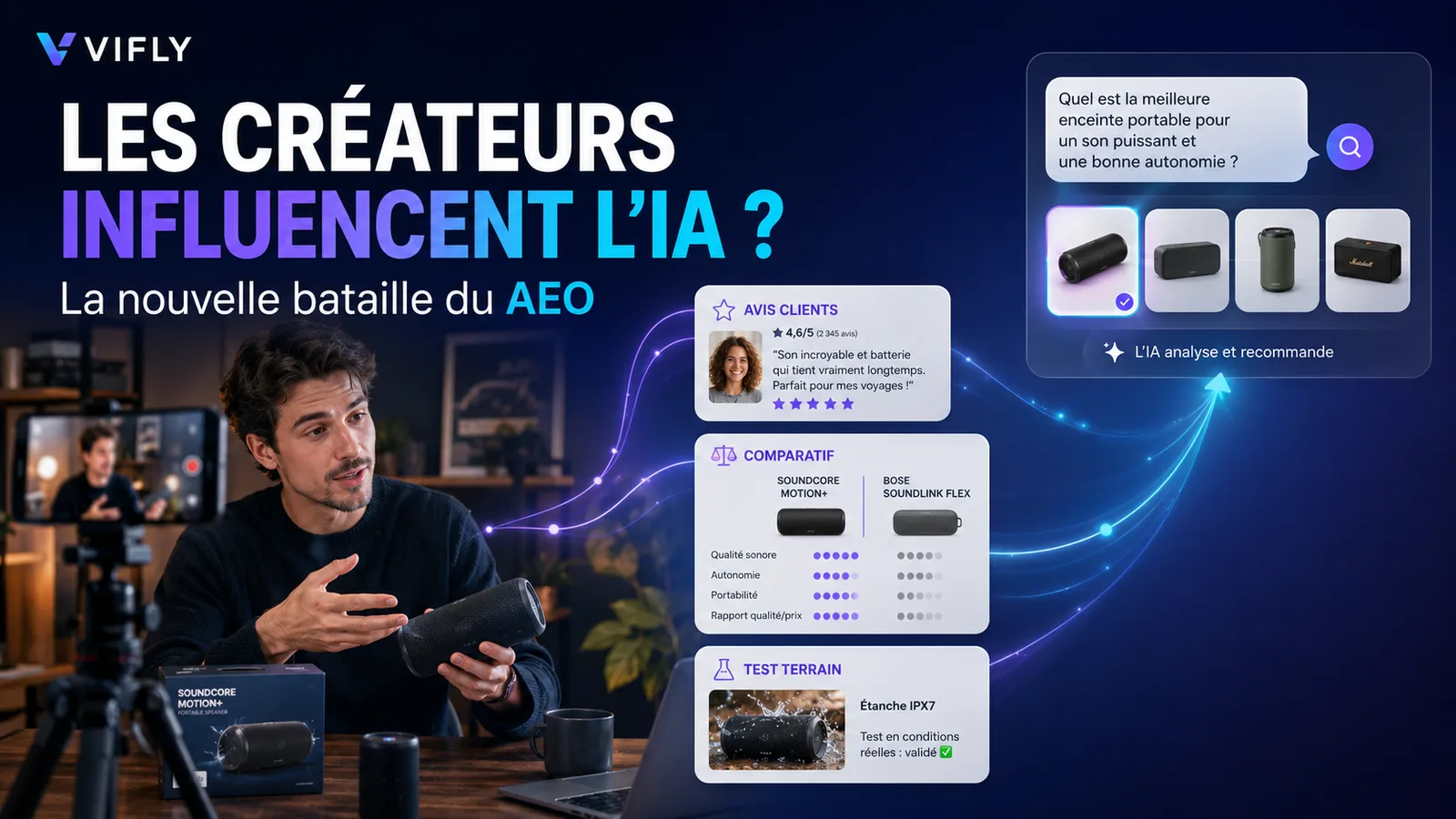
You’re posting a Reel for a brand.
It generates 80,000 views, a few thousand likes and several hundred clicks.
The campaign has ended.
At least, that is how influencer marketing has long been measured.
But a new problem is emerging for brands: What happens when a consumer no longer searches for their next product on Instagram or Google, but asks an artificial intelligence directly what to buy?
‘Which accounting solution should you choose if you’re a freelancer?’
‘Which camera is best for a beginner creator?’
‘Which platform should I use to take online bookings?’
In this new landscape, a company may have spent a great deal on influence… and doesn’t even appear in the response.
This is precisely the problem that Influencer and Profound aim to tackle with a new approach announced on 26 August 2026: the Creator-First AEO. Their aim is to measure how content and experiences published by creators are picked up by AI engines, and then to build campaigns capable of enhancing the information available about a brand.
This is not an official new ChatGPT algorithm.
Nor is it a formula that guarantees a brand will be recommended.
But this move sends out a very important signal:
a creator’s content is increasingly being valued not only for the audience it reaches today, but also for the information it leaves on the web tomorrow.
What is Creator-First AEO?
AEO stands for Answer Engine Optimisation, or search engine optimisation.
There is a similar logic behind the term GEO, Generative Engine Optimisation.
The overall aim is to gain a better understanding of how a brand, a product, a person or a piece of information appears when someone queries a generative model.
On 26 August, the Influencer agency and the AI analytics platform Profound announced an approach they have dubbed Creator-First AEO.
The principle: first analyse what AIs understand
Profound must analyse, in particular:
- how a brand appears in AI responses
- on which queries it is present or absent
- which competitors feature more prominently
- what elements and sources appear to accompany the responses
- how quotations and representations evolve
Influencer then uses this information to tailor campaigns with creators.
The agency specifically cites content such as:
- reviews
- comparisons
- demonstrations
- real-life experiences
- content providing context for the products
Finally, Profound measures the responses and citations again to see what has changed.
The logic therefore becomes:
measure → create → publish → measure again.
This is not proof that the creators “control ChatGPT”
That’s the crucial distinction.
The announcement has just come from two companies that market this method.
Neither OpenAI, nor Google, nor Anthropic have announced:
“Influencer videos are now an official ranking factor.”
It would therefore be incorrect to write:
“Get influencers to talk about your brand and ChatGPT will recommend you.”
No such guarantee exists.
Generative engines use different architectures, search systems and sources.
And their answers may vary depending on:
- the exact question
- the template
- language
- location
- Available sources
- the latest news
- the context of the conversation
Google also warns against “AEO hacks”
In its official guide published in 2026, Google explicitly explains that it regards optimisation for its AI experiences as an extension of SEO.
Google recommends, in particular, prioritising content unique, useful and non-generic, as well as continuing to apply the technical fundamentals of SEO.
Google also advises against pursuing so-called tactics such as artificial mentions or creating content solely intended to manipulate generative responses.
The Creator-First AEO should therefore be regarded as a new marketing strategy to test and measure, rather than a proven algorithmic formula.
Why content created by creators can still be very interesting for AI
There is a logical reason behind this move.
A brand may write on its own website:
“Our product is excellent.”
The information is useful for understanding what the brand is selling. However, it is still produced by the brand itself.
A creator, on the other hand, can publish:
‘I tested this product for a fortnight. Here are the three situations where it really helped me, and the two limitations I encountered.’
This second post provides much more context.
Real-life experience yields different insights
The content may answer questions such as:
- for whom the product works
- in what situation
- up against which competitor
- what are the limitations
- What is the result?
- in what context is it used?
This is precisely the type of content that Google highlights in its documentation on generative search.
Google contrasts, in particular, generic, easily reproducible content with content that provides a unique experience or perspective.
In other words:
An interesting AI creator is probably not one that simply parrots the brand’s brief.
This is the one that adds something that wasn’t in the brief.
Influencer marketing can shift from ‘distribution’ to ‘evidence’
This is probably the most interesting change in this update.
Traditionally, a brand pays a designer largely for their ability to post a message.
The creator has:
20,000 subscribers. 100,000 subscribers. 1 million subscribers.
The brand has temporary access to this audience.
The Creator-First AEO introduces a second value:
the production of evidence and public information.
Influencer explicitly describes this shift as a move from the simple production of content to a model of ‘evidence production’ – producing experiences, comparisons and demonstrations that can help to build the brand’s reputation.
The potential lifespan of a campaign varies
A Story disappears quickly. A Reel can continue to generate a few views.
However, a detailed review, a comparison or a publicly accessible demonstration may remain available for much longer.
Its potential appeal therefore no longer depends solely on:
How many people saw it on the day it was published?
The question also becomes:
What lasting value does this content add to the brand’s digital ecosystem?
Small-scale designers could prove particularly interesting
This approach could benefit a category that is often underestimated:
niche creators.
Let’s take a brand that sells booking software for therapists.
She can work with a major business influencer with 500,000 followers.
The scope will be significant. But she could also work with:
- a psychologist who creates professional content
- a sophrologist
- a freelance coach
- a consultant specialising in the digitalisation of the liberal professions
Their audience is smaller.
But their experiment potentially allows us to answer a much more specific question:
‘Is this tool really suitable for this type of professional?’
For an AI engine, just as for a future client, the credibility of the person giving evidence becomes essential.
Your next collaboration could therefore be measured differently
Nowadays, a media kit primarily highlights:
- subscribers
- scope
- engagement
- views
- audience
- demographics
These elements will remain important. But tomorrow, a designer might also demonstrate:
- the quality of its tests
- thematic expertise
- its ability to produce comparisons
- the duration of visibility of its content
- its visibility in search results
- quotes or references to its content in various contexts
The question would no longer simply be:
“How many people can I reach?”
But also:
‘What credible information can I create about your product?’
This represents a significant shift in how one markets one’s value to brands.
The wrong approach to Creator-First AEO would be to fabricate fake reviews
This is where the border becomes important.
Faced with this new opportunity, some might be tempted to create artificially:
- false testimonies
- Fake comparisons
- disguised sponsored articles
- artificial discussions
- hundreds of brand mentions
That would be exactly the wrong way to go.
Artificial mentions do not constitute a sustainable strategy
Google makes it clear that searching for inauthentic mentions solely to influence generative search systems is not a recommended tactic.
And, of course, the advertising rules still apply.
Where a content creator is paid to feature a product, the content must comply with the transparency requirements applicable to advertising and commercial influence.
The credibility of the content becomes even more important if its significance extends beyond a mere social media campaign.
Fake evidence remains fake evidence, even when it is intended for an AI.
The best AEO content is very similar to excellent human-generated content
This is perhaps the best news to come out of this development.
You don’t need to write like a robot to be understood by AI.
Google explicitly states that it is not necessary to rewrite content specifically for its generative systems or to create a page for every query variant.
Good content can simply provide a very good answer to a genuine question.
Poor example
“Discover X, the best app for growing your creator business.”
The sentence provides very little information.
A much more useful example
“I tried out X for a month to manage my bookings. Here are the three things that really saved me time, what frustrated me, and the type of professional I’d recommend it to.”
The content immediately contains:
- test duration
- usage
- benefits
- limits
- recommended public
This is useful for the user.
And this is precisely the sort of information that a system could potentially use when it needs to compare several solutions.
Creatives must therefore stop producing overly prescriptive briefs
This shift also poses a problem for brands. Some influencer campaigns still look like this:
‘Here are the eight phrases you need to say.’
‘Do not mention any faults.’
‘Use exactly these syntax elements.’
‘Act as if you were using the product every day.’
This template was already capable of producing rather implausible adverts.
It becomes even less appealing if the aim is to produce useful and distinctive information.
To create genuine proof, the creator must be able to test
A more interesting campaign might set the following task:
Actually use the product for two weeks.
Then:
Showcase your use case.
Then:
Explain what works and for whom.
Then:
Compare this with your old method.
The brand relinquishes some control.
But she stands to gain something far more valuable:
reliable content.
Social SEO and AI SEO are starting to converge
For years, social media content and SEO have been treated as two separate worlds.
On the one hand:
Instagram, TikTok, YouTube, LinkedIn.
On the other hand:
Google and the website.
This distinction is gradually becoming less relevant.
Content, videos, profiles, discussions and posts circulate in a much more connected environment.
Creative marketing can therefore simultaneously produce:
- on social media
- brand searches
- indexable content
- disclaimers
- links
- conversations
- potentially useful signals in certain AI engines
The challenge then becomes to think ecosystem, not a standalone post.
For a creator, having a focal point becomes even more important
Imagine that a brand comes across your content because an AI monitoring tool has identified it as particularly relevant to a niche.
She opens your profile. What does she find?
Your bio says:
Creator | lifestyle | business | motivation ✨
No portfolio.
No media kit.
There’s no way to make sense of your formats.
No offers.
No obvious professional contacts.
You’ve been discovered. But you’re not ready to turn this discovery into an opportunity.
LinkHub is becoming a professional platform
A VIFLY LinkHub can centralise social media, content, offers and calls to action, whilst allowing you to track specific sources of traffic.
For a creator focused on partnerships, we could organise:
Work with me
My media kit
My best content
My areas of expertise
My offers
Contact me
The logic remains the same:
visibility → understanding → trust → action → opportunity.
For experts, AI visibility must also lead to a service
The same reasoning applies to coaches, consultants, trainers and freelancers.
Suppose a search engine recommends your name to someone searching for:
“an SEO consultant specialising in e-commerce in Réunion”.
The prospect discovers your content.
He wants to work with you.
If he now has to send a DM, wait for your reply and then exchange five messages to find out when you’re available, you’re creating friction.
With VIFLY Booking, a professional can showcase their services, display their availability and allow direct bookings, with payment where required.
AI visibility therefore only has commercial value if the ecosystem behind it is ready.
AI can also help creators produce better proofs
This topic has another practical implication.
A creator can use AI not to fabricate a fake review, but to improving the depth of the test.
For example:
“I need to test this tool for a week. Give me 15 specific scenarios to check so I don’t end up with a superficial review.”
Or:
“Here are my notes following my test. Which statements do I need to check before publication?”
Or:
‘What objections might someone considering buying this product have?’
Or:
“Compare my observations with the brand’s brief and identify the points where my actual experience does not match the marketing promises.”
This is precisely the kind of use advocated by VIFLY AI : the tool aids reflection, but judgement and experience remain human.
How to adapt your content strategy right now
It is still too early to rebuild an entire business around the Creator-First AEO.
However, several decisions are already sound regardless of the success of this new category.
1. Make your expertise clear
A search engine, just like a brand, must be able to understand:
who you are, what you create, for whom, and what experience you have.
2. Create more experiential content
Add regularly:
- tests
- comparisons
- demonstrations
- feedback from the field
- case studies
- personal analyses
3. Keep your content accessible
Public and long-lasting content is more likely to remain useful than a story that disappears after 24 hours.
This does not mean abandoning ephemeral formats. It also means building a library.
4. Form partnerships that truly match your area of expertise
An opinion carries more weight when the person giving it appears to be an authority on the subject.
5. Don’t automatically hide flaws
A review that’s entirely positive across the board sounds more like an advert than a genuine experience.
6. Centralise your brand identity
Your profile, your best content, your media kit and your contact details should be easy to find.
7. Measure beyond views
Whenever possible, please also note:
- brand searches
- profile visits
- clicks
- backlinks
- reprises
- quotes
- leads
- sales
- bookings
What should brands do?
Brands, too, need to make slight adjustments to the way they brief their teams.
Instead of asking:
“Make a 30-second video using these three points.”
They might start by asking:
What real-life experience do we want to document?
Then:
which creator has the legitimacy to document it?
Then:
What questions do consumers actually ask?
Then only:
what content should we create?
That’s a very interesting reversal.
Content is no longer based solely on the brand’s message.
It starts from the a problem that someone is trying to solve.
Be careful with the measurement: correlation does not imply causation
This new category is also set to feature lots of impressive graphics.
A brand is launching twenty designer campaigns. Its visibility on ChatGPT is increasing.
Conclusion:
‘The designers have caused this rise.’
Not necessarily.
In the meantime, the brand may also have:
- has published new content
- launched a product
- received media coverage
- gained new backlinks
- updated their website
- increased its profile
AEO figures should therefore be interpreted with caution.
Observing a change following a campaign does not automatically prove that the campaign is the sole cause.
This is particularly important whilst this discipline is still in its infancy.
Google has already set the best example: produce content that AI cannot easily replicate
The Google documentation does, in fact, provide excellent guidance.
Google recommends content:
- unique
- really useful
- based on experience
- offering a perspective
- going beyond the general information available everywhere
That’s almost exactly the definition of a good creator. A creator doesn’t add value simply because they know how to rephrase a brand’s product description.
It adds value because it can say:
“I tried it. Here’s what actually happened.”
And this phrase can now have a value in three contexts at once:
for its audience, for the brand and potentially for the systems that are trying to understand the product.
Conclusion: the next source of power for creators may not be limited to their audience alone
For years, the economic value of a creator has been defined primarily by:
how many people it can reach.
The Creator-First AEO adds a new question:
what credible information might this creator have left behind?
This is a far more profound development than simply a new sponsored format.
Because a post’s distribution is temporary.
A documented experience can continue to be searched for, cited, compared and discovered long after the campaign has ended.
It is still too early to say whether creators will determine what ChatGPT or Gemini recommends.
No one can guarantee that.
But one thing is becoming clear: Brands are already beginning to view creator-generated content as a key factor in their visibility within the new AI search ecosystem.
Your next step
If you’re a content creator, take your ten best professional pieces of content and sort them into three categories today:
Opinion — you’re expressing a point of view.
Experience — you’re showing what you’ve actually tested or experienced.
Generic — anyone could have published practically the same thing.
Your priority for the coming weeks is simple:
gradually increase the second category.
Then make it easy for people to discover your work: organise your profile, compile your best content and your media kit in your LinkHub VIFLY, and make sure that any brand that finds you immediately understands why they should work with you.
Because in the next phase of the creator economy, the question may no longer simply be:
‘How many people are watching you?’
It could become:
‘When you talk about a subject, does your experience become a benchmark?’
FAQ
What is Creator-First AEO?
This approach was announced on 26 August 2026 by Influencer and Profound. It aims to analyse how a brand is portrayed in AI responses, and then to use creator campaigns to produce experiences, comparisons and content likely to enrich the information available about that brand.
Can creators guarantee that a brand will appear in ChatGPT?
No. Neither Influencer nor AI engines can guarantee a specific recommendation for every query. Results may vary depending on the engine, the prompt, the sources and the context.
What is the difference between AEO and GEO?
AEO stands for Answer Engine Optimisation and GEO Generative Engine Optimisation. Both terms describe strategies aimed at improving visibility in systems that generate direct responses. Google, for its part, regards the optimisation of its AI features as an extension of SEO.
Does Google recommend GEO?
Google recognises the existence of the terms AEO and GEO, but above all recommends following good SEO practices and producing unique, useful and reliable content rather than looking for specific ‘hacks’.
Which creator’s content seems most relevant?
Real-world experiences, demonstrations, comparisons and detailed reviews generally provide more information than simply repeating a sales pitch. This is precisely the type of content highlighted in the approach announced by Influencer and Profound.
Should you create fake reviews or increase the number of mentions of a brand?
No. Google explicitly advises against searching for inauthentic mentions in an attempt to improve visibility in its generative experiences.
Sources
Influencer: “Influencer launches Creator-First AEO, a new category for earning Brand Authority in the AI Discovery Era”, 26 August 2026. Primary source of news. It describes the partnership with Profound, the ‘analysis → activation of creators → measurement’ model, and the stated aim of linking creators’ content with brand visibility in AI responses.
View the official announcement
The Wall Street Journal / CMO Today: “Creator-First Answer Engine Optimisation Takes Centre Stage”, 27 August 2026. A very recent secondary source used to confirm that this approach is already beginning to be treated as a new trend in creative marketing/AEO, and to put into context brands’ demand for measuring their AI visibility.
Google Search Central: “Optimising your website for generative AI features in Google Search”, documentation 2026. Official source used to highlight that Google regards traditional SEO as the foundation of its generative search, recommends unique rather than generic content, and advises against AEO/GEO hacks or artificial mentions.
Read the official Google guide
Google Search Central: “Guidance on third-party SEO tools and advice”, 5 June 2026. Official source used to reiterate that no third-party tool has access to Google’s internal ranking data and that no external solution can guarantee a result in Search or its AI experiences.
Google Search Central: documentation updates 2026. Used in particular to confirm the discontinuation of the FAQ rich result from 7 May 2026, so as to avoid recommending Schema today solely for the sake of achieving this display.