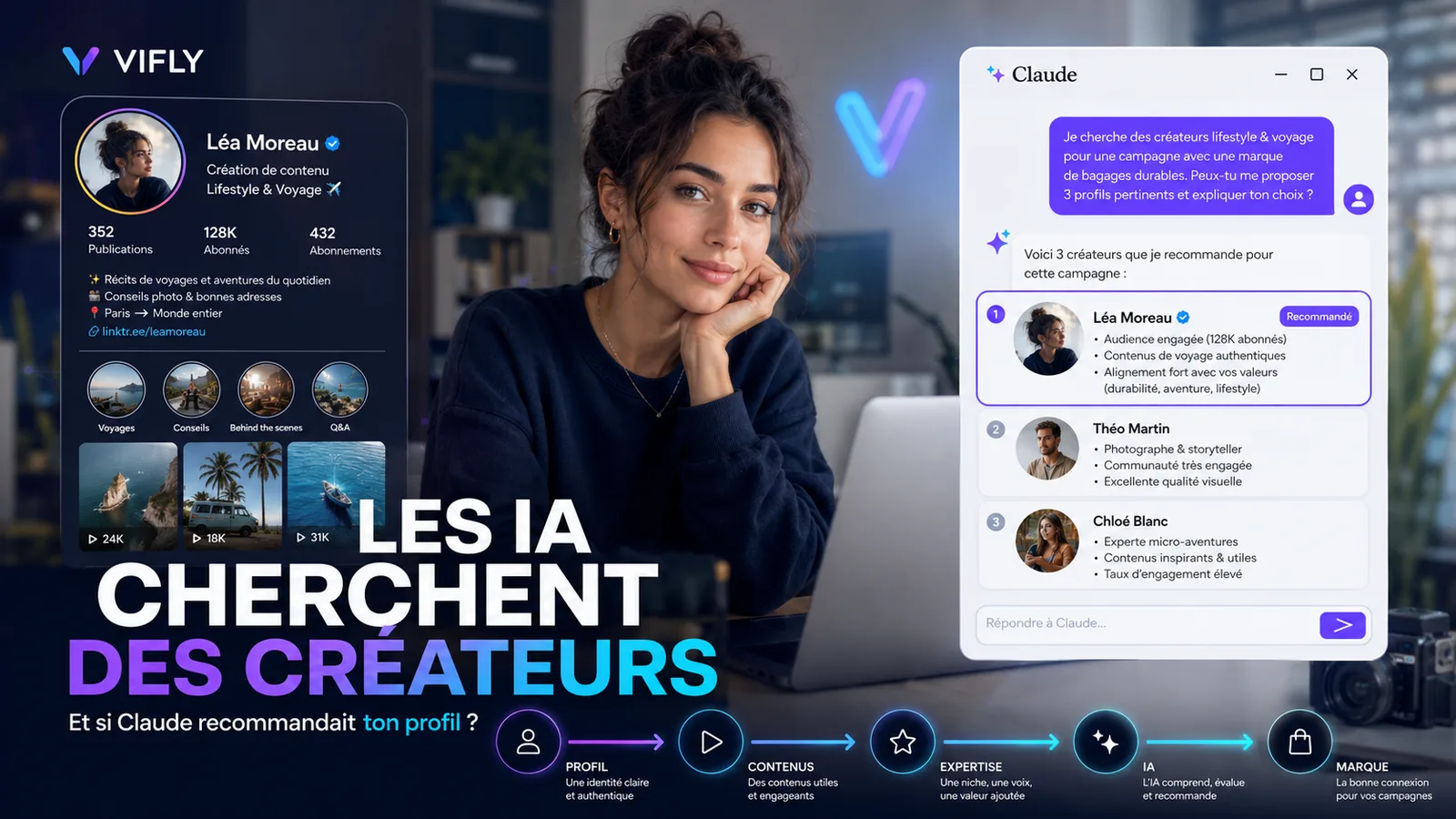
For years, content creators have learnt how to appeal to the algorithms of Instagram, TikTok, YouTube and LinkedIn.
Another area of visibility is now emerging: artificial intelligence engines.
Some brands and agencies are starting to use AI assistants such as Claude to identify creators who might be a good fit for their upcoming campaigns. On 17 August 2026, Digiday reported, in particular, that the brand Kosterina regularly begins its search for creators directly in Claude, whilst agencies are starting to factor visibility in AI engines into their thinking about partnerships.
In other words, tomorrow, a brand might no longer be looking solely for:
“Which creator has 100,000 followers in this niche?”
She could ask an AI:
“Which French digital marketing specialists produce educational content and work with entrepreneurs?”
And the question then becomes something completely different:
Does AI clearly understand who you are, what you do and why it should mention you?
Welcome to a new battle for visibility for creators.
Brands are starting to use AI to discover their future creators
This is still a relatively new phenomenon, and we should avoid presenting it as a practice that is already widespread across the entire industry.
But the message is important.
Digiday reports that brands and agencies are starting to use AI chatbots to search for creators and analyse which ones appear in the responses generated by these systems. The American brand Kosterina explains, in particular, that it frequently begins its search for potential partners on Claude.
This is gradually changing the traditional logic of influencer marketing.
In the past, a brand would mainly look to platforms
The search could be carried out via:
- TikTok
- YouTube
- specialist agencies
- influencer platforms
- designer databases.
The criteria were often fairly obvious:
- number of subscribers
- engagement
- audience
- theme
- content performance
- location.
These criteria remain important. But a new layer is emerging.
Now, a brand can simply query an AI
A marketing team might ask a much more specific question:
Which French-speaking creators are discussing artificial intelligence with entrepreneurs?
Or:
Which French micro-start-ups could be developing a SaaS solution for coaches?
Or alternatively:
Which experts regularly produce credible content on personal branding?
The AI then attempts to identify people who match this description based on the information it is able to find, understand or associate.
This change may seem subtle. For a designer, however, it is significant.
Being visible on Instagram no longer necessarily means being easy to find
Let’s imagine two creators.
Creator A
He has 80,000 followers. His bio simply reads:
“Designer • lifestyle • business ✨”
Its content works well.
But apart from his social media accounts, there is very little structured information about him.
His services are not clearly presented. It is difficult to summarise his expertise.
Creator B
He has 12,000 followers.
But his stance is crystal clear:
“I help freelancers turn their expertise into LinkedIn and Instagram content.”
His name appears consistently across several platforms. He publishes detailed content on his area of expertise.
His profile clearly outlines the services he offers. It features a centralised section showcasing his content, his services and his key links.
External websites, podcasts and publications also mention him. If a brand asks an artificial intelligence:
‘Find me a content strategy specialist for freelancers’,
the second profile can become much easier to understand. The number of followers does not disappear, therefore.
But the creator’s digital presence also becomes an asset.
GEO: why creators are starting to optimise their presence for AI
This new practice is often referred to as GEO, for Generative Engine Optimisation.
The idea is to make a person, a brand or content more easily understood and identifiable by artificial intelligence systems.
But beware of exaggerated promises.
GEO is not a magic formula
There is currently no button that allows you to say:
“Show my name in Claude or ChatGPT.”
And every AI engine works differently.
Digiday rightly points out that creators currently experimenting with GEO are still developing their own methods, in the absence of a truly universal playbook.
Even Google is urging caution regarding so-called ‘GEO hacks’.
In its official documentation on generative search, Google explains that fundamental SEO best practices remain relevant for its AI experiments and that no special files, ‘magic’ markup or secret GEO techniques are required to appear in its generative results.
The real aim, therefore, is not to manipulate an AI. It is much simpler:
make your digital identity clear, consistent, credible and understandable.
How can an AI understand who you are?
Artificial intelligence does not view your profile in exactly the same way as a human.
A human can understand this quickly:
“This person appears to be a business coach.”
Or:
“This creator mainly writes about photography.”
For an automated system, this understanding depends on the information available and how it is linked. Several signals may then become significant.
Your identity
Your name or creator name should be fairly consistent.
If you use:
- an Instagram username
- another username on TikTok
- your first name on LinkedIn
- a brand name on your website
With no connection between these different identities, it automatically becomes more difficult to realise that they are the same person.
Your expertise
An AI must be able to answer an extremely simple question:
‘What is this person known for?’
If your ranking changes every three days, the answer becomes much more complicated.
Your content
Public content also helps to clarify the topics with which your name is associated.
A creator who regularly publishes original analyses on a specific theme provides much more context than a profile consisting solely of generic trends.
Information published elsewhere about you
Podcasts. Interviews. Articles. Collaborations. Events. Professional websites. Legal notices.
All these elements can help to create a digital environment in which your creator business becomes easier to understand.
This never guarantees that an AI will recommend you. But it does improve the quality of the information available about you.
How to make your creator profile more understandable to AI engines
The right strategy isn’t to chase after a new SEO tip every week. Start with the basics.
1. Clearly define your positioning
Try to finish this sentence:
“I help [AUDIENCE] achieve [OUTCOME] through [EXPERTISE].”
For example:
I help coaches and consultants turn their expertise into short pieces of content that generate leads.
This is infinitely more precise than:
Digital creator | entrepreneur | motivation | business | AI.
An AI, just like a human, understands expertise better when it is clearly expressed.
2. Use a consistent brand identity across your various platforms
Ideally, your name, profession and specialism should remain recognisable across different platforms.
This doesn’t mean copying exactly the same bio everywhere. But it should be possible to quickly understand that:
Instagram + LinkedIn + TikTok + website = the same person.
This consistency gradually builds a stronger digital identity.
3. Create a focal point for your digital presence
Social media naturally fragments your identity.
Your TikTok contains your videos. Your Instagram contains your Reels. LinkedIn contains your professional posts. Your booking calendar may be elsewhere. Your offer may be elsewhere too.
For both human visitors and automated systems, this scattered layout makes it difficult to understand.
Creating a central space can therefore be particularly useful.
With VIFLY LinkHub, a creator can bring together on a single page:
- her social media accounts
- its content
- its main offering
- its resources
- its calls to action
- its booking options.
The purpose of a LinkHub is therefore no longer simply:
‘including multiple links in your bio’.
It can also be used to create a clear gateway to your digital world.
Please note, however: Having a LinkHub is by no means a guarantee that an AI will recommend you.
The value comes from the clarity of the information you make available.
4. Avoid overly vague descriptions
Some phrases may sound good to people but do very little to explain what your creator business does.
For example:
I help people become the best version of themselves.
It’s inspiring. But extremely wide.
Compare with:
Public speaking coach for entrepreneurs who want to feel more at ease on camera and when giving talks.
The second sentence immediately contains:
- a profession
- a skill
- an audience
- a need
- some context.
Your profile is becoming much easier to understand.
5. Make your offers clear
This step could become particularly important in AI-driven commercial discovery.
Suppose a company asks:
“Find me some cybersecurity specialists who also offer in-house training.”
Two designers may possess exactly the same expertise.
But whilst the former never explicitly states that it offers vocational training, the information becomes difficult to find.
Your digital presence must therefore make it possible to understand:
Who you are
Creator, consultant, artist, coach, trainer, therapist...
What you already know
Your expertise.
Who you work for
Your audience or your customers.
What you’re offering
Collaboration, coaching, services, training, sponsored content, conferences...
How to work with you
Contact, bookings or partnership enquiries.
AI visibility is pointless if nobody can take action
This is where we need to avoid falling into yet another marketing obsession. Let’s imagine that Claude actually recommends your name to a brand.
Right. What happens next?
People are likely to search for:
- your profile;
- your content;
- your references;
- your offer;
- how to contact you.
Visibility is therefore only the first step. At VIFLY, we follow a simple approach:
Visibility → understanding → trust → action → opportunity.
The discovery made by artificial intelligence simply adds a new entry point at the start of this journey.
From AI recommendations to bookings: avoiding unnecessary DMs
Let’s now consider the case of a consultant. Someone asks an AI:
Please recommend a consultant specialising in LinkedIn to support my business.
It finds your name.
She’s viewing your profile.
She’s interested.
Then she discovers:
“Please DM me to check my availability.”
You’ve just created some unnecessary friction.
If your creator business relies on appointments, audits, coaching sessions or consultations, a solution such as VIFLY Booking allows you to showcase the services available and offer direct online booking.
The aim is therefore very simple:
turning a discovery into action without adding unnecessary steps.
Publishing expert content is becoming even more strategic
Another consequence of this development concerns content. For a long time, some creators published mainly to achieve:
- likes;
- comments;
- views;
- subscribers.
In an environment where AI engines are gradually playing a part in discovery, content can play an additional role:
showcase your expertise!
A viral Reel disappears quickly, but documented expertise can remain discoverable
Let’s imagine you’re a Meta advertising specialist. You could post:
“3 mistakes that are ruining your Facebook adverts”
This content could work very well.
But you can also publish a much more in-depth guide at the same time:
How should you structure a Meta Ads campaign with a daily budget of €20 in 2026?
Or:
What is the difference between a traffic campaign and a conversion campaign?
You then produce content that specifically addresses these issues.
Google specifically recommends prioritising content that is useful, reliable, original and genuinely designed for users, rather than pages produced primarily to manipulate search rankings.
This recommendation remains valid in his generative research experiments.
Personal branding is entering a new phase
For several years, personal branding was mainly about being recognisable to other people.
Colours. Visuals. Style. Storytelling. Tone. Personality.
These elements remain essential. But a second layer is gradually emerging:
also be machine-readable.
A strong digital identity should therefore be able to provide clear answers to six questions:
Who are you?
What is your area of expertise?
Who are you designing for?
What problems can you solve?
What have you actually produced or achieved?
How can we work with you?
If these six answers are hard to find online, there are probably still some grey areas in your personal branding.
Should we create content specifically for ChatGPT, Claude or Gemini?
Not necessarily. And certainly not at the expense of humans.
The worst strategy would probably be to create hundreds of pieces of artificial content solely to try to influence the AI’s responses.
Google specifically advises against strategies involving the mass production of content with no added value and points out that the use of AI does not exempt one from producing useful and original content.
The priority must remain:
create something that’s truly worth recommending.
Next, make this content easy to understand and discover.
What you must definitely not do
Increasing the number of artificial mentions of one’s name
Creating fake articles, fake reviews or fake profiles solely to boost your visibility is a bad strategy.
Google also states that artificially searching for mentions with the aim of influencing its generative experiences is not a recommended approach.
Create dozens of virtually identical pages
‘Best marketing coach in Paris’
‘Best marketing coach in France’
‘Best Instagram marketing coach’
‘Best marketing coach for entrepreneurs’
Artificially creating hundreds of variations does not make someone an authority. Above all, it just creates noise.
Believing in magic files
Google specifies, in particular, that an llms.txt file or markup specifically designed for AI is not required to appear in its generative features.
The fundamentals remain far more important.
7 practical steps to take right now
You don’t need to be a GEO expert. Just start with this checklist.
1. Search for your own name
Try different searches:
- your name;
- your name + profession;
- your name + area of expertise;
- your name + town;
- your name + brand.
Look at what really stands out.
2. Ask the AI engines
Try, for example:
Who is [your name] and what is their area of expertise?
Then:
Which French-speaking designers specialise in [your field]?
Please do not regard the answers as absolute truth.
The aim is simply to observe how your digital identity is currently perceived.
3. Clarify your bio
An effective bio should quickly highlight:
who can help you + with what + and possibly how.
You can also test the consistency of your user journey for free using VIFLY Profile Roast, which analyses, amongst other things, the clarity of the bio, the CTA, the LinkHub and the Booking section.
4. Centralise your online presence
Create a page that makes it easy to find:
- your social media accounts;
- your offers;
- your important content;
- your references;
- your contact details;
- your booking.
A LinkHub VIFLY can fulfil this role without forcing your audience to navigate between a multitude of pages.
5. Publish content that demonstrates your expertise
Don’t just say:
“I’m a marketing expert.”
Show it. Analyse it. Explain it. Test it.
Share your methods. Document your experiences. Answer the real questions your audience has.
6. Build genuine mentions
Join in:
- a podcast
- a conference
- an interview
- a collaborative post
- a study
- a professional intervention
Can gradually build your digital footprint. Not because you need to ‘trick AI’.
But because other independent sources actually document your activity.
7. Learn how to use AI engines wisely
This new visibility isn’t just about search engine optimisation. It also requires an understanding of how to query an AI, compare its responses, verify its information and identify its limitations.
VIFLY AI offers practical resources to help you learn how to use artificial intelligence in a systematic way, without jargon and whilst maintaining a critical perspective. The resources currently available cover, in particular, how to formulate an initial request, how to compare AI responses and how to protect personal data.
What if your next partnership began with a question for Claude?
We are probably still in the early stages of this phenomenon.
Not all brands are currently looking to Claude for their designers. Not all recommendations generated by AI are reliable.
And no one yet has a method that guarantees a creator will be credited in a reply. But the signal sent by the leading brands is hard to ignore.
For years, designers have been asking:
‘How do you get featured in the Instagram algorithm?’
Then:
‘How do I get listed on Google?’
A third question is on its way:
‘How can I make artificial intelligence understand that I exist and what I’m capable of?’
The answer is unlikely to come from a hack. It will come from something much more sustainable:
a clear identity, proven expertise, useful content and a consistent digital presence.
Because tomorrow, your next opportunity might not start with someone discovering your Reel.
It might simply start with a brand asking an AI:
‘Who do you recommend to me?’
Discover vifly here
FAQ
What is GEO for a content creator?
GEO, or Generative Engine Optimisation, refers to practices aimed at improving the understanding and visibility of a person, a brand or content within generative search engines. However, there is no universal method that guarantees a citation or recommendation by an AI.
Do brands actually use Claude to find designers?
Yes, some are beginning to experiment with this approach. Digiday reports, in particular, that Kosterina frequently begins her search for creative partners on Claude and that some agencies are also monitoring visibility in AI-generated responses.
Can we guarantee that we’ll appear in ChatGPT or Claude?
No. There is no way to guarantee that an AI will recommend a particular person in a given response. The systems, available sources and mechanisms used differ depending on the platform.
Is GEO replacing SEO?
Not for Google. Google explicitly states that the fundamentals of SEO remain relevant to its generative experiments and regards the work on visibility within its AI functions as a continuation of traditional SEO rather than a completely separate system.
Does a LinkHub automatically improve my visibility in AI systems?
No. A LinkHub is not a magic AI SEO tool. Its purpose is to create a clear space that centralises your identity, your links, your content and your offers. VIFLY LinkHub enables you, amongst other things, to centralise social media, content, offers and calls to action.
How can I find out what AI systems understand about my profile?
You can start by asking several AI engines to describe your creator business and your expertise, then compare their responses with the information that is actually available publicly. It is important to check these responses, as generative systems can produce incomplete or incorrect information.
Editorial sources
The main source of this news is the Digiday survey published on 17 August 2026, which describes the emergence of GEO strategies amongst creators and reports that certain brands and agencies are beginning to use AI engines in their search for partners.
The recommendations regarding visibility in Google’s generative experiences are based on the official Google Search Central documentation, which confirms that the fundamentals of SEO remain relevant and warns against so-called GEO hacks, special files and artificial mentions.
At the same time, Google recommends content that is useful, reliable and primarily aimed at people rather than search engines.