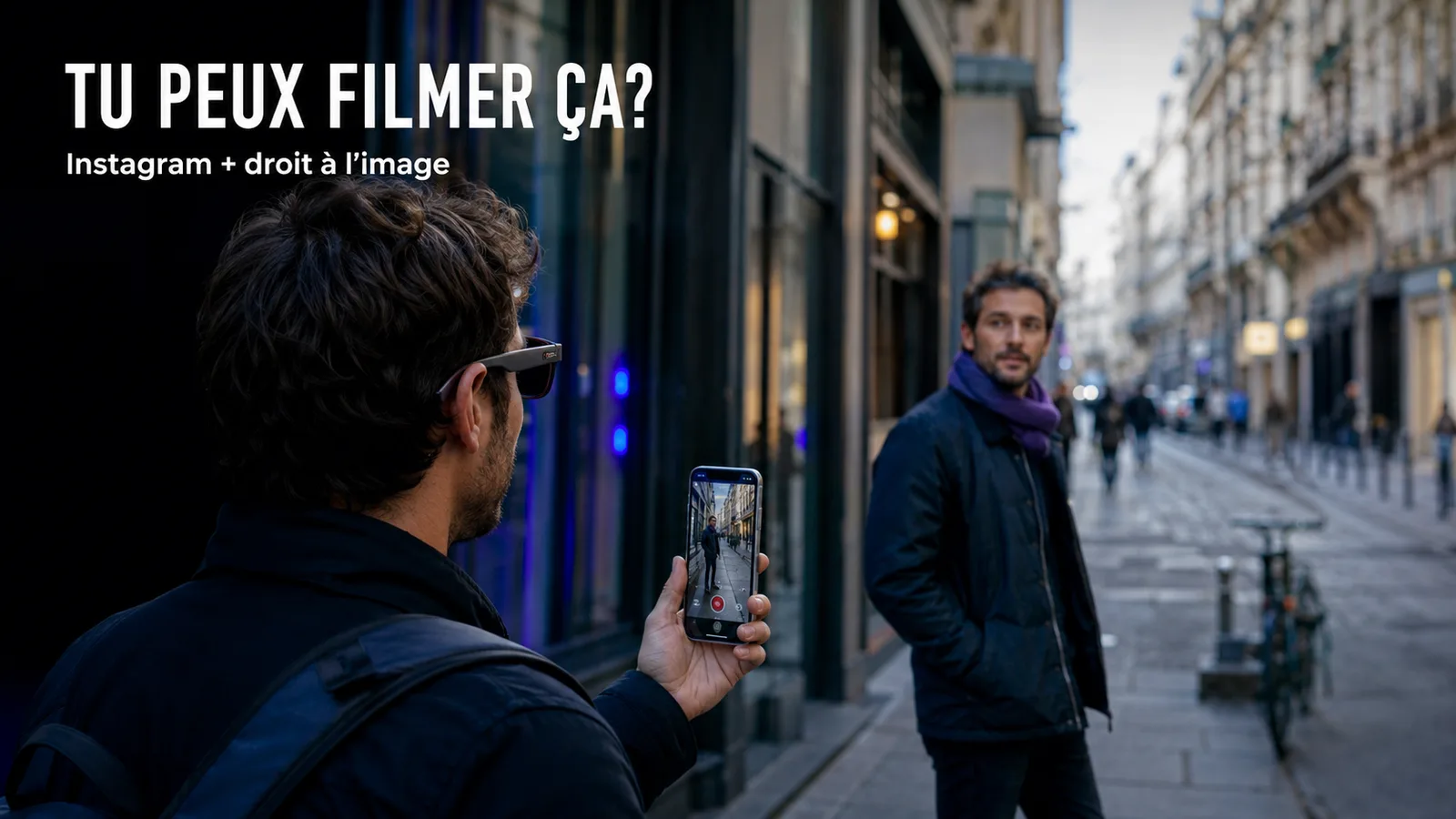
Filming strangers for Instagram: should content creators now ask for their permission?
A camera in a pair of glasses. A brief interaction on the street. A quick edit. Then several hundred thousand, sometimes millions, of views on Instagram.
Videos featuring street interviews, pranks, ‘cold approaches’ or spontaneous interactions with strangers have become an extremely common format on social media.
But a controversy surrounding the Meta AI Glasses highlights a reality that many creators overlook: Being able to film someone does not necessarily mean you can publish their image.
A survey published on 16 August 2026 by Business Insider shows that Instagram is still struggling to remove certain videos in which people are filmed without their knowledge or subjected to behaviour that could constitute harassment, despite a public statement by Adam Mosseri a few weeks earlier.
For French designers, this issue goes far beyond Meta’s smart glasses alone.
She asks a crucial question:
Can we still create viral content by using images of strangers without explicitly asking for their permission?
The answer warrants some qualification.
What’s just happened on Instagram
For several months now, Meta’s smart glasses have been used to record first-person videos without having to hold a smartphone.
Meta explains that its glasses feature a white LED that is visible when a photo or video is being recorded. On recent models, covering or tampering with this LED can automatically disable the camera.
The problem is therefore not solely a technological one.
Some content creators use these glasses to make videos in which they approach strangers, particularly women, or organise pranks involving staff and people they meet in public places.
In response to the controversy, Adam Mosseri had stated that Instagram would remove content using this type of technique where it exploits or harasses the people being filmed.
Meta already has policies against harassment and states that it does not tolerate content involving bullying or harassment on Facebook and Instagram.
However, the investigation published on 16 August by Business Insider shows that the enforcement of these rules remains imperfect.
The media outlet explains that it has identified more than twenty problematic videos that are still accessible. After they were reported to Meta, several were removed, but others remained online.
This is therefore not a new Instagram algorithm announced on 16 August.
It’s more a sign of a problem that’s set to become increasingly significant with glasses, miniature cameras and devices that allow you to film without taking your phone out.
Why this issue affects far more creators than we realise
It would be easy to conclude:
‘I don’t use Meta Glasses, so this doesn’t apply to me.’
That would be a mistake.
The issue potentially concerns all formats in which an identifiable person becomes a significant part of the content:
- street interviews;
- hidden cameras;
- pranks ;
- social experiences;
- reactions on the street;
- seduction videos;
- spontaneous interviews;
- staff filmed in shops;
- customers filmed in a restaurant;
- people filmed at the gym;
- clips used as the main element of a Reel.
And the difference between filmer and publish becomes essential.
In France, being in a public place does not mean that one’s image can be used freely
This is probably one of the most common misconceptions amongst designers.
A person in the street does not automatically waive their right to their own image.
Service-Public points out that individuals have the right to authorise or refuse the reproduction and public display of their image. In the case of an adult who is alone and recognisable in a public place, authorisation is, in principle, required to use their image.
The CNIL also points out that the right to one’s own image continues to apply on the internet and that a person may object to the reproduction or use of their image without prior authorisation.
There are, of course, exceptions, particularly those relating to the right to information, freedom of expression or artistic creation.
A crowd filmed at a public event, for example, is not in the same situation as a single person who has become the main character in a Reel.
It is this difference that creators need to understand.
‘He knew I was filming him’ does not necessarily mean ‘he agrees to me publishing it’
This is probably the most important point to remember.
Imagine a designer approaching someone in the street with a phone in plain view.
The person can see the camera perfectly. They answer the questions. They smile. They take part.
Can we automatically assume that she consents to the video being published for several hundred thousand people to see?
Not necessarily.
Service-Public even specifies that a videographer cannot simply rely on the consent of the person being filmed: the authorisation regarding broadcast must specify the intended use of the image.
This is a fundamental distinction:
Agreeing to be filmed is not quite the same as agreeing to have the footage posted on Instagram, TikTok or Facebook.
For a professional filmmaker, this difference is worth incorporating directly into the filming workflow.
The issue with Meta Glasses makes consent even more difficult
On a smartphone, there are usually several obvious social cues.
The person sees the phone. They see the camera pointed at them. They often realise that filming is taking place.
Smart glasses significantly reduce this friction.
Meta is specifically attempting to address this issue with its recording LED. The company states that this LED flashes whilst a recording is in progress and that recent models can disable the camera if an attempt to cover or tamper with this LED is detected.
However, an LED does not automatically constitute consent to publication.
A person can:
- not noticing the light
- not knowing what it means
- realising she is being filmed but not knowing that the video will be published
- accept the recording but then refuse to broadcast it.
This is precisely what makes this type of content particularly sensitive.
Instagram doesn’t simply penalise filming whilst wearing glasses
We must also avoid over-interpreting current affairs.
Instagram has not announced:
“All videos filmed without permission using Meta Glasses are prohibited.”
The issue highlighted by Adam Mosseri mainly concerns content in which people are exploited, humiliated or harassed.
Meta continues, moreover, to present its glasses as tools for capturing photos and videos, and explains that users remain free to choose whether or not to import and subsequently share the recorded content.
We must therefore distinguish between three different levels:
1. What the device is technically capable of
The camera can record.
2. What the platform accepts
Instagram has its own moderation rules.
3. What the law permits
Rules governing image rights and privacy may apply regardless of whether Instagram decides to leave the video online or not.
A video can therefore technically be posted on Instagram and still pose a legal problem.
Conversely, a platform may decide to remove content even where no infringement has been recognised by a court.
Street interviews: do you need to ask each person for permission?
For a French designer, the most secure solution is relatively simple.
When someone is:
- clearly identifiable;
- isolated in the image;
- in the centre of the video;
- used as part of your content;
it is advisable to obtain their consent regarding publication.
Service-Public states that, in practice, authorisation should be specific, particularly regarding the medium, the purpose of the broadcast and its duration.
This does not necessarily mean interrupting every video with five minutes of administrative procedures.
Consent can be cleverly integrated into the filming process.
For example:
“The video is intended for posting on my social media. Are you OK with that?”
For professional or commercial film shoots, written authorisation remains a much more reliable option.
The best workflow for creators
Here is a much safer way to create content with strangers.
Step 1: Film the interaction
You can retain the spontaneity that makes this format work.
Step 2: Clearly inform the person
Once the interaction is complete, explain:
- that the scene was filmed
- on which social media platforms it can be published
- possibly that the content is monetised or commercial.
Step 3: Obtaining approval
For important or professional content, opt for authorisation that is both practical and sustainable.
Step 4: If consent is refused, do not publish the identifiable person
You can:
- delete the sequence
- blur the face
- edit the layout
- use a different interaction.
Step 5: Retain permissions
A video can go viral several weeks or months after it is published.
Being able to trace the consent associated with a sequence can prevent a great many problems.
Blurring can save a great deal of content
Another extremely useful habit is to distinguish between:
the main person
and
people who are simply part of the backdrop.
A street interview can feature dozens of passers-by.
This does not necessarily mean that every element must become a distinct part of the content.
When someone adds nothing to the video:
blur it.
Automatic tracking tools make this process much simpler than it used to be.
The same reasoning applies:
- to number plates;
- on mobile screens;
- children;
- to personal documents;
- to the people working behind the scenes on your topic.
The best content isn’t necessarily the one that shows the most information. It’s the one that shows only what really serves the story.
Please also keep an eye on the children
The rules are even more sensitive when a minor becomes identifiable in a piece of content.
The CNIL reminds users that parental consent is required before publishing a photograph of a minor on the internet.
Service-Public also points out that parents must protect their child’s right to privacy and image rights, particularly with regard to images posted on social media.
For a creator producing content in the public sphere, the rule of thumb can therefore be very simple:
if an identifiable child is not essential to your content, avoid showing them or blur them out.
Why the problem is likely to get worse
Meta Glasses are just another step in the miniaturisation of cameras.
Smartphones had already made continuous filming possible. These glasses now make the camera much less visible.
Meta claims that millions of people already use its AI glasses on a daily basis and cites the trust of those around them as a key factor in their adoption.
This means that platforms will gradually have to address an increasingly difficult question:
how can one distinguish between a spontaneous scene, an artistic creation, a news report, a joke and the exploitation of someone who never wanted to become ‘content’?
The survey published on 16 August shows that automated moderation is not yet capable of resolving this problem perfectly.
And it’s also a question of building trust with your audience
Finally, there is a dimension that is neither legal nor algorithmic.
Trust. There are more and more creators. Production tools are becoming increasingly accessible.
Artificial intelligence enables us to produce more content. Smart glasses allow us to capture more moments on film.
In this environment, the real differentiator may be:
the way a creator treats the people who contribute to their content.
A Reel can rack up two million views. But if its success is built on the humiliation of someone who never asked to be the star of a video, the performance may end up costing far more than it brings in.
Creators: virality must not override consent
The Meta Glasses controversy does not spell the end of street interviews, spontaneous videos or interactions with strangers.
These formats will probably continue to work. But their professionalisation also requires us to professionalise what goes on behind the camera.
Request authorisation. Retain this authorisation. Blur where necessary. Respect a refusal.
Do not turn someone into mere content simply because technology allows them to be filmed discreetly.
It may be less spectacular than a new Instagram algorithm.
But for creators who want to build a lasting audience and a genuine business, it’s probably far more important.
Visibility attracts attention. Trust helps to retain it.
FAQ
Is it allowed to film someone in the street in France?
The situation depends on the context, but a distinction must be made between the act of filming and that of publicly disseminating the image. Where an adult is isolated and recognisable in a public place, their consent is, in principle, required to use their image, subject to various exceptions.
Can a video be published if the person knew they were being filmed?
The mere fact that a person agrees to be filmed does not automatically mean that they consent to all subsequent uses of their image. Service-Public states that authorisation for broadcast must be sufficiently specific.
Are street interviews banned on Instagram?
No. Instagram has not banned street interviews in general. The current controversy centres in particular on videos that may exploit or harass the people being filmed, especially when using discreet devices such as Meta Glasses.
Does Instagram ban videos filmed with Meta Glasses?
No. Meta specifically markets its glasses to enable users, amongst other things, to take photos and videos. However, the content remains subject to the platform’s rules.
Can someone request the removal of a video?
Yes. Service-Public states that a person whose image is published without authorisation may, amongst other things, request that the author remove it and then, if necessary, take further action.
Do you need permission to publish a picture of a child?
Protection for minors has been strengthened, and the consent of legal guardians must, in particular, be taken into account.
Sources
Business Insider: survey published on 16 August 2026.
Investigation into the continued circulation of harassment videos filmed using Meta Glasses, despite the measures announced by Instagram.
Meta: Newsroom, July 2026.
Official documentation on how the Meta AI Glasses work, the recording LED and the mechanisms preventing it from being disabled.
Meta Transparency Centre.
Rules and policy regarding harassment on Facebook and Instagram.
Service-Public.fr.
A French reference guide on image rights, authorisation for publication, recognisable individuals in public places and the main exceptions.
CNIL.
Reminder regarding the application of image rights on the Internet and the rights relating to the publication of an image without authorisation.
Key points
A good strategy isn’t just about publishing more. It’s about guiding your audience towards a clear call to action.
Create your LinkHub today
Centralise your links, offers, content and services on a clear and professional page.
Get your services booked in just a few clicks
Offer your services, show your availability and simplify your bookings with VIFLY Booking.