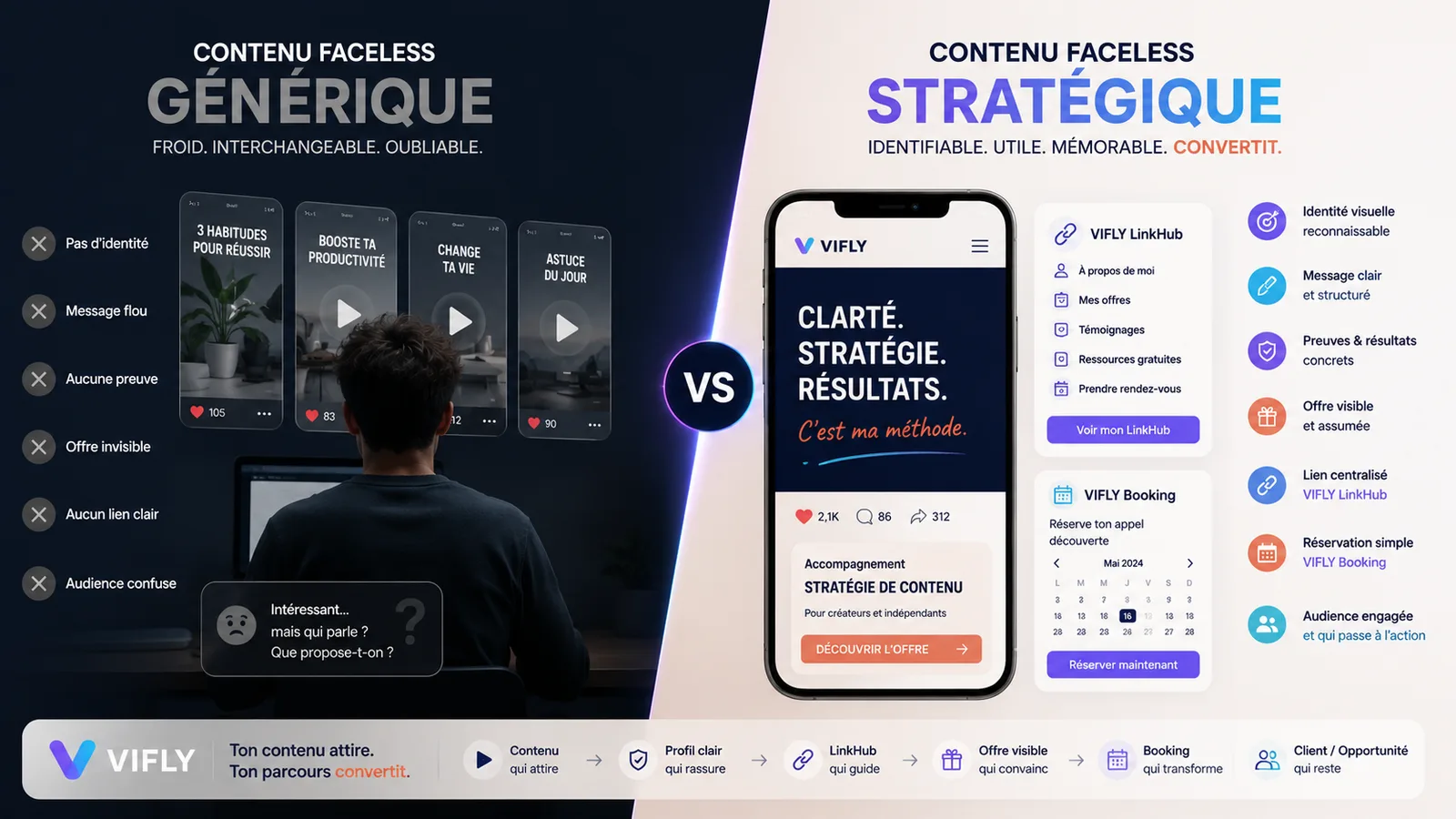
Not showing his face can be a strategy. But hiding behind generic content is a risk.
Faceless content attracts more and more creators.
They promise something very attractive: to create without showing up, to publish without exposing themselves, to develop an audience without having to speak against camera, to produce faster, to test formats, to remain discreet, to protect your privacy and sometimes even to build an entire account around a universe, a niche or a concept.
On paper, the idea is attractive.
And for many creators, coaches, consultants, independents, freelancers or entrepreneurs, it responds to a real tension. Not everyone wants to film themselves. Not everyone is comfortable with his image. Not everyone wants to facecam, tell their life or turn their personality into a permanent show.
But you have to be lucid.
Faceless content can be an excellent strategy. It can also become a trap.
Because the problem is not to show his face or not. The real problem is elsewhere: does your content give enough benchmarks to create trust?
A faceless video can be powerful, useful, memorable, identifiable and very professional.
But it can also become cold, interchangeable, impersonal, without proof, without voice, without link and without conversion.
In other words, the real question is not:
Do I have to show my face
The real question is:
Does my content faceless still allow my audience to understand me, recognize me, trust me and take action
That's where it's all played.
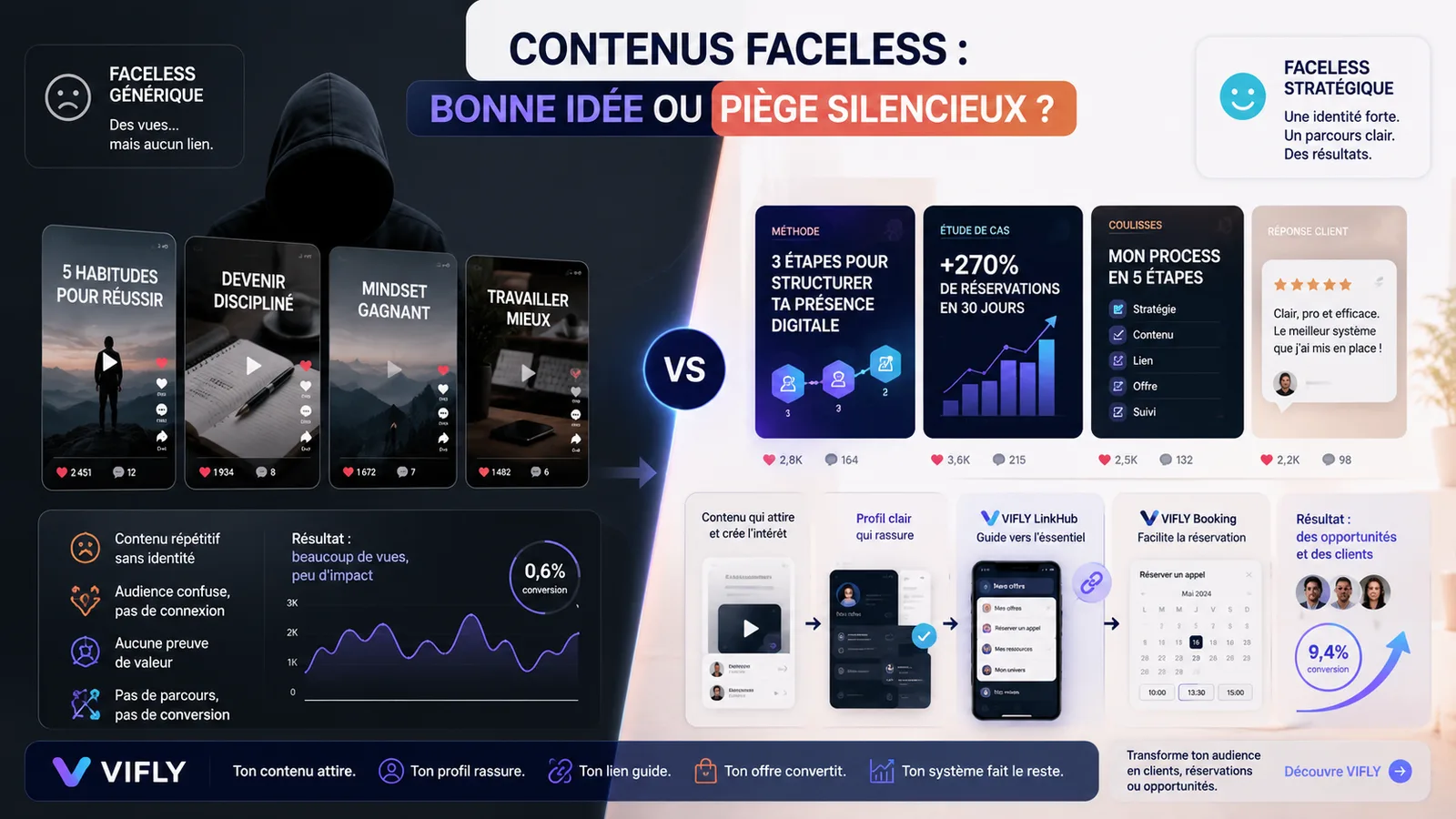
What exactly is faceless content?
Faceless content is content in which the creator does not show his face as the main element.
This can take several forms: videos with text on screen, voice off, illustration images, screenshots, b-roll, desktop scenes, handwriting, screen tutorials, animations, carousels, quotes, faceless reaction videos, educational content with diagrams, or formats entirely built around a visual atmosphere.
The faceless therefore does not mean without personality.
He just means your face isn't at the centre of the content. And that shade is very important.
A faceless account can have a strong personality. It can have a recognizable tone, artistic direction, a way of telling, a clear promise, a strong editorial line and a real relationship with its audience.
Conversely, a creator can show his face every day and remain totally forgetable if he doesn't have a angle, no message, no consistency and no clear path.
So the face is not the only confidence factor.
But the lack of a face obliges us to work more seriously on other signals: clarity, repetition, consistency, proof, editorial voice, content quality and the path after publication.
Why faceless content attract so many creators
If faceless likes so much, it's no coincidence. It removes part of the pressure.
Many creators want to publish, but don't like to see themselves in video. Some are afraid of judgment. Others do not want to expose their privacy. Some work in a sensitive area. Others prefer to build a brand around a subject rather than around their personal image.
For an independent, coach, consultant or trainer, faceless can also be a way to start faster.
You can publish tips, show diagrams, film your screen, use work scenes, desktop plans, captures, examples, case studies, strong texts, carousels or demonstrations, without facing you every day camera.
That's reassuring. And sometimes it's even more suitable.
A SEO consultant can create faceless videos with site audits.
A business coach can show examples of blurred offers and then reformulate them.
A trainer can create small visual lessons.
A therapist can publish soothing, educational and anonymized content.
A freelance design can show before/after.
A digital designer can use coffee, desktop or screen scenes to illustrate funny and highly recognizable situations.
The faceless then becomes a format of expression. Not a hiding place.
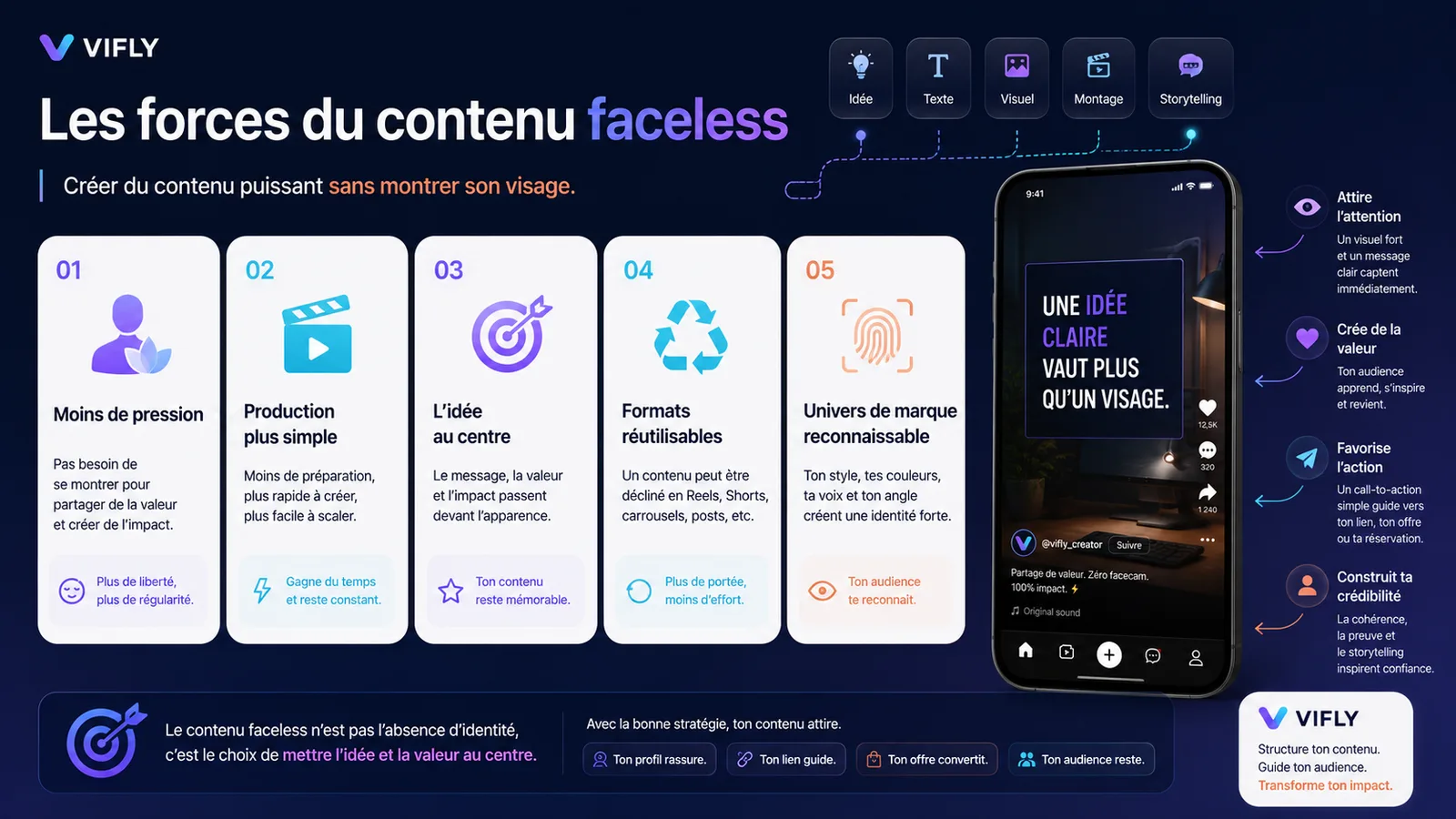
The real advantage of faceless: you can put the idea in the center
One of the main interests of faceless content is that it sometimes requires better work.
When your face is not there to carry energy, your message must be stronger. Your text must be more precise. Your assembly needs to be better attended to. Your visual must be more legible. Your scenario must be clearer. Your fall must be more memorable.
It's a constraint, but it's a good constraint.
An effective Reel faceless can't just make pretty. It must create a tension very quickly.
For example:
When you choose your coffee with more strategy than your content
This sentence can work without voice, without facecam, simply with two planes: a desk with coffee cups, then a person who seriously chooses his coffee machine.
Why does it work?
Because the situation is visual. The joke is quick. Target recognizes itself. The message speaks of a real problem: publish without strategy.
And the link with VIFLY is natural: structure its content, its course, its offers and its actions.
The faceless then becomes powerful because it does not try to hide the creator.
He puts the idea in the foreground.
The danger: becoming interchangeable
The great risk of faceless content is interchangeability.
When everything is based on free images of rights, off-generic voices, repetitive templates, quotes already seen, recycled scripts and visuals without identity, the audience can consume content without ever remembering who it has published.
She sees the video. But she doesn't memorize the creator.
She understands the board. But she doesn't identify the expert.
Maybe she's saving the post. But it does not necessarily develop trust in the person or the brand behind.
This is the main danger.
Faceless content can make views without building attachment. And for a creator who wants to sell a service, offer support, get reservations, generate requests or build a personal brand, this is a real problem.
Because visibility alone is not enough. This is exactly the idea developed in the article Views do not pay bills: how to turn your audience into customers. Content may attract attention, but if the profile, offer and route do not take over, the opportunity disappears.
So the faceless is not bad. But a faceless faceless without identity, without proof and without direction can become a sight machine without relationship.
Faceless does not mean without human
This is probably the most important point.
You may not show your face and remain deeply human. Human is not limited to a sidecam.
He can be in your way of speaking. In your examples. In your opinions. In your observations. In your stories. In your choice of words. In your way of showing behind the scenes. In the regularity of your universe. In your ability to respond to the real problems of your audience.
Human faceless content can show:
a daily situation, a work screen, a notebook, a real error, a before/after, a tested method, a relatable scene, a concrete example, a comment received, a client question, a mini-analysis, a silent reaction, a strategic decision.
The audience doesn't necessarily need to see your face. But she needs to feel a presence.
She must understand that there is a thought behind the content. A person, a method, an intention, a look.
This is also why the article I'm not going to kill the creators... except those who look alike is very related to this. The problem is not using AI or creating faceless. The problem is to publish content that could be signed by anyone.
The faceless works when it keeps a voice. It fails when it becomes anonymous in every sense of the word.
When faceless is a good idea
Faceless is a good idea if you want to create a strong editorial universe without depending on your physical presence.
It is particularly interesting in several cases.
If you start and the fear of showing yourself completely blocks you, the faceless can allow you to publish without waiting to be perfectly comfortable.
If your content is based on pedagogy, diagrams, demonstrations or analysis, your face is not always necessary. A screen tutorial, visual explanation or a front/after can sometimes be more effective than a facecam.
If you want to build a media brand, the faceless can also be relevant. Some pages are not based on a visible person, but on an editorial line, tone, promise and identity.
If you have a sensitive, personal or confidential activity, the faceless can protect part of your exposure while allowing you to create value.
If you want to produce regularly without always turning against camera, the faceless can complete a more incarnate strategy.
But in all these cases, we need a real structure.
An effective faceless must have a clear promise, a recognizable identity, recurring formats, strong editorial angles, proof of competence and a path after the content.
Otherwise, you might publish a lot without creating any positioning.
When faceless becomes a bad idea
Faceless becomes a bad idea when it only serves to avoid trust.
If your audience needs to buy a service, book a session, confide in a problem, ask for an accompaniment or invest in your expertise, it needs strong benchmarks.
These landmarks can be your face, but not just. They can also be your name, your story, your proof, your results, your opinions, your examples, your tone, your profile, your offer, your booking page, your LinkHub and the consistency of your universe.
But if everything is blurred, the faceless reinforces the doubt.
An account that never shows who is behind it, that gives no concrete example, that does not prove its expertise, that uses generic visuals, that recycles the same sentences as everyone else and hides its offer behind a confused link may lose credibility.
The viewer may ask:
Who's talking? Why should I listen? Is it a real experience or a copied content? Can this person really help? Where's the offer? What's the next step?
And when these questions remain unanswered, attention does not change.
It evaporates.
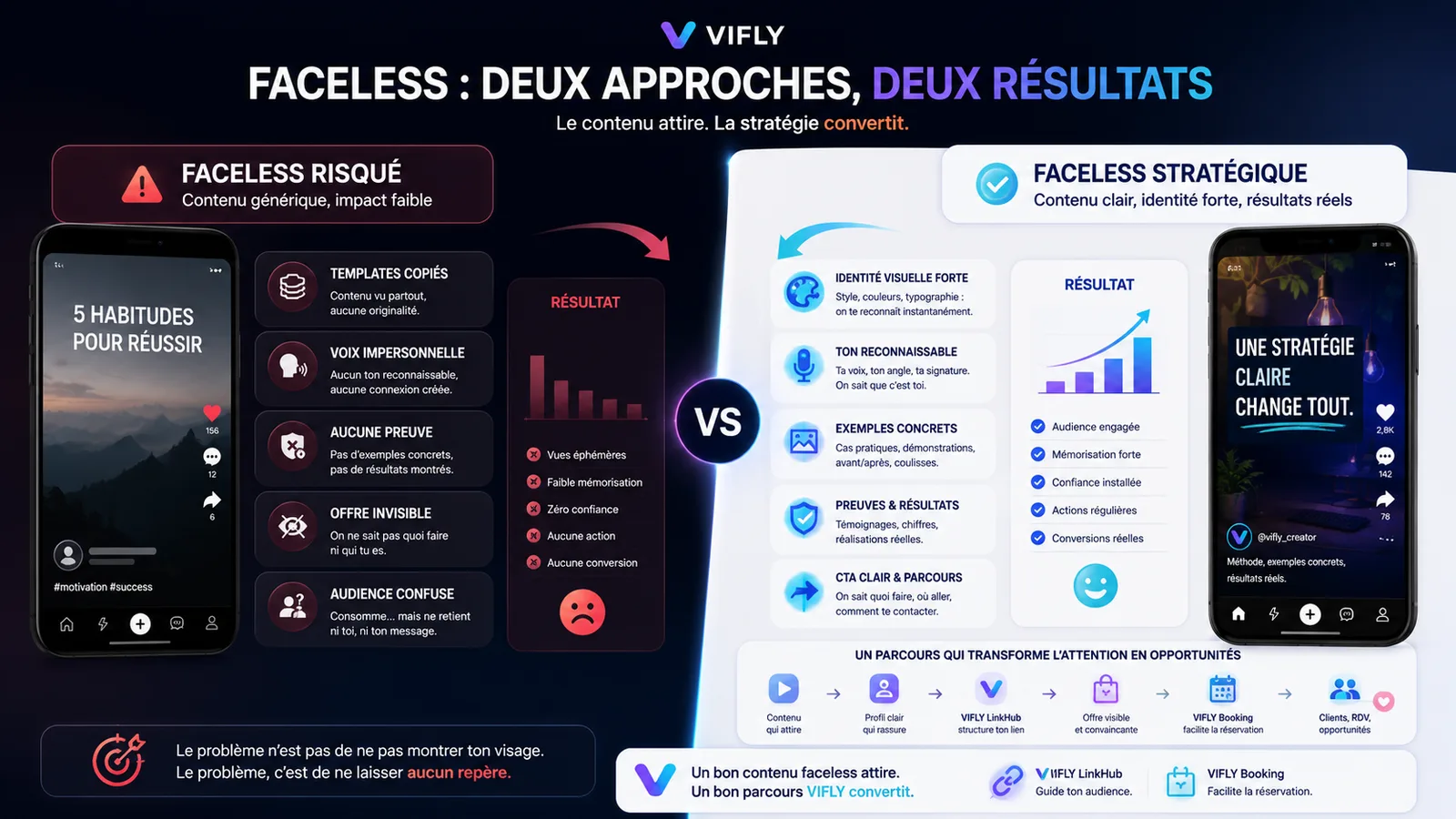
The 5 essential elements of good faceless content
Performance faceless content is based on five pillars.
The first is an identifiable editorial voice.
Even faceless, your audience must recognize your way of speaking. Is your tone direct, funny, educational, premium, provocative, reassuring, introspective, strategic? If each publication looks like a generic phrase found elsewhere, you don't build a brand.
The second is a coherent visual identity.
Colors, typography, rhythm, slide structure, editing style, way of presenting titles, general atmosphere: everything must create a form of recognition. The audience must be able to see content and feel that it comes from your universe.
The third is concrete examples.
The faceless quickly gets cold if you never show real situations. Uses practical cases, anonymous catches, before/after, reactions, frequent errors, daily scenes, comparisons, mini audits.
The fourth is the proof.
Reviews, returns, results, demonstrations, method, field experience, behind the scenes, process. The evidence compensates for the absence of a face. It shows that your content is not just aesthetic, but credible.
The fifth is a clear path.
After seeing your content, the person needs to know what to do. Read an article, discover your offer, book a call, access a resource, consult your LinkHub, contact you, sign up, buy.
This is where many creators fail.
They make good content faceless, but their audience then arrives on a blurred profile. The bio link does not guide. The offer is not visible. The CTA is vague.
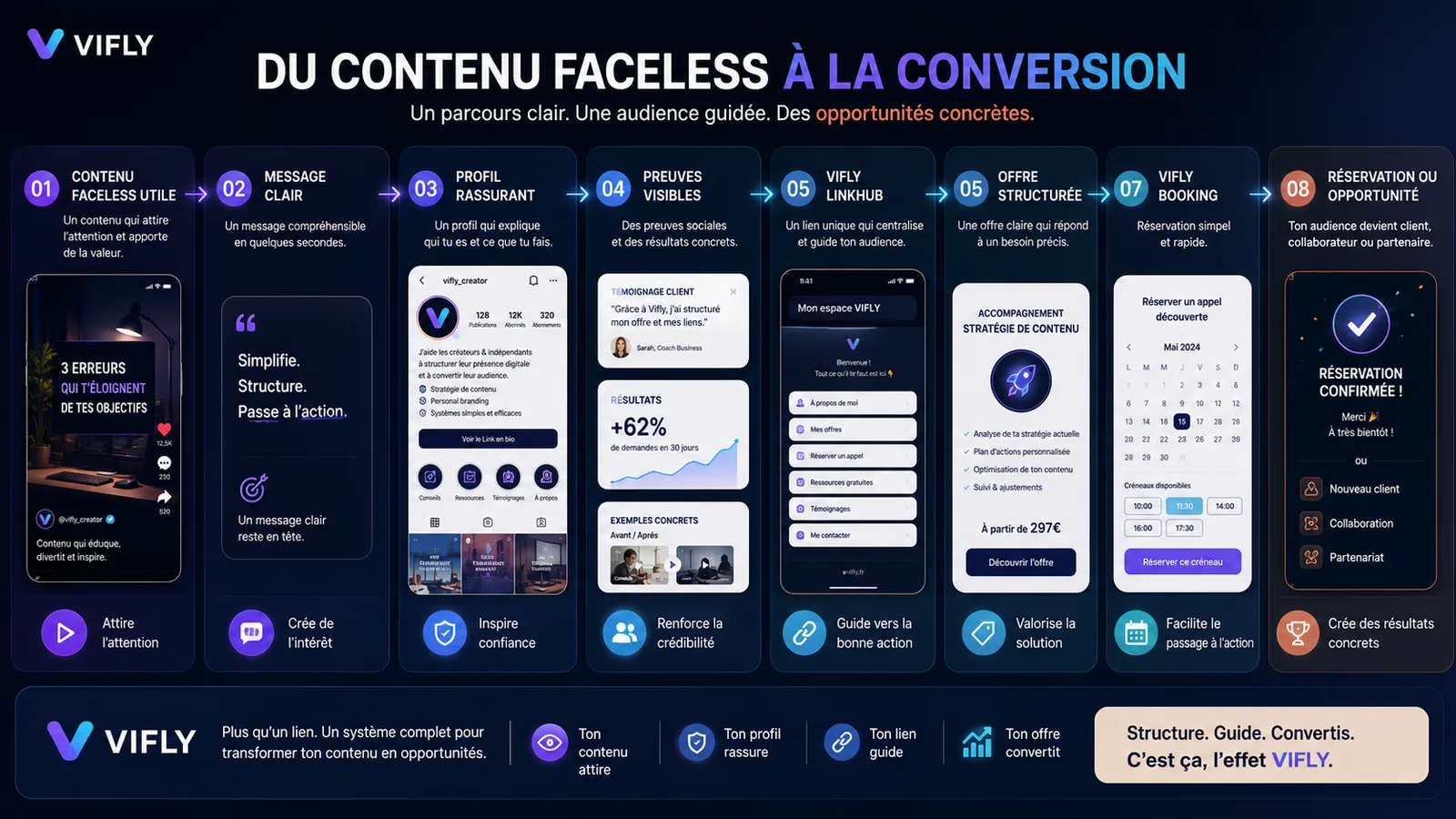
This is precisely what VIFLY is trying to correct: the content attracts, but the path has to convert.
How to use faceless when selling a service
If you're a coach, consultant, trainer, therapist, freelance or independent, you can use faceless, but you need to build trust elsewhere.
Your content can be faceless. But your profile must be clear.
Your bio must explain what you're doing. Your offer must be visible. Your evidence must be accessible. Your bio bond must guide. Your services must be understandable. Your booking page must reassure you.
For example, if you offer Instagram audits, you can create Faceless Reels with bio errors, examples of weak CTAs, blurred profiles, poorly structured bio links. You don't need to show your face to be useful.
But if someone wants to go further, they must quickly find a clear page with your offer, your process, your price or your discovery call.
That's where VIFLY LinkHub becomes interesting. It allows you to centralize your links, present your offers, organize your resources and guide your audience towards the right actions. Faceless content can attract a person, but your LinkHub must help him understand what to do next.
And if you propose appointments, audits, sessions, coaching or discovery calls, VIFLY Booking can turn interest into reservation. Your audience doesn't need to exchange ten messages to know how to work with you. It can choose a service, a niche and take action more simply.
The faceless is therefore compatible with the sale of services.
But only if the course behind is professional.
The most interesting faceless formats for VIFLY
For a brand like VIFLY, the faceless can be very powerful, especially if the format remains human, funny, useful or educational.
The most interesting formats are the daily scenes with text on screen.
For example: a coffee machine, a desk, a screen, coffee cups, a notebook, a telephone, a whiteboard. These scenes work well because they are simple, recognizable and easy to divert.
An example:
“5 coffee today. 0 planned content. But I still take 2 minutes to choose the right espresso
This format is funny, but it carries a real message: many creators have more rigour in some small decisions than in their content strategy.
Another effective format: mini-visual audits.
You show a blurred bio, a disorganized bio link, a hidden offer or a weak CTA, then you explain what to change.
Another format: schematics.
Contents → profile → link → offer → booking.
Idea → script → Reel → profile → LinkHub → Booking.
Audience → trust → action.
These diagrams are perfect for VIFLY because they show that the platform is not only used to publish a link. It helps build a course.
Finally, silent reactions can also work very well. An absurd advert, a too vague offer, an exaggerated price barred, an incomprehensible profile, a link in saturated bio: you don't need to talk. Your look, text on screen and fall are enough.
Should we mix faceless and facecam?
In many cases, yes.
The best strategy is not necessarily to definitely choose between faceless and facecam. It may consist of using both intelligently.
The faceless can be used to produce regularly, test angles, create educational formats, illustrate situations, show examples, publish humorous content or share diagrams.
The facecam can be used to build confidence, give personal advice, tell an experience, respond to an objection, present an offer, share a conviction, create a more direct relationship.
You don't have to show up all the time. But if you sell your expertise, it may be useful to appear sometimes.
Even briefly.
A face, a voice, a personal anecdote or a position statement can humanize the whole. Faceless can attract and clarify. The sidecam can reassure and connect.
The right balance depends on your personality, your activity, your audience and your purpose. But for many creators, the right question isn't either a faceless or not a faceless one
It's more like:
Which format best serves this specific message
The checklist before posting faceless content
Before you publish faceless content, ask yourself these questions:
Is the message understandable without explanation?
Does the content have a clear angle?
Do we recognize my universe?
Is the text on screen readable in a second?
Does the video bring a useful, funny or memorable idea?
Does the content make you want to go see my profile?
Does my profile clearly explain what I'm proposing?
Does my bio link guide to action?
Is my offer visible?
Can the interested person book, ask or buy easily?
If you answer no to several questions, the problem may not be that the content is faceless.
The problem is that your journey is not clear enough.
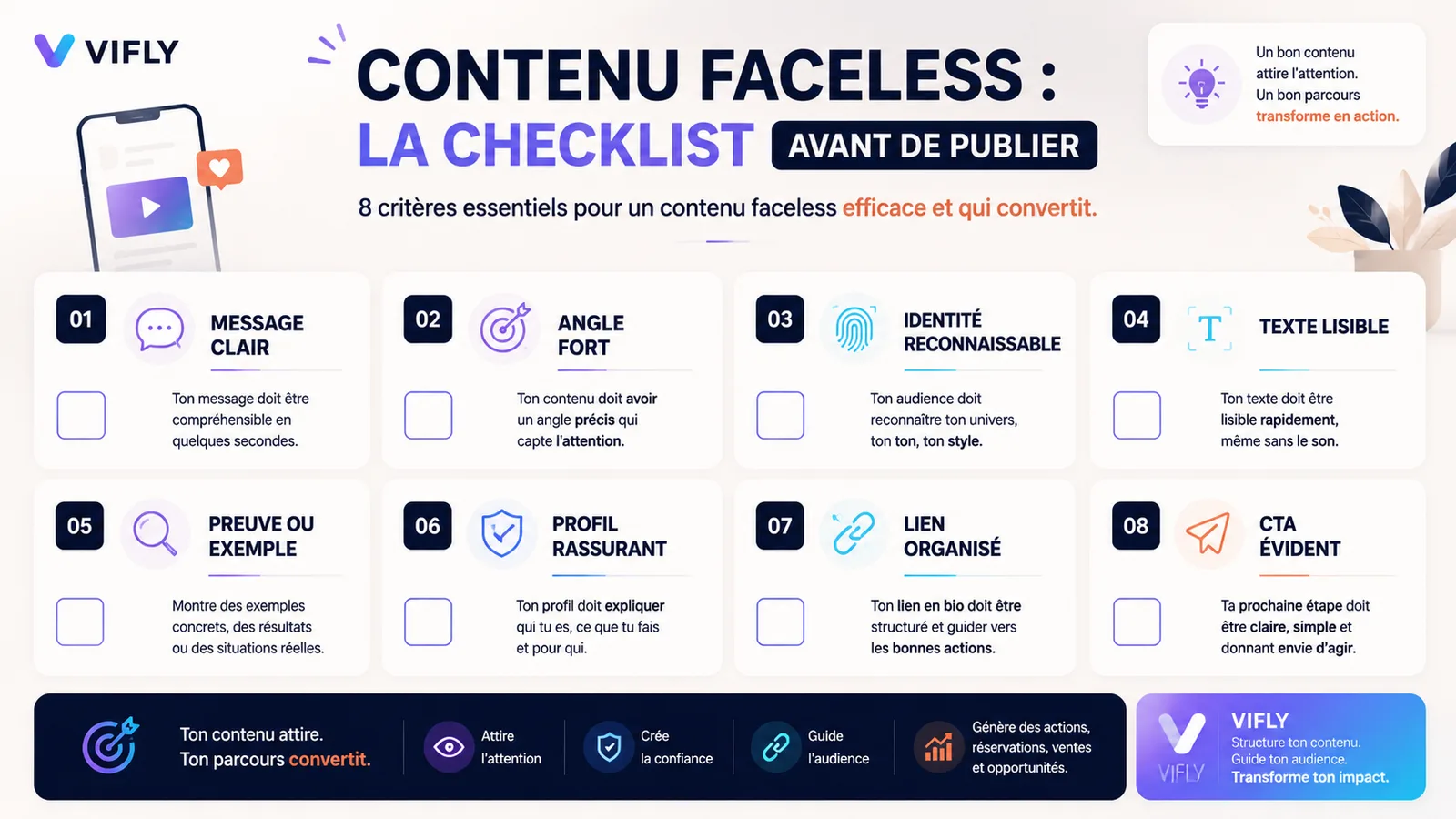 Checklist of criteria for publishing faceless content that is effective, clear, identifiable and converted.
Conclusion: faceless is neither a magic solution nor a bad idea
Faceless content is not a bad idea.
But neither are they an automatic strategy.
They can help to publish more easily, preserve your privacy, test formats, create a universe, put the idea at the centre and produce more regular content.
But they can also make you interchangeable if you don't have a voice, no evidence, no identity, no visible offer and no clear path.
So the difference is not on your face. She plays on clarity.
Good faceless content must do three things:
attract attention, create confidence, make you want to go further.
If it only entertains without building a relationship, it may remain a simple publication. If he attracts without guidance, he may lose the opportunity. If it is beautiful but anonymous, it may be forgotten.
The faceless works when it becomes a real editorial format. Not when it becomes a way to disappear behind generic content.
So yes, you can create without showing your face. But do not create without identity.
Do not publish without direction.
And most importantly, don't let your audience guess what it's supposed to do after you find out your content.
With VIFLY, you can structure your profile, centralize your links, present your offers and facilitate your bookings to turn attention into concrete opportunities.
Frequently Asked Questions
What is faceless content?
Faceless content is content in which the creator does not show his face as the main element. It can be videos with text, voice off, screenshots, b-roll, schematics, tutorials or visual content.
Is faceless content a good idea?
Yes, faceless content can be a good idea if it is based on a clear editorial voice, a recognizable identity, concrete examples and a path that guides the audience towards action.
What are the risks of faceless content?
The main risk is to become generic or interchangeable. If the audience does not recognize your style, expertise or offer, it can consume your content without remembering who you are.
Can we sell our services with faceless content?
Yes, but you must compensate for the lack of a face with a clear profile, evidence, a visible offer, a well structured link and a reassuring booking page.
How does VIFLY help faceless designers?
VIFLY helps creators structure their journey after content through LinkHub and Booking. The audience can discover offers, access resources and book more easily.