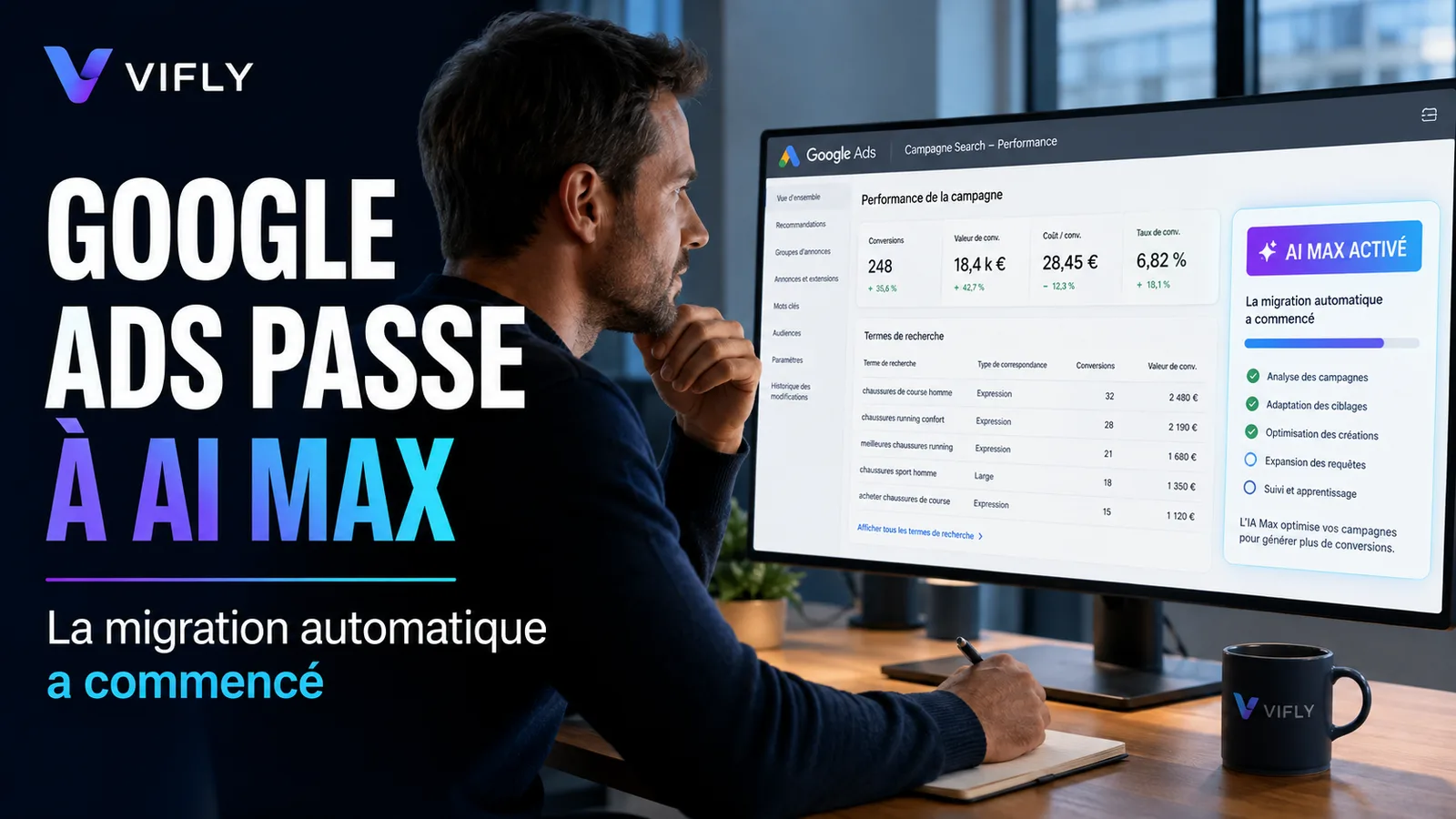
Google Ads automatically switches certain Search campaigns to AI Max: what you need to check straight away
You’re launching a Google Ads campaign. It’s running smoothly. Your keywords are being tracked. Your budget is stable.
Then, over the course of September, Google gradually changes the campaign structure. Without you necessarily having created a new campaign.
This is exactly what is currently starting to happen for some advertisers.
Since 1 September 2026, Google Ads is gradually transitioning to AI Max some Search campaigns still using legacy settings, notably the Broad match at campaign level or the older ones Automatically Created Assets. The roll-out is set to continue until 30 September 2026.
Be careful with the shortcut, though:
Google does not convert all Search campaigns into fully automated campaigns overnight.
The configuration applied depends on what was already active prior to the migration. And this is precisely what an advertiser needs to check today.
What is Google Ads AI Max?
AI Max is a suite of features designed for Search campaigns.
Google uses this to combine more signals and automate several aspects of distribution:
- search for additional queries
- adaptation of the advertising text
- selection of landing pages
- use of brand and localisation controls
Google is presenting AI Max as an evolution of its Search engine, designed to better respond to searches that have become longer, more conversational and harder to capture using traditional lists of keywords alone.
AI Max is structured around three main features
These include, in particular:
Search Term Matching
Google may search for more queries that are likely to match the intent of your campaign.
Text Customisation
Google may generate or adapt certain text elements of the advert from your existing content.
Final URL Expansion
Google may select a more suitable landing page than the one originally intended when this feature is enabled.
These three components can be configured separately.
And above all:
they are not all enabled automatically in every migration.
Which campaigns will be migrated in September 2026?
The first phase concerns two specific historical configurations.
1. Campaigns using broad match at campaign level
Google had previously offered a setting allowing broad match to be applied more widely at campaign level.
Since 1 September, these configurations have begun to be migrated to AI Max.
2. Campaigns using the old Automatically Created Assets
Campaigns that still use the ACA, or automatically generated assets, are also affected.
Google has, in fact, renamed this logic to Text Customisation in its AI Max environment.
What about Dynamic Search Ads?
This is an extremely important distinction. Google had originally planned to migrate the DSAs as well in September.
But this event has been postponed.
Existing Dynamic Search Ads campaigns remain active for the time being, and their automatic migration is now scheduled for February 2027.
So:
September 2026 ≠ immediate abolition of all DSAs.
What Google actually activates during the migration
This is probably the most important part to check in your account.
If your campaign used broad match at campaign level
Google states that the migration to AI Max applies the following by default:
- Search Term Matching: enabled
- Text Customisation: disabled
- Final URL Expansion: disabled
Existing brand lists are retained and transferred to the new configuration.
This means that Google is primarily expanding the search matching logic, without automatically having to start rewriting your adverts or choosing different landing pages.
If your campaign used Automatically Created Assets
The default configuration becomes:
- Search Term Matching: enabled
- Text Customisation: enabled
- Final URL Expansion: disabled
In this case, Google can therefore continue to generate or adapt certain text, but does not automatically change the landing page via Final URL Expansion.
This distinction is essential.
Two advertisers may be assigned the same label AI Max in their account and yet exhibit different campaign behaviours.
Why Google is promoting AI Max now
Google explains that searches have become more complex.
Internet users no longer just type:
marketing coach Paris
They can search for:
Which consultant can help me secure more appointments without increasing my advertising budget?
Or formulate longer search queries influenced by conversational usage.
Search campaigns that rely solely on a limited set of keywords may therefore miss out on certain search intentions.
AI Max is trying to make better connections:
- advert content
- website content
- signals of intent
- queries
- campaign history
Google states that, according to its internal 2026 data on non-retail advertisers, the use of the full range of AI Max features generated, on average, 7 % of additional conversions or conversion value to comparable CPA/ROAS compared to Search Term Matching alone.
However, this data should be interpreted as:
an average result from Google internal data, not a promise of +7 %] for your campaign.
The problem for small advertisers: more automation can also mean less understanding
For a large company with:
- solid tracking
- thousands of conversions
- a CRM
- media teams
Greater automation can be relatively easy to control. For an independent spending 500 € or 1 000 € per month, the situation is different.
Imagine a consultant.
Before migration, it has a relatively simple campaign:
sEO consultant La Réunion
reference consultant
sEO audit
After migration, Search Term Matching searches for more requests corresponding to the estimated intent.
This can discover:
improve seo site
Excellent.
But potentially also much higher research in the funnel. The additional traffic is therefore of interest only if:
additional conversions are really useful.
More clicks mean nothing on its own.
The first thing to check: your search terms
After migration, especially monitor Search Terms.
Ask yourself:
- what new searches trigger my ads?
- do they really match my offers?
- is the intention commercial or simply informational?
- do some requests consume budget without producing conversion?
This is the most important control when Search Term Matching becomes more aggressive.
Example
You sell:
instagram consultation for professionals: 150 €
Google starts broadcasting on:
how to have more Instagram subscribers for free
The theme is linked. But the intention is not necessarily the same.
The user may only be looking for a free tip. Your CPC can be consumed without producing the desired lead type.
Second check: your negative keywords
The more Google expands the understanding of queries, the more your exclusions become important.
For a premium consultant, this could include, depending on their activity:
- free
- employment
- internship
- salary
- free training
- free tuto
Attention, however:
negative words must be built from real data. Do not block words massively simply because they seem bad to you.
Look first:
request → click → conversion → lead quality.
Third check: Text Customisation
If your campaign came from the former Automatically Created Assets, Text Customization can now be enabled in AI Max.
This means that Google can use the content of your site to adapt certain advertising elements. It's convenient when your site is well structured.
But this introduces a new problem.
A bad landing page can produce bad advertising
Suppose your site contains:
Free training: understand the basics of AI
and
Audit IA company: 900 €
If your campaign is looking to sell the premium audit, your editorial environment should allow Google to clearly understand what information belongs to the relevant offer.
The more you let automated systems operate your site, the more:
site clarity becomes part of advertising performance.
Fourth check: Final URL Expansion
In the September migrations described by Google, Final URL Expansion is disabled by default for the two major migrated categories.
This is important.
It would be wrong to write:
"Google will now automatically send your visitors to any page of the site. »
This is not the default behavior described for this migration. But you can then activate this feature.
If you do, check carefully:
- pages allowed
- URLs to exclude
- consistency between query and landing page
- tracking conversions
Your tracking is becoming much more important than before
Automation works from signals.
If you tell Google:
this is a conversion
Google will try to get more. The problem happens when your definition is wrong.
Wrong signal
Someone visits the contact page. You count that as conversion.
Google optimizes campaigns to generate more contact page visits. But no requests are actually sent.
Better signal
You measure:
- form actually submitted
- booking confirmed
- purchase
- lead qualified
- call for significant duration depending on your activity
The closer your conversion is to the true business value, the more the algorithm receives a useful signal.
IA does not automatically improve a bad KPI. It can simply optimize much faster.
For VIFLY Booking, the tracking process must continue right through to the booking
Let's take a coach using Google Ads.
The course is:
ad → page → offer → Booking → appointment.
Measure only:
click on
is less useful than measuring:
reservation finalized.
With a system like VIFLY Booking, the aim must be to gradually bring the marketing follow-up to the action which really has value.
The logic becomes:
Google Ads → INtent → booking → turnover.
This is much more interesting than:
Google Ads → click → impressive statistics.
Profiles and LinkHub also need to become more consistent
AI Max shows a wider trend. Platforms are increasingly using your own content as context.
Google reads your landing pages. IA engines read your content. Networks are trying to understand your expertise.
A dispersed professional identity therefore gradually becomes more difficult to exploit.
A VIFLY LinkHub can help centralize:
- your positioning
- your offers
- your content
- your main CTAs
- your contact points
This obviously does not mean that LinkHub "improves AI Max".
The benefit is elsewhere:
you make the course after the click much more understandable.
AI Max is no excuse for handing your campaigns over to Google
It's probably the main trap.
The name AI Max can give the impression:
"Google now takes care of everything. »
It's not a strategy. Google automates in particular:
- matching
- text
- certain distribution decisions
But he doesn't necessarily know:
- your margin
- the actual quality of a customer
- your ability to absorb new appointments
- your positioning
- your creator business strategy
Example
Google can generate 30 leads to 20 €.
Technically:
excellent CPL.
But 25 leads are looking for a service to 50 € as you sell a mission to 2 000 €.
Your "perform" campaign.
Your business isn't.
This is why an automated system must be powered by business signals, not just advertising.
Creators using Google Ads should start with their offer
Many creators think:
I'm gonna advertise for my profile.
That's not always the best logic. A search campaign works particularly well when it responds to a intention already expressed.
For example:
wedding photographer Meeting
coaching LinkedIn leader
vocational training
online therapist
The problem to be solved is clear. The landing page must then respond precisely to this intention.
AI Max can expand the search for similar applications. But it cannot make a vague offer suddenly convincing.
How to check if your campaign has already been migrated
Google says the migration takes place gradually throughout september.
Do not assume that your account has already been changed in 2 September. In Google Ads, open your Search campaign settings and check the section AI Max.
Look:
- AI Max activated or not
- Search Term Matching
- Text Customisation
- Final URL Expansion
- brand parameters
- history of change
For advertisers working via API, Google also provides fields to identify migration dates.
Use change history
It's probably the simplest reflex. If a performance changes suddenly:
first look at what has actually been changed.
Do not immediately conclude:
" Google algorithm has become bad. »
You can discover that an AI Max setting has just started to work.
Take a screenshot of your current setup
Before adjusting anything:
capture:
- parameters
- budget
- CPA / ROAS
- conversions
- main requests
- conversion rate
Why?
Because in two weeks, you must be able to answer:
what really changed?
Without an initial state, the analysis quickly becomes subjective.
Should AI Max be disabled immediately?
No.
It would be as excessive as blindly activated. The right reasoning is:
test → measure → compare.
Google itself recommends using experiences to measure the impact of its AI Max features.
A company can perfectly discover that:
- more relevant queries are captured
- cPA remains stable
- conversions increase
In this case, removing automation only in principle would be counterproductive.
Conversely, if:
- non-target queries increase
- CPL explodes
- quality leads fall
we have to tighten.
The VIFLY method: granting greater freedom only when performance improves
The principle can be summarized as follows:
the more freedom the algorithm has, the more precise your measure must be.
If you give Google more latitude on:
- requests
- texts
- pages
you need to improve in parallel:
- conversion tracking
- quality of landing pages
- exclusions
- CRM
- value of leads
Automation and control are therefore not opposed. They evolve together.
AI Max confirms a wider trend: the keyword is losing its monopoly
The Historical Search relied heavily on:
keyword → advert.
Today, Google is gradually evolving towards:
intent → content → signals → announcement.
The keyword remains important.
But the entire environment is gaining more weight.
This means that your marketing work needs to better align:
- positioning
- page
- offer
- content
- conversion
- tracking
SEO, advertising and user experience become less and less separate.
Seven things to do this week
1. Identify your campaigns
Search for Search campaigns using historically:
- campaign-level road match
- Automatically Created Assets
2. Check if migration has already taken place
The deployment continues until 30 September.
3. Note AI Max settings actually enabled
Don't just see AI Max ON.
Look at the subsets.
4. Audit your search terms
Look for new requests triggered.
5. Check your conversions
Ask:
is it a real business action or only a superficial signal?
6. Check your landing pages
They must be:
- precise
- coherent
- rapid
- simple
- action-oriented
7. Compare before/after
Not after 24 hours if your volume is low.
Allow sufficient data to accumulate before drawing a conclusion.
Conclusion: AI Max doesn’t take your job away — it shifts your workload
The mistake would be to see this migration as:
"Google Ads becomes automatic, so I have fewer things to do. »
Actually, your work is changing.
You will probably spend less time at:
- maintain some lists
- mechanically adjust certain matches
- create each variant
But more time to:
- check intentions
- analyze conversions
- improving supply
- control the quality of leads
- structure your pages
Google can find more searches. It can adapt certain texts. It can exploit more signals.
But he still cannot answer your place to the question:
" Did this click really create an opportunity for my company? »
Your next step
Today, open your Search campaigns and do only four things:
1. Check if AI Max has already appeared on your campaigns.
2. Record exactly which modules are enabled.
3. Export your main search terms and current performance.
4. Check that your main conversion is a real value: booking, lead qualified or sale.
If your creator business is based on appointments, bring the actual booking follow-up as close as possible to your appointment making system, for example VIFLY Booking.
And if your visitors discover several offers or content before choosing, use a clear central point like VIFLY LinkHub to reduce friction.
Because with AI Max, Google makes more decisions.
Your advantage will no longer be to control every click. It will be better to define what a good click is.
FAQ
What is Google Ads AI Max?
AI Max is a feature suite for Search campaigns that uses more signals and automation to extend query correspondence, customize some texts and eventually select other destination pages.
When does the automatic migration start?
The first phase began on 1 September 2026 and shall be progressively deployed until 30 September 2026.
Do all Search campaigns automatically switch to AI Max?
No. The September phase targets campaigns using Broad Match at the country level and the former Automatically Created Assets.
Are Dynamic Search Ads migrated in September?
No. Their automatic migration has been pushed back to February 2027.
Is Final URL Expansion enabled automatically?
Not in the two main September migrations described by Google: it remains disabled by default.
Does Google automatically generate my texts?
For campaigns from Automatically Created Assets, Text Customization is enabled by default. For campaign-level road match campaigns, it remains disabled by default.
Should I disable AI Max?
Not automatically. It is best to measure requests, conversions, CPA/ROAS and lead quality before deciding.
SOURCES
Google Ads Developer Blog : , 12 august 2026. Main official source of calendar and configurations. Google confirms that the migration started the 1 September 2026 and must continue until 30 september, with different parameters according to historical configurations.
Google Ads: 15 april and updated on 11 june 2026. Official source of context on AI Max, the postponement of DSAs to February 2027] and the average performance reported by Google on all AI Max features.
Google Ads Help: . Official documentation explaining how existing settings are taken over and managed in AI Max after migration.
Google Ads Help : . Official documentation detailing the transition from the former Automatically Created Assets to Text Customization in AI Max.