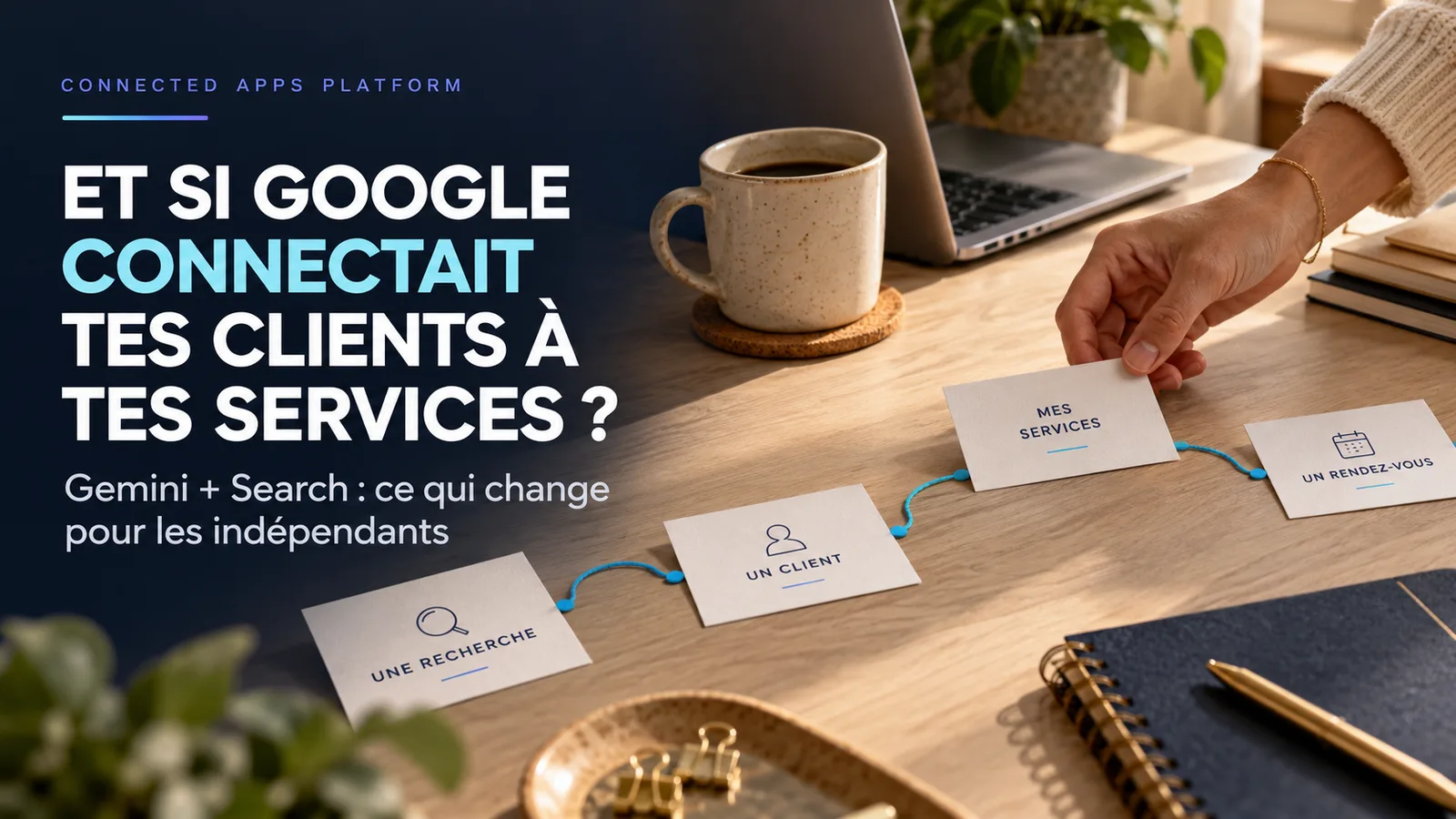
Google has just formalized an important evolution: in Gemini and Search, a service can not only be discovered, but also used to perform an action. For creators and independents, this means that visibility will no longer be based solely on a well referenced page. An AI will also need to be able to understand an offer, identify the available action and execute it in a secure environment.
On 28 October 2026, Google launched its Connected Apps Platform in preversion. This platform gives developers a common entry point to connect their applications to the Gemini application and Google Search. Integration can be supported on a remote MCP server or on Android MCP with AppFunctions APIs, and then saved, tested and validated in Google Connected Console.
This announcement does not mean that all companies can immediately appear in Gemini or Search, nor that all applications are available in France and Réunion. Google opens developer access in phases and plans to add developers, markets and other products in the coming months. The availability of already connected applications varies by country, language, device, account type and Google experience used.
The novelty nevertheless deserves the attention of professionals VIFLYbecause it moves the central question. Yesterday, we had to find something. Tomorrow we will have to be understandable, permissible and actionable. Information verified on 29 October 2026.
What Google actually launched on 28 October 2026
In its official announcementGoogle presents Connected Apps Platform as a unified environment for building and managing integrations for Search and Gemini application. The developer then chooses the subject surfaces: Gemini, Search or both.
The term Connected App means a third party service that the user can connect to his Google account. Once authorized, Gemini or Search may consult certain permitted data and call certain service functions. The aim is to complete a task in the conversation or to prepare an action that continues in the application concerned.
Google reports that it has already launched more than fifty connected applications between Gemini and Search, in areas such as productivity, ticketing, creation, health and sport. Adobe, Experian, Localiza and Peloton are part of the integrations announced as active in Gemini. Google plans to bring them to Search in the coming weeks and also quotes Calm for future availability in both environments.
However, the platform for developers remains preversion. Access is open gradually. An application does not become public as soon as its server exists: it must be saved, tested, reviewed by Google and approved before its general publication.
User-side availability has to be verified application by application. Google explains in its help that Connected Apps vary according to location, language, device and version of Gemini. In Search, the integration of creative services like Canva into AI Mode remains notably presented as available in the United States and in English. It would therefore be incorrect to announce a general availability in France or in La Réunion.
From "findable" to "actionable": what really changes
Classic SEO helps a person discover a page. A Connected App adds a layer of action: the assistant can recognize that a service matches the intent, request the necessary information and call an authorized function.
The MCP protocol Model Context Protocol, serves as a standard language between the assistant and the service. The developer describes tools with specific parameters: searching for availability, creating a draft, saving an item or preparing a reservation. Google analyzes the user's request, selects the relevant tool and transmits the settings to the service server.
This architecture does not automatically give Google unlimited access. The application only displays the functions provided by the developer. When a personal account is to be used, authorization is required. Documentation recommends OAuth 2.1 with PKCE, a mechanism designed to delegate access without directly sharing the user's password.
Editorial change is major. The VIFLY guide for be visible in ChatGPT and IA agents already explained that an offer must be explicit, attributable and linked to consistent public data. Connected Apps adds a step: certain information and actions must also be described in a form that the machine can call unambiguously.
A clear page remains indispensable. Google does not present Connected Apps as a Web or SEO replacement. It is an additional channel, subject to registration, examination and technical constraints. VIFLY analysis on links and profiles in Google AI Mode therefore remains valid: a brand must first be identifiable and credible before hoping to turn an interaction into action.
Two concrete examples for VIFLY professionals
A coach makes his sessions understandable before making them bookable
Imagine a coach who offers three formats: discovery call, individual session and three-month accompaniment. If its durations, rates, conditions and publics are divided into several contradictory pages, an IA integration does not solve the problem. It only makes confusion faster.
The work begins with a structured offer: name of the service, objective, public concerned, duration, price, cancellation conditions and available slots. A future Connected App could then display a performance reading function and a availability search function. The final creation of a paid reservation would retain a clear confirmation of the user.
Today, without waiting for access to the Google platform, the coach can already organize this course with a VIFLY LinkHub to present its resources and a page VIFLY Booking to make sessions, availability and conditions understandable. This does not automatically create Google integration, but prepares data and a more consistent path.
Digital Product Designer Avoids Unreadable Catalogue
A designer sells guides, workshops and models. A request like "find me a beginner resource of less than an hour on creating an offer" can only receive a good answer if each product has reliable attributes: level, theme, format, duration, price and availability.
A Connected App could query this catalog, filter the results and prepare the right shopping path. It should not invent a level or duration when the information is missing. It should return a lack of data, propose an alternative or request clarification.
The creator can therefore act now: normalize sheets, remove vague promises, define variants and verify links. The page vIFLY features illustrates this unified path logic between profile, offers, digital products, reservations and results measurement.
VIFLY: The AI will not convert an offer that it does not understand
The VIFLY perspective is clear: the future of visibility consists not only of being quoted by an AI, but of making the next action correct, explicit and measurable.
This evolution does not remove the need for content, identity or trust. On the contrary, an action proposed by an assistant becomes risky if the mark, the performance and the conditions are not understandable. A person more easily agrees to log in an account or confirm an action when they know who provides the service, what will happen and how to go back.
Brands will therefore have to work on two interfaces in parallel. The human interface explains, reassures and helps to decide. The machine interface describes the functions, parameters, limits and possible responses. These two layers must tell the same thing.
Poor integration promises to "reserve support" without distinguishing between formulas. Good integration exposes specific services, refuses invalid settings, requests confirmation and returns a traceable result. It does not replace positioning: it obliges it to become clearer.
The seven VIFLY rules to frame an AI agent become particularly relevant: separate reading, preparation and action; limit permissions; confirm sensitive operations; log changes; planning a human recovery.
Nuances, limitations and points to watch
The platform is in preversion. Google opens developer access in phases. An access request does not guarantee acceptance, publication date or simultaneous availability in Search and Gemini.
More than fifty integrations do not mean fifty applications available everywhere. Connected Apps vary according to Google markets, languages, devices, accounts and products. Official assistance must be consulted for each service.
France and La Réunion are not announced as a general launch market. Some Gemini features are widely available, but the Canva example in AI Mode remains limited to the US in English at the time of verification. This availability should not be extrapolated to the entire platform.
MCP is not a guarantee of quality. A misdescribed server can be called at the wrong time, receive ambiguous parameters or return an answer difficult to interpret. Google requires highly typed diagrams, clear semantic descriptions and annotations that signal read-only, modifying or destructive actions.
Permissions must remain minimal. A function looking for slots does not need to be able to delete bookings. An action that creates a draft should not publish without confirmation. OAuth protects the authorisation, but does not replace a good design of rights.
A Connected App is not an automatic SEO technique. It requires separate technical integration, registration and validation processes. It does not guarantee exposure, traffic or conversion.
The rescue route remains necessary. If a function is unavailable, if the user refuses to log in to his account or if a market is not covered, a clear web page must always be able to understand the offer and act manually.
What to do now? An eight-step action plan
- Map your useful actions. List what a prospect can actually do: consult an offer, search a niche, ask for a quote, buy a resource or follow an order.
- Structure your data. Give each service a stable name, description, audience, price, duration, conditions and availability status.
- Clarify your public journey. Check that your site, LinkHub, offers and booking pages tell the same story.
- Separate reading and modification. A search function must not have the same rights as a reservation, purchase or cancellation function.
- Set confirmations. Any paid, irreversible or engaging action must clearly demonstrate what will be executed before validation.
- Prepare your APIs. If you are developing a service, document stable inputs, outputs, errors and identifiers before building an MCP server.
- Test cases of failure. Check missing data, unconnected accounts, deleted slots, duplicates and ambiguous requests.
- Measure the final value. Follow qualified requests, reservations, purchases and completed tasks, not just the number of calls to the tool.
Independents without a technical team do not need to build an MCP server this week. Their priority is to make their activities readable and their actions predictable. Platform publishers can begin to assess the quality of their APIs, their licensing model and the separation between consultation, preparation and execution.
Connected Apps Platform thus confirms a fundamental trend: the Web remains a source of discovery, but assistants also become action interfaces. The advantage will not only be to the most visible marks. It will go to services that are clear, reliable and safe enough to be used at the right time.
Frequently Asked Questions and Sources
What is Google Connected Apps Platform?
This is a preversion platform that allows developers to connect their services to Google products such as Gemini and Search, then manage integration, testing, review and publication from Google Connected Console.
Is the platform already available in France and in La Réunion?
Google does not announce a general availability by country. Developer access is open in phases and the availability of each Connected App varies according to the location, language, device, account and product used.
What is MCP?
Model Context Protocol is a standard that allows a service to describe the tools and data that an assistant can use. The protocol facilitates calling a function, but the developer remains responsible for rights, validations and results.
Do we need an Android app?
No. Google offers two main channels: a remote MCP server for a multiplatform reach, or Android MCP with AppFunctions for functions closely integrated into an Android device.
Does a Connected App replace the website?
No. The site remains essential to explain the offer, reassure, provide a backup route and allow action when integration is not available or the user refuses the connection.
What can an independent prepare now?
It can structure its services and products, harmonize prices and conditions, clarify its pages, document its useful actions and separate reading operations from sensitive actions.
Sources
- Google — Build and manage Connected Apps in one place, 28 October 2026.
- Google for Developers — Connected Apps Platform.
- Google for Developers — MCP server developer guide.
- Google for Developers — Register, test and publish a connected app.
- Google Gemini Help — Availability and requirements of Connected Apps.
- Google Search Help — Connect creative design apps in AI Mode.
- Google for Developers — OAuth 2.1 implementation guide.