These days, many creators, media outlets and entrepreneurs are fighting for one thing: the click.
They work on their SEO, publish on Google Discover, optimise their headlines, improve their content… and then hope that readers will return one day.
The problem is that this return still depends largely on Google, its recommendations and the user’s memory.
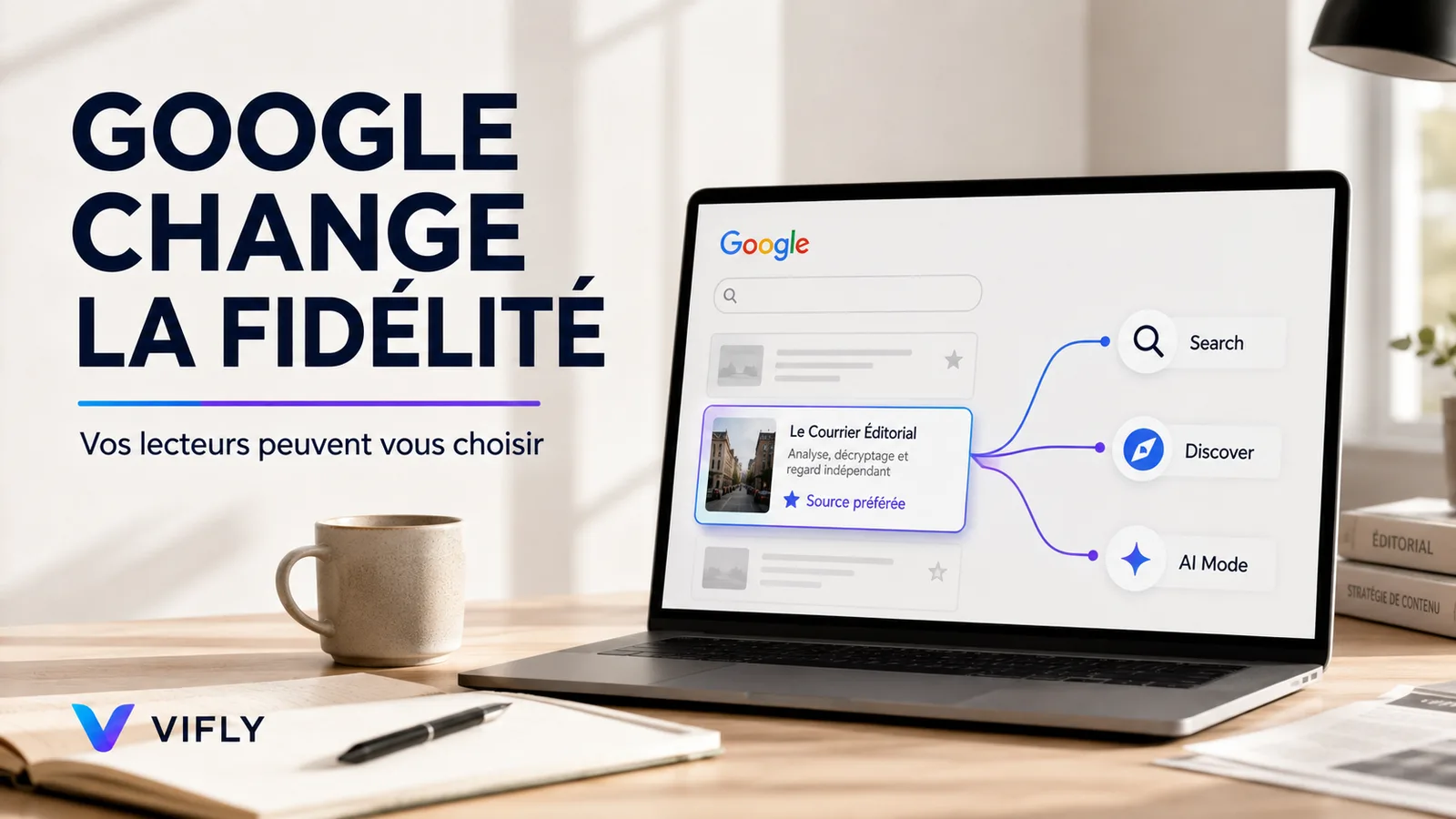
Since 20 August 2026, Google has added a new layer to this battle for visibility: internet users can now explicitly choose the sites they wish to see more of through ‘Preferred Sources’. Publishers can even embed a button directly on their site allowing their readers to add them as a preferred source.
This change may seem subtle, but it addresses a key issue: no longer simply attracting an audience, but becoming a source that this audience actively chooses to return to.
And for content creators, freelancers and specialist media outlets, this development could transform the way we think about SEO, customer retention and conversion.
Google Preferred Sources: what exactly is changing?
Preferred Sources allows a user to explicitly tell Google:
“I like this site and would like to see more of its content.”
Google states that when a post is selected as a preferred source, its content is more likely to appear in the Top Stories, possibly accompanied by a badge indicating its status as a favourite source. Google for Developers
But the developments of 20 August go further than that.
Favourite sources can also be highlighted in AI Overviews and AI Mode
Google states that content from a selected source may appear with a ‘preferred’ badge in its generative experiences AI Mode and AI Overviews, in languages and regions where these features are available. Google for Developers
This is important.
Retaining a reader is therefore no longer only useful for:
- direct visits
- the newsletter
- social media
- spontaneous return visits to your site.
It can also influence the way in which this specific user find your content on Google.
Google now allows publishers to embed the button directly
This is the real practical innovation.
Google now provides publishers with an interactive button that they can place directly on their pages.
By clicking on it, the reader can add the domain as a favourite source and then automatically return to the page they were viewing. Google for Developers
Google also provides a direct link solution for websites that do not wish to, or are unable to, embed the JavaScript component. Google for Developers
In other words:
Content creators can now actually ask their audience to add them as a favourite source in Google.
Over 600,000 sources have already been selected by internet users
Google claims that users have already selected over 600,000 unique sources with the Preferred Sources feature. blog.google
Please note the wording: this does not mean 600,000 users.
Google does indeed mention Selected unique sources.
However, the figure shows that the feature is no longer limited to a small-scale trial.
For publishers, it is therefore worth considering the best time to offer this option.
And this is where the strategy gets interesting.
This isn’t some new magic SEO factor
We must immediately avoid any misinterpretation.
The arrival of the button does not mean:
“The more your site is added to Preferred Sources, the higher it will rank in Google for everyone.”
Google doesn’t say that.
The documentation explains that when a user selects a site, the content on that site becomes more likely to appear in its own Top Stories and may be highlighted in its AI Mode and AI Overviews experiences. Google for Developers
Preferred Sources should therefore be seen first and foremost as a mechanism for personalisation and customer loyalty, rather than as a new technique for manipulating the overall ranking.
That’s the difference between acquisition and preference
Traditional SEO focuses in particular on achieving initial discovery.
Preferred Sources has become more involved following this discovery.
The path could become:
Google search → useful content → trust → added as a favourite source → more opportunities to find you.
This approach is particularly well suited to specialist blogs.
Google Discover is also becoming customisable with phrases
On the same day, Google announced another significant development.
In the coming days, via the three-dot menu on any content item in Discover, users will be able to specify in their own words what they’d like to see more or less often. blog.google
Google provides very specific examples:
- more kitchen renovation ideas, but only eco-friendly ones
- more videos of weekend road trips, but without camping. blog.google
Google states that Discover will then adapt the feed and will remember these preferences. blog.google
This represents a significant development for the feed.
Users are no longer solely reliant on implicit cues
Traditionally, a recommendation system can infer interests from signals such as:
- searches
- clicks
- content viewed
- interactions.
Google now includes a much more direct signal:
the person explains for themselves what interests them.
For creators, this reinforces the importance of clearly identifiable niches.
Very generic content risks becoming even less distinctive
Let’s take an example.
Two websites publish content on entrepreneurship.
The first one publishes:
10 tips for business success.
The second one publishes:
How to turn an Instagram following of 5,000 followers into your first bookings as a coach.
The second piece of content has a much more specific context:
- platform
- audience size
- objective
- profession
- issues.
In an environment where a user can declare:
“I’d like more marketing advice for coaches and freelancers”
a specific editorial stance becomes much easier to associate with a preference.
This obviously does not mean that Google will use these exact words as a simple keyword filter.
But the editorial approach remains extremely sound:
the more your content clearly addresses a specific audience and need, the more recognisable your value proposition becomes.
For creators, the website is once again becoming a strategic asset
For several years now, many designers have been focusing almost all their energy on:
- TikTok
- YouTube.
The website sometimes takes a back seat.
This development from Google serves as a reminder of why having your own space remains important.
On your website, you control:
- your identity
- your content
- your structure
- your offer
- your CTAs
- your relationship with the reader.
And now, you can also offer visitors the option to make your domain a favourite source on Google.
For a publishing platform such as VIFLY, this is a particularly attractive opportunity.
The ‘Preferred Sources’ button should form part of the customer loyalty strategy
The new button should not stand alone. A satisfied reader can now carry out several different actions:
Subscribe to your newsletter
To create a direct link.
Follow us on social media
To find your content in a feed.
Add this site to your favourites
To go back directly.
Select Google as your preferred source
To strengthen your presence within its Search experience.
Taking commercial action
When the content addresses a need related to your offering. The aim is not to present five CTAs at the same time.
We need to establish a hierarchy.
How do I link this new feature to a LinkHub?
For creators who do not publish a media blog, the Preferred Sources feature will be less directly relevant.
However, the principle behind the advert remains extremely relevant:
to transform someone who stumbles upon you into someone who deliberately chooses to seek you out.
That’s also the aim of a good bio link.
VIFLY LinkHub allows you to centralise social media, content, offers, subscriptions and calls to action on a single page. Vifly
Rather than creating a simple list:
TikTok
YouTube
Site
you can organise a proper journey:
Discover my work
Read my resources
View my offer
Book with me
Follow me elsewhere
Google is currently working on user retention within Search. Your own ecosystem must do exactly the same thing after the click.
Visibility alone is not always enough: you need to plan the next step
Let’s assume that an article is recommended in Google Discover.
A reader arrives. The content is excellent. They add your site as a favourite source.
Excellent.
But if your creator business is based on providing a service, this reader must also understand what they can do next.
For a coach, consultant, trainer or therapist, this could be:
book an appointment.
VIFLY Booking enables you to showcase services, display available time slots and offer online booking, with payment where the service is chargeable. Booking can also be linked directly to LinkHub. Vifly
This gives us a complete walkthrough:
Discover / Search → article → trust → LinkHub or offer → Booking → appointment.
That’s exactly the VIFLY approach:
visibility → understanding → trust → action → opportunity.
AI is also changing the way users build their own feeds
The customisation of Discover using natural language is also worth examining from the perspective of artificial intelligence.
The user no longer simply needs to click on:
“I want to see more of this.”
It can gradually explain a complex idea.
This is a change that can be seen in many digital products:
interfaces are becoming conversational.
Instead of simply choosing from menus, the user describes what they want.
For professionals who wish to understand this development and learn how to use these interfaces more effectively, VIFLY AI offers educational resources on best practice in the use of AI, how to formulate queries and the habits to adopt. Vifly AI
Will Preferred Sources increase your traffic?
Potentially, for some users.
However, no promises can be made regarding overall traffic.
Google simply explains that when a user chooses you, your content is most likely appear in its Top Stories and may be highlighted in AI Overviews and AI Mode. Google for Developers
This does not guarantee:
- nor a printout
- or a click
- nor a global position
- nor a measurable increase in traffic.
We will need to wait until sufficient data is available before assessing the actual impact.
However, as the implementation cost is low, the test seems particularly relevant for editorial websites that already have a loyal readership.
Please note: only domains and subdomains can be selected
Here is a particularly important technical detail.
Google states that Preferred Sources operate at the following level:
- from domain
- or the subdomain.
A simple subfolder does not qualify as a separate source. Google for Developers
For example:
example.com → eligible
blog.example.com → eligible as a subdomain
example.com/blog → the /blog folder cannot be set independently as the preferred source. Google for Developers
For VIFLY, whose blog can be found at vifly.fr/blog, the choice would therefore be vifly.fr as the source domain, not just the blog directory.
This is important for the site’s overall strategy.
What should creators and publishers be doing today?
Here is the action plan I recommend.
1. Check that your domain appears in the Preferred Sources tool
Google recommends starting by checking whether the site can be found in its source selection tool. Google for Developers
2. Add the official button
For a blog or regular media outlet, try out the integration offered by Google.
Don’t turn it into an intrusive pop-up.
The right moment is when the reader has already recognised your value.
3. Also add a link in the newsletter
Google states that the direct link to a source’s selection can also be used in:
- social media
- newsletters
- promotional campaigns. Google for Developers
This is probably one of the most interesting uses.
Your newsletter already includes your most loyal readers.
These are therefore the people most likely to want to choose you as their favourite source.
4. Strengthen your editorial line
Ask yourself three questions:
Who are we publishing for?
In which areas do we want to become a leading authority?
Why would anyone choose our site over another?
Preferred Sources literally turns this third question into a product feature.
5. Create more truly memorable content
The CTA will only work if the reader thinks to themselves:
“I want to revisit this site.”
So the real optimisation isn’t the button. It’s what comes before the button.
Preferred Sources turns SEO into a relationship
For a long time, we mainly thought of SEO as a competition to secure a ranking.
Google is gradually introducing another approach:
personal preference.
A user can now say:
‘I’m particularly interested in this source.’
And Google can take this into account in its personalised experience. Google for Developers
This is an extremely interesting development for content creators and specialist media outlets. Because it potentially rewards something that traditional SEO metrics fail to measure properly:
the fact that a reader genuinely wants to find you again.
Your aim should therefore no longer be solely:
get a visit.
It should be:
make it worth a return visit.
And that’s probably the best marketing lesson to be learnt from this new Google feature.
The real challenge is no longer simply about being found: it’s about being chosen
Google Preferred Sources does not revolutionise SEO overnight.
This feature does not guarantee a better overall ranking, a surge in traffic, or automatic inclusion in AI Overviews.
But it introduces something far more interesting: the user’s explicit preference.
For a long time, SEO has focused on one question:
How can we get Google to show us?
A new question is now just as important:
How can we get readers to ask Google themselves to show us more?
The difference is huge. Because a click can be accidental.
As for favouritism, that has to be earned.
To achieve this, it’s not enough simply to add a button to your website. You need to create a genuine reason for people to click on it: a clear editorial line, genuinely useful content, recognisable expertise and an experience that makes people want to come back.
Your next step
If you publish content regularly, do three things right now:
- Check whether your domain is eligible for Google Preferred Sources.
- Embed the official button in a place where the reader has already gained enough value – ideally in the middle or at the end of your best articles.
- Optimise the post-click experience : centralise your content and offers with a VIFLY LinkHub, make it easier to book appointments with VIFLY Booking and develop your skills in new applications of AI with VIFLY AI.
The logic remains the same:
visibility → understanding → trust → preference → action → opportunity.
Google has simply just added a new step to this journey.
The next competitive advantage may not be ranking first on Google.
You’ll be the source your audience has chosen to return to.
FAQ
What are Google Preferred Sources?
Preferred Sources allows users to select the posts they wish to see more frequently. Google states that content from these sources is more likely to appear in Top Stories for these users and may also be highlighted in AI Mode and AI Overviews. Google for Developers
Is Preferred Sources available in France?
Google states that the feature is available worldwide in Top Stories, in all languages where Google Search is available. Its use in AI Mode and AI Overviews depends on the availability of these features in the relevant language and region. Google for Developers
Does adding a website as a favourite source improve its SEO?
Google does not present Preferred Sources as a factor that improves the domain’s overall ranking. The customisation mainly concerns the experience of the user who has chosen the source. Google for Developers
How do you add a ‘Preferred Sources’ button to your website?
Google provides an official JavaScript component and a direct-link alternative. Its Search Central documentation contains the recommended implementation and customisation options. Google for Developers
Can a blog located in /blog be selected independently?
No. Google states that the selection applies at domain or subdomain level, not at subdirectory level. Google for Developers
What’s changing in Google Discover?
Google has announced that users will soon be able to explain in their own words which topics or links they would like to see more or less often, and that Discover will remember these preferences. The roll-out is due to take place in the coming days in the Google app.
Sources
Google Search “Personalise the content you see on Search, Discover and News”, 20 August 2026. Main official source of the announcement: new ‘Preferred Sources’ button, natural language personalisation of Discover, and customisable audio briefings in Google News. Google also states that over 600,000 unique sources have already been selected. blog.google
Google Search Central “Help your readers find your site through preferred sources in Google Search”, updated on 20 August 2026. Official technical documentation on global availability, behaviour in Top Stories, AI Overviews and AI Mode, eligible domains, and integration via JavaScript or deep links. Google for Developers
The Verge 20 August 2026. Independent coverage of the roll-out of Google Discover’s conversational personalisation and the strengthening of Preferred Sources. Used solely to provide secondary context; the technical details of the article are based on Google’s information.