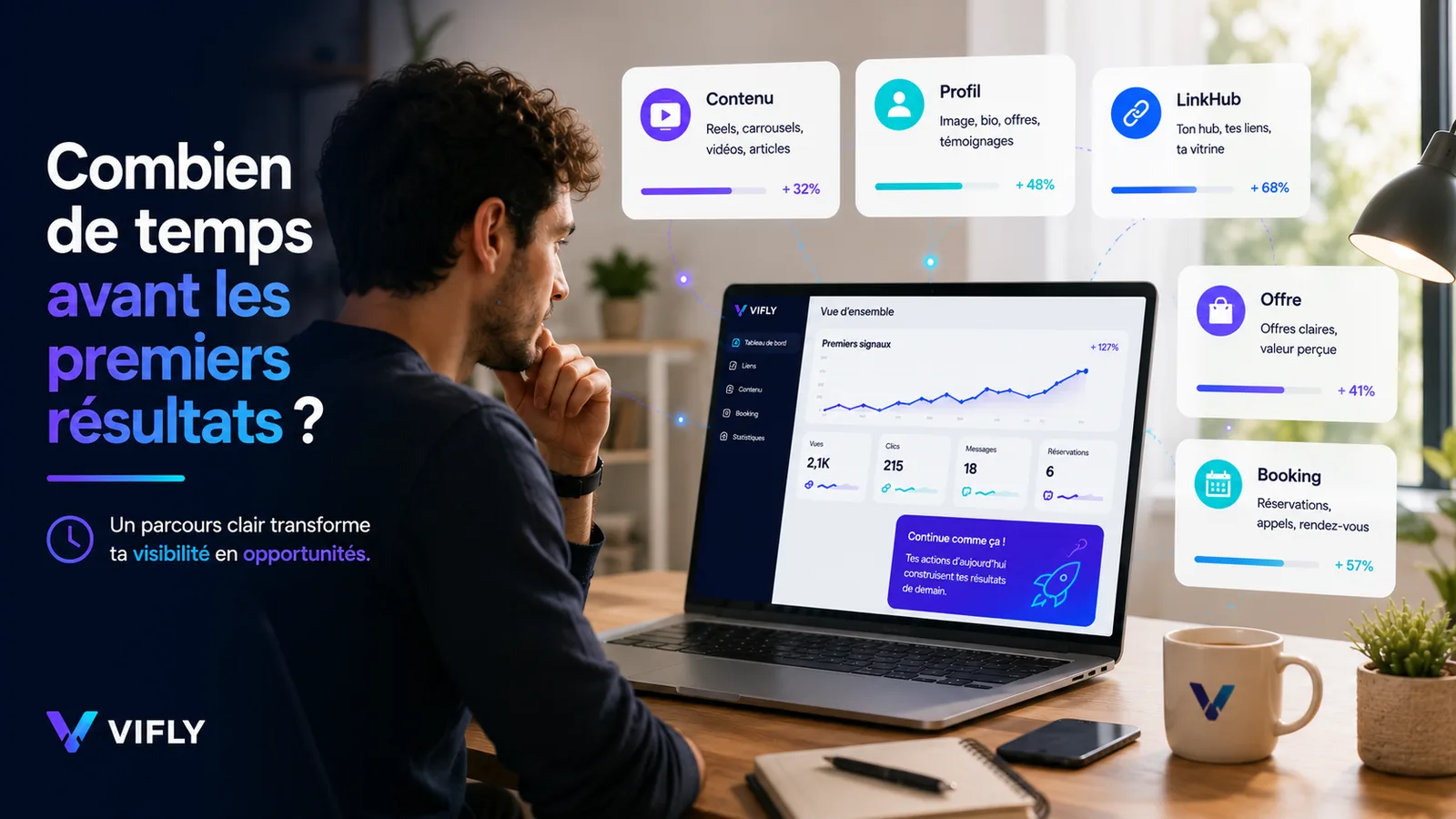
The problem is not just time. That's what you're building during this time.
How long before the first results
This is probably one of the most common questions when you start publishing content, launching an e-commerce, creating an offer, developing an audience or structuring a digital presence.
And it's normal. No one wants to publish for months in a vacuum. No one wants to work every night without knowing if anything is moving forward.
No one wants to create posts, Reels, product sheets, pages, emails or videos without seeing a minimum return.
But the real answer is more nuanced than: "You have to be patient!" Because patience is not enough.
You can publish for six months without results if your journey is blurred. You can start an online store without selling if your offer is unclear.
You can make views without receiving requests if your profile doesn't reassure you. You can attract visitors without converting if your bio link disperses people. You can have an interested audience, but unable to take action.
Time is not magic. Time amplifies what you're building.
If your system is clear, time can help learn, adjust, improve and convert. If your system is confused, time can simply prolong the confusion.
That's why the real question isn't just:
When will the results arrive
The real question is:
Can what I publish today really create a result tomorrow
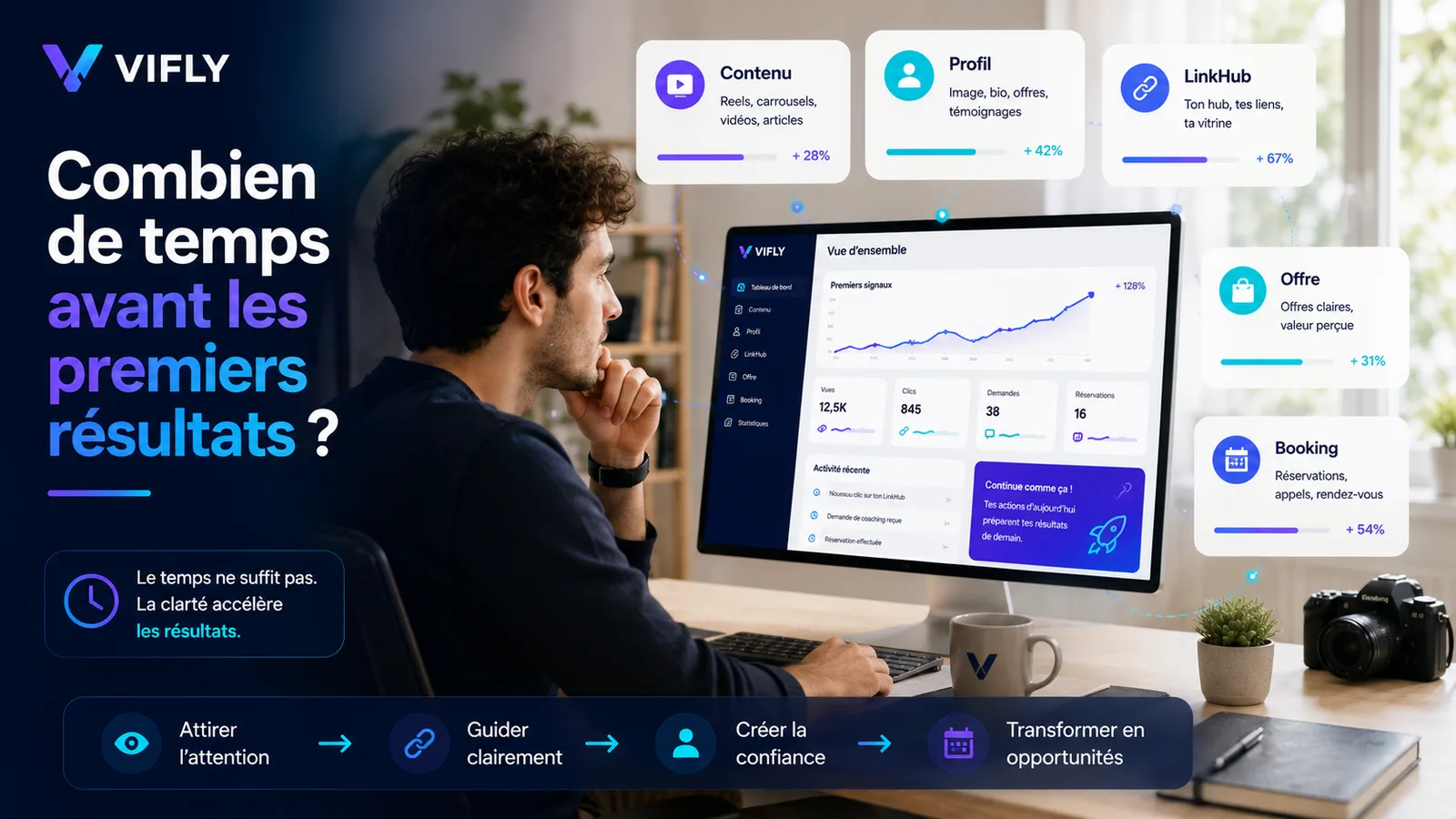
The truth: there is not a single type of result
When someone asks how much time before the first results.
Because a result can be:
an initial view; a first comment; a first click; a first qualified subscriber; a first visit to your profile; a first entry; a first request;
a first reservation; a first sale; a first customer; a first partnership; a first SEO signal; an indexed first page; a first content that begins to position itself.
Not all of these results happen at the same time. And most importantly, they don't all mean the same thing.
A Reel can make 10,000 views in two days without generating a single request. An article may take several weeks to bring traffic.
An e-commerce can receive visitors quickly with advertising, but not sell if the product page does not reassure. A coach can receive an application with only 800 subscribers if his profile, offer and Booking are clear.
This is exactly what VIFLY develops in the article Views don't pay bills: how to turn your audience into customers. A view is a signal. This is not yet a business result.
Key points
The first result to look for is not necessarily a sale. It is often a signal of understanding: someone clicks, backs up, responds, requests, reserves or returns.
The first results come in stages
We must stop seeing the results as a switch.
It's not:
nothing, nothing, nothing... then success. It's more like:
weak signals, reactions, clicks, questions, adjustments, requests, and sometimes sales or reservations.
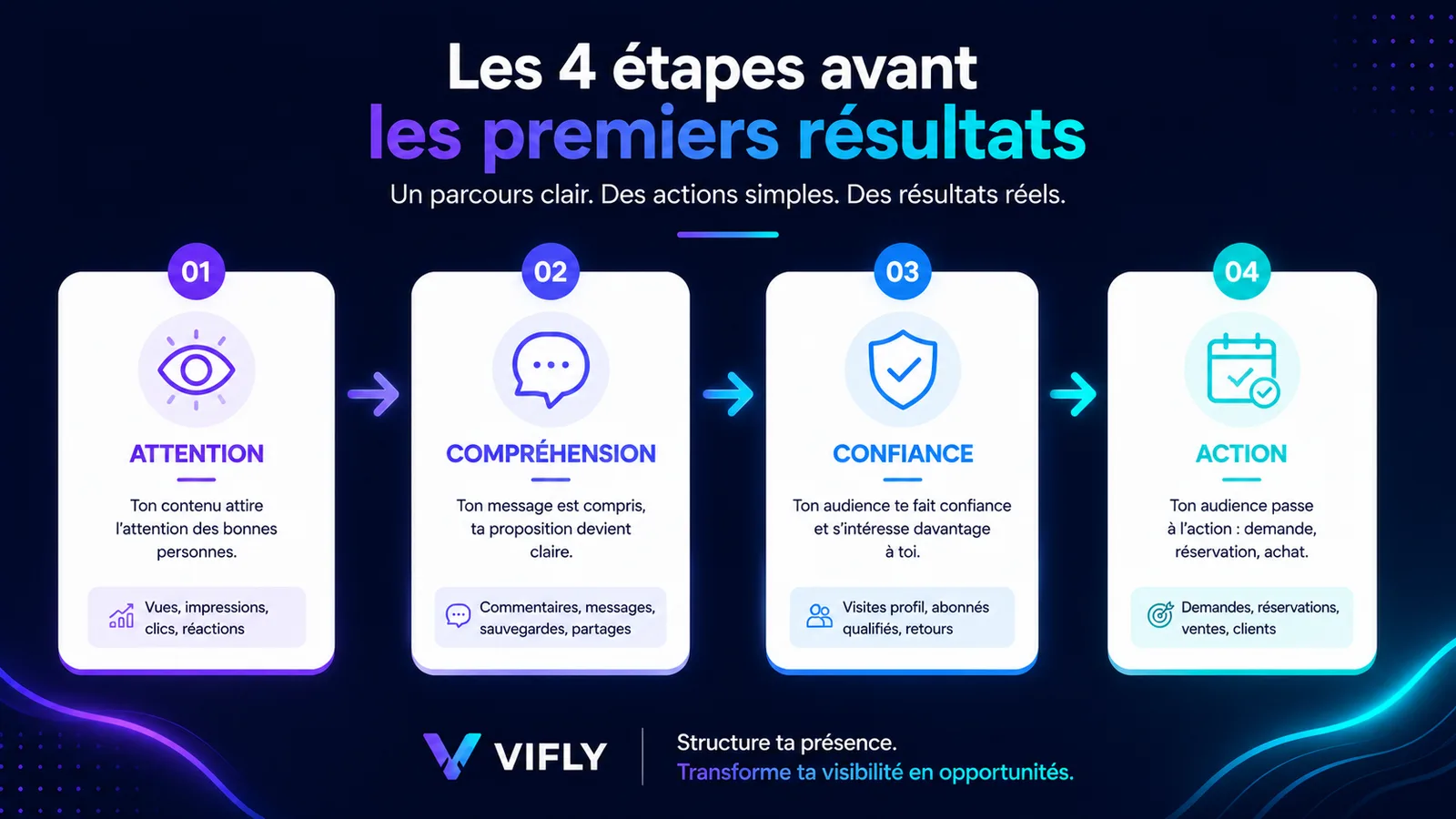
Step 1: the first attention signals
They can arrive soon enough.
Content can get views from the first hours. A story can be answered. A LinkedIn post can generate a comment. A Reel can be saved. A product sheet can be visited.
But these are not yet solid results. These are signals.
They say, "Someone saw."
Not yet:
Even less:
Step 2: the first signs of understanding
These are the most important signals at first.
They look like this:
That's exactly my problem
What exactly do you propose
How can I book
Can you send the info
Does your offer fit my case
Can I have the connection
At that time, your audience isn't just looking. She's trying to figure it out. This is a real progress.
Step 3: the first confidence signals
Trust appears when people come back.
They read several contents. They're looking at your profile. They're consulting your bio link. They're comparing your offers. They send a more precise question. They're saving your content. They're starting to see you as a credible person.
It is often here that many give up too soon. They don't see a sale yet, so they think nothing works.
But sometimes trust is building.
Step 4: The first concrete results
This is the time when attention becomes action.
A reservation. A sale. A request for a quote. A call discovered. An inscription. Collaboration. A qualified message. A client.
But this result is not just from the content.
It's from the trail. Your content attracts. Your profile reassures. Your offer clarifies. Your LinkHub guides. Your Booking makes it easier.
Your proof creates confidence.
Realistic deadlines: what you can observe according to the periods
We must be careful with the deadlines. No one can guarantee an exact result. No platform promises a sale on a specific date.
SEO, social networks, e-commerce and service offerings do not all work at the same pace. But one can observe a logic.
0 to 7 days: you watch the reaction signals
At first, you should not judge your project solely on income.
You have to observe:
are people watching? are they staying? do they click? are they answering? do they understand the subject? does some content create more reactions than others?
For a Reel or Short, you can get signals very quickly.
For a SEO page, it's different: Google needs to discover, explore, index and understand the page. Google also recalls that its systems do not guarantee the crawl, indexing or display of a page, even if it respects good practice.
So at first, don't confuse slowness with failure.
2 to 6 weeks: you look for the first patterns
After a few weeks, you can start to spot trends.
What topics attract the right people? What formats generate useful comments? What content causes clicks? What posts bring visits to your profile?
Which pages receive impressions? What offers create questions? What buttons are clicked in your LinkHub?
This is where many make a mistake.
They already want to conclude:
it works or it doesn't work.
Instead, you should ask:
What does the data start to show me
2 to 3 months: you can judge the consistency of the course
After several weeks of content, your problem is no longer just regularity.
Your problem becomes coherence.
Does your content speak to the right people? Does your profile confirm your positioning? Is your offer visible? Does your bio link really guide? Do your visitors know what to do? Is your Booking or your form simple?
It is then that Article VIFLY Is your offer clear enough to make you want to buy? becomes important. A confused offer can slow down results even when the content attracts.
From 3 to 6 months: you can measure the real cumulative effects
At this point, you can analyze more seriously:
content that creates trust; topics that come back; frequent objections; pages that bring traffic; offers that trigger requests; reserved calls; sales; collaborations; qualified subscribers; research that finds you.
This is not yet a guarantee of success. But that's often where you're starting to see if your system is going down.
After 6 months: you must distinguish patience and stubbornness
There is a great difference between persevering and repeating the same mistake.
If after several months you publish regularly, but nobody clicks, nobody asks, nobody reserves, no one understands your offer, so this may not be a time problem.
It may be a problem of clarity.
Common mistake
Say:
I'm gonna go on like this for a few more months
Sometimes you don't have to go on like this. We have to adjust!
Why Some People Get Results Faster
Two creators can publish for the same duration and obtain very different results.
It's not always about talent. It is often a question of structure.
They talk to a specific target
General content sometimes attracts a lot of people, but few people are willing to act. Precise content attracts fewer people, but often better opportunities.
Example:
How to succeed on Instagram is very wide.
Why your coach profile attracts views but no requests is much more precise.
The second sentence speaks to a concrete pain.
They have a visible offer
Many creators hide their offer. They publish, give advice, create value... But their audience doesn't know what they're proposing.
As a result, people like content, but don't take action.
Article VIFLY Clear offer: be understood before being perfect sum up this idea: an offer does not need to be perfect to start creating movement, but it must be understandable.
They have a profile that reassures
A person may like your content, then leave by seeing your profile.
Bio blurred. Unprofessional photo. No visible offer. No clear connection. No example. No proof. No call to action.
This is why the article Is your profile amateur? The 7 mistakes that drive your future customers away completes this subject perfectly.
A good profile doesn't sell for you. But he avoids breaking trust.
They guide the audience with a clear LinkHub
The bio bond is often the place where attention is lost. A creator publishes good content. A person clicks.
She arrives on a page with too many links. She doesn't know where to go. She's leaving.
With VIFLY LinkHub, the objective is to turn this link into a clear path: main offer, resource, reservation, important content, contact or request.
A LinkHub must not only list. He must guide!
They facilitate the next action
If you sell coaching, advice, training, performance, session or accompaniment, the reservation must be simple.
If an interested person has to send three messages just to know when you are available, you create friction.
With VIFLY Booking, you can make this step clearer: presenting the service, displaying slots, reducing round trips and facilitating the transition to action.
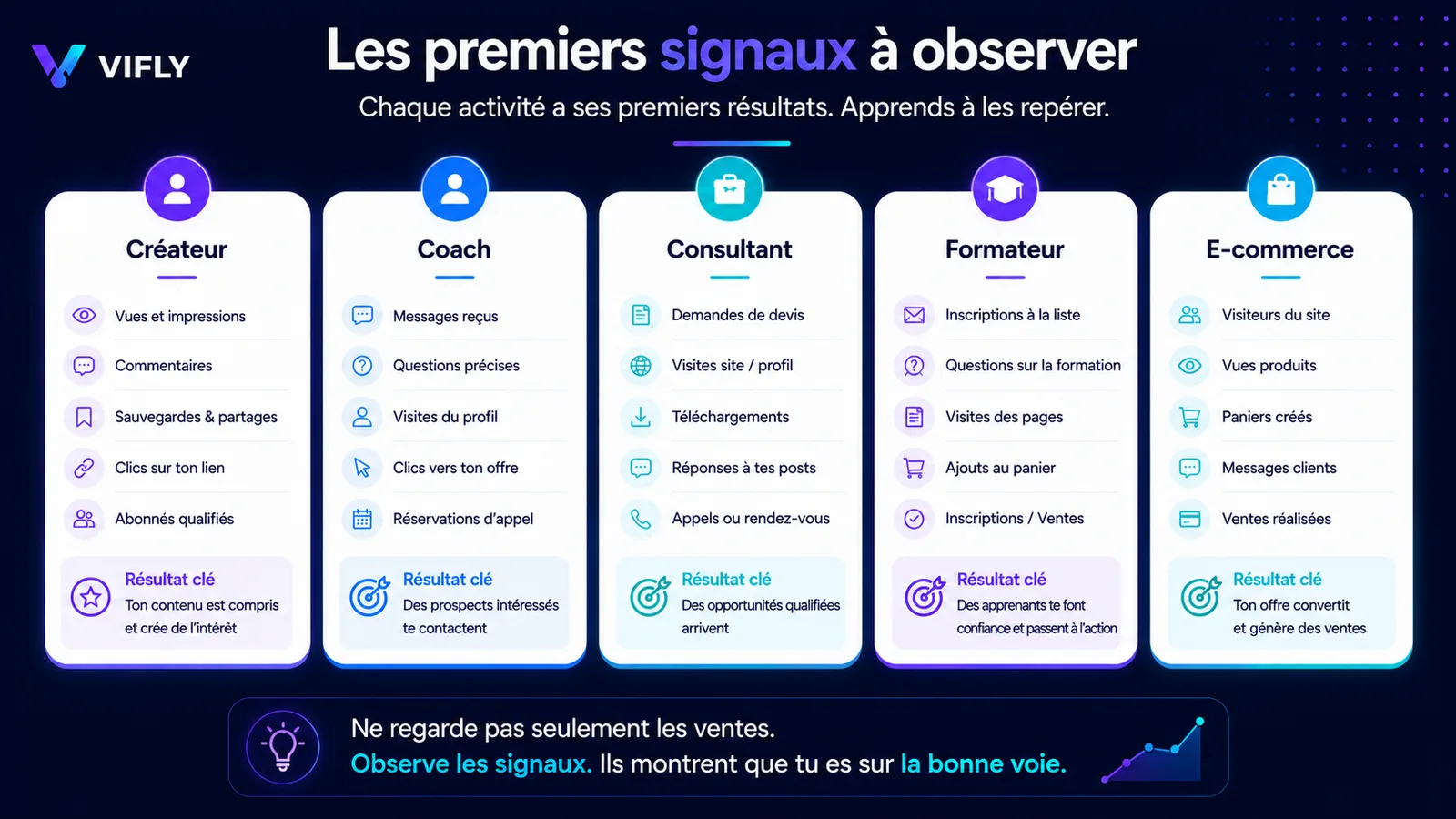
Creator, coach, consultant, trainer, e-commerce: results do not read the same
For a Content Creator
Your first result is not necessarily money. This is often proof that your positioning is beginning to be understood.
You can observe:
comments that follow your words; messages that ask more specific questions; people who click on your bond; saved content; returning subscribers; the marks or prospects that contact you.
A creator who only looks at the views can miss more important signals.
For a coach
Your first important result may be a qualified request. Not necessarily an immediate sale.
A person may need to read multiple content, see your approach, understand your frame, look at your profile, check your offer, and book.
Your role is not to force. Your role is to make the way clear.
For a consultant
Results can take longer because the decision is more rational. The person wants to understand your expertise.
She wants to see if you understand her problem. She wants to feel that the exchange will be useful.
A consultant must therefore create diagnostic content: frequent errors, audits, concrete cases, comparatives, weak signals, questions to ask.
For a trainer
The first results often come when the audience understands your pedagogy.
She must say:
This person explains well
I understand better thanks to her
I would like to learn with this method
The content must therefore show your ability to transmit, not just your level of expertise.
For an independent or freelancer
Your first useful result can be a message like:
Can you do that for me
But for this message to happen, your profile must be clear:
what you do; for whom; with what result; how to request a quote; what examples can be consulted.
For e-commerce
The results must be read differently.
You can have traffic without sales if:
the product page does not reassure; the visuals do not show the product enough; the price is not included; delivery costs arrive too late; social proof is lacking; the purchase journey is too long; the promise is blurred;
the content attracts curious but not buyers.
For e-commerce, publishing content is not enough. Content must be linked to a clear page, a readable offer, evidence, a clean mobile experience and simple action.
The question to ask before asking how long does it take
Before you ask how much time before the results, ask yourself these five questions.
1. Does my content speak for a real purpose?
Content can be well done but too vague. Low example:
“5 conseils pour réussir en ligne.”
Stronger example:
Why do you publish every day but no one's booking your call
The second content starts with real pain.
2. Does my profile confirm my message?
If your content speaks of professionalization, but your profile is blurred, you create a contradiction.
Content attracts. The profile confirms or destroys trust.
3. Is my offer visible?
If your audience has to guess what you're selling, she'll leave often before she understands. Your offer must respond quickly to four questions:
for whom? what problem? what result? what next step?
4. Does my bio link really guide?
An effective bio bond should not resemble a drawer filled with links.
He's got to steer. Discover. Settle. Buy. Read. Contact. Sign up. Ask.
5. Do I measure the right signals?
At first, don't just look at the number of views.
Look:
clicks; backups; messages; profile visits; applications; objections; pages consulted; abandonment; reservations; recurring questions.
The numbers are not used to judge you. They are used to orientate.
The 10-second test
Here's a simple test. Imagine someone discovering your content today.
She clicks on your profile. In less than 10 seconds, can she understand:
who are you helping? what do you propose? why can she trust you? where to click? what action now?
If the answer is no, you may not need to wait any longer. You need to clarify.
This is also the subject of Article VIFLY More subscribers? Create a path that converts. A large audience does not always compensate for a confused journey.
Key points
The results come more easily when the person who discovers you doesn't need to guess what's next.
When should we wait, and when should we change?
There are times when we have to wait. And there are times when you have to adjust.
You have to wait if..
You just started. You still have little data. You're testing several subjects. You're building your consistency.
You haven't published enough yet to see a pattern. Your SEO is still new. Your pages have just been posted.
Then don't panic too fast.
You have to adjust if..
You've been publishing without clicks for several months. People don't understand your offer. You always get the same basic questions.
Your bio link doesn't get any action. Your Booking is invisible. Your profile doesn't make it clear what you're doing. Your content attracts people who will never be clients.
You have views, but no request. Waiting here is not enough. We need to improve the course.
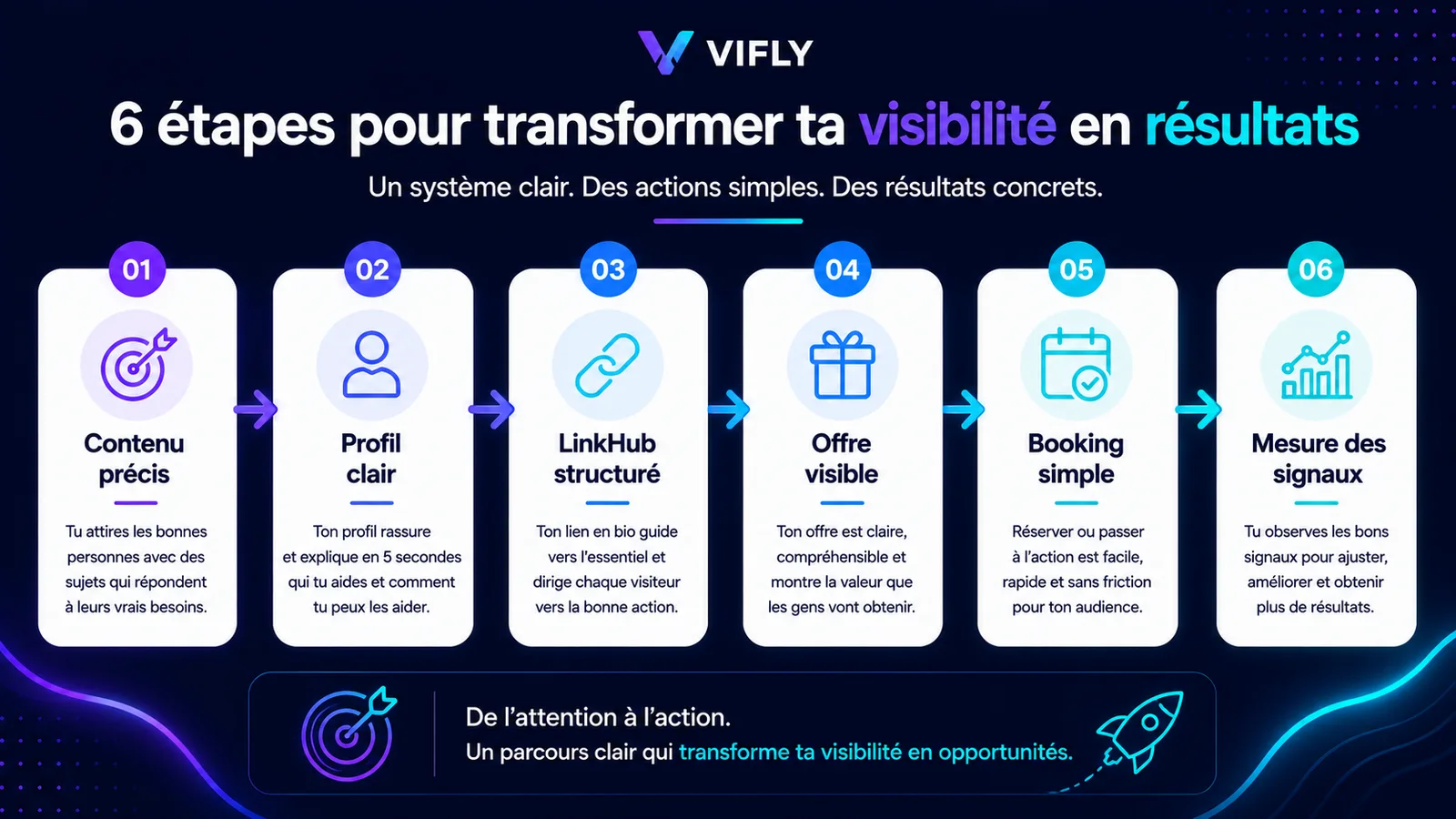
The VIFLY method: making the time useful
Time becomes useful when you use it to improve your system. Here's a simple method.
1. Attract with specific content
Publish content that addresses real problems. Not just pretty content. Not just trends.
Not just motivating phrases. Content that shows you understand the situation of your target.
2. Reassuring with a clear profile
Your profile must be a quick answer. Not a guess.
A person must understand your universe without scrolling for five minutes.
3. Guide with a structured LinkHub
Your LinkHub needs to set up the suite. Put forward the main action.
If your goal is reservation, please bring up the Booking. If your goal is sale, put the offer first. If your goal is trust, display a resource or proof.
4. Convert with a visible offer
An invisible offer cannot be improved. You need to show it, test it, see where people block it, then adjust it.
5. Facilitate with a simple Booking
If a person is willing to exchange, do not make contact complicated.
A clear reservation system reduces friction.
6. Measuring the right signals
Look what's really going on
clicks; requests; reservations; answers; questions; consultation rate; content that creates conversations; offers that trigger interest.
The role of Google, AI and SEO in the first results
If you publish articles, bid pages, long content or e-commerce pages, the results can be more progressive than on social networks.
Google works with several steps: discovery, exploration, indexing, ranking, then potential display in the results.
Google recalls that it is not enough to publish a page to guarantee its indexing or visibility. It also recalls that the SEO remains useful when it helps to better discover and understand content thought for humans.
With research experiences integrating AI, such as AI Overviews or AI Mode, the background does not change: you need to create useful, reliable, clear, original, well structured and really useful content for the user.
Don't run after fake hacks. Content must be built to answer complex questions.
Example:
How much time before the first results is not just a matter of delay.
It is a question that hides several concerns:
am i doing the right thing? is it normal not to have customers yet? what signals should i watch? when do i change my strategy? how do i know if my content works? how can i turn my views into results?
A good article must respond to this complexity. Not just a keyword.
Conclusion: results not only come over time
Yes, it takes time. But time alone is not enough.
What creates results is what you build during that time.
Content that attracts. A profile that reassures. An offer that understands. A LinkHub that guides. A Booking that makes it easier. Data that helps adjust. A digital presence that becomes clearer week after week.
Don't just ask yourself:
How long before the first results
Ask yourself, too
Does my journey really allow a result to arrive
Because time does not correct a blurred path. It stretches!
Create a clear course with VIFLY
You want to stop publishing in a vacuum?
With VIFLY, you can structure your digital presence, centralize your links, present your offers and facilitate reservations.
Simple start:
clarify your profile; organize your LinkHub; Put your offer forward; adds clear action; easy to book if your activity is ready.
Your audience shouldn't be looking. It must understand, click and move forward.
Frequently Asked Questions
How long does it take to get the first results online?
There is no guaranteed deadline. The first signals can arrive in a few days on social networks, but concrete results such as customers, sales or reservations depend on the clarity of content, profile, offer, bio link and action path.
Why do I publish but I don't have any customers?
Often, the problem is not just content. A person can see your publications but not understand what you are proposing, not find your offer or not know how to take action. We need to check your profile, your LinkHub, your offer and your CTA.
How long does it take to get SEO results?
SEO effects can take time. Some changes can be seen quickly, others require several weeks or months. You must follow indexing, impressions, clicks, content quality and internal meshing.
Is it normal not to sell at first?
Yes, it's common. At first, you must observe the signals: views, clicks, messages, backups, questions, profile visits, bookings or abandoned baskets. If nothing progresses after several weeks or months, you have to adjust the course.
What to do to get results faster?
It is necessary to clarify its positioning, publish targeted content, make its offer visible, structure its link in organic, facilitate contact or reservation, and then measure the right signals to adjust. The aim is not only to publish more, but to make the journey clearer.