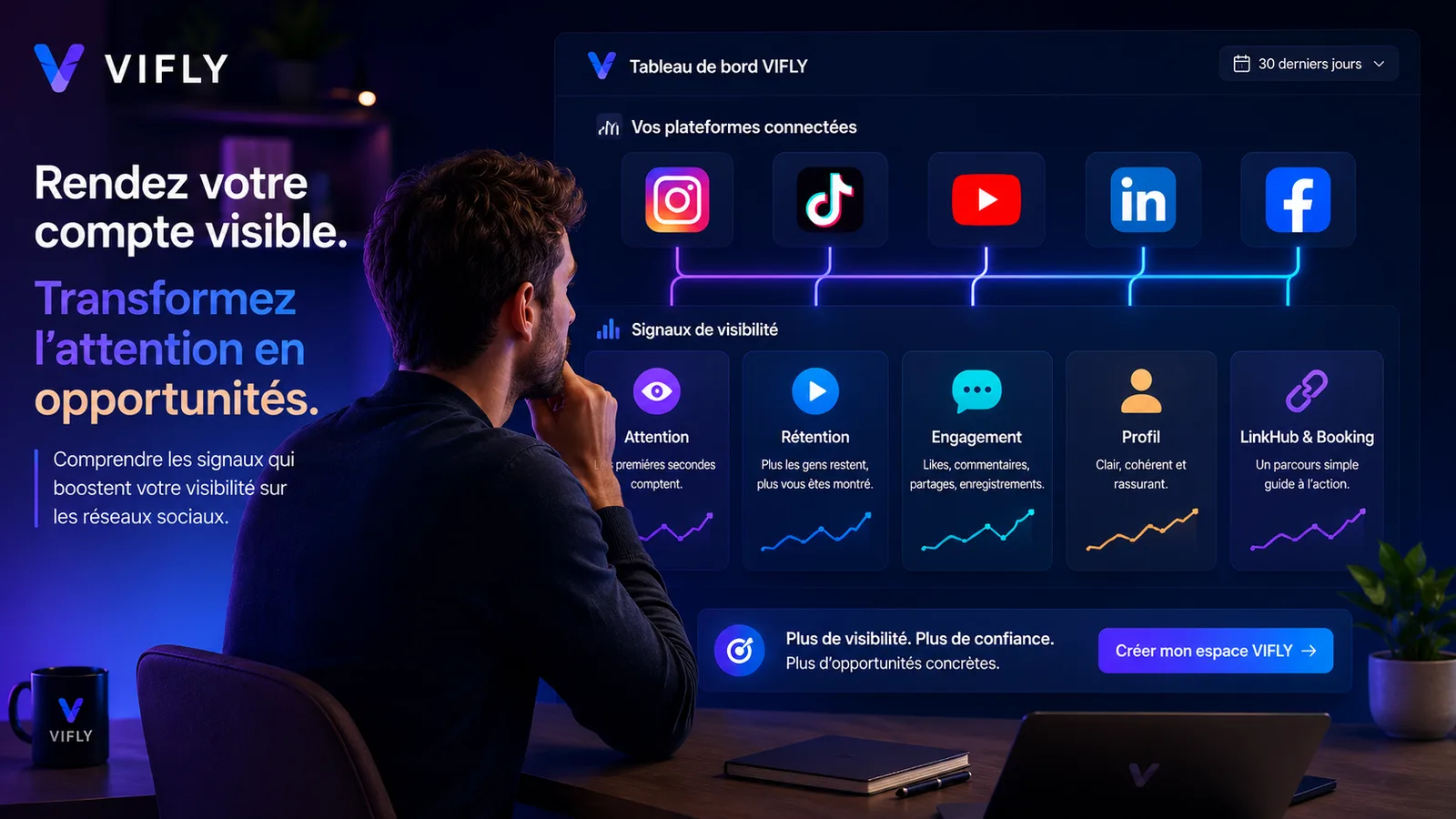
The real problem is not the algorithm. That's what he understands of you.
Many creators think that their account does not advance because it does not push them. This is sometimes true in appearance. But that's not the right question.
The right question is more direct: what does the platform include with your content, your account and your audience?
A social network does not reward a creator because he deserves it. He tests content, observes reactions, compares signals and decides if there is a good reason to show this content to more people. It's not personal. It's not magic. It's not always fair either. But it's rarely completely random.
Visibility arises from alignment: clear content, identifiable audience, positive signals and a profile that makes you want to continue. If one of these elements is weak, the content can be seen and forgotten. Or worse: it can attract the wrong people.
This is why a creator, coach, consultant, trainer or independent person should not only seek to make views. It must build a system: attract, reassure, guide, convert.
To go further on this difference between visibility and result, you can read the article VIFLY on why more views doesn't mean more customers.
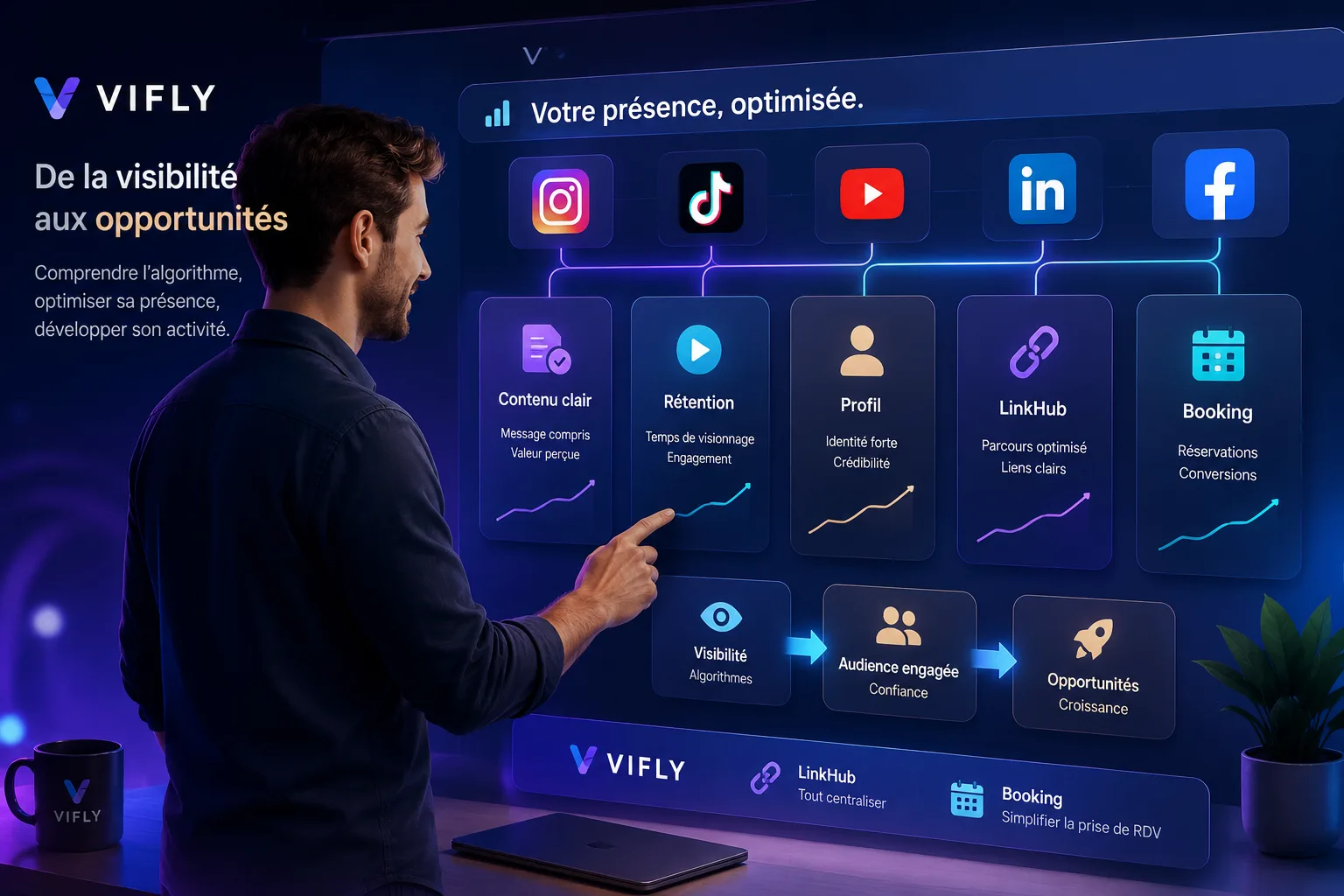
There is no algorithm, but several recommendation systems
When it's called "algorithm," we simplify too much.
On Instagram, for example, the ranking is not the same depending on whether we talk about Feed, Stories, Explore or Reels. Instagram officially explains that each part of the application uses its own signals, as the user's intention is not the same everywhere.
On TikTok, the For You page is highly customized. TikTok explains that the recommendations are influenced by interactions, video information and certain parameters such as language or country.
On YouTube, the recommendation is played in several places: home, suggested videos, Shorts, search. YouTube indicates that its recommendations help users discover content and creators corresponding to their interests, with signals that go beyond a simple view counter.
On LinkedIn, the logic is still different. The platform seeks to customize the Feed according to the professional context, network, activity and relevance of the content to the person who sees it.
Key points: content can be good on TikTok and medium on LinkedIn. A post can work in Story but not in Reels. A video can be useful on YouTube but too slow for Instagram. The problem is not always the bottom line. Sometimes it is the format, context or signal sent.
What platforms are really trying to predict
A social network does not read your content as a human. He's trying to predict a reaction.
The implicit question is not: Is this content brilliant? The question is, who is most likely to be interested in this content
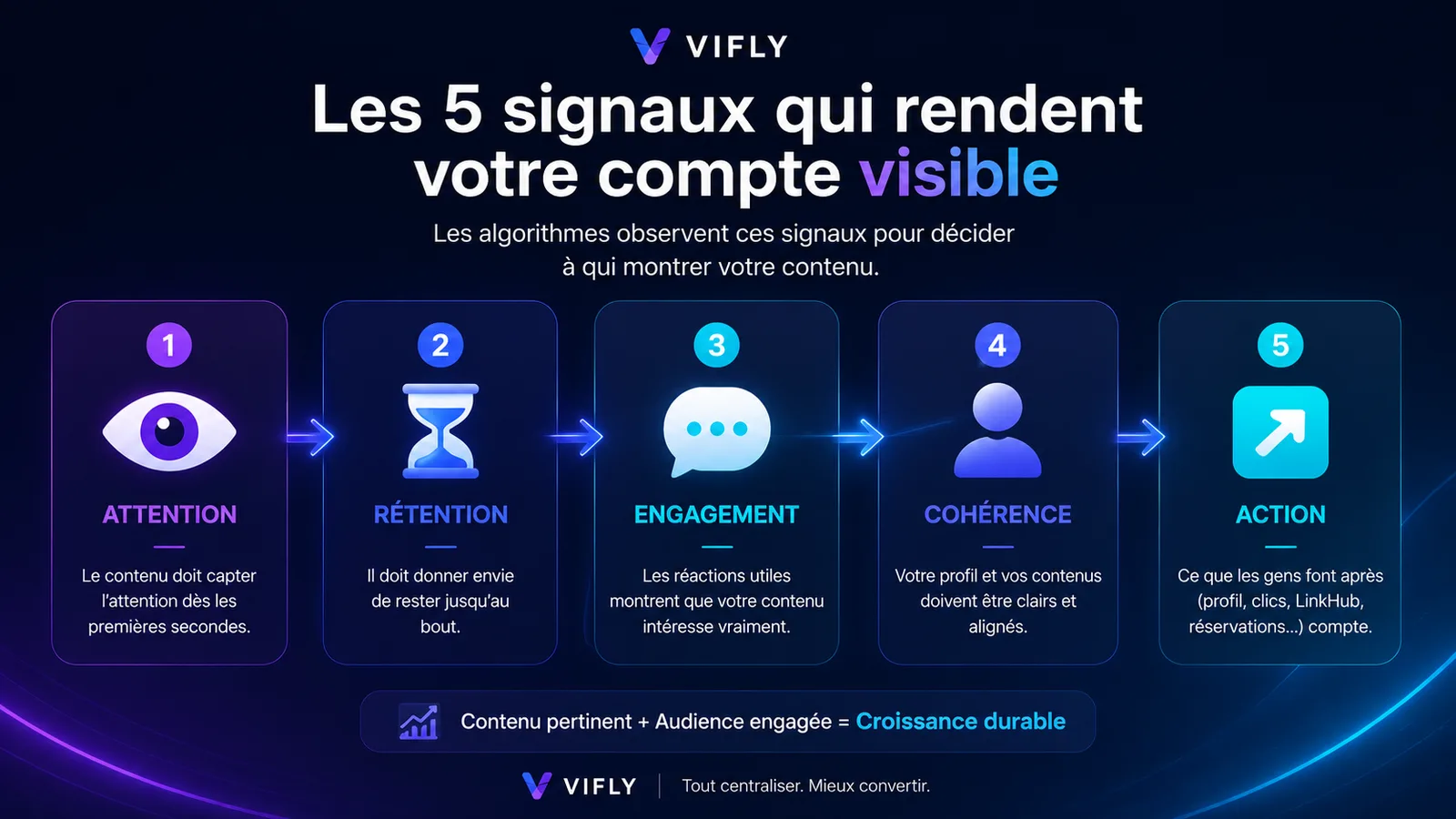
According to the platform, the signals change, but we often find five large families.
1. The attention signal
It's the first filter. Does the person stop? Is she looking? Does she read? Does not she immediately switch to the next content?
On short formats, the first seconds are decisive. If your hook is blurred, too long or too generic, the platform receives a weak signal. It's not just a question of shock. It is a matter of immediate understanding.
A good start to content quickly responds to a tension:
You publish every day, but your profile doesn't convert
These hooks work because they identify a specific situation. They don't talk to everyone. They're talking to someone.
2. The retention signal
Retention indicates whether the content should be continued. On a short video, it can be the completion rate, rereading, pauses or time spent. On a LinkedIn post, this can be the playback time, clicks, comments or quality interactions. On YouTube, satisfaction and viewing habits also fit into the recommendation logic. YouTube notably mentions satisfaction surveys among the signals that help its systems understand the appreciation of videos, beyond the mere viewing time.
Retention is not earned with artificially long text. She wins with a progression.
The spectator must feel: wait, the suite is interested
3. The useful engagement signal
Not all commitments are valid.
A like may indicate a slight interest. Sharing can signal social utility. A comment may indicate a conversation. A recording can show that the content is perceived as reusable.
But we need to be nuanced: looking for commitment at all costs can attract the wrong audience. A post polemic can generate reactions without building confidence. A very funny video can make views without making your offer understand. Too generalist tricks can attract curious people who will never become customers.
Useful engagement is the one that brings your audience closer to your positioning.
4. The account relevance signal
Isolated content can work. But a coherent account is easier to understand.
If you publish one day on the business, the next day on quotes, then on your meal, then on an unrelated trend, the platform and your audience may find it difficult to understand who you are addressing.
A visible account is not necessarily a rigid account. But he has a direction.
A coach can talk about transformation, method, frequent errors and client cases. A consultant can talk about diagnosis, strategy, results and decisions. A trainer can talk about pedagogy, progress, examples and practice. A creator can talk about his universe, his value, his formats and his collaborations.
Consistency does not limit creativity. It makes your creativity identifiable.
5. The satisfaction signal after the click
Visibility does not stop at content. If someone clicks on your profile, understands your universe and easily finds the next step, you increase your chances of turning attention into an opportunity.
That's where many accounts lose.
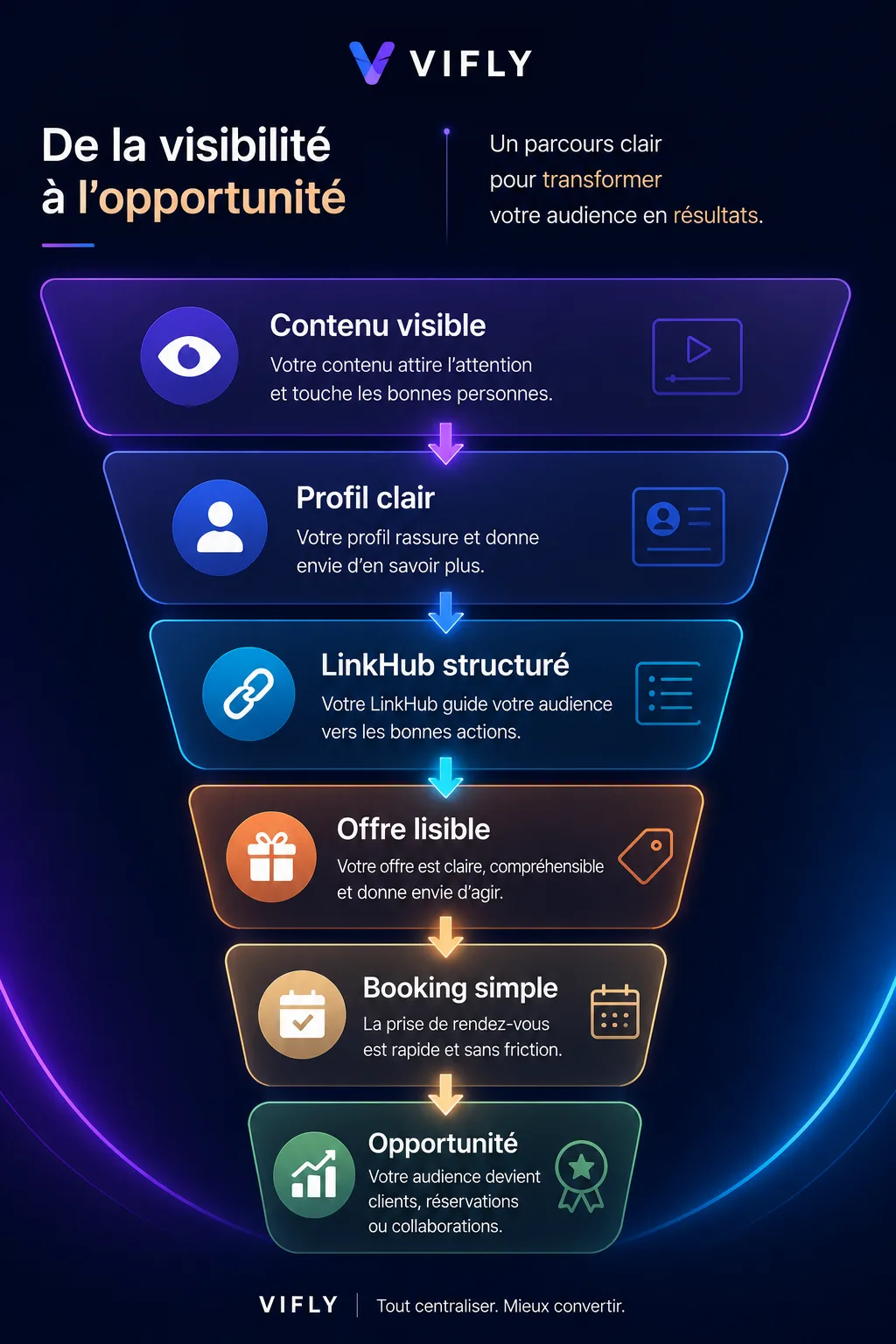
Content attracts. The profile reassures. The bioguide link. The offer clarifies. Booking reduces friction.
If your profile is confused, if your bio doesn't say clearly what you're doing, if your bio link looks like a messy list, you can get visibility without result.
Article VIFLY on bio Instagram errors that cause customers to lose complete this point well.
TikTok: The algorithm quickly tests the value of content
TikTok is often seen as the platform where everything can explode. This is partly true: an account with few subscribers can sometimes get a lot of views if a video sends good signals. But that doesn't mean that TikTok pushes at random.
TikTok explains that its recommendation system takes into account interactions such as liked, shared or commented videos, tracked accounts, created content, but also video information such as legend, sounds or hashtags, as well as language or country settings.
For a creator or independent, it means three things.
Your video must be understandable without context
On TikTok, a person can discover you without knowing you. She doesn't know who you are. She doesn't know your offer. She doesn't understand your universe yet.
Your video must therefore be self-contained.
Bad start: Today, I wanted to talk to you about an important subject. Best start: If you have views but no customer, your problem may not be your content
The second departure poses a situation, a tension and a promise. It gives TikTok a chance to understand who may be interested.
The first seconds must qualify the hearing
Too wide a hook can attract a lot of people, but not necessarily the right people.
How to succeed on TikTok is wide.
How a coach can use TikTok to attract qualified calls is more targeted.
The second hook may have fewer views, but a better business value.
Profile to confirm promise
If a TikTok video works and people visit your profile, they must quickly understand what you are proposing. This is precisely where a Structured LinkHub becomes useful: it avoids losing the audience in several scattered links.
Common error: make very viral videos but have a bio wave, without offer, without proof, without next step.
Action to be taken: watch your last three videos. For each one, write the sentence: If you fail to complete clearly, the algorithm will probably find it difficult to identify your audience.
Instagram: Each surface has its own logic
Instagram is not just a network of beautiful images. It is an ecosystem with several zones: Feed, Stories, Reels, Explore, Search. Instagram explains that these spaces are not classified in the same way, as the expected behaviours are not identical.
Reels: catching a cold audience
Reels are often used to reach people who don't know you yet. The content must therefore be quick to understand, visual and discovery oriented.
For a creator, a good Reel can show a frequent mistake. For a coach, he can dismantle a limiting belief. For a consultant, he can explain a problem that prospects cannot formulate. For a trainer, it can give an applicable mini-lesson.
The Reel is not only a visibility format. It's a filter. He attracts a type of person.
Stories: Building confidence
Stories are more used to maintain the link with people who already know you. They can show behind the scenes, answer questions, share evidence, recall an offer or create a transition to action.
Stories rarely convert a totally cold audience. They reassure a hearing already exposed.
Feed: Building authority
Feed can be used as an editorial showcase. When someone visits your profile, it must understand your theme, tone, seriousness and promise. That's why Feed should not be just a collection of posts. He has to tell a direction.
Search: be found by intent
Instagram also becomes a research reflex for some topics. Words used in your name, bio, captures and content can help the user understand your positioning. VIFLY has already developed this topic in the article Does Instagram become a search engine?
Key points: on Instagram, you don't publish for the algorithm. You publish for different contexts: discovery, trust, authority, research and conversion.
YouTube and Shorts: the promise must keep to the end
YouTube works more like an intentional consumption system. Even with Shorts, the user can stream videos, go back to a topic, search for a response or subscribe to a channel to deepen.
YouTube explains that its recommendations help users find content appropriate to their interests and that they appear in particular on the host and in the suggested videos. YouTube also mentions satisfaction signals, which reminds that keeping someone for a long time is not enough if the content disappoints.
On Shorts, the subject must be clear immediately
A Performance Short doesn't need to explain everything. But he has to deliver a clear idea.
Low example: Stronger example:
The second example creates a bridge between visibility and business. It attracts a more qualified audience.
On YouTube, the structure counts more
The long content allows to deepen, but it requires a true architecture: clear promise, logical chapters, examples, rhythm, conclusion. If the video goes in all directions, the audience picks up.
The chain must have a serial logic
An isolated video can attract. A series builds authority.
For VIFLY, for example, a series could be called: Each episode would deal with a platform: TikTok, Instagram, YouTube Shorts, LinkedIn, and then turn visibility into opportunities.
This type of logic helps the audience to know why to come back.
LinkedIn: Professional relevance counts more than buzz
LinkedIn does not have the same culture as TikTok or Instagram. Visibility is less dependent on pure entertainment and more on professional relevance.
LinkedIn explains that its systems take into account hundreds of signals, including post context, profile, network and member activity. The platform also focuses on expertise, quality of exchanges and professional coherence.
A good post LinkedIn shows a thought, not just a sentence
Posts that work on LinkedIn on a sustainable basis are not always the loudest. It is often those who give a useful reading of a professional problem.
For a consultant: For a coach: The real block is not motivation, it is the clarity of the next step. For a trainer: What learners forget when training is too theoretical. For a B2B creator:
Comments have strategic value
On LinkedIn, a relevant comment can sometimes create more opportunities than an average post. It shows your expertise in the context of a conversation.
But be careful: commenting everywhere without consistency can dilute your positioning. The objective is not to be visible everywhere. The goal is to be visible where your expertise becomes obvious.
The LinkedIn profile must be a decision page
If a post works, the player often visits the profile. He must quickly understand who you are helping, on what problem, with what method and next step.
It is here that a clear link to a structured page, media kit, diagnosis or reservation system can turn an impression into an opportunity. Article VIFLY on how to create a simple and professional creative media kit can complement this credibility work.
Facebook: proximity, communities and local relevance still count
Facebook remains powerful for some audiences, including local communities, groups, recommendations, events, more mature audiences and service activities.
Meta explains that the Facebook Feed uses d的IA systems to order posts according to what the person is likely to find relevant or useful.
This means that Facebook content can work if it is very concrete, local, relational or community.
A therapist can share reassuring advice. A trainer can promote a workshop. A local independent can explain a common problem. An entrepreneur may publish an accessible case study.
Facebook is not always the most popular platform, but it can remain profitable if your audience is active and your content is part of a real relationship.
Google and SEO IA: visibility does not depend solely on social networks
The discovery is no longer only in the feed. A person can find you via Google, Instagram Search, YouTube Search, TikTok Search, LinkedIn or a response generated by an IA interface.
Google recalls that its ranking systems seek to promote useful, reliable and thought-out content for humans. Google also published recommendations to understand how Search's IA features, such as AI Overviews and AI Mode, can include content, without promising to appear or miracle method.
The consequence for creators is simple: you have to stop producing content that just repeat what everyone says already.
The useful content will often have four qualities:
- real experience;
- specific examples;
- a shade;
- a clear next step.
An article, a video or a post that simply says, "Be regular, bring value, know your audience" doesn't bring anything. These are correct advice, but too vague.
Good content goes further:
Here's why your audience is looking at your content without buying it
It is this type of content that can feed a sustainable strategy, both on social networks and on Google.
What makes a really pushable account
An account becomes easier to recommend when it gives consistent signals. Not perfect. Coherent.
Positioning is legible
A person must understand your theme quickly. If she has to guess, you lose some attention.
Your account must answer these questions:
Who are you helping? What problem? What kind of content? What action do you want to guide?
If you are a coach, your account must not only say personal development. It must show what kind of transformation you are accompanying.
If you are a consultant, your account must not only say digital strategy. It must clarify the problem you solve.
If you are a creator, your account must not only show your personality. It must make your universe understandable.
Content forms a territory
A visible account does not publish at random. He repeats his major themes from several angles.
For example, a VIFLY creator can build five pillars:
- profile errors;
- link in bio;
- clear offer;
- reservation or contact;
- turning views into opportunities.
These pillars can then become Reels, LinkedIn posts, Shorts, carousels, articles or emails.
Content creates a useful reaction
The useful reaction is not just like. It's more like:
"I recognize myself.""I didn't see the problem like that.""I have to correct my profile.""I should clarify my offer.""I want to see how he works."
Good content does not only push consumption. He pushes to understand.
Profile confirms expertise
After good content, many visitors look at the profile. If the profile is low, visibility is lost.
The profile must contain:
- a clear sentence about your value;
- proof or a sign of credibility;
- a useful link;
- an offer or next step;
- pinned or visible content that confirms your theme.
To deepen this topic, VIFLY published an article on why you don't always need more subscribers, but better route.
Why some accounts remain invisible despite good content
There are accounts that publish good things, but they don't take off. Often the problem is not a lack of talent. It's a lack of clear signals.
Content is useful, but too general
To create quality content is not an angle. How a coach can attract prospects without publishing generic tips is an angle.
The more accurate your content, the more identifiable it becomes.
The account talks to too many different audiences
One day to entrepreneurs, one day to students, one day to brands, one day to individuals, one day to beginners. By wanting to touch wide, the account becomes blurred.
Clarity does not mean talking to one person all his life. But in a growth phase, we must allow platforms and humans to rank you mentally.
Content attracts, but profile doesn't reassure
This is one of the most costly mistakes.
A video can make 20,000 views. But if the profile doesn't say what you're proposing, if the link is confused, if the offer is invisible, the audience goes back.
This is exactly the subject of Article VIFLY Views don't pay: turning your audience into clients.
Creator changes direction too fast
Social networks need repetition. Hearing too.
If you test a theme for three days then quit, you don't have enough data. Sometimes you have to repeat an idea in several formats before you understand what works.
Concrete examples according to your profile
Content creator
Your challenge is not just to make people laugh, inspire or inform. Your challenge is to make your universe memorizable.
Example strategy:
- Reels short to attract;
- carousels to explain;
- Stories to create the relationship;
- LinkHub to centralize media kit, collaborations, offers and contact;
- Booking to allow a brand or partner to book a call.
The aim is not to become overly commercial. The objective is to be readable.
Coach
Your visibility must show the problem you are helping to solve. Not just your personality.
A self-confidence coach could publish:
“3 signs that your lack of confidence comes from a poorly defined objective. Why motivation isn't enough if your environment pulls you down. How to prepare a first coaching call without feeling judged
After content, the profile should guide to a contact or reservation. One Simple Booking reduces unnecessary exchanges and facilitates the transition to action.
Consultant
Your content must prove your ability to diagnose.
A consultant does not need to publish only advice. It can publish problem readings:
Your tunnel doesn't convert because your offer comes too late
This type of content signals expertise. It attracts fewer people than a motivational phrase, but it attracts better.
Trainer
Your strength is educational. The algorithm can value your content if people understand, save or share it.
A good format:
- a frequent error;
- a simple explanation;
- an example;
- a mini-action.
The trainer must also show the following: resource, workshop, program, call, wait list or premium content.
Independent or entrepreneur
Your account must clarify your activity. Many independents publish as if they wanted to become influencers, while their real goal is to generate qualified applications.
A graphic designer can show before/after. A therapist can explain common situations with caution and pedagogy. A photographer can show his eyes, his process and his offers. A SaaS entrepreneur can explain the problem he solves, not just his product.
In all cases, visibility must lead somewhere.
LinkHub's role: turning curiosity into a clear path
Visible content creates an entry door. But if there's a blurred corridor behind this door, the audience goes away.
A LinkHub is not just a list of links. It's a decision page.
He must answer three questions:
- Who are you?
- What do you propose?
- What is the next logical action?
WithVIFLY LinkHub, the objective is to centralize your links, offers, resources, important content, contact or Booking in a clearer path.
A good LinkHub can contain:
- your main offer;
- your key content;
- your media kit;
- your Booking;
- your newsletter;
- a useful proof or resource;
- a contact link.
The mistake is to put fifteen links without priority. The more choices you give without hierarchy, the more hesitation you increase.
Action to be taken: open your current bio link and ask yourself: If this action is not visible first, your journey can be improved.
The role of Booking: reducing friction when intent is hot
When a person is interested, every friction is expensive.
If it has to send a DM, wait for an answer, ask for your availabilities, compare schedules, check the price, then restart, you lose opportunities.
A clear Booking makes it easier to turn an intention into action. He doesn't force anyone to buy. It simply makes the next step simpler.
For a coach, this can be an open call. For a consultant, an audit. For a trainer, an accompanying session. For a therapist, a session. For a creator, a collaboration call.
VIFLY Booking can integrate naturally into this journey: the content attracts, the profile reassures, the LinkHub organize, the Booking allows to act.
The VIFLY method to no longer depend solely on the algorithm
Depending on the algorithm is dangerous. Understanding it is useful. Building a system around it is much stronger.
Here's a simple method.
1. Choosing a Priority Audience
Don't start with "I want to be visible." Start with:
Wide visibility without intent can flatter the ego. Targeted visibility can create opportunities.
2. Define three recurring problems
Your content must revolve around problems that your audience really feels.
For VIFLY, for example:
- i have views but no customers;
- my profile does not clearly state what i propose;
- my bonds are scattered;
- I'm losing prospects in DM;
- i don't know what to put forward
3. Create formats adapted to each platform
TikTok : strong hooks and fast angles. Instagram Reels discovery and identification. Stories trust and relationship. LinkedIn : expertise and grade. YouTube Shorts : strong and memorizable idea. Blog depth, SEO and credibility.
4. Optimize Profile
Your profile must confirm the promise of your content. A clear bio is better than a stylish but vague phrase.
5. Structure the transition to action
Your LinkHub must prioritize. Your Booking must be simplified. Your offer must be visible.
6. Measuring the right signals
Don't just look at the views. Look:
- profile visits;
- click on the link;
- incoming requests;
- reservations;
- registration;
- qualified messages;
- backups;
- useful sharing;
- progress of the qualified hearing.
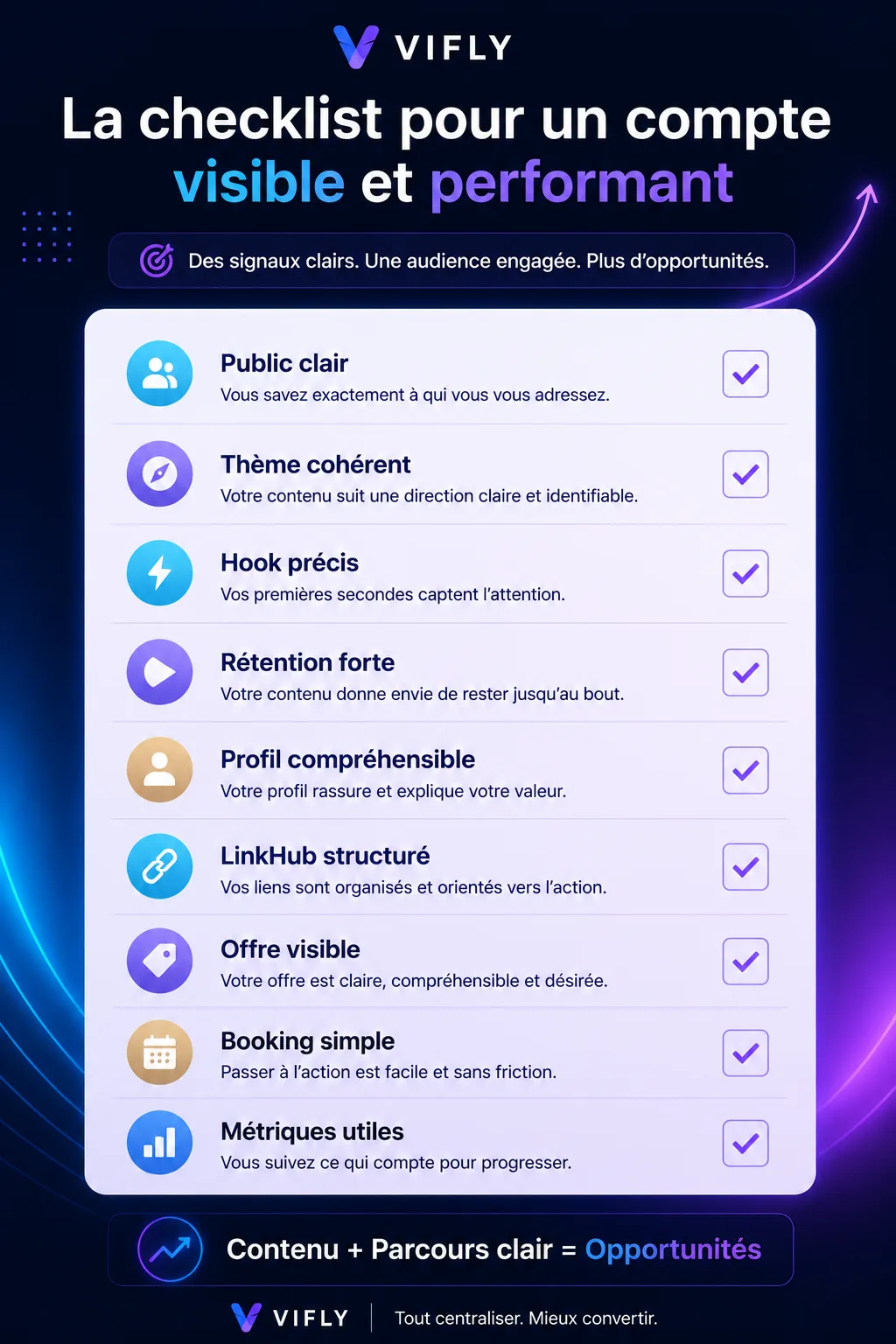
What you shouldn't do: false algorithmic hacks
False hacks often give a sense of control. But they rarely create a sustainable strategy.
Publishing at a magical hour will not compensate for blurred content. Putting thirty hashtags will not compensate for a bad catch. Copying a viral format will not compensate for a misposition. Making controversial content will not compensate for an invisible offer. Using AI to produce more will not compensate for a lack of real experience.
Platforms are changing. Quick recipes are getting older quickly. The fundamentals remain: clarity, relevance, usefulness, coherence, confidence, transition to action.
It's also Google's search-side logic: creating useful, reliable and thought-out content for users first, rather than content designed solely to manipulate a system.
Conclusion: The algorithm rarely pushes a blurred account very long
Being visible is not just a matter of luck. It's not a perfect equation either.
Platforms test, customize, classify, recommend and adjust. They look at behavior. They try to predict what will interest a person at some point.
But your role is not to run behind every micro-changed algorithm. Your role is to make your account more understandable, your content more useful, your profile more reassuring and your journey simpler.
Good content can attract attention. A good profile can create confidence. A good LinkHub can guide. A clear offer can make you want. A simple Booking can turn interest into action.
Visibility is the beginning. Not the final result.
Create a clearer course with VIFLY
If your content is already eye-catching, but these looks do not become clicks, requests, reservations or opportunities, the problem may not be your algorithm.
Maybe that's your path.
With VIFLY, you can structure your digital presence, centralize your links, present your offers and facilitate your bookings in a clearer space.
Start by clarifying your profile. Then organize your LinkHub. Then make your next action obvious.
FAQ - Frequently Asked Questions
How does the algorithm of social networks work?
There is no single algorithm. Each platform uses several recommendation systems that analyze signals such as interactions, time spent, content relevance, user profile, post context and satisfaction. TikTok, Instagram, YouTube, LinkedIn and Facebook do not use exactly the same criteria.
Why isn't my account pushed by the algorithm?
An account may not be visible if its content is too generic, if its target audience is blurred, if the first seconds do not receive attention, if the profile does not confirm the promise or if the engagement signals are weak. The problem is not always the quality of the content, but sometimes the clarity of the positioning.
What is the most important criterion to be visible?
There is no universal criterion. On short formats, attention and retention are essential. On LinkedIn, professional relevance and quality exchanges are important. On YouTube, satisfaction and sustainable interest play an important role. The best criterion remains the match between your content, your audience and the context of the platform.
Is it necessary to publish every day to please the algorithm?
Publishing regularly can help, but publishing every day without clear direction can dilute your positioning. The useful regularity is to repeat your major themes, test your formats, analyze reactions and improve your journey. Frequency does not replace clarity.
How to transform visibility into customers or opportunities?
Content must be linked to a journey. The content attracts, the profile reassures, the LinkHub organizes important links, the offer clarifies the value and the Booking facilitates the action. Without this path, views can remain passive.