
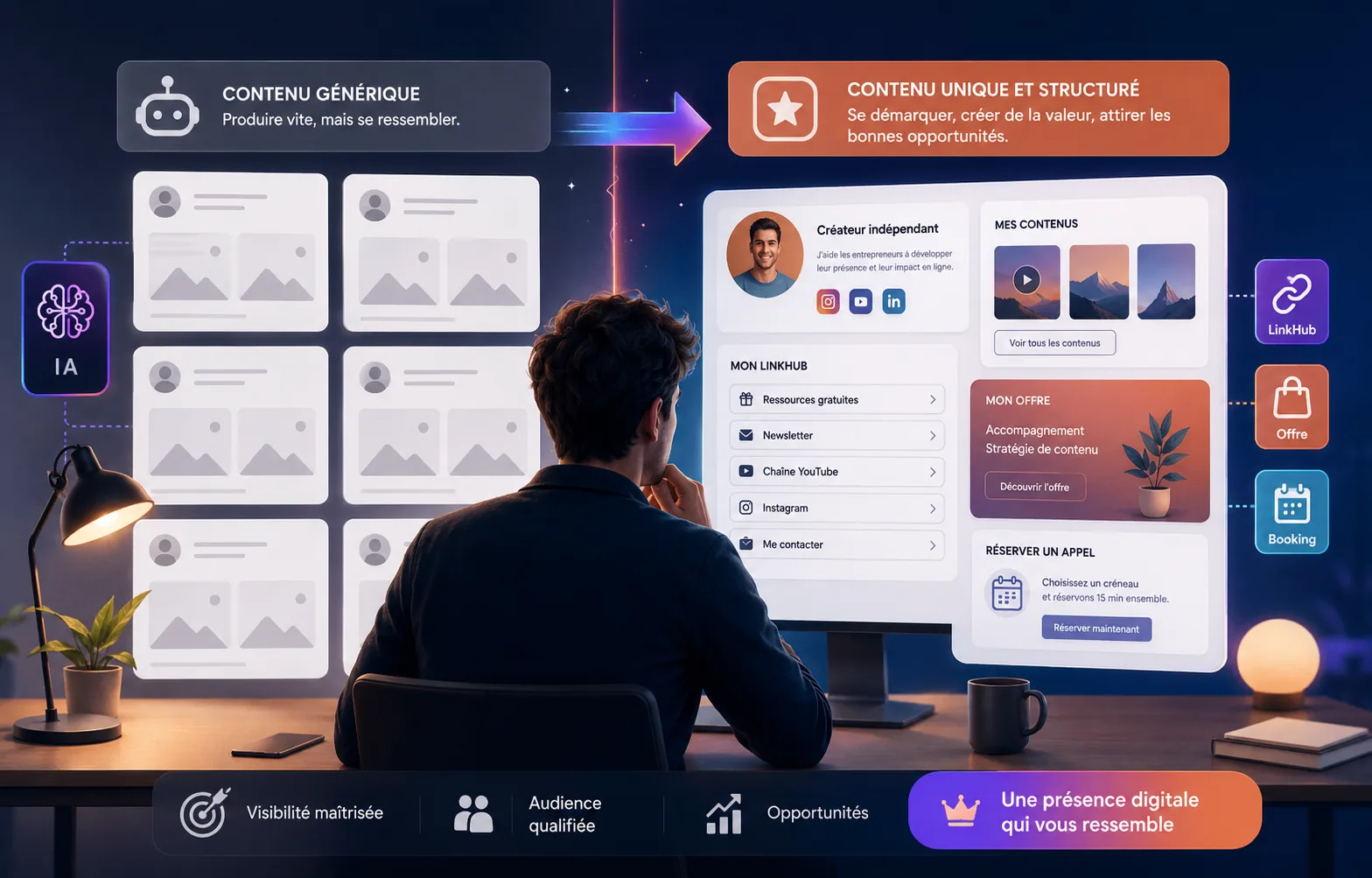
The real danger of AI is not that it replaces creators
The real danger is that it makes many creators impossible to distinguish.
Even yours. Same structure. Same hook. Same carousel. Same recycled advice. Same sentence that looks like a sentence already seen a hundred times.
It can save a huge amount of time. It can help find ideas, clarify a plan, reformulate a sentence, prepare a script, summarize a trend or structure an article. But used without direction, it often produces something dangerous for a creator: clean content, but without fingerprints.
And on social networks, own content is no longer enough.
A creator is not chosen because he publishes a correct sentence. It is chosen because it has an angle, a voice, an experience, a proof, a way of seeing the problem and a clear path after the content.
That's exactly the shade that many people will have to understand: IA does not replace your personal branding. She reveals if you have one.
Google recalls that its systems seek to highlight useful, reliable and created content for humans, not content designed solely to manipulate rankings. Google also states that the use of AI is not a problem in itself if the result actually brings value, but that producing many pages without added value can be a large-scale spam issue.
Why do so many AI content look alike?
Most IA-assisted content is similar for a simple reason: applications are similar.
When a creator simply writes to me, give me 10 ideas for posts on monetization or write a TikTok script about creators' mistakes, theIA often answers with very medium angles, because it does not have enough personal matter to do better.
She doesn't know your experience. She doesn't know your clients. She doesn't know your objections. She doesn't know your territory. She doesn't know how you talk. She doesn't know your evidence. She doesn't know your offer. She doesn't know what your audience won't say in comment.
It can simulate a shape. But she can't invent your experience for you.
Common mistake
Use theIA as a complete content creator instead of using it as a structuring partner.
The difference is huge.
In the first case, you ask:
Write for me
In the second, you ask:
Help me to better express what I already know, what I've experienced, what my audience feels and what I want to transmit
That's where the content gets stronger.
IA should not replace your point of view
A point of view is not a free opinion. That's not to say the opposite of everyone to create buzz. This is a clear way of interpreting a problem.
For example, generic content will say:
To succeed on Instagram, you need to be regular, create quality content and know your audience
That's right. But it's weak. Everyone can say that.
Content with a point of view would say:
Regularity is no use if each content attracts people who do not understand what you are proposing
There's an angle. There's a tension. There is an idea that can make a creator, coach or consultant think.
Another example:
Use AI to save time
It's commonplace.
Stronger version:
If IIA makes you publish blurry content faster, it just accelerates your invisibility
This sentence has more weight because it does not only speak of tool. It speaks of a real risk: to produce more without becoming clearer.
Key points
IA can help produce more. But your role is to produce fairer.
More aligned. More useful. More incarnate. More related to your offer. More recognizable.
What changes with Google, the AI and search
Two mistakes must be avoided.
The first would be to believe that AI makes SEO useless. The second would be to believe that there are magic hacks to force Google AI Overviews or AI Mode to resume your content.
Google explains that good SEO practices remain relevant to search's generative experiences, as these features are based on Google Search's ranking and quality systems. Google also emphasizes the importance of non-generic, useful, reliable, expert-led and thought-out content for humans.
In other words: fundamentals remain important.
A page must be indexable. The subject must be clear. The content must meet a true intention. The structure should help read. The titles must guide. Examples must bring more than standard content. Internal links should help the user to continue their journey. The mobile experience must be clean.
The page must be read, quoted, shared or saved.
IA does not remove these fundamentals. It makes the average content more numerous. So it increases the value of really useful content.
What Google expects from useful content
Useful content does not just reformulate what everyone already knows. It really helps the reader to make a decision, understand a nuance, avoid a mistake or take action.
For a creator, this means:
- to bring a living example;
- show a real error;
- explain a method;
- give a shade;
- cite a source when necessary;
- linking advice to concrete action;
- avoid unrealistic promises;
- not only create to fill an editorial calendar.
If you want to deepen this topic, you can read article VIFLY on what creators need to understand on Google, the AI and the SEO.
Generic content has become a reputation risk
In the past, publishing average content was mostly costing scope. Today, it can cost more: your credibility.
When your audience sees a post that looks like an automatic answer, it doesn't necessarily say it's the creator who uses the IA. She can just feel something more dangerous:
He has nothing special to say
And for a creator, coach, consultant or independent, it's a real problem.
Because your content isn't just there to exist. It is used to build a perception. Your hearing must include:
- what you know;
- who you help;
- how you think;
- what makes you different;
- why she can trust you;
- what she can do after eating your content.
If AI erases your singularity, it doesn't help. It makes you interchangeable.
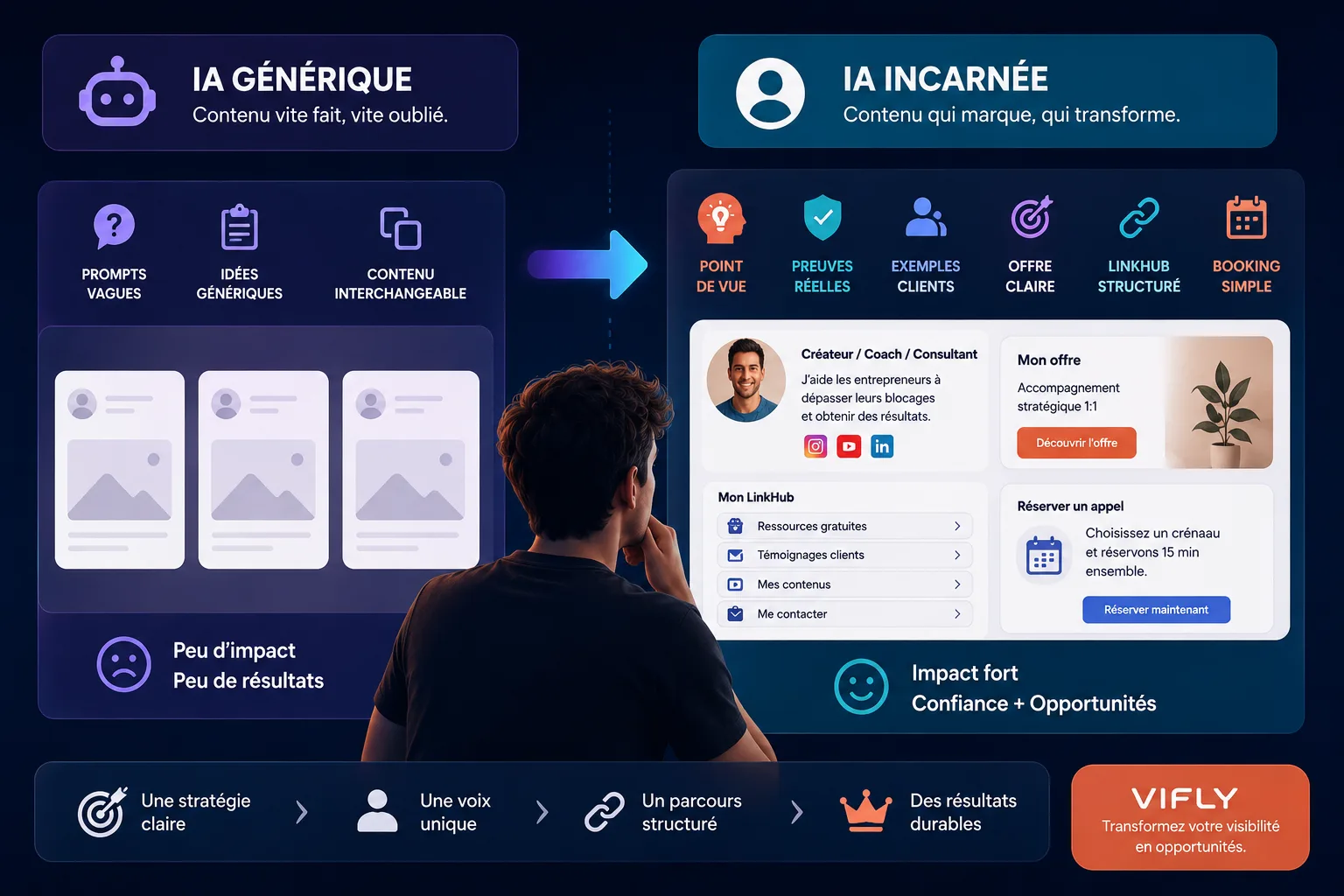
The VIFLY method: use AI without losing your voice
The aim is not to reject AI. That would be pointless.
Tools are changing fast. For example, YouTube integrates IA features into Shorts, including video generation, editing and assisted creation tools, while presenting IA as a tool for human creativity.
The real challenge is to regain control of creative leadership. Here is a simple five-step method.
Step 1: Start with your angle, not your tool
Before you open ChatGPT, Claude, Gemini or another tool, write your angle in one sentence.
Not the subject. The angle.
Subject: Biolink.
Angle:
Subject: IA and creators.
Angle:
Subject: Monetization.
Angle: You don't have to wait until a platform activates a button to build your income
This step changes everything.
A subject gives a broad direction. An angle gives a tension. And the tension holds attention.
Action to be taken
Before your next content, write:
I want my audience to understand that..
Then complete the sentence.
Example:
I want my audience to understand that making more views is useless if the profile does not lead to clear action.
From there, AI can help structure. But you gave the spine.
Step 2: Give AI your raw material
If you give AI a vague demand, it produces vague content.
Your raw material must contain:
- your specific audience;
- the real problem;
- a sentence heard in a client;
- a mistake you often see;
- your opinion;
- a concrete example;
- an objection;
- an action to be taken;
- your offer or your course if it's relevant.
Example of bad speed:
Make me a post about AI for creators
Example of a more useful prompt:
I am addressing creators, coaches and independents who use ChatGPT to create content, but whose posts are similar. I want to explain to them that the AI must amplify their point of view, not replace their reflection. Give me 5 angles of Reels with a punchline, a concrete example and a natural CTA to an item
The second prompt gives context, target, pain, opinion and action.
IA can then help without crushing your voice.
Step 3: Adds proof that AI cannot invent
Content becomes more credible when it contains human evidence.
This can be:
- personal experience;
- a customer discussion;
- a mistake you made;
- an observed result;
- one before/after;
- an example profile;
- an excerpt from the commentary;
- a nuance related to your profession;
- a field observation.
A coach can tell an objection heard on appeal. A consultant may show a recurring error in audits. A trainer can explain where his learners block. A UGC creator can show why a portfolio is not enough to get missions. An independent can tell how he wasted time in DM before structuring his reservations.
It is this type of material that makes your content less interchangeable.
On VIFLYThis logic is directly related to the subject of the career path. A creator does not only win by publishing more. It gains by making its value more readable. This is also shown in the article on the difference between making views and getting customers.
Step 4: Turns each content into an input door
Content should not be an impasse.
If a person discovers you through a Reel, a LinkedIn post, a Short, an article or a TikTok video, they must be able to easily understand what to do next.
Read a guide. Discover your offer. Book a call. Buy a product. See your services. Check your portfolio. Contact you. Sign up for your newsletter.
That's where many creators lose opportunities. Their content attracts attention, but their journey is unclear.
They have a good video, but a bio wave. They have a good post, but no visible offer. They have an interested audience, but a disorderly bio link. They have prospects in DM, but no simple system to book.
IA can help create more content. But she won't fix your career on her own.
To structure this suite, a tool like VIFLY LinkHub allows you to centralize your links, offers, important content, profile and action calls in a clearer space than just a list of buttons.
And if you offer calls, sessions, audits, accompaniments or appointments, VIFLY Booking can help make booking easier.
You can also use this audit IA of an Instagram account creator to spot the elements that blur your positioning, bio or course.
Key points
The content attracts attention. The profile creates confidence. The LinkHub guides. The offer clarifies. Booking facilitates action. The system turns visibility into opportunities.
Step 5: Use AI to decline, not replace
A good use of AI is based on a strong idea and then declines it.
For example, you first write a central idea:
I'm not going to kill the creators. It will make visible those who do not have a point of view
Then you can ask the AI to help create:
- a 30-second Reel script;
- a more humorous TikTok version;
- a more professional LinkedIn hook;
- an Instagram legend;
- a newsletter;
- an article plan;
- three SEO titles;
- a FAQ;
- a checklist;
- a carousel.
In this case, the AI becomes a multiplier of coherence. But the source is still your idea. It's an essential difference.
Concrete examples according to your profile
For a Content Creator
Misuse of AI:
“Donne-moi 10 idées de Reels sur Instagram.”
Best use:
I speak to creators who make views but don't get customers. My angle is: ‘Visibility does not replace a clear course'. Give me 10 ideas of Reels with precise pain, a strong hook, an example and an CTA to my LinkHub
As a result, your content is no longer confined to space. They become connected to your positioning.
For a coach
Misuse:
“Écris un post motivation sur la discipline.”
Best use:
I'm a coach. My audience thinks it lacks motivation, but I want to show that his real problem is often the lack of a framework. Write a post that breaks this belief with a simple example and an CTA to a reservation
Result: you don't produce one more quote. You install your expertise.
For a consultant
Misuse:
Make an article on the digital strategy
Best use:
I want to explain to the independents that they do not need more tools, but a clearer path between content, offer, proof and conversion. Proposes an article plan with concrete examples and frequent errors
As a result, you don't look like a generic blog. You show a strategic reading.
For a trainer
Misuse:
Create a training course on Canva
Best use:
I want to create a Canva mini-training for creators who want to produce more professional visuals without losing their identity. Help me structure the modules around a clear result, with exercises and examples
As a result, IA helps structure a pedagogy, not just to produce titles.
For a UGC Creator
Misuse:
Write a message to contact a brand
Best use:
I am a UGC creator specializing in educational videos for SaaS tools. I want to contact a brand with a concrete idea: a short video that shows how to solve a specific problem. Help me write a professional message, value oriented, no gift request
As a result, your approach becomes more credible, more accurate and more professional. If you work at the UGC, you can also read the VIFLY guide on how to turn your UGC content into missions and opportunities.
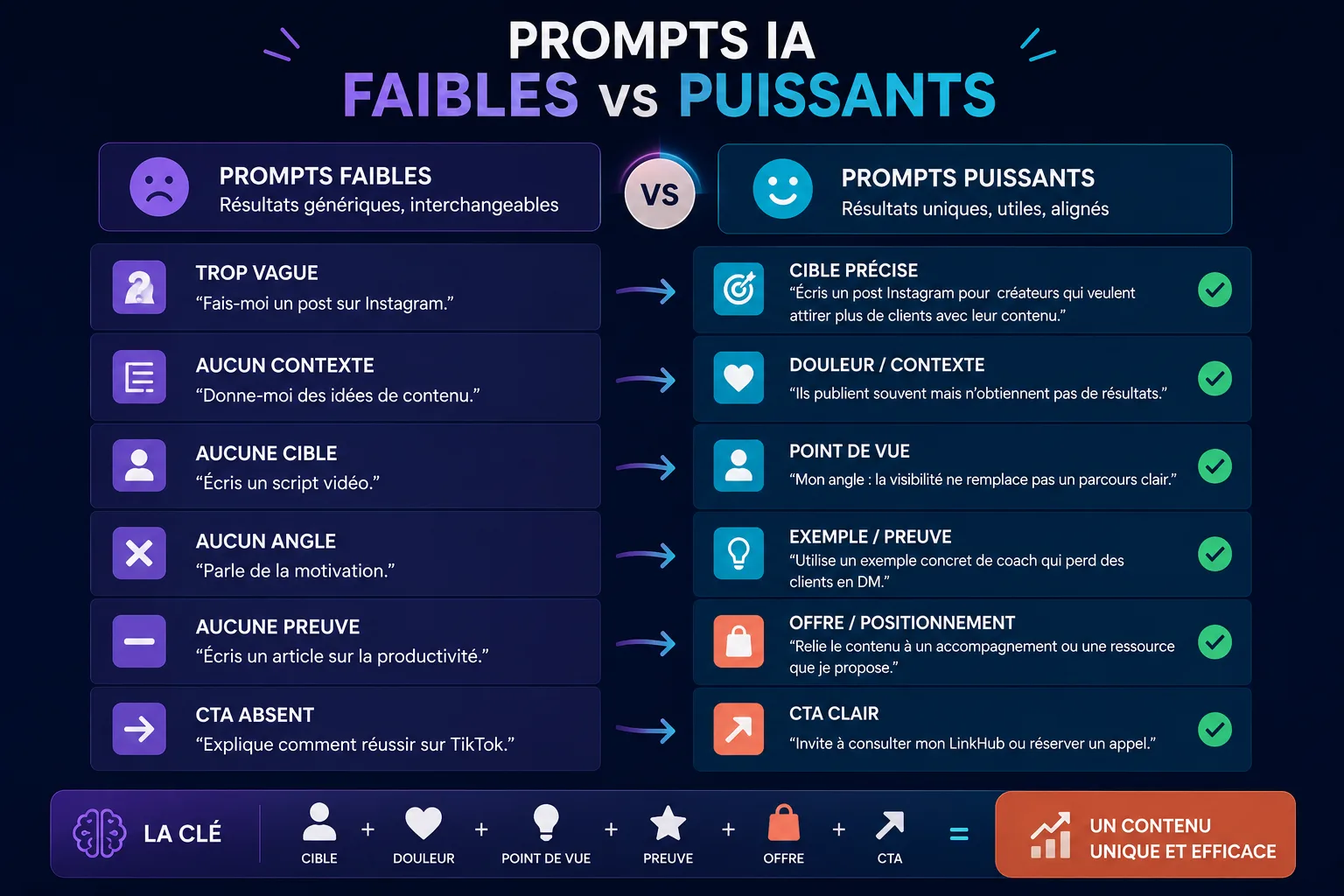
The 7 errors that make your AI content recognizable
1. Start with phrases too wide
In a changing digital world..
In the digital age..
It is essential to..
These sentences immediately give an impression of standard content.
Rather, start with a real tension.
Example:
You can publish every day and stay invisible if your content doesn't have an angle
2. Use obvious advice
Know your audience
- Be regular
Value creation
Use the right tools
These advices are not wrong. They're just too vague.
Replace them with concrete situations.
If your audience doesn't know what to do after seeing your content, your problem isn't regularity. It's the course
3. Write without example
An exampleless article quickly resembles a theoretical sheet.
Adds cases:
- a coach who loses requests in DM;
- a designer who has views but no clicks;
- a consultant whose offer is invisible;
- a trainer who sells a training that is too blurred;
- a UGC designer whose portfolio does not answer brand questions.
4. Copy the structure everyone uses
Hook. Problem. Solution. CTA.
This structure can work, but it becomes flat if everything is predictable.
Add a surprise element:
- a contradiction;
- an uncomfortable truth;
- a comparison;
- an unexpected example;
- a sentence that breaks a belief.
5. Let AI choose your tone
Your tone must come from your identity.
Are you direct? Educator? Light black humor? Very concrete? Accessible expert? Local? Premium? Provocative? Benevolent? Very visual?
If you don't define it, AI will often choose a neutral tone. And the neutral is rarely memorable.
6. Do not link content to your offer
Content can be useful without being commercial. But it must be consistent with what you want to develop.
If you're a coach, your content must show you how to accompany.
If you're a consultant, they have to reveal your way of analyzing.
If you're a UGC creator, they have to prove your sense of communication.
If you're a trainer, they have to show your pedagogy.
If you're independent, they have to make your expertise readable.
Content unrelated to your positioning can make views, but few opportunities.
7. Publish without next step
The contents should not die in the scroll. An interested reader must be able to continue:
- read an article;
- discover your profile;
- consult your offers;
- see your premium content;
- book a call;
- buy a product;
- contact you.
This is why a clear course is essential. You can lean on VIFLY to centralize your digital presence and make your next steps more visible.
How to write a prompt that produces less generic content
Here's a simple structure.
The rapid in 8 blocks
- Expected role
- You are an expert in copywriting, pedagogy and content strategy for creators
- Specific target
- I am speaking to coaches, creators and independents who make views but do not convert
- Real pain
- They publish a lot, but their offer remains invisible
- Editorial angle
- I want them to understand that visibility does not replace a clear route
- Perspective
- My opinion: content should guide to action, not just create attention
- Practical example
- Example: a coach receives DMs but loses prospects because he doesn't have a simple Booking
- Format
- “Rédige un script Reel de 40 secondes, naturel, facecam, avec punchlines courtes.”
- Natural ATA
- “Termine par une invitation à vérifier son lien en bio ou lire mon article.”
Example of a complete prompt
You're an expert in copywriting, video retention and creative strategy. I am speaking to creators, coaches and independents who use theIA to create content, but whose posts are similar. Their pain: they publish faster, but do not become more recognizable. My angle: the AI does not replace creators, it exposes those who do not have a point of view. Writes a 45-second, direct, human Reel script with a strong punchline, a concrete example and a natural CTA to a blog post.
This prompt does not guarantee perfect content. But it gives a much stronger direction than a vague demand.
IA, social networks and originality: what creators need to understand
Platforms don't just want more content. They want content that holds attention, creates real interaction and brings a form of originality.
Instagram reported on its willingness to better reward original creators in the recommendations, including to help more creators find new audiences. TikTok also presents its Creator Rewards Program as focused on creativity and original quality content.
This does not mean that every content must be revolutionary. But this means that the content copied, recycled without angle or generated without personality becomes more fragile.
For a creator, the real question becomes:
Could this content be published by anyone
If the answer is yes, you have to work again.
Add your experience. Add your territory. Add your vocabulary. Add proof. Add a contradiction. Add a real situation. Add a useful opinion. Add an example of terrain.
It is this human layer that changes everything.
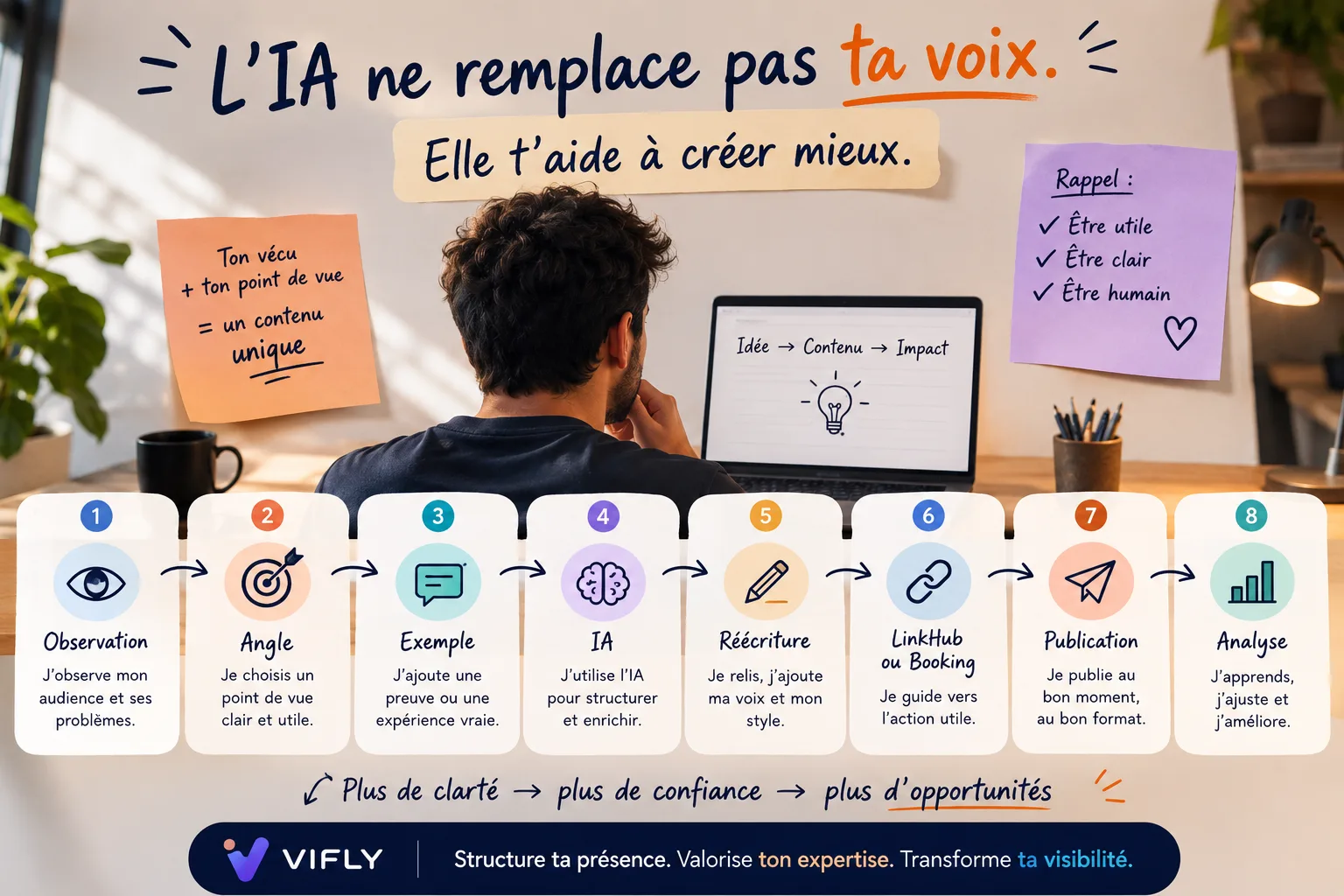
IA can help you be more human, if you use it in the right order
This may seem paradoxical, but the AI can help create more human content if it comes after your reflection.
The wrong order:
- IA
- content
- publication
- hope it works
The right order:
- actual observation
- personal angle
- concrete example
- structure with AI
- human rewriting
- link to your journey
- publication
- analysis of reactions
In this second model, the AI does not replace your thought. She's organizing it.
How to connect your AI content to your creative ecosystem
Creating good content is a first step. But if you want to turn that visibility into opportunities, you have to think about what happens next.
Someone sees your content. She clicks on your profile. She reads your bio. She opens your link. She's looking at your offer. She checks if she can contact you, book or buy. She decides whether it seems simple or not.
This is often where the opportunity is won or lost.
A creator who uses the AI only to publish more can end up with a lot of content and few results. A creator who uses the AI to clarify his message, then structure his profile, his LinkHubits offers and its Bookingbuild a stronger system.
If you want to reinforce this logic, article VIFLY on the place of the content creator in 2026 shows why publishing is not enough anymore. The creator must become a clear gateway to his offers, content, reservations and income.
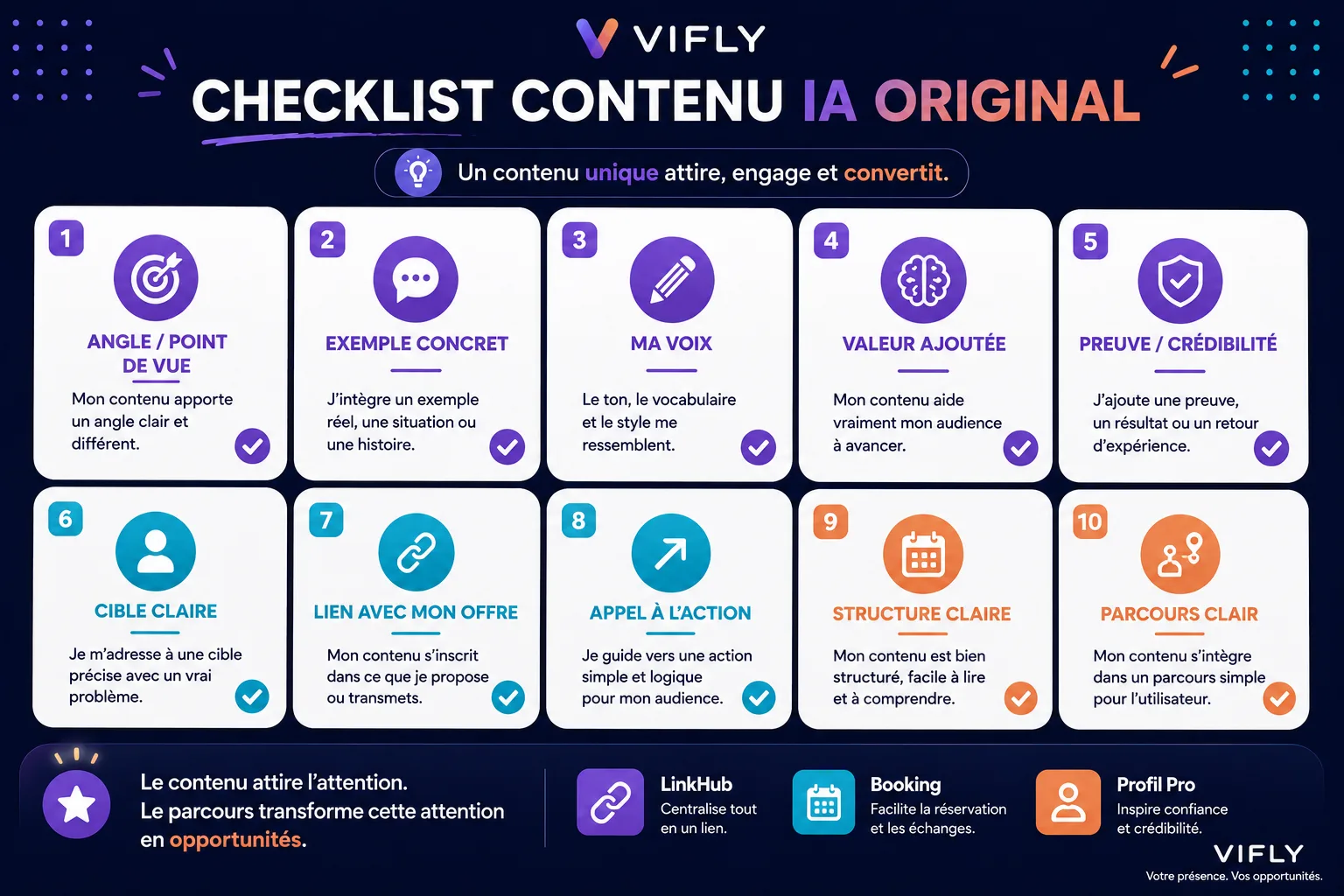
Checklist: Is your AI content really yours?
Before publishing IA-assisted content, ask yourself these questions:
- Is the central idea really clear?
- Does this content contain my view?
- Does he bring a concrete example?
- Could it be published by anyone?
- Does the tone look like my way of speaking?
- Does he respond to any real pain in my audience?
- Does he avoid generic phrases?
- Does it contain a useful action?
- Does it fit into my content strategy?
- Does it lead to a clear next step?
If you answer a few questions, don't publish yet. Work again.
Conclusion: AI must not create in your place, it must make your message clearer
The AI is a powerful tool. But she can't carry your identity alone.
She can offer. It can structure. She can reformulate. She can speed up. It can decline.
But she can't live your experience. She can't choose your editorial courage. She can't understand your audience better than you if you don't give her anything. She can't turn blurred positioning into a strong brand without your involvement.
The creator who wins with the AI will not necessarily be the one who publishes the most. It will be the one who knows what to say, to whom, why, with what proof and to what action.
IA can help create faster. But your difference comes from what only you can bring.
Your point of view. Your experience. Your examples. Your way of speaking. Your offer. Your journey. Your system.
And if you want your content not to remain mere isolated publications, VIFLY will help centralize your digital presence, organize your LinkHub, present your offers and facilitate your reservations.
Create my VIFLY account and is beginning to turn your visibility into concrete opportunities.
Frequently Asked Questions
Is it wrong to use AI to create content?
No. The problem is not to use AI. The problem is to publish generic content with no added value, no experience, no point of view and no real usefulness. Google states that the use of AI is not prohibited per se, but that content must comply with standards of quality, utility and rules against abuse of content produced on a large scale.
How can I avoid a content generated by IA getting too far?
Add your angle, your vocabulary, your examples, your field observations and your evidence. Remove the generic sentences. Read it out loud. If the content could be signed by any creator, it must be reworked.
Can I have a chance to help the SEO?
Yes, if it helps structure a useful response, clarify a plan, identify sub-questions or improve readability. But SEO fundamentals remain essential: indexable page, useful content, clear structure, internal meshing, performance, relevance and user experience. Google points out that SEO good practices remain relevant to search's generic experiences.
How to use ChatGPT to create more original Reels?
Don't just ask for a script. Gives a precise target, a pain, a belief to break, your opinion, a concrete example, the tone desired and CTA. The more precise your starting material, the less generic the result.
What should a creator do after publishing content?
It must check whether the course after the content is clear: organic, profile, LinkHub, offer, premium content, Booking, contact or registration page. The views attract attention, but it is the path that turns this attention into opportunities.