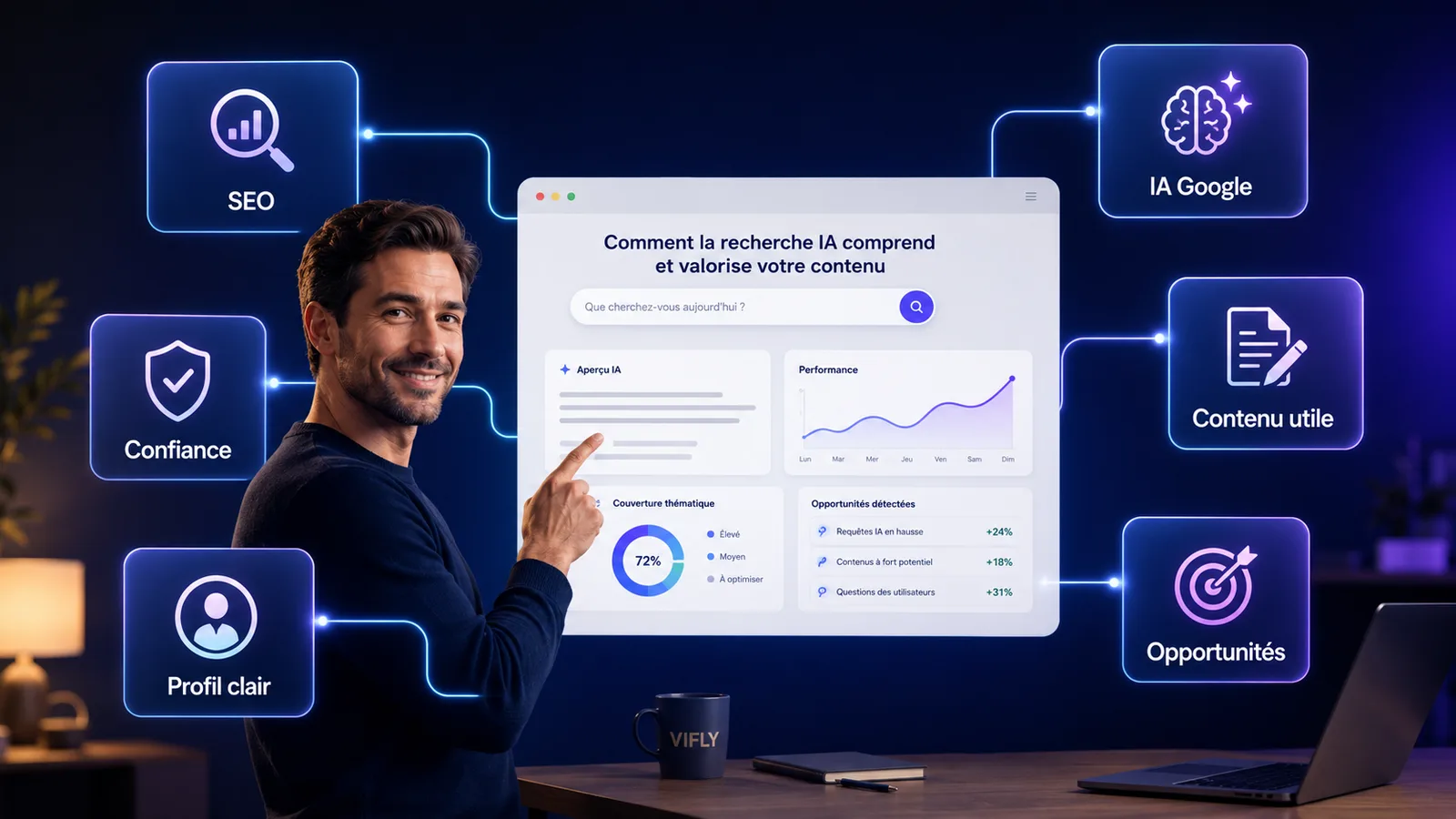
SEO doesn't disappear. He's getting more demanding.
Google's IA does not remove SEO, but it changes the way content is understood, summarized and presented. To remain visible in 2026, creators must produce more useful, expert and structured pages, then give a real reason to click.
For a long time, many creators summarized the reference to a simple idea: finding the right keywords, writing an article, waiting for Google to do the rest.
This time is not completely dead. But it is clearly changing.
With the arrival of general search experiences such as AI Overviews, AI Mode and new IA visibility reports in Google Search Console, Google is no longer content to display a list of links. It can synthesize, compare, reformulate, contextualize and propose answers directly in the results page.
For a creator, coach, consultant, trainer, freelancer or entrepreneur, the question is no longer just:
How to be visible on Google
The real question becomes:
How to become a clear, credible and useful source in a search engine that better understands intentions
And above all:
If Google responds more directly to users, how do you still want to click, discover me, trust me and take action
That's where the subject becomes strategic.
Because good content must no longer be found.
It must be understood, cited, recognized, memorized, and linked to a clear path.
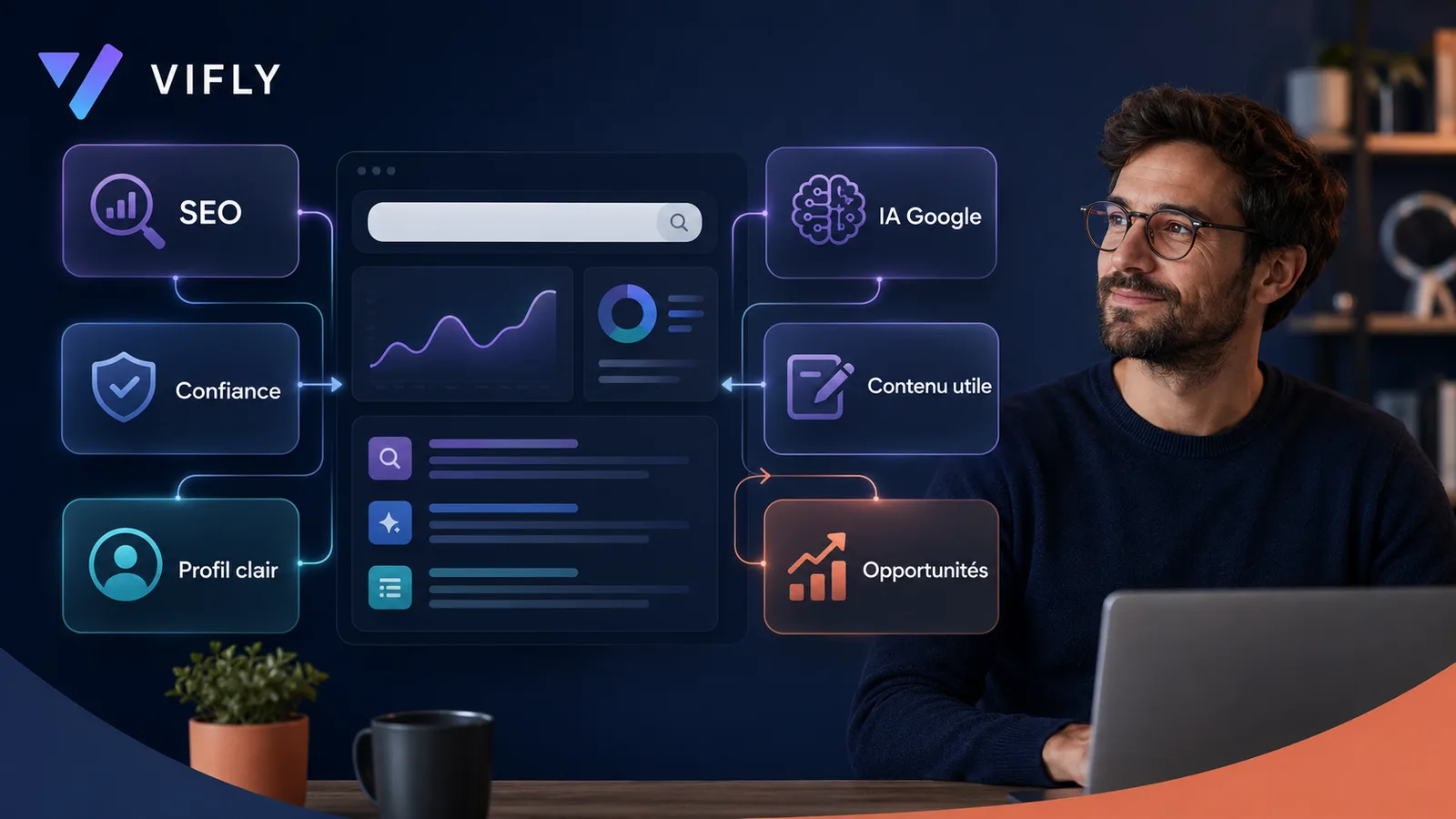
What Google actually announced in June 2026
The important announcement of June 2026 is not just .
The strongest signal for the SEO is that Google is beginning to give site owners more specific visibility of their presence in general search experiences.
In concrete terms, Google has announced new Search Generative AI reports in Search Console. These reports are designed to help sites understand how their pages appear in Google Search's IA features, including AI Overviews, AI Mode and the generative experiences in Discover.
This is an important change.
So far, many creators, media, publishers, bloggers and independents saw their traffic evolve without always understanding whether part of their visibility was captured, transformed or redistributed by IA responses.
With these new reports, Google sends a clear message: generative search becomes a visibility area to follow.
And what is measured often becomes strategic.
For a creator, this means that the SEO is no longer limited to being first on a query. We must also ask ourselves:
Is my content clear enough to be understood by a research AI?
Does my article bring real value or simply repeat what everyone says?
Does my page make you want to click even if Google already displays a partial answer?
Is my expertise visible enough to inspire confidence?
Does my content lead to a clear profile, offer, link or reservation?
This is exactly where creators must change their way of thinking.
Real change: Google understands intentions better, not just keywords
Many SEO strategies used to rely on very specific queries.
How to monetize Instagram
Best link in bio
How to attract customers with TikTok
How to create a coaching offer
How to improve your Instagram bio
These requests still exist.
But users no longer search only with short keywords. They ask questions longer, more natural, closer to their real problems.
For example:
I am a coach and I have a small Instagram audience, how do I find my first customers without being too commercial
Or:
I've got views of my Reels but no one's keeping my calls, what's blocking
Or alternatively:
How do I make my profile more professional to attract brands or customers
With the AI in search, Google can better interpret these complex requests. It can also explore several sub-questions at the same time: profile, offer, credibility, bio link, social proof, CTA, reservation, type of content, commercial intent.
In other words, Google no longer only looks at whether a page contains the right words.
He's trying to figure out if this page really answers the problem.
This is great news for serious creators. But this is bad news for generic content.
Generic content will become even more invisible
The average content is already struggling to exist. With AI, it may have even less room.
Why?
Because if your article simply repeats tips that you find everywhere, Google can easily summarize them in a generated answer. User no longer necessarily needs to click.
An article entitled7 tips to succeed on Instagram, without an angle, without an example, without experience, without a method and without a concrete case becomes very fragile.
This type of content can be synthesized in a few lines.
On the other hand, content with real vision becomes much more interesting.
For example:
Why creators who make views do not always sell
How to turn a blurred Instagram profile into a clear path to an offer
Why a small, qualified audience can generate more opportunities than a large, passive audience
“Comment structurer son lien en bio pour guider vers une réservation”
These angles do not merely inform. They provide reading, nuance, position, pedagogy and practical utility.
This is exactly what creators should aim for today.
If you want to deepen this logic, you can read the article VIFLY on the SEO of social networks and how to be found, not only visible. It complements this evolution very well: your content should no longer only attract attention, they must also respond to an intention.
SEO becomes a confidence problem
SEO has long been treated as a technical subject.
Tags. Keywords. Links. Structure. Speed. Indexation.
All this remains important.
But for a creator or an independent, the real subject also becomes trust.
When someone is looking for an answer on Google, they don't just want a well-optimized text. She wants to know if she can believe what she's reading.
And when she arrives on your website, blog, profile or creative space, she unconsciously asks several questions:
Does this person really understand my problem?
Does she have any real expertise?
Is his approach clear?
Does its content make me want to go further?
Can I trust him?
Do I know what to do next?
This is why SEO, personal branding and conversion are increasingly linked.
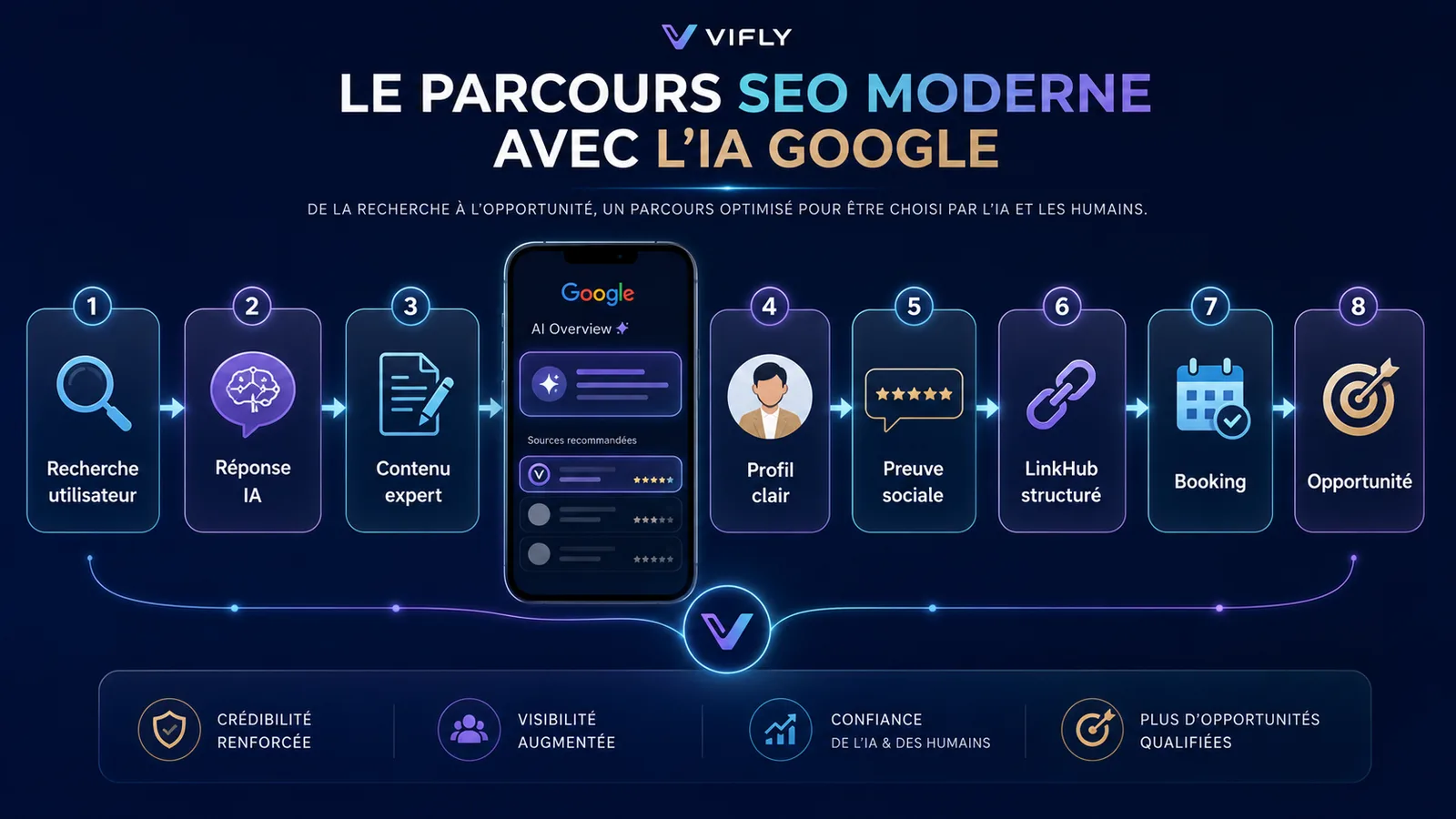
An article can attract. But your profile must reassure. Your bond must guide. Your offer must be visible. Your Booking needs to simplify the action.
Otherwise, you can win an impression, maybe even a click... but lose opportunity.
VIFLY starts from this logic: the content attracts attention, but a clear path turns this attention into customers, reservations or opportunities. You can use VIFLY LinkHub to structure your links, offers and calls to action, and VIFLY Booking to facilitate online bookings.
What it changes for content creators
For a content creator, this evolution imposes one thing: stop creating only to publish.
Creating more is not enough anymore. We have to create better.
This does not mean producing perfect content. This means producing content that is more useful, clearer and anchored in real expertise.
A creator talking about nutrition should not only write balanced eating.
He must explain the concrete mistakes of his audience, the frequent situations, false beliefs, psychological blockages, examples of meals, simple choices, the limits of his approach and the next steps.
A business coach must not only say .
It must show what makes an offer confusing, how to reformulate it, how to present it in a bio, how to link it to a bio link, how to avoid going back and forth in DM, how to propose a discovery call.
A trainer should not only publish .
It must structure a method, show progress errors, give examples, propose exercises, illustrate with visuals, create a FAQ, explain realistic results.
It is this type of content that becomes more difficult to replace with a simple automatic response.
Because it's not just informative. He's incarnate.
What it changes for coaches, consultants and independents
For professionals selling a service, change is even more important.
Why?
Because your content isn't just meant to be read. He must create a desire to work with you.
When someone discovers your article via Google, an IA response, an extract, a LinkedIn post or a Reel, they must quickly understand:
what you do; who you help; what a problem you solve; what transformation you propose; why your approach is different; how to go further with you.
If these elements are not visible, you can lose requests without even knowing it.
A consultant can publish a very good article on digital strategy, but if his offer is not visible, the reader will go back.
A therapist can write a very reassuring content, but if the appointment is complicated, the person hesitates.
A trainer can attract traffic on a very useful guide, but if no route leads to a resource, program or reservation, attention remains unanswered.
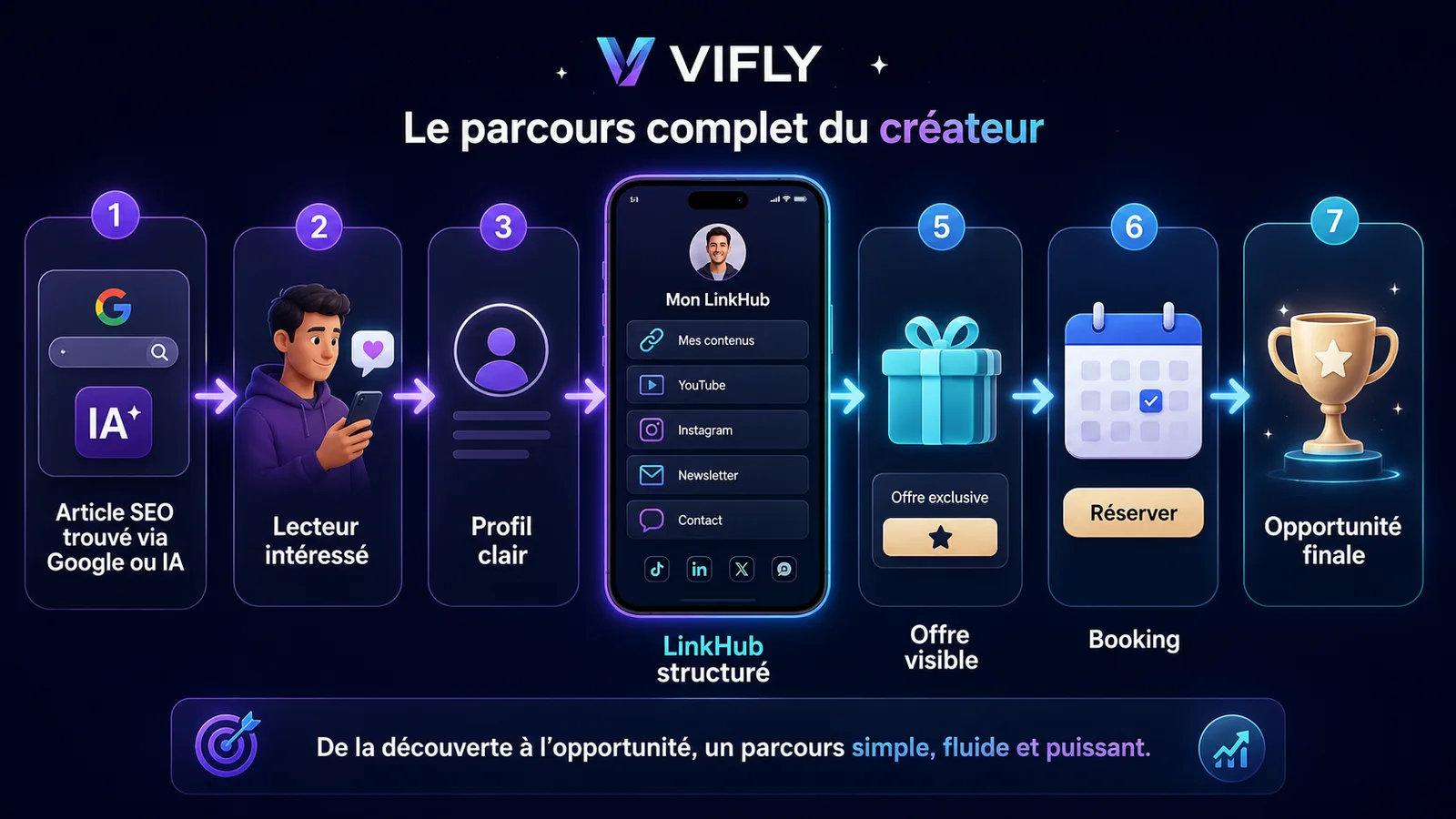
That's where the structure counts. Good content attracts. A good profile clarifies. A social proof reassures. A LinkHub guide. A Booking turns intent into action.
Article VIFLY on errors of an unprofessional creative profile is very useful at this level, because the SEO can bring someone to you, but your image often determines if it remains.
New rules for SEO content ready for AI
We must not fall into the trap of the IA.
The subject is not to create a magic file for robots or to cut all your texts into artificial mini-blocks.
The real subject is simpler, but more demanding: creating a page that really helps someone.
This is what this implies.
1. From a real problem, not an isolated keyword
A keyword is a front door.
But the real problem is what gives value to the article.
For example, Google's IA is a keyword.
But perhaps the real problem of the reader is:
Are my items going to lose traffic
Do I need to change my content strategy
Do my Reels, posts and blog need to be linked
How do you want to click if Google already summarizes the answer
A good article must answer these fears and concrete questions.
2. Add a clear perspective
Content without a point of view looks like everyone else. He informs, but he doesn't score.
For a creator, the point of view can come from your experience, your approach, your method, your mistakes, your clients, your observations, your way of explaining.
Example:
Instead of writing, you need to optimize your content for the SEO
Instead, write: "The SEO is no longer only used to attract traffic. It serves to prove to your audience that you are a reliable source even before she contacts you
It's stronger. Because it has an idea.
3. Structure the article as a journey
A reader should not get lost in your content. He has to move on.
A good structure can follow this logic:
Problem; awareness; explanation; examples; method; mistakes to avoid; practical implementation; Next step.
It's also better for the user experience.
And if your article is clear to a human, it is much more likely to be properly understood by research systems.
4. Use concrete examples
The examples make your content more difficult to replace.
A generic advice can be summarized. A specific example gives substance.
For example:
Improving your bio-link is vague.
“Place ton offre principale en premier, ajoute une phrase qui explique le résultat, puis propose un bouton clair comme ‘Réserver un appel découverte’” est beaucoup plus utile.
This is also what VIFLY defends in the article on how to build a clear offer when you are independent. An offer doesn't need to be complicated. It must first be understandable.
5. Add useful visuals
Visuals must not only decorate. They have to explain.
A diagram can make an idea more memorable than a long paragraph.
For an article on Google AI and SEO, useful visuals can show:
the transition from conventional to generic research;
the course content → confidence → action ;
the difference between generic and expert content;
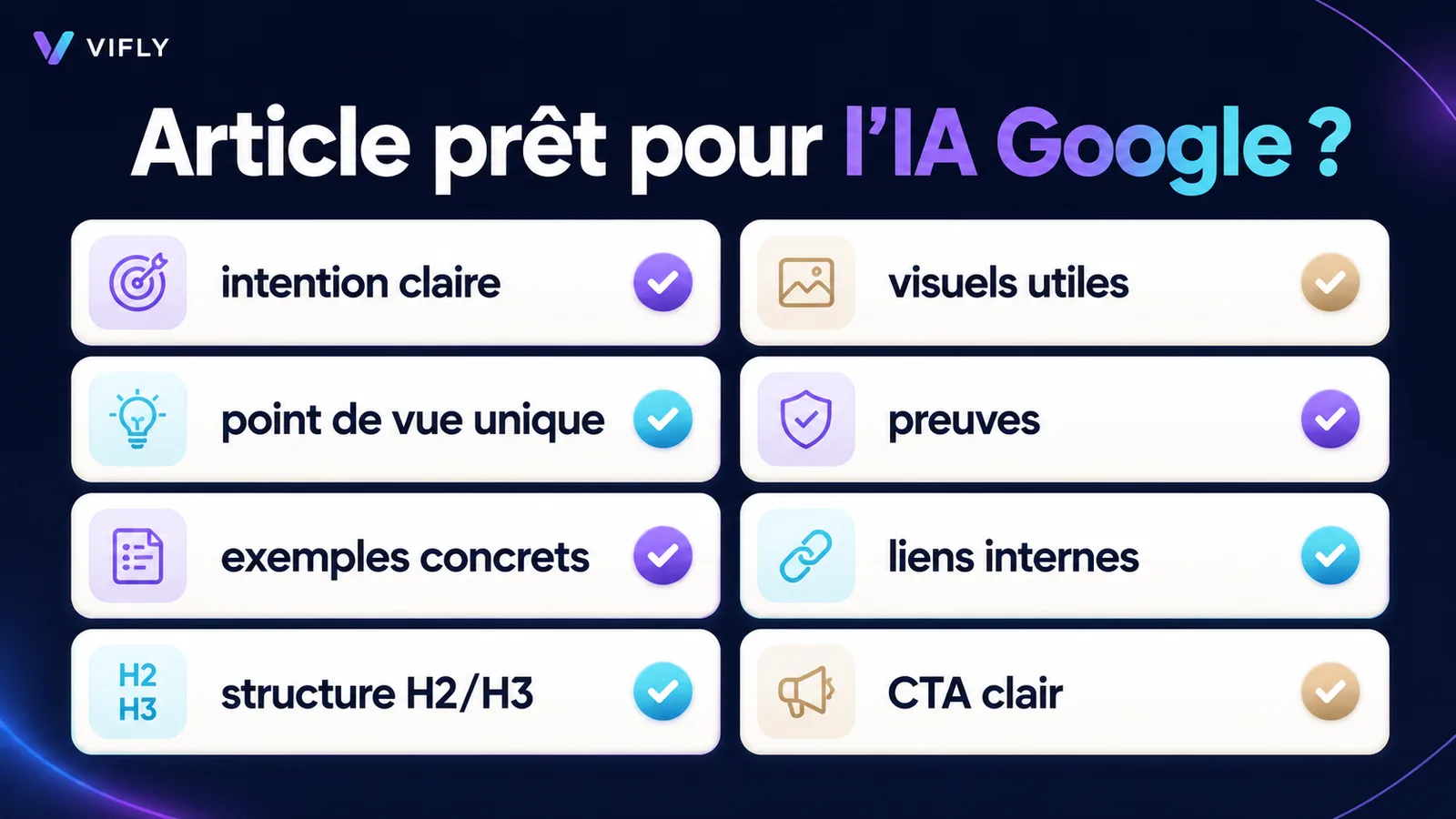
the checklist of an article ready for AI;
the role of profile, LinkHub and Booking in conversion.
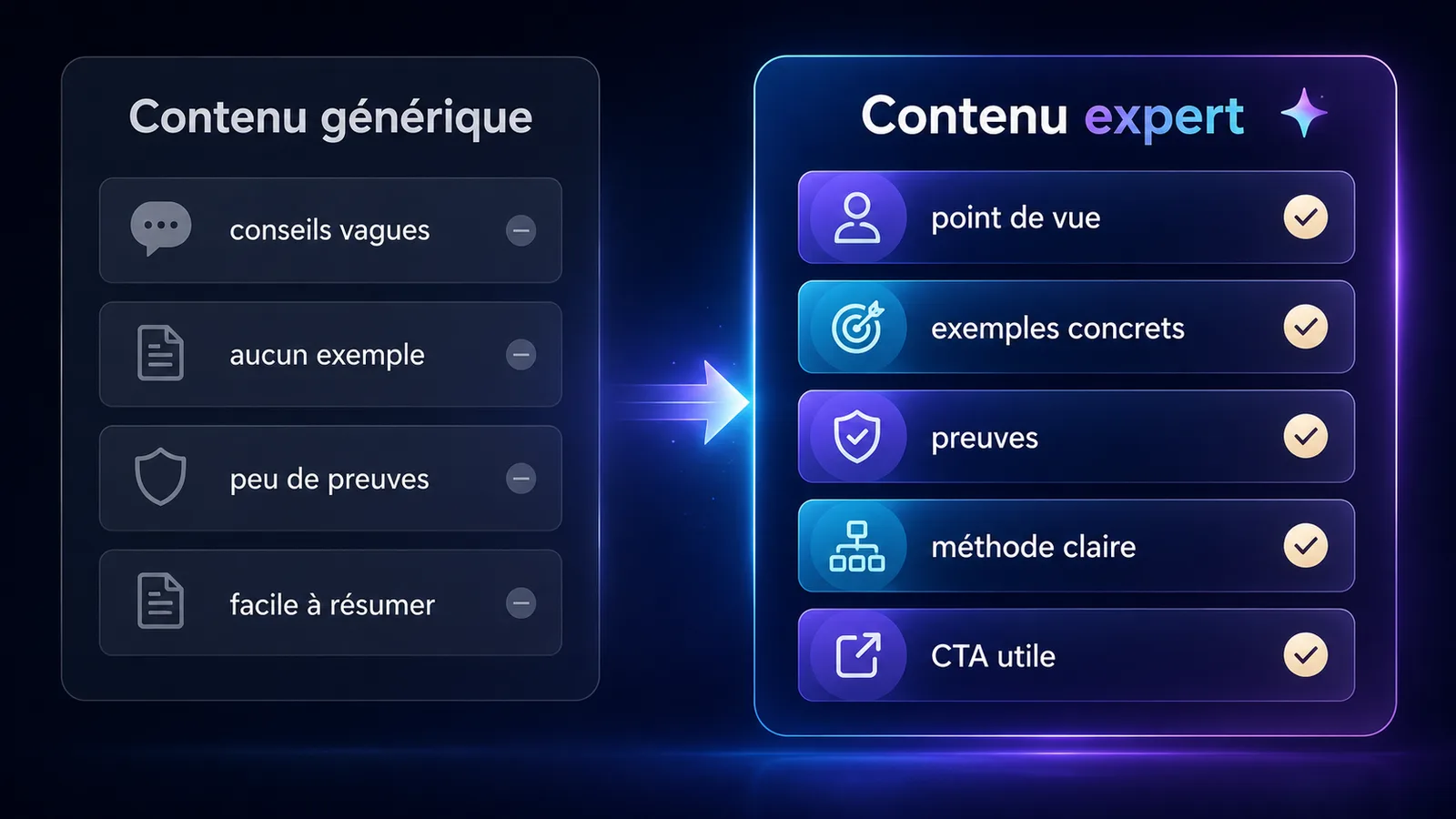
What the Google AI changes in content creation
Content creation will have to become more intentional.
Before, some creators could separate their channels:
a Reel for Instagram; a post for LinkedIn; an article for Google; a bio to convert; a bio link to group; a separate booking schedule.
But today, everything is connected.
A person can discover you on Google, check you on Instagram, read your article, click on your LinkHub, look at your evidence, and then book a call.
Or the other way around.
She can see a Reel, look for your name on Google, fall on your blog, compare your offer, then go back to your profile.
Content is no longer a series of isolated publications. It's an ecosystem. And in an ecosystem, each element must play its part.
Short content attracts. The article goes further. Bio clarifies. The LinkHub organizes. The offer gives a reason to act. Booking reduces friction. The evidence reassures.
If one of these elements is blurred, you lose part of the value created by others.
This is why it becomes essential to structure its link in bio with VIFLY LinkHub, especially if you publish on multiple platforms and your audience doesn't always know where to click.
What you need to change right now in your SEO strategy
You don't need to do it again. But you have to adjust the way you produce.
Audit your existing articles
Look at your content and ask yourself these questions:
Does this article answer a real question from my audience?
Does he bring anything other than a generic summary?
Does it contain concrete examples?
Does he show my point of view?
Is it well structured with clear H2 and H3?
Does it contain useful visuals?
Does it lead to logical action?
Does he want to trust me?
If the answer is no, the article is not necessarily bad. But it's probably incomplete.
Turn your short content into deep content
A viral Reel can become an article. A frequent comment can become a FAQ. A DM question can become a guide. A customer objection may become an H2.
A common error can become a checklist. A carousel can become a schematic.
It's a great way to create SEO content really aligned with your audience.
And it has an advantage: you don't leave abstract keywords. You're leaving real trouble.
Build Pillar Pages
A pillar page is a central content that addresses an important topic in depth.
For example:
How to turn your audience into clients
How to create a clear offer when you're independent
How to optimize your Instagram profile to inspire trust
How to structure a link in professional bio
How to receive online reservations when you're a coach or consultant
These pages can then be linked to more focused articles.
It's exactly the kind of strategy that strengthens your editorial authority.
The VIFLY blog has already started this work with articles like Micro-influencer: monetizing a small audience, Understanding social media and web algorithms and SEO social networks: being found and chosen.
Add a real logical suite after each article
An article must not end in a vacuum. At the end, the reader must know what to do. Not necessarily buying right away. But move on.
This can be:
read a supplementary article; discover a method; download a resource; visit your LinkHub; book a call; compare your offers; sign up for your newsletter; Follow you on a social network.
If you offer accompaniments, audits, sessions or calls discovered, think about facilitate online reservations with VIFLY Booking. The simpler the transition to action, the less motivated you lose.
The trap: believe that the AI will replace the SEO
No, SEO isn't dead. But the mechanical SEO is losing value.
The SEO which consists of stacking keywords, reformulating already existing articles and producing pages without personality becomes increasingly fragile.
On the other hand, useful SEO becomes more important. Because a search engine, even assisted by IA, still needs sources.
It needs reliable, accessible, organized, understandable and updated content. The problem is that not all sources will have the same value.
The most useful content will be those that bring:
real experience; identifiable expertise; a clear structure; concrete answers; examples; evidence; visuals; a human intention; a real utility after the click.
That's where creators have a card to play. Because they can embody their content.
They can talk from the field. They can show their methods. They can answer the real questions of their audience. They can build a relationship, not just publish information.
How VIFLY integrates into this new SEO
The AI changes how people find information. But it does not remove the need for trust.
It does not remove the need for clarity. It does not remove the need for a simple route.
On the contrary.
The more attention becomes difficult to capture, the more valuable each click becomes.
If someone arrives on your profile or website after a Google search, article, Reel or recommendation, you need to help them quickly understand what you are proposing.
VIFLY can help structure this often neglected part.
With VIFLY LinkHub, you can organize your links, content, resources, offers and calls to action in a clearer space than just a list of links.
With VIFLY Booking, you can present your services and allow your audience to book a call, session, audit or accompaniment more easily.
And with VIFLY, you can build a more coherent digital presence around your creator business.
The goal is not to replace your content. The aim is to give him a follow-up.
Because the content attracts attention. But it is your journey that turns this attention into an opportunity.
Conclusion: Tomorrow, the average content will be summarized. Useful content will be sought.
Google's announcement in June 2026 should not be seen as mere technical novelty.
It's a signal.
Research becomes smarter, more synthetic, more conversational and more demanding.
For creators, coaches, consultants, independents, trainers and entrepreneurs, this means one thing: it is no longer enough to publish to exist.
We must become a source. A clear source. A useful source. A credible source. A source that really helps.
And above all, a source that does not let attention get lost.
Because tomorrow's SEO will not only play in Google. It will also play after the click!
In your bio. In your profile. In your bond. In your offer. In your Booking. In the clear path you propose to your audience.
Content attracts. Trust holds back. The structure is changing.
And in a world where AI can sum up many things, which will remain the most valuable, that's what your audience cannot find everywhere: your angle, your expertise, your universe, your method and your ability to guide towards real action.
Create a clearer course with VIFLY
You want your content not only to be seen, but to create concrete opportunities?
Discover VIFLY, structure your bio link, present your offers and facilitate bookings.
Start here: create your VIFLY space
Frequently Asked Questions
Is Google going to kill SEO?
No. SEO remains important, but it is evolving. Generic, repetitive and useful content may be less different. The expert content, clear, useful, structured and based on real experience keeps value.
What did Google announce in June 2026?
Google has announced new Search Generative AI reports in Search Console to help site owners track their visibility in Google Search's IA features, such as AI Overviews, AI Mode and some generative experiences in Discover.
Do you have to write differently to appear in IA responses?
You should not write only for AI. Above all, it is necessary to write for humans: to respond clearly to an intention, to bring true value, to structure content, to add examples, useful visuals and identifiable expertise.
Do creators still have to have a blog?
Yes, especially if they sell expertise, services, accompaniments or resources. A blog allows us to deepen topics, strengthen credibility, be found on Google and create a more solid path between content, trust and conversion.
How can VIFLY help after the SEO click?
VIFLY helps turn attention into action with a clearer profile, a structured LinkHub, visible offers and a reservation solution. The goal is to avoid interested visitors leaving without understanding what to do next.