What platforms really want to understand when you publish
There is a sentence that many creators repeat when a content does not work:
Sometimes it's true. But it's often incomplete.
Because an algorithm is not a person sitting behind a screen to decide who deserves to be seen. It's a system that observes signals, compares behaviors, interprets content and tries to answer a simple question: Who can this content bring value to now
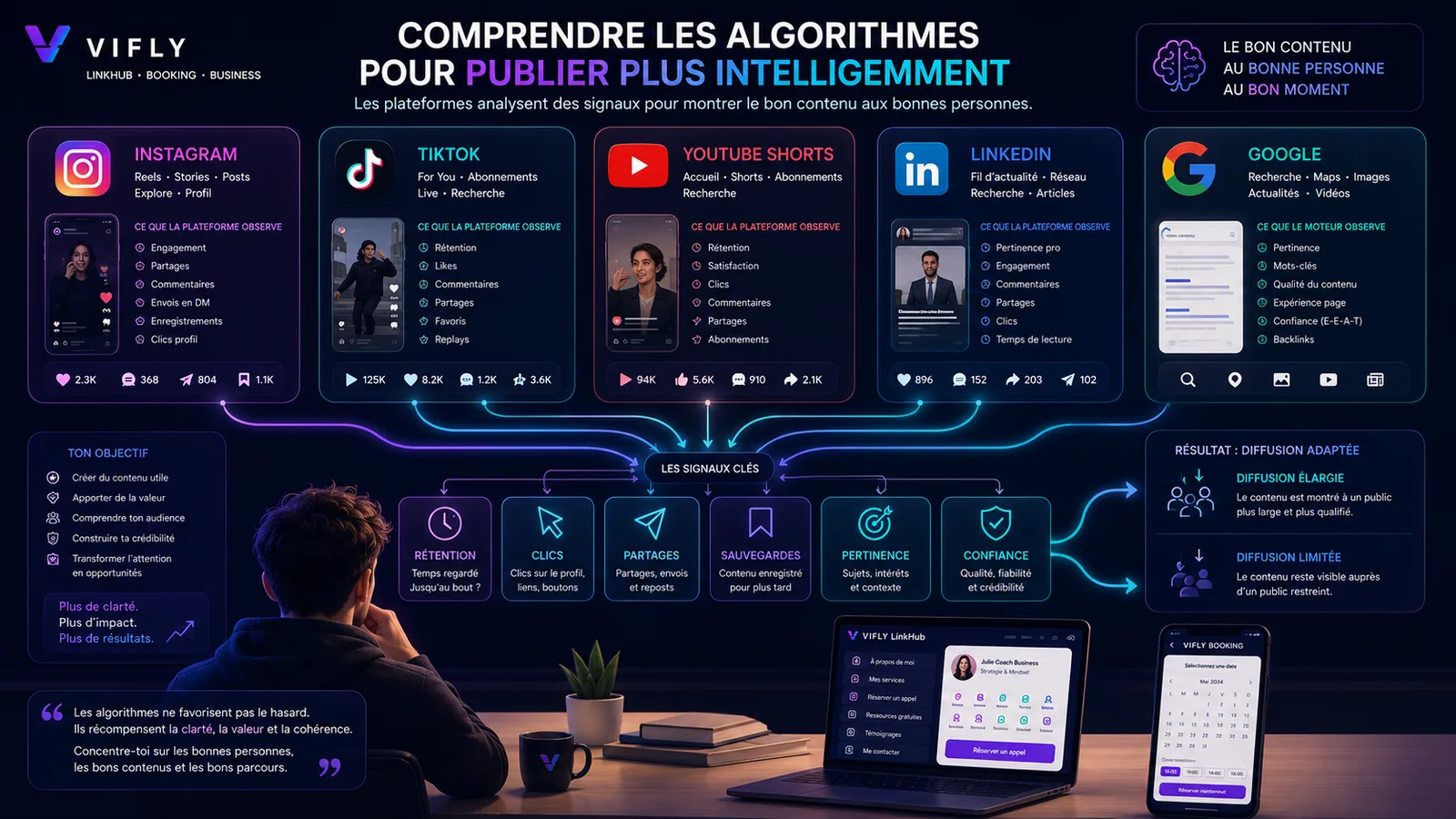
On Instagram, TikTok, YouTube Shorts, LinkedIn or Google, the logic is not exactly the same. But the principle remains close: a platform wants to show the right content to the right person, at the right time, in the right context.
And that's where many creators are wrong.
They're looking for an algorithmary, while they should learn to be clearer for humans and more understandable for platforms.
A content that works is not only a content that is a good, inspiring or timely content. It is a content that the platform manages to classify, test, understand and recommend to people who can pay attention to it.
So the real question isn't: How to hack the algorithm
The real question is: How to create content that is clear, useful and engaging so that platforms understand who to show it to
That's exactly what this article will help understand.
What exactly is a recommendation algorithm?
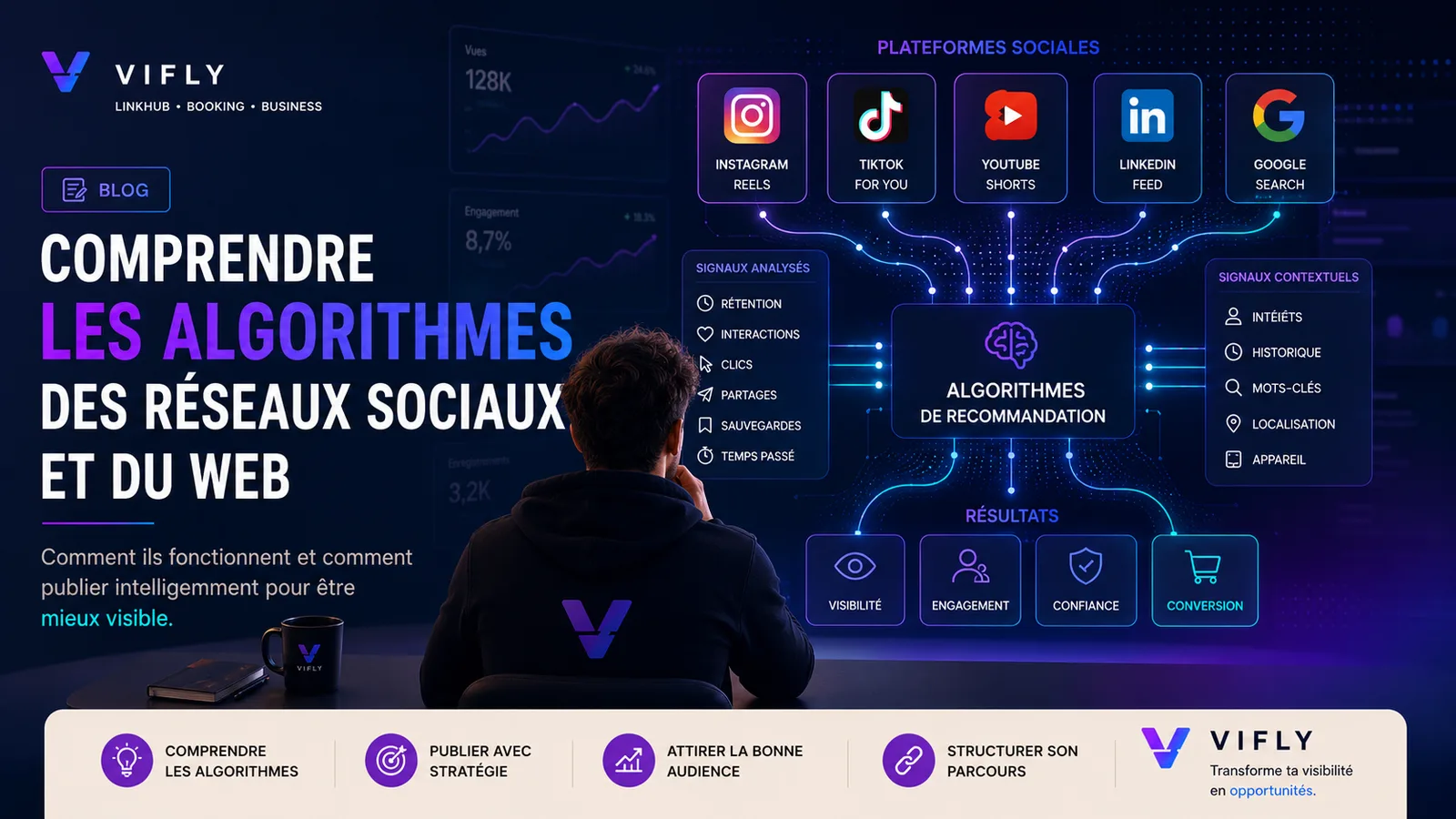
A recommendation algorithm is a system that chooses which content to show to which users.
When you open TikTok, Instagram Reels or YouTube Shorts, you don't just see the latest videos published in order. You see a selection. This selection is tailored to your behaviours, interests, interactions and sometimes your history.
If you often watch digital marketing videos to the end, if you save carousels on the personal branding, if you comment on entrepreneurial posts, if you ignore certain topics, the platforms gradually learn what seems to be interesting.
They don't read your mind. They interpret signals.
It's a big difference.
An algorithm was not that a content is good as a human feels it. Rather, he observes clues: do people stop? How long are they watching? Do they share? Are they coming back? Do they click? Do they interact? Does the content seem to correspond to a theme, intent, behavior or focus of interest?
On social networks, the algorithm mainly tries to predict interest. On Google, he tries to respond to a search intent. On YouTube, he tries to recommend videos that can be watched and rated satisfactory. On LinkedIn, he also seeks to maintain professional relevance.
The common point is that platforms want to avoid showing content at random.
They want to organize attention.
Social network, search engine, web browser: three different things
Many people mix everything: Instagram, Google, Chrome, TikTok, YouTube, browser, search engine, algorithm.
To publish intelligently, we must first distinguish roles.
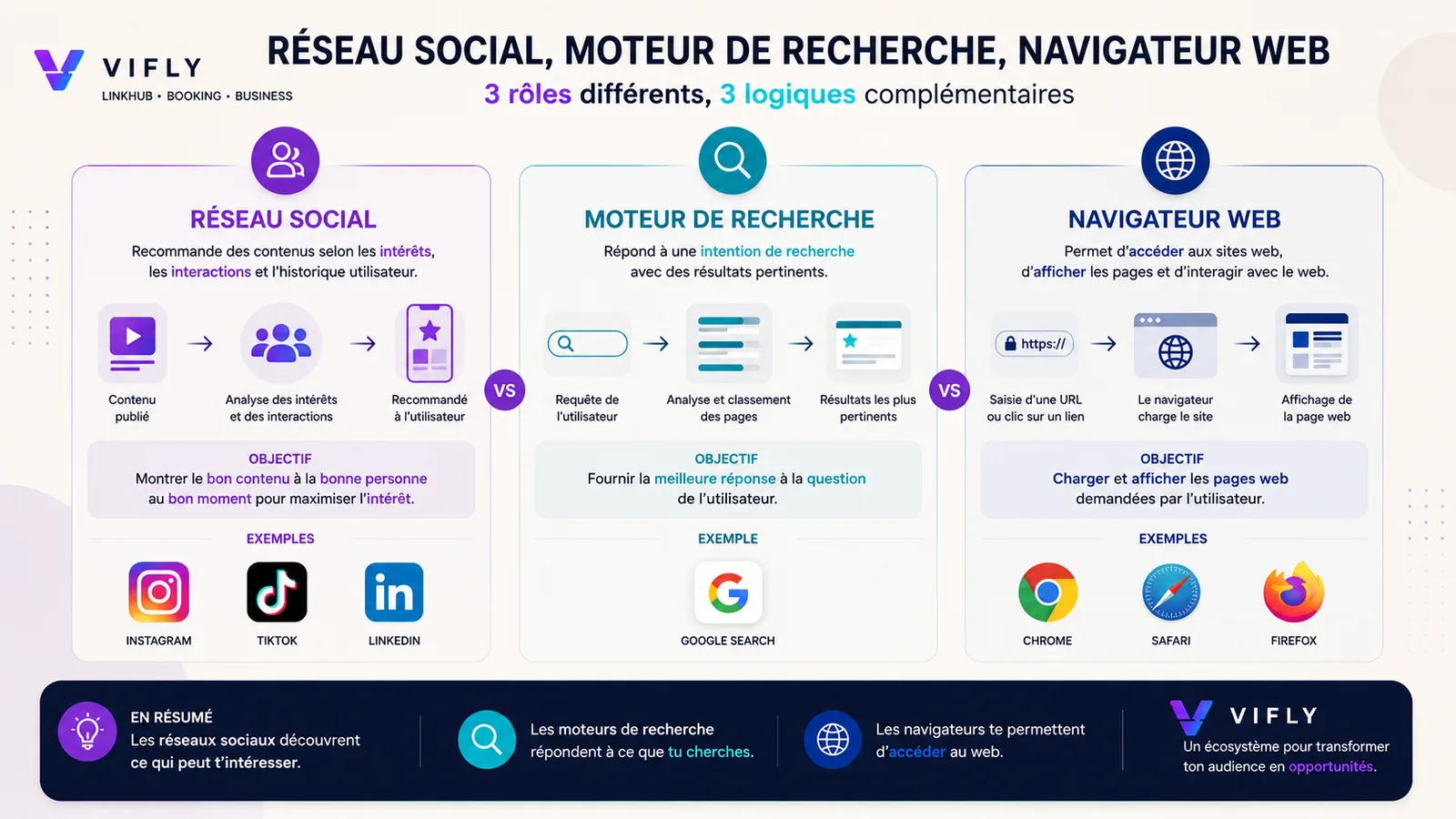
A social network is a platform where content circulates in a social or community environment. Instagram, TikTok, LinkedIn or Facebook analyze user behaviors to recommend content, highlight certain publications, rank comments, organize news feeds and customize the experience.
A search engine, such as Google Search, is used to answer a query. The user expresses an intention: how does the Instagram algorithm work, the best time to publish on TikTok, the link tool in bio-creator. The engine then looks for the most relevant, useful and reliable pages to meet this intent.
A web browser, such as Chrome, Safari, Firefox or Edge, is the software that allows access to sites. It is not he who decides alone whether to rank your article in Google or the visibility of a Reel. It serves as a gateway to view pages, view content, run JavaScript and navigate the Internet.
Why does this difference matter?
Because you don't publish the same way for a recommendation platform, a search engine or a web page.
On TikTok or Instagram, you need to catch up quickly and keep your attention. On YouTube, you also need to work on title, miniature, topic and satisfaction. On LinkedIn, you have to create a professional relevance. On Google, you must respond deeply to a search intention with a clear, well structured and indexable page.
On your site or blog, you also need to think about how Google can explore, understand and classify your content.
A creator who understands this difference stops posting everywhere with the same logic.
It adapts its content to the place where it wants to be discovered.
Why some publications are seen and others remain invisible
When a publication does not take off, many creators immediately think of an algorithmic problem.
But you have to look at it more broadly.
Content may remain invisible for several reasons. It can be too blurry. Too long to start. Badly formulated. Not clear enough for the target. Not engaging enough in the first seconds. Too generic. Too close to what everyone is already publishing. Badly positioned. Unshareable. Or simply published in a format that does not match the platform.
Visibility rarely comes from a single factor.
On a Reel or Short, the platform can observe if people stay, leave, see, share or interact. On a post LinkedIn, she can observe professional relevance, interactions, conversation, relationship between people. On Google, she will analyze the page, its content, its subject, its quality, its indexing, its links, its relevance to a search.
The problem is that many creators create content as if they were talking to everyone.
Too general a content is difficult to recommend precisely.
For example, saying "believe in you" can touch emotionally, but it's too wide. Saying if you're a coach and your audience likes your posts but never reserves, this may be the problem of giving context, target, pain and promise.
The algorithm understands better. Human too.
Visible content is often a content that quickly gives clear signals: clear subject, identifiable target, immediate interest, retention, reaction, coherence with a universe.
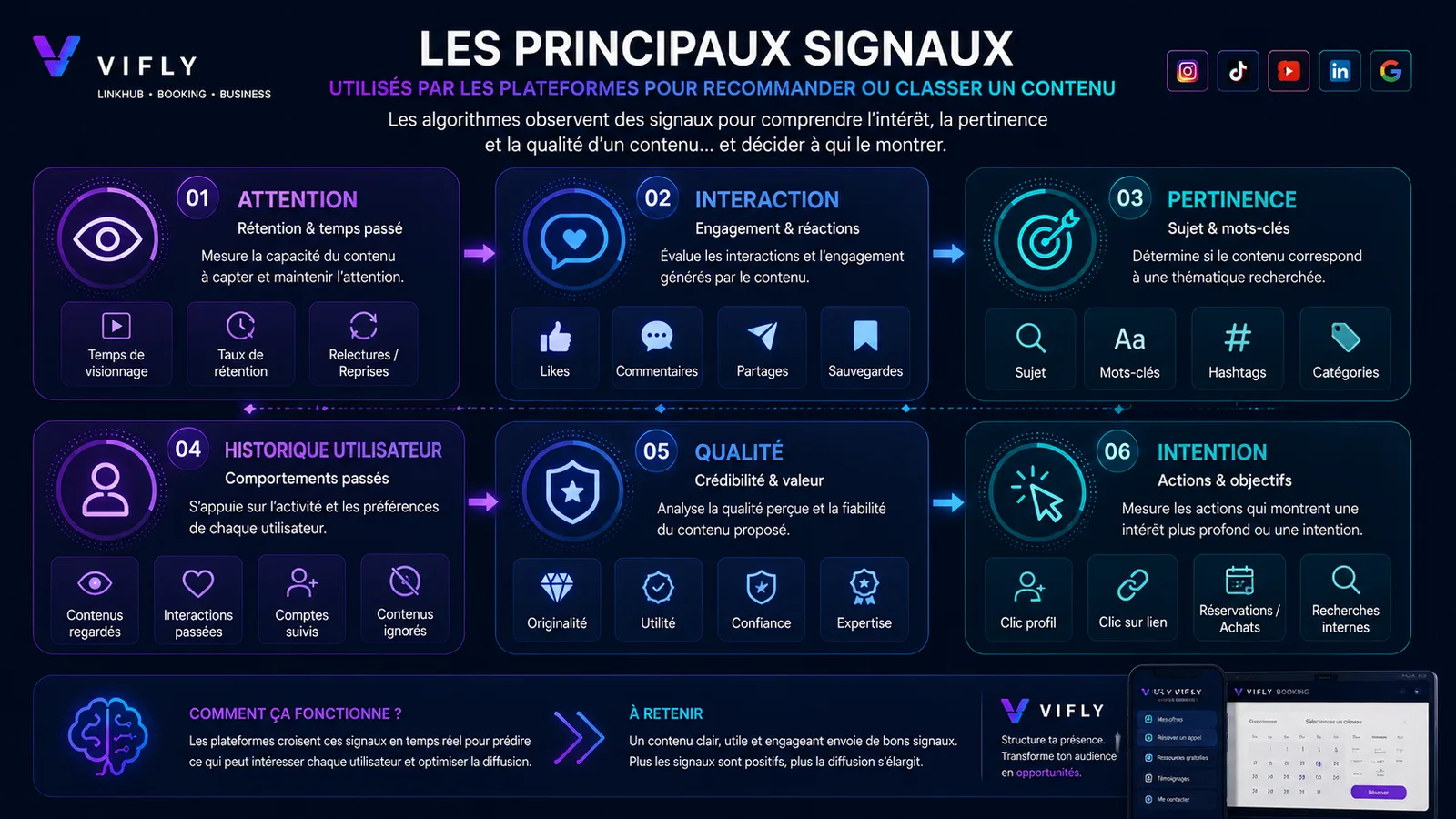
The signals that platforms really observe
Platforms do not reveal an exact formula, and we must be wary of the content that claims to know the secret of the algorithm.
On the other hand, the major types of signals are known.
There are first the signs of attention: do people stop? Are they watching? How long do they stay? Do they come back at first? Do they finish the video?
Then there are the interaction signals: likes, comments, shares, backups, replies, subscriptions, clicks, messages, reactions.
There are also signals of relevance: content subject, words used, hashtags, description, title, audio, image, category, behaviour of people who interact with this content.
There are the signs of user history: what the person looks at, ignores, searches, loves, shares, comments or follows.
And there are signals of quality or satisfaction: does the content seem useful, reliable, original, consistent, non-deceptive, non-spammy, suitable for purpose?
For a creator, the conclusion is simple: you must not create only to provoke a quick reaction. It is necessary to create content that is clear enough to attract the right people, useful enough to retain them and credible enough to make you want to go further.
Because not all interactions have the same value.
A like can be light. Sharing often means that content deserves to be transmitted. A backup indicates that the person wants to come back. A qualified comment can show real involvement. A click to your profile or link may indicate a stronger intention.
If your goal is to turn your audience into customers, reservations or opportunities, you must not only look for views. You need to look for qualified signals of interest.
Instagram, TikTok, YouTube Shorts, LinkedIn, Google: same goal, different logics
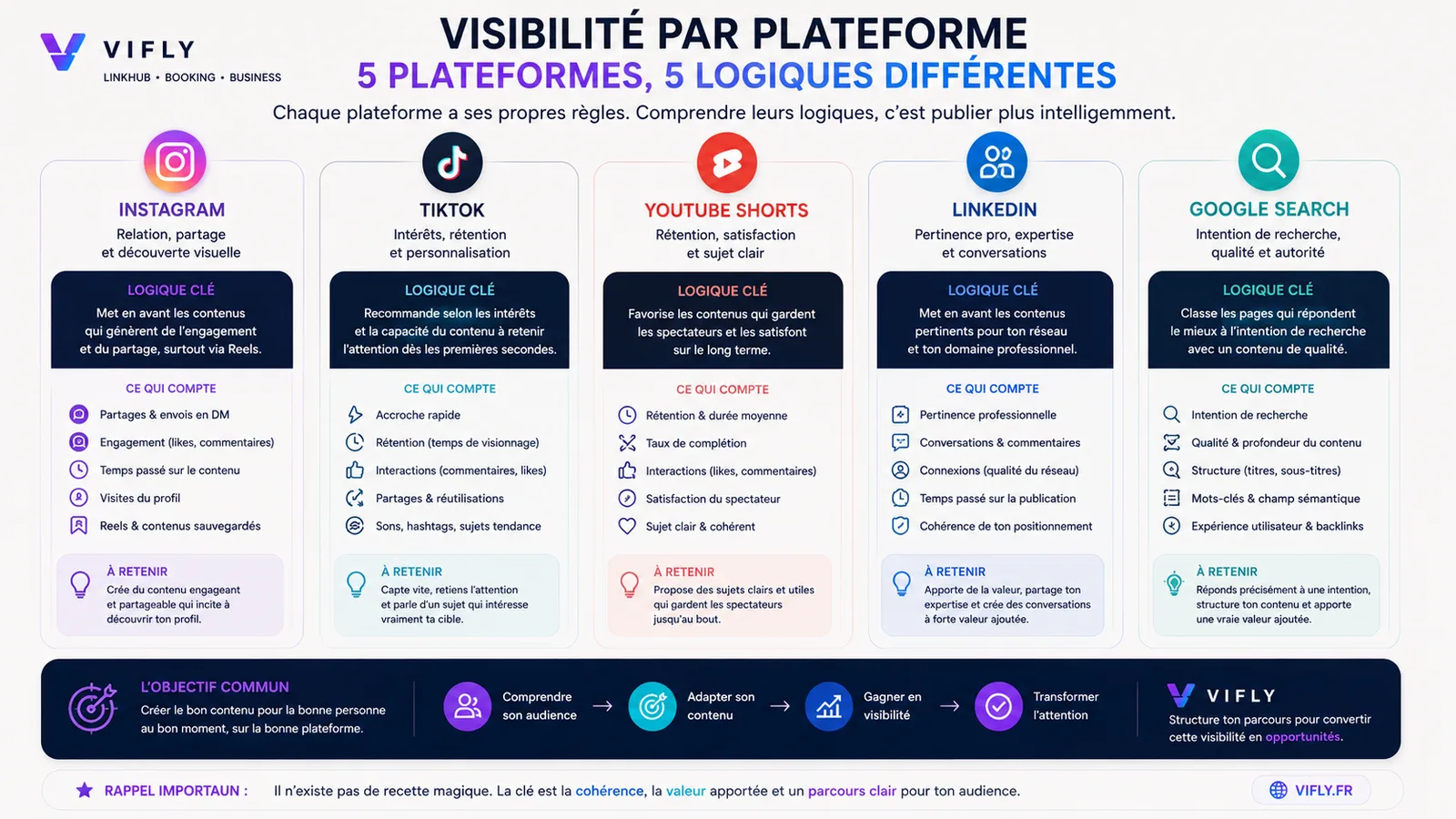
Instagram: relationship, interest and sharing
Instagram is no longer just a gallery of beautiful images. It is a space of recommendations, Reels, private messages, internal research and professional profiles.
For a creator, this means that the content must be clear quickly and shareable enough to circulate. A Reel can be seen by people who don't know you. A carousel can be saved. A publication can be sent in a private message. Your profile can become a mini-conversion page.
The trick would be to publish only for likes.
A creator who wants to attract opportunities must think of the following: what does the person understand after seeing the post? Does she click on the profile? Does she understand the offer? Does she find the connection? Can she book or contact you?
Instagram can bring attention. But your profile must turn that attention into trust.
TikTok: Quick interest and behavioral loop
TikTok is strongly associated with the custom recommendation. The user does not need to follow many accounts to receive a flow of content adapted to his interactions.
This means that the first seconds are decisive.
If your content starts too slowly, if the promise is blurred, if the hook does not speak to a clear pain, the user passes. And this behavior becomes a signal.
On TikTok, we often have to think in terms of immediate tension: a mistake, a question, a contradiction, a demonstration, a surprise, a problem that the target quickly recognizes.
But be careful: capturing attention does not mean making sensationalism.
A good TikTok content for a coach, consultant or business creator must quickly capture and then keep a useful promise. Otherwise you can get views without building trust.
YouTube Shorts: retention, satisfaction and clear topic
YouTube Shorts works in the YouTube ecosystem, where the topic, title, satisfaction and viewing behaviours matter a lot.
A Short must be understandable quickly. But it must also fit into a chain logic. If you publish Shorts on digital marketing, hooks, creative profiles, bio link and conversion, YouTube gradually understands your universe.
The goal is not only to make a viral video. The goal is to become identifiable.
A creator who constantly changes themes blurs understanding. A creator who repeats clear editorial pillars allows the platform and audience to better situate it.
LinkedIn: Professional relevance and credibility
LinkedIn is different. Content often circulates around a professional context: expertise, career, business, sector, network, opportunities, conversations.
A successful LinkedIn post is not necessarily the one that makes the most laugh or react. It is often the one that brings useful observation, a clear idea, a credible position or professional experience that others can comment on.
For VIFLY, LinkedIn is particularly interesting for consultants, freelancers, trainers, coaches and entrepreneurs who want to professionalize their digital presence.
On LinkedIn, the authority counts.
You have to show that you understand the problem, that you have a method, that you see common mistakes and that you can help structure the course.
Google: search intent, quality and structure
Google works differently.
When a person types a search, it expresses a need. She wants to understand, compare, solve, learn or find a solution.
A blog article must therefore respond deeply to this intention.
If someone is looking for how the Instagram algorithm works, they don't just want to read three tricks. He wants to understand. If someone is looking for how to publish on social networks to be visible, he wants principles, examples, a method, mistakes to avoid.
Google must be able to explore the page, index, understand its content and propose it when it corresponds to a query.
This involves clear titles, structured subtitles, complete content, examples, explanatory visuals, internal links, alternative text images and real added value.
That's why a well-built VIFLY blog can become a sustainable SEO asset, where a Reel can quickly disappear into the stream.
The path of post-publication content
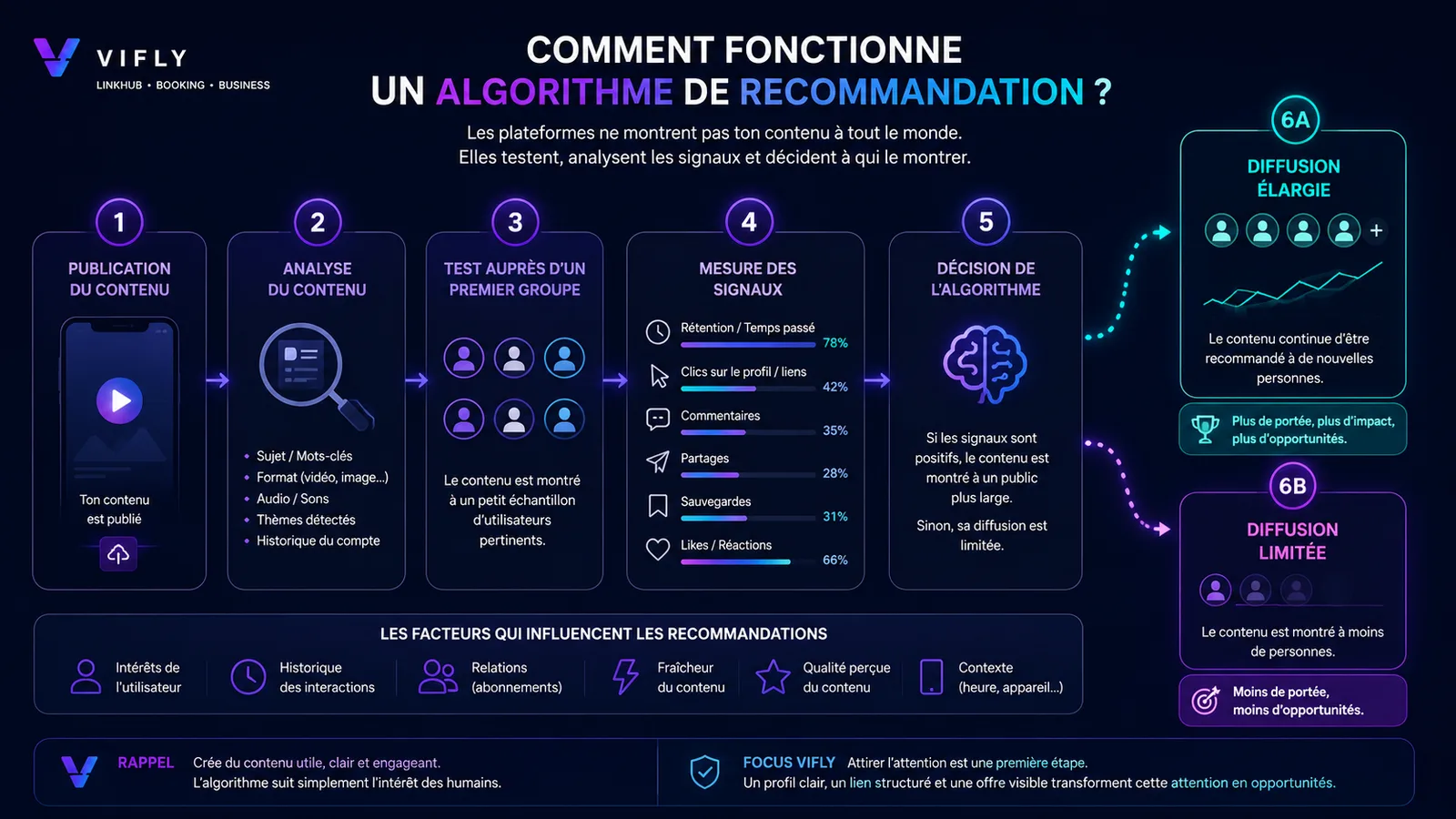
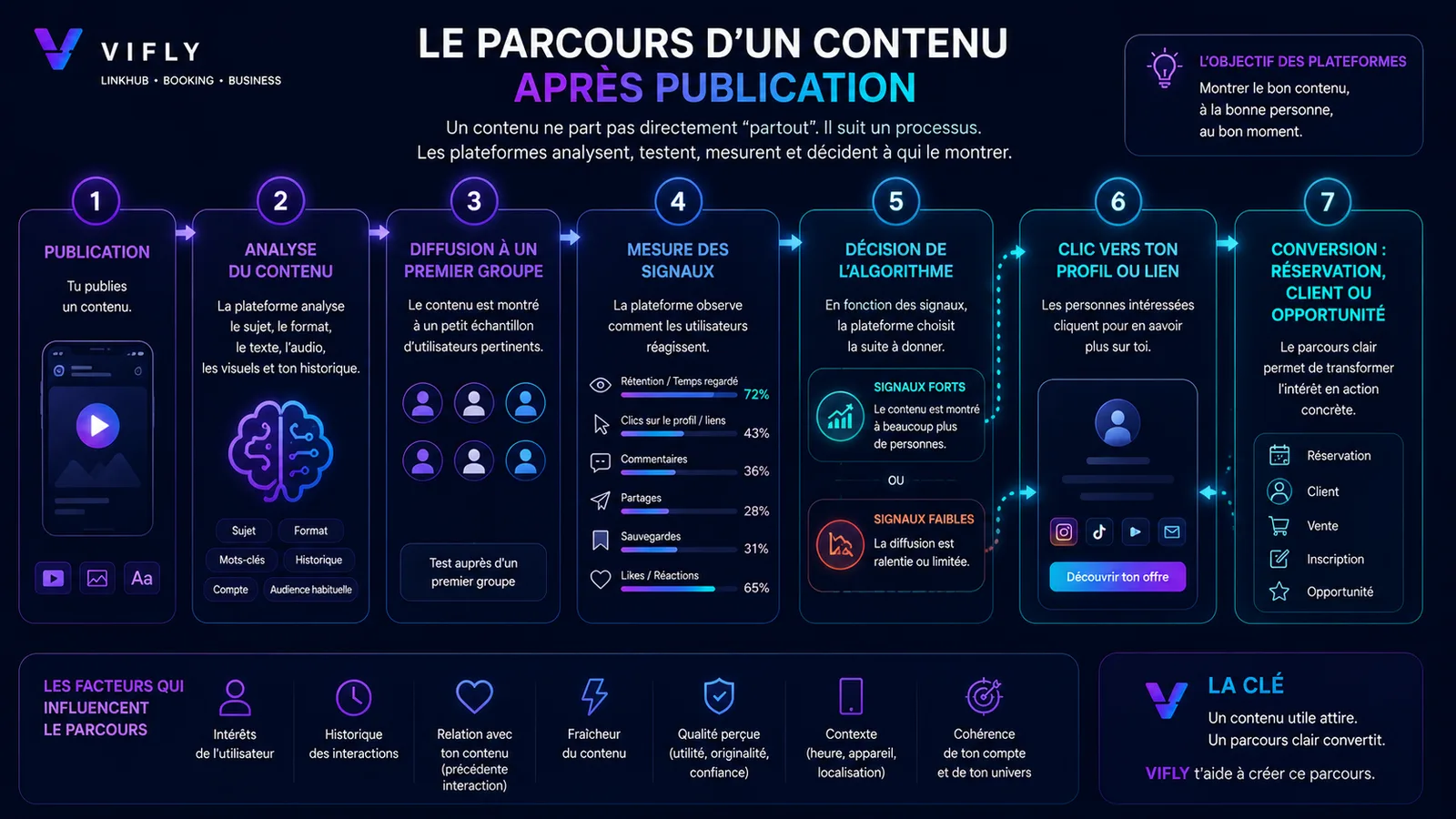
When you publish content, it doesn't go directly to everyone.
He's on a course.
First, the platform analyses the content: format, text, sound, image, theme, account that publishes, account history, usual audience, first signals.
Then she can show it to a first audience. This audience may consist of subscribers, people interested in similar content, or a small sample useful for testing the reaction.
Then the signals come: do people stop? Are they looking? Do they interact? Do they share? Are they saving? Do they click? Do they ignore? Do they pass quickly?
If the signals are good, the platform can expand the broadcast. If the signals are weak, it may limit the range.
It's not a perfect mechanical rule. But this logic makes it possible to understand one important thing: your content must succeed both in being understood by the platform and in triggering a human response.
This explains why the first seconds are so important in video. Why a clear title counts on YouTube. Why an accurate H1 counts in SEO. Why an introduction must quickly pose the problem. Why a bio must be readable. Why a bio link should guide.
Visibility is not just a matter of algorithm.
It is a question of clarity.
Posting more is not enough if the message is blurred
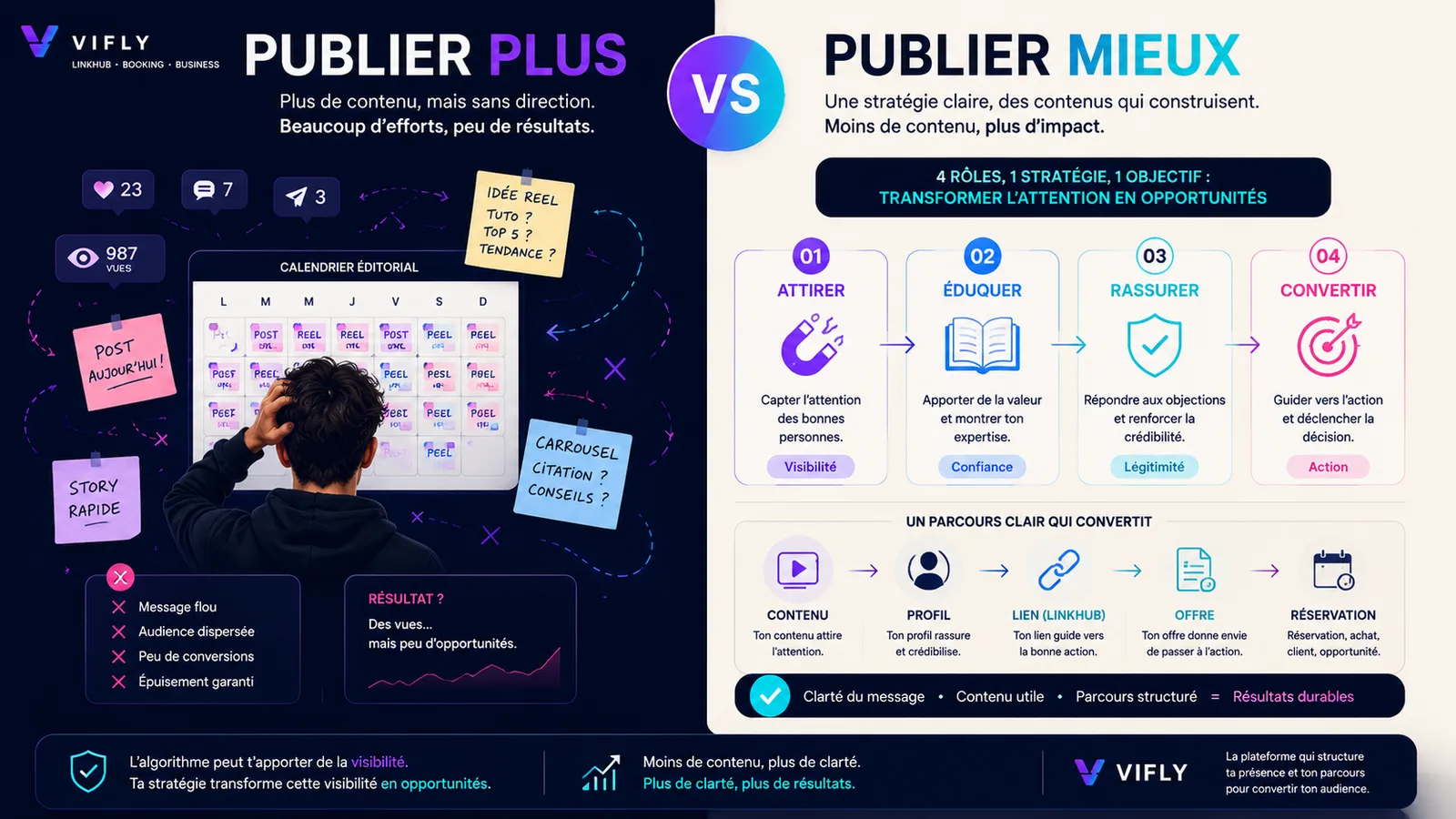
Many creators think the solution is to publish more.
More Reels. No more Shorts. No more posts. No more stories. No more carousels. More content.
But publishing more does not correct a blurred strategy.
If your message isn't clear, you're just gonna spread more confusion. If your profile doesn't reassure you, you're going to attract more visitors who leave. If your offer is invisible, you will increase the views without increasing the demands. If your bio link is poorly structured, you will lose people already interested.
Frequency is useful when it amplifies a clear strategy.
It becomes exhausting when it compensates for a lack of direction.
A creator who publishes three well-thought-out content a week can sometimes get more results than a creator who publishes every day without a course.
Why?
Because every content has a role.
Content can attract. Another can reassure. Another can explain an offer. Another may respond to an objection. Another can guide to a reservation. Another can create trust with evidence or behind the scenes.
The question is not how much do I publish
The question is, what is each content built
How to publish intelligently according to platforms
Publishing intelligently is not looking for a magic trick. It's making your content clearer, more useful and easier to recommend.
Start with a clear promise
Each content must answer a simple question: why should a person stop?
Here we go 3 marketing advice is weak.3 errors that prevent your profile from converting is stronger, because the promise is accurate, problem oriented and related to a result.
A good promise helps the user understand. It also helps the platform to classify content.
Work the first seconds
In short video, the first seconds often decide on the continuation. So you have to avoid soft startups: "Hi everybody," "little video fast," "today," we're going to talk about..
Start with the problem, the tension or the benefit.
For example:
Use the words of your target
Platforms analyze texts, titles, descriptions, legends, hashtags, subtitles and sometimes audio or visual content.
Most importantly, humans recognize their own problems in the right words.
A coach is not just looking for digital conversion. He may think, "Why don't my subscribers book?" A freelancer is not just looking for a sales tunnel. He thinks: How do I turn my views into customers
Your content must speak the real language of your target.
Creates content that deserves to be saved or shared
Safeguardable content is often practical: checklist, method, errors, examples, phrases to reuse, steps, templates.
Shareable content often touches a strong truth: "Likes don't make customers," "Published every day won't save a fuzzy strategy," "your content attracts," but your journey converts.
The ideal is to create useful and memorable content.
Build series
A series helps the audience come back. It also helps your account become identifiable.
Examples for VIFLY:
“Les erreurs qui coûtent des clients aux créateurs”
“1 minute pour améliorer ton profil”
The hooks to test this week
Digital decoding VIFLY
Your content attracts, but..
Before / After Creative Profile
A series gives a structure to your regularity.
Connects each content to a logical suite
Content should not always sell. But he must often guide.
If you're talking about a blurred profile, the logical sequel can be a blog article. If you're talking about a confounding bio bond, the next one may be VIFLY LinkHub. If you're talking about an appointment lost in DM, the next one may be VIFLY Booking. If you're talking about digital strategy, the next step can be your VIFLY space or a complete guide.
Without logical follow-up, you create attention without direction.
Visibility is worthless if the course behind is low
This is the point that many creators discover too late.
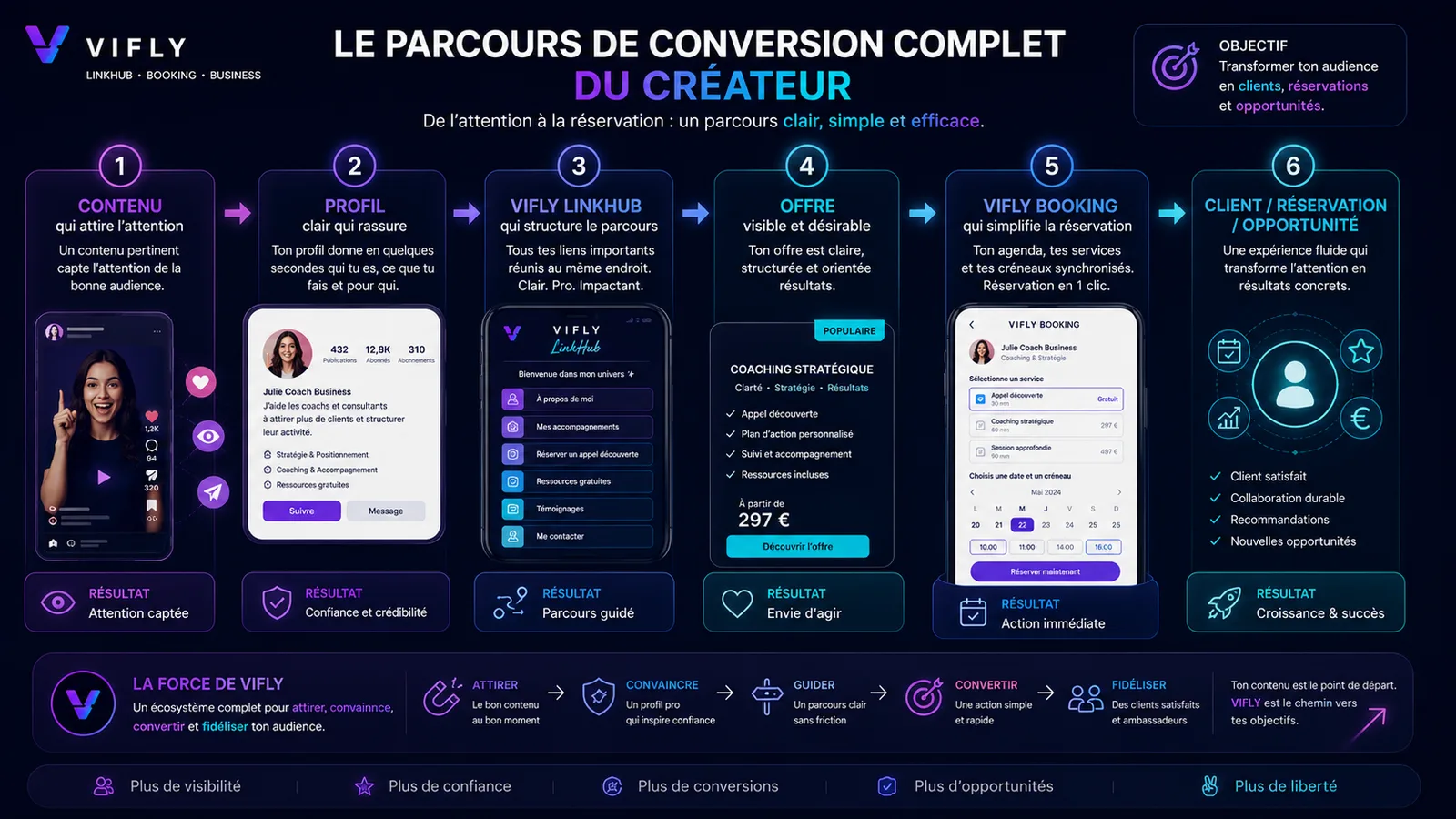
The algorithm can bring views. But it does not automatically turn these views into clients.
A person can see your Reel, like your idea, click on your profile, then go back if they don't understand what you're proposing. She may be interested, but quit if your bio bond is confused. She may want to book, but not find clear space to choose a niche. She can appreciate your content, but never buy because your offer is not visible.
This is exactly where the VIFLY strategy makes sense.
The content attracts attention. But a clear profile reassures. A structured link guide. A visible offer gives a reason to act. A simple reservation system turns an intention into concrete action.
With VIFLY LinkHub, you can centralize your links, highlight your offers, organize your resources and guide your audience towards the right actions. Your bio link is no longer only used to display links. It becomes a gateway to your activity.
With VIFLY Booking, you can offer more easily bookable calls, coaching, audits, sessions or services. Your audience no longer needs to send multiple messages to understand how to work with you.
This transforms fragile visibility into a career path.
VIFLY method to publish better
To publish intelligently, you can use a simple five-step method.
1. Clarify target
Before you create content, ask yourself who you're talking to.
Content for everyone, often ends up not really touching anyone. Content for coaches who have views but few reservations is much more precise. Content for independents who want to make their profile more professional will give a clear angle.
The more precise your target, the stronger your content can be.
2. Identify concrete pain
Good content often starts from a real problem.
Not an abstract theory. A living situation.
I publish but no one clicks
I have subscribers but few customers
My profile doesn't give enough confidence
I don't know what to put in my bio link
I lose requests in private messages
A clear pain creates a strong grip.
3. Give a useful answer
The content must bring something: an explanation, a method, a checklist, an error to correct, an example, a sentence to reuse, an awareness.
If the person goes back and says I understand better, your content has won.
4. Create an action signal
Strategic content must often invite something to do.
Not necessarily buy. But move on.
Read an article. Save post. Check his bio. Review its bio link. Book a call. Discover a resource. Structure his profile.
That's how attention becomes a movement.
5. Organize the course after the content
This is the part that many forget.
If someone clicks after your content, what do they find?
A clear profile? A visible offer? A structured link? A booking button? A useful resource? Professional space?
If you don't, your content works half.
To deepen this point, you can also read Views don't pay bills: how to turn your audience into clients, You don't need more subscribers, you need a better route and Does your Instagram bio make you lose customers?.
Key takeaways
Algorithms are not enemies. These are sorting systems.
They don't guarantee anything. They don't understand everything. They can be wrong. They're changing. They're testing. They're interpreting. But they generally seek to show relevant content to people who might find it interesting.
For a creator, the best answer is not to run after every rumor of algorithm.
The best answer is to build a clearer presence.
Content with a strong promise.
An understandable message.
An identifiable target.
A real value.
A reassuring profile.
A link in structured bio.
A visible offer.
A simple journey.
Because visibility is only a first step.
The real stake is what you do with that visibility.
An algorithm can help to be discovered. But it is your positioning, your clarity and your journey that make you want to stay, click, book or buy.
Conclusion: no longer publishes to feed the algorithm, publishes to be understood
To publish intelligently is not to publish for a machine.
It's creating content that humans quickly understand, that platforms can properly classify and that your journey can turn into an opportunity.
The creators who will advance will not only be those who publish the most. They will be those who better understand the role of each content.
A Reel can attract.
An article can educate.
A post LinkedIn can build authority.
A carousel can be saved.
A bio can reassure.
A LinkHub can guide.
A Booking can convert.
So the real strategy is not to beat the algorithm.
It is to create a digital presence so clear that the algorithm, your audience and your future clients all understand the same thing: who you are helping, why you are credible and how to take action.
If you want to structure your digital presence, centralize your links, present your offers and turn your audience into customers, reservations or opportunities, discover VIFLY.
Key points
A good strategy isn’t just about publishing more. It’s about guiding your audience towards a clear call to action.