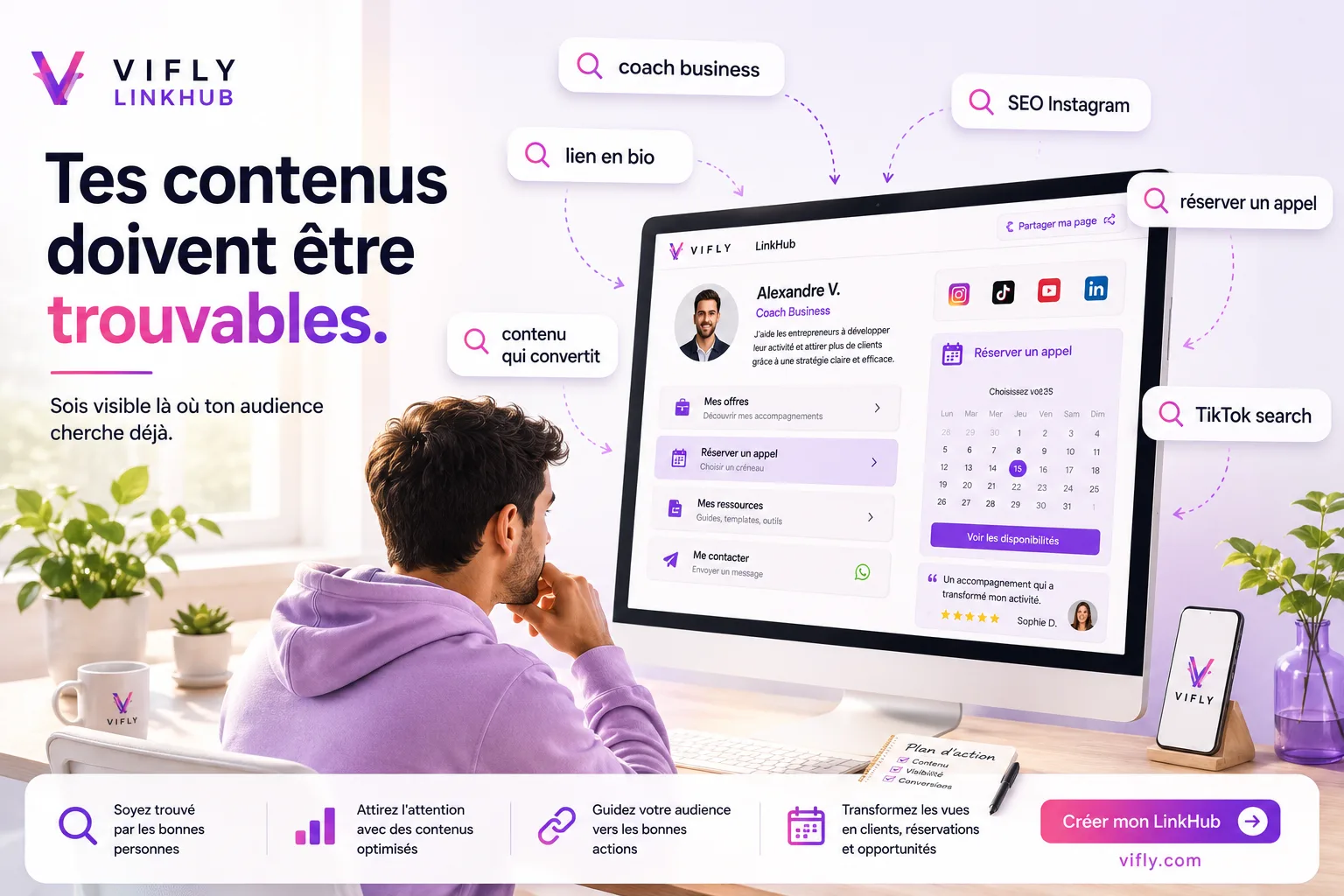
Instagram, TikTok, YouTube Shorts and LinkedIn are no longer just visibility platforms. They become search engines where your future clients are looking for answers, evidence and trusted people.
For a long time, many creators have published with one obsession: being seen. Make more views. Have more likes. Drilling with a Reel. To appear in the news. Algorithm plating.
But another battle is becoming decisive: being found.
Because your future client doesn't always come across you by chance. Sometimes he's looking. He types a question in TikTok. He's looking for an idea on Instagram. He's watching Shorts on YouTube. He explores LinkedIn to understand a topic. It compares profiles. He reads the comments. He's checking if your content really answers his problem.
And then a question becomes essential: when someone looks for what you can do, can your content come out?
The SEO of social networks is not putting three hashtags at random at the end of a post.
It's building content that's clear enough to be understood by platforms, accurate enough to respond to real research, and credible enough to make you want to go further.
For a creator, coach, consultant, trainer or independent, this is a huge opportunity.
Because the content that disappears in 24h fatigue. But the content we can find still works for you.
The real change: people no longer scroll only, they seek
Before that, we used to open social networks mainly to entertain ourselves, watch what others published or spend time.
Today, some uses have changed. Someone can look for how to find customers when you're coached.
Content idea for therapists.
How to structure your link in organic.
How to sell a service online.
Why my Reels make views but no customers.
How to make reservations without going through DM.
These searches do not always look like classic Google searches. They are often more human, more direct, more conversational. The person is not just looking for a definition. She's looking for an incarnate answer. A method. An experiment. An example. Someone who understands his problem.
That's where creators have an advantage. A site can answer a question. But a creator can create a connection.
The SEO of social networks is located exactly in this place: between the search for information and the relationship of trust.
Social SEO is not a classic copied-paste SEO
The classic SEO often seeks to position a page on Google.
The SEO of social networks seeks to make content, profile or series of publications more understandable and findable on social platforms.
It's not the same mechanics.
On Instagram, TikTok, YouTube Shorts or LinkedIn, the algorithm does not only look at keywords. He also observes the behavior of users: what they look at, what they hold back, what they comment, what they share, what they seek, what they save, what they send to someone.
In other words, well-optimized social content should not only contain the right words. He must want to stay. That is why the Social SEO does not replace copywriting.
It obliges him to become more precise.
You need to talk like your audience is looking for, but write like a human who understands his problem.
Why creators must take social SEO seriously
If you're a creator, coach, consultant, independent or trainer, you don't necessarily need to be viral every day.
You need to be found by the right people.
Virality can attract a lot of attention. But research often attracts a stronger intention.
A person looking for how to organize my bio links is not in the same state of mind as a person who accidentally falls on a funny video. She already has a problem. She's already looking for a solution. It may be closer to a click, reservation, request or purchase.
That is why social SEO is valuable.
It allows to create content that does not only live in the moment.
A good, optimized post can continue to attract visitors several days, weeks or months after publication. A good Short can come out on a search. A good carousel can be saved. A good video can become a gateway to your profile.
And if your profile is clear, your well-structured bond and your visible offer, this front door can become a real opportunity.
The first error: publish interesting but unobtainable content
Many creators publish useful content.
The problem is that they are formulated too vaguely.
Small important reminder
You have to understand that
Stop making that mistake
Nobody tells you that
The real problem is elsewhere
These hooks can work to capture attention. But if they are never accompanied by precise words, the content becomes difficult to classify, difficult to find and difficult to associate with a clear search.
The algorithm can include part of the subject through image, audio, text on screen, comments and description. But you have to help him.
If your subject is how to turn Instagram views into customers, say it.
If your subject is organic link for coach, say it.
If your subject is online reservation for consultant, say it.
If your subject is contained that attracts but does not convert, say it.
Content can remain creative while being clear. Clarity does not remove the force of a message. She gives him a chance to be found.
The second mistake: to think that hashtags do everything
The hashtags are still useful. But they are no longer a complete strategy.
Many creators still think that it is enough to add fifteen hashtags at the end of a publication to be well referenced. In reality, the platforms look much wider: the text displayed, the legend, the real subject, the engagement signals, the comments, the creator profile, the user behavior and the overall consistency of the account.
The hashtag can help. But it won't save blurred content. A good social SEO starts before the hashtags. It starts with the very idea of content.
What question does this content solve? What problem does he name? What research could lead to him? What word would your audience really use? What confidence signal does he give?
The hashtags are the finish. Not the foundations.
The real power is in the words that your audience already uses
Social SEO starts with listening. Not by a tool.
Listen to the sentences your clients use. The questions they ask in DM. The objections that come back. The comments under your posts. The terms they would type spontaneously. The pains they express with their words, not with your jargon.
A coach should not only talk about transformational accompaniment.
His audience may be looking for: how to regain confidence, how to stop procrastination, how to change working life, how to manage a difficult period.
A consultant should not only talk about strategic optimization.
His audience may be looking for: .
A creator should not only talk about the digital ecosystem.
His audience may be looking at: How to put all my links in my bio, how to sell with Instagram, how to receive bookings, how to turn my subscribers into customers.
The right keyword is not always the most professional word. This is often the word the person uses when he really needs help.
Optimize your profile: your first social SEO lever
Your content can be well optimized. But if your profile isn't, you lose some of the opportunity.
Your name, your bio, your pinned content, your categories, your link and your first posts must all help understand your positioning.
It's not just a matter of aesthetics. It is a question of readability.
If you're an independent business coach, those words must appear somewhere. If you offer online booking, accompaniments, audits, resources, services or training, your profile must allow you to understand it quickly.
Social SEO is not only about publications. It's about your entire account. An optimized profile acts as a home page.
It gives context to your content. He reassures visitors. It helps the audience understand your universe. And above all, it allows good people to recognize themselves faster.
You can go into this with the article VIFLY on passive audience vs activating audience, because a hearing that finds you must then know what to do.
Optimizing your content: talking to research without losing emotion
Good social content SEO is not cold. It's not written for a machine. It's written for someone looking for something.
The right method is to associate a clear keyword with a human tension. For example, instead of publishing only:
You need to improve your bio
You can say:
Your organic Instagram may make you lose customers
The subject is clear: bio Instagram.
The tension is strong: losing customers.
The benefit is implicit: better convert your profile.
Instead of saying:
"Structure your links."
You can say:
Your bio link must guide your audience, not lose it
The subject is clear: organic link.
The issue is concrete: guiding the audience.
The promise is action oriented: avoid confusion.
Instead of saying:
Prepare your account
You can say:
The day your content pierces, your journey must be ready
The subject is clear: content that pierces.
The tension is strong: do not miss the opportunity.
The link with VIFLY becomes natural: prepare a profile, a LinkHub, an offer, a Booking.
Social SEO doesn't kill style. It prevents your style from becoming invisible.
Areas where to place your keywords naturally
On social networks, keywords can appear in several places.
Profile name. Bio. The text displayed in the video. The first sentence of the legend. The title of the carousel. The subtitles. The pinned comments. The hashtags. The playlist names or series. YouTube Shorts descriptions. The titles of the videos.
But be careful: the goal is not to mechanically repeat the same word everywhere.
The objective is to send a coherent signal.
If you want to be found on organic link for creator, your content must really talk about organic link, your profile must show that you are helping creators, your visual must be understandable, your legend must explain the stakes and your CTA must guide to a logical sequel.
Consistency is better than repetition.
Concrete example: a coach who wants to be found
Imagine a coach who helps women entrepreneurs regain confidence and structure their business.
It may publish inspiring content, but if it never clearly identifies the problems it seeks, its content may remain in an emotional bubble.
It can create a series of content around concrete research:
How can you regain confidence when you start your creator business
Why can't you sell your services
How to present your offer without feeling illegitimate
How to turn your Instagram into a real professional showcase
How to receive requests without running after customers
Every content remains human. But each content becomes also findable.
And if its profile is clear, if its organic link leads to a structured page, if its offer is visible and if the reservation is simple, this visibility can become a real demand.
This is where the Social SEO joins conversion.
Concrete example: an independent person who wants to receive more reservations
Let's take a consultant, therapist or trainer.
It publishes regularly, but receives few requests.
His problem may not be the quality of his expertise. Maybe that's how his expertise is named.
Instead of publishing only general reflections, it can create searchable content:
How do I book an online coaching session
How to choose a consultant to clarify his offer
Why don't your prospects make an appointment
How do I avoid interminable DM exchanges
Why a reservation system reassures your customers
These content can attract people who already have an intention. But they still need a clear follow-up.
This is exactly where a tool like VIFLY Booking becomes useful: it turns interest into a possible reservation, without unnecessary friction.
Social SEO without pathways is not enough
Being found is good. But being found without clear action is an incomplete opportunity.
A person can discover your content through research. She may like your approach. She can visit your profile. But if she doesn't understand your offer, if your bio link is confused or no action is obvious, she's leaving.
Social SEO must therefore be linked to a route. Your content attracts. Your profile reassures. Your LinkHub guides. Your offer gives a reason to act. Your Booking facilitates the reservation. Your CTA triggers the next one.
This is why VIFLY should not be seen as a simple link tool.
VIFLY LinkHub allows you to create a clearer page around your universe: links, offers, resources, networks, contact, reservations, testimonials, important content.
The goal is simple: do not let an interested person get lost after the click.
Because good social referencing attracts attention. But a good course transforms this attention.
How to build a simple social SEO strategy
You don't need to become a technical expert to start with. You can already work with three families of content.
The first family: the content of the problem. They respond to the direct pains of your audience.
Why don't your posts generate customers
Why doesn't your profile trust
Why does your bio bond lose visitors
The second family: the content of research. They're taking back the questions that your audience could type.
How to structure your link in organic
How to turn your views into customers
How to receive more reservations
The third family: the contents of the "proof". They reassure and show you know what you're talking about.
Before / after a clear profile
“Exemple de parcours client simple.”
“Checklist avant de publier un Reel.”
“Les erreurs qui empêchent une audience d’agir.”
These three families create a balance. You attract problems. You're caught by research. You convert by proof.
Comments also become content
Comments are often thought to be a simple consequence. But they become increasingly important in understanding content.
The comments reveal the real context: what people understand, what they ask, what they add, what they contest, what they want to deepen.
For a creator, it's a gold mine. A comment can give you a video idea.
A question can become a carousel. An objection may become an article. A repeated sentence can become a keyword. A debate may indicate that the subject is a real problem.
If you want to improve your social SEO, don't just look at your statistics. Read your comments. They often tell you how your audience makes its research.
Content series: an underestimated lever
Platforms like consistency signals.
Your audience, too. A series of content allows you to repeat a territory without giving the impression of repeating the same thing.
For example:
“1 minute pour améliorer ton profil.”
The mistakes that block your reservations
Your bio-shelled link
“Contenu visible vs contenu rentable.”
Social SEO for creators
A series helps the algorithm understand your theme. She also helps your audience locate you.
Instead of being a creator who talks about everything, you become a reference on a specific subject. And when someone looks for this subject, your universe becomes more coherent.
Why VIFLY is a logical follow-up to social media SEO
Social SEO attracts the right people to your content. But then we have to organize the rest.
It is precisely the role of VIFLY: to help creators, coaches, consultants, trainers, independents and entrepreneurs structure their digital presence to transform visibility into actions.
With VIFLY LinkHub, you can centralize your links, highlight your offers, guide your audience, add resources, networks, contact and call to action.
With VIFLY Booking, you can make it easier to make appointments and prevent interest from getting lost in scattered messages.
With the blog VIFLY, you can deepen your strategy and build a clearer, more credible and more conversion oriented presence.
You can also complete this reading with the article on the day your content pierces, because the Social SEO prepares precisely this moment: the one where a person finds you and decides whether to go further.
The real issue is not just to be found.
It's to be found, understood and chosen!
Conclusion: tomorrow your content will have to answer before seduce
Social networks are no longer just quick showcases. They become spaces for research, comparison and decision-making.
This does not mean that it is necessary to create cold, mechanical or keyword-filled content.
On the contrary.
The best content will be those that combine three things: a true research intention, a human formulation and a clear path after discovery.
Good social content must attract. But he also has to answer. Rest assured. Guide. Make you want to move on to the next step.
The creator who understands this no longer publishes only to fill his feed.
He's building an asset. Content that can be found. A profile that I can understand. A link that can guide. An offer that one can choose. A reservation that can be made simply.
Social media SEO is not a fashion. It's a new way of thinking about your visibility. Not just to be seen.
To be found at the right time, by the right people, with a clear suite.
Create your VIFLY space
You want your content not only to make views, but to guide your audience towards concrete actions?
Create your VIFLY space, structure your LinkHub, present your offers and facilitate your reservations.
Your content can be found.
Your journey must be ready.