Instagram is set to reduce the reach of undeclared AI influencers: what creators need to understand
Imagine you’ve been following a lifestyle influencer for several weeks.
She posts about her travels. Photos of restaurants. Beauty routines. Selfies. She sometimes replies to comments.
Then you discover that she does not exist. No people were photographed.
The face, the body and sometimes an entire part of their identity have been artificially generated. This is exactly the sort of situation that Instagram now wants to make much more visible.
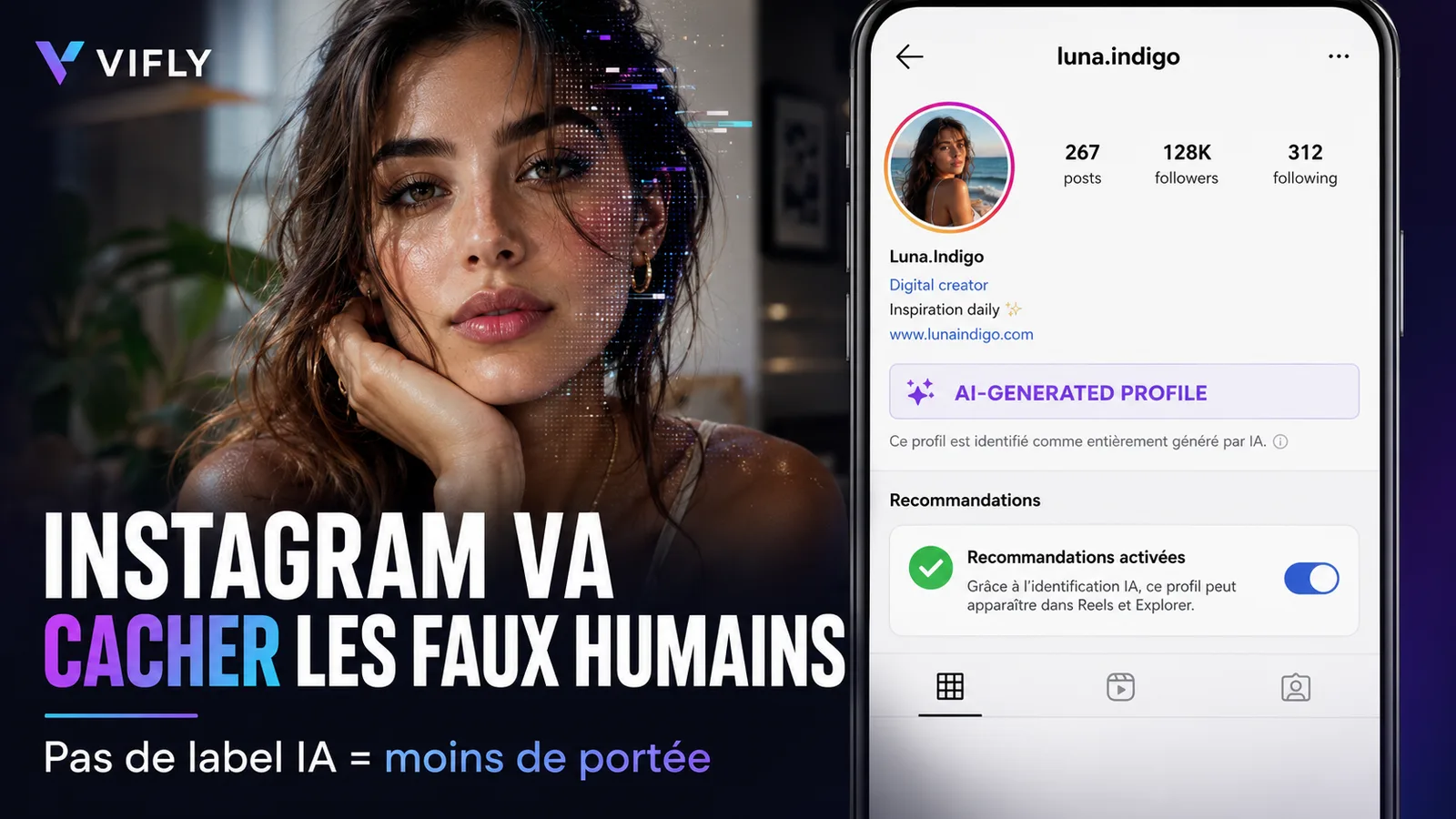
The 31 August 2026, Instagram has announced that it will be replacing its old, ambiguous label “AI creator” with a much more explicit formulation: “AI-generated profile”.
And this time, the label isn’t just for information.
A profile featuring an AI-generated person that is not correctly labelled may have its reach limited in Reels and Explore recommendations to non-followers.
This is a significant development. Because Instagram is starting to draw a much clearer line between:
a human who uses AI as a tool
and
an artificial identity that resembles a human.
Instagram is changing the label’s name to remove any ambiguity
The old name posed an obvious problem.
“AI creator” could mean several things. A designer specialising in artificial intelligence might wonder whether the label applied to them.
A graphic designer using Midjourney might also have thought they needed to enable it. A human influencer using ChatGPT to write their captions might have had the same hesitation.
Instagram therefore replaces this code with:
“AI-generated profile”
or, in English, something along the lines of:
AI-generated profile.
The intention becomes much clearer.
The label indicates that the person depicted at the centre of the profile was generated or substantially created using artificial intelligence, and that this is therefore not simply a case of a human using a few generative tools in their workflow.
Instagram is particularly keen to ensure that users no longer discover after the fact that a person does not exist
Instagram explains that this change is a direct response to feedback from its users.
The platform reports that it has found people do not like discovering too late that a profile which appeared to represent a real person is in fact artificial.
This is probably the crux of the problem. The question is not:
‘Can AI create beautiful images?’
Of course it is. The question then becomes:
‘Does a user clearly know with whom — or with what — they are interacting?’
And in the creator economy, this nuance becomes hugely significant. Because an audience doesn’t just follow pixels.
It is gradually building up:
- trust
- a relationship
- a perception
- sometimes an intention to buy
If the person in the photo doesn’t actually exist, Instagram now wants to make it much harder to hide this information.
What happens if an AI profile rejects the label?
This is where the advert becomes particularly important.
Instagram doesn’t just say:
“We’d like you to be transparent.”
The platform plans to limit the scope of the profiles in question when they are not declared correctly.
According to the details provided, the profile may, in particular, become not eligible for recommendations to people who do not already follow him.
In practice, the most significant areas affected are:
- Reels
- Explore
For a creator, this is significant. Because these platforms are precisely the ones that enable them to reach beyond their own subscriber base.
The account does not necessarily disappear
Be careful with the shortcut. Instagram doesn’t say:
“An unlabelled AI influencer will be automatically removed.”
The announced consequence mainly concerns the recommendation and thus the discovery.
However, this can be extremely detrimental.
A profile can continue to post to its existing followers whilst finding it much more difficult to attract new users.
For a creative business, it’s almost like cutting off the flow of new visitors.
A correctly tagged profile is not automatically penalised
Another key point. Instagram does not say:
“Virtual influencers will all be less visible.”
On the contrary, the platform states that creators who deliberately add the correct label will not see their reach reduced simply because they use an AI-generated persona.
So the new rule is not:
IA = less reach.
It should be:
artificial identity + lack of transparency = risk of restriction.
This distinction completely changes the analysis.
Do you use ChatGPT, Midjourney or an AI image-editing tool? The labelling requirement may not apply to you
This is probably the most important part for the vast majority of VIFLY creators.
Instagram states that the label “AI-generated profile” should not be applied simply because a human uses AI tools in their creative process.
For example, if you’re a real person and you’re using AI to:
- improving a caption
- cropping a photo
- create a background
- create a visual
- slightly modify an image
- search for ideas
- improve your script
this does not automatically mean that your full profile must be marked as AI-generated.
That makes sense. The label does not describe the production method.
It describes the identity represented by the account.
The real new frontier: AI tools versus AI identity
There’s a lot of talk about ‘AI content’.
But today, this term encompasses completely different realities.
Case 1: human + AI
A real designer uses ChatGPT to improve a description.
It remains real.
Case 2: human + generated image
A consultant uses a Midjourney illustration to accompany a post.
It remains true.
Case 3: heavily retouched human
A designer modifies their environment or certain visual elements.
The identity remains primarily that of a real person.
Case 4: synthetic personality
A young woman appears in 200 photos.
She travels. She tries on clothes. She posts stories.
But no human actually exists with this identity.
It is primarily this fourth scenario that the new profile label is designed to address.
This distinction is likely to become increasingly important on social media.
Why Instagram is now starting to protect the concept of identity
The capabilities of generators have improved enormously.
It is becoming increasingly difficult for the average user to distinguish instantly between:
photo of a person
and
generated photo.
The same applies to:
- videos
- voice
- avatars
- virtual influencers
This creates a fundamental problem for a social platform.
Instagram has historically been based on an implicit promise:
“You’re following real people, businesses or creators who actually exist behind their accounts.”
If a growing proportion of the feed consists of artificial personas that cannot be identified as such, trust in the environment as a whole may erode.
Transparency therefore also becomes a business-related question for Instagram.
This change could be excellent news for human creators
The instinctive reaction might be:
“Yet another new Instagram rule.”
But for true creators, this development can also be an advantage.
Because when artificial production becomes extremely abundant, one thing becomes even more valuable:
the verifiable human experience.
A real designer might show:
- his experience
- behind the scenes
- its errors
- his reactions
- her encounters
- his tests
- its contradictions
These elements are much more difficult to replace with a completely synthetic personality.
Authenticity is becoming an economic advantage
Imagine two beauty profiles.
Profile A
A perfectly rendered virtual influencer. Every image is flawless. No signs of fatigue. No imperfections.
Profile B
A real designer.
It displays:
- how the product actually reacts on her skin
- what she likes
- what she hates
- his slip-ups
- its results after several weeks
The first can be visually striking. The second has a different value:
first-hand evidence.
Against a backdrop of AI saturation, this figure could become even more significant.
Brands will also need to check who they are collaborating with
This rule doesn’t just apply to creators. Imagine a brand partnering with an ‘influencer’.
She later discovers that:
- his face is synthetic
- his audience thought he was human
- the required label was not enabled
- Instagram is now limiting its recommendations
The commercial value of the partnership may plummet. Brands will therefore need to gradually add an additional question to their audits:
Does this profile represent a real person, a deliberate avatar or an undisclosed synthetic identity?
This could become just as important as:
- engagement
- fake followers
- demographics
- audience quality
Virtual influencers aren’t going to disappear
It would also be wrong to conclude:
“Instagram is killing off AI influencers.”
This isn’t what was advertised.
A clearly defined virtual persona can continue to exist.
It may have:
- a creative identity
- a world
- an audience
- partnerships
- content
Instagram wants above all to avoid the deliberate blurring of the lines between artificial identity and real human beings.
An AI avatar that is openly acknowledged and clearly labelled therefore does not pose exactly the same problem as a fake ‘human’ designed to deceive users.
How can Instagram tell that a profile is generated?
Instagram does not publicly disclose all of its detection methods. It would therefore be incorrect to invent a list of specific indicators.
What we do know, however, is that the platform plans to identify certain accounts that may be affected and to restrict their eligibility for recommendations.
Affected property owners can consult Account Status and, in the event of an error, challenge the decision.
In other words:
systems can make mistakes.
And so Instagram is planning a call-to-action mechanism.
What should you do if Instagram mistakenly identifies you as an AI profile?
First things first:
Don’t panic and don’t create a new account.
Start by checking:
Settings → Account Status
to identify any potential limitations on the recommendation.
If Instagram considers your profile to be that of a bot when it is not, please use the appeal process provided.
You should also avoid trying to ‘trick’ detection systems. The aim should be to clarify the situation.
Creators who make extensive use of AI should improve their transparency
Even if you’re human and don’t need the ‘AI-generated profile’ label, this development sends a broader signal:
the public wants to know what is real.
This does not mean you should publish:
‘I used ChatGPT to correct three commas’
for each post.
But when AI plays a significant role in content, transparency can build trust.
For example:
“Image generated using AI based on our original concept.”
Or:
‘This scene is a computer-generated illustration, not a real photograph.’
You are not necessarily obliged to use a platform in every case.
But you’re developing a a culture of trust.
Human personal branding will have to become more tangible
For several years, many personal branding strategies relied primarily on:
- lovely photo
- quotes
- carrousels
- inspirational content
In a world capable of generating this automatically, the value will probably shift towards:
evidence of reality.
For example:
Show work
Screenshots. Drafts. Workflows.
Show experiences
Tests. Results. Failures.
Show real-life interactions
Events. Clients. Collaborations.
Show continuity
A consistent image and journey over time.
These are all elements that reinforce a credible professional identity.
For VIFLY, this development confirms the importance of a central professional profile
The more ambiguous identities become on social media, the more important it is for a creator or professional to have a central section that clearly explains who he is and what he does.
A VIFLY LinkHub can, amongst other things, centralise:
- identity
- bio
- social media
- content
- offers
- contact
- booking
The aim is not simply to list links. It is to create a stable point that immediately responds to:
Who are you? What do you do? How can we work with you?
Instagram remains an excellent channel for discovery. But your professional identity shouldn’t depend on a single platform.
Trust must then lead to action
This news story serves as a reminder of something essential:
Trust is a step along the journey, not its destination.
For a coach, consultant, trainer or therapist:
Instagram can spark discovery. Your profile fosters understanding. Your content builds trust. Then you need to encourage action.
With VIFLY Booking, this action can become a direct booking when your creator business relies on appointments.
The code becomes:
content → profile → trust → LinkHub → Booking → opportunity.
In an internet full of fake accounts, this professional consistency is all the more reassuring.
VIFLY AI: using artificial intelligence without losing your identity
The other lesson is particularly important. AI is not the problem.
Instagram itself demonstrates this by clarifying that human creators using AI tools in their workflow are not automatically covered by the new label.
The real question is:
Does AI increase your workload or artificially replace your identity?
That is exactly the philosophy behind a space such as VIFLY AI can help with development.
Using AI to:
- reflect
- structure
- search
- challenger
- automate certain tasks.
But keep:
- judgement
- expertise
- disclaimer
- identity
6 steps to take today
1. Check your Account Status
Make sure your account remains eligible for recommendations.
2. If your persona is fictional, use the correct label
Do not attempt to hide a fully generated identity in order to temporarily preserve the scope.
3. If you’re human, don’t panic
Using ChatGPT, Midjourney or other AI tools does not automatically turn your profile into an ‘AI-generated profile’.
4. Make your professional identity clear
Bio. Photo. Website. LinkHub. Portfolio.
5. Enhance your experiential content
Show us what you’ve got:
- tested
- learned
- experiences
- built
6. Measure more than just reach
Keep an eye on:
- profile views
- clicks
- contacts
- bookings
- sales
- collaborations
Credible content must gradually generate more than just views.
Conclusion: Instagram does not penalise AI; it is starting to penalise ambiguity
The nuance is crucial. Instagram hasn’t just stated:
‘AI-generated content will have less reach.’
The platform says something much more specific:
if your profile depicts an AI-generated person and you do not state this clearly, your ability to be recommended may be limited.
It’s a logical development.
Because the easier it becomes to create people who do not exist, the more a social media platform must safeguard a fundamental piece of information:
which one is real?
For human creators, this development should not give rise to a fear of AI.
It should do exactly the opposite:
Use the tools. Automate whatever you can. But make your identity even more recognisable.
In a feed where everything can be artificially perfected, your imperfections, your experiences, your evidence and your consistency can become real assets.
Your next step
Today, assess your profile with three questions:
1. Does someone visiting my account immediately understand who I am?
2. Can she distinguish between what is part of my actual experience and what is merely illustrative or generated?
3. If she trusts me, does she know straight away what to do next?
If the third answer is ‘no’, take this opportunity to organise your website: centralise your content and offers on your VIFLY LinkHub and add VIFLY Booking if your creator business relies on appointments.
Because the next battle on social media may no longer be solely about:
‘Which one attracts the most attention?’
It will also be:
‘Who can we still trust?’
FAQ
Does Instagram penalise all AI-generated content?
No. Instagram distinguishes between accounts representing artificial entities and human creators who simply use AI tools as part of their workflow.
What is the “AI-generated profile” label?
It indicates that a profile primarily features a person or identity generated or substantially created by artificial intelligence rather than a real human. It replaces the former ‘AI creator’ label.
What happens if an AI profile does not use the label?
Instagram may limit its eligibility for recommendations, particularly to non-followers in Reels and Explore.
Do I need this label when using ChatGPT for my captions?
No. Instagram states that people using AI tools to enhance their content, captions, images or graphics should not automatically have the label applied to their profile.
Is a properly registered virtual influencer penalised?
Instagram states that voluntarily adding the appropriate label does not automatically reduce a profile’s reach simply because its identity is generated by AI.
What should I do if Instagram mistakenly classifies me as an AI profile?
See Account Status to identify the restriction and use the appeal mechanism if you believe the decision is incorrect.
SOURCES
Instagram Creators “AI-generated profile label”, 31 August 2026. Official primary source. Instagram is replacing “AI creator” with “AI-generated profile”, distinguishing synthetic personas from human creators who are simply using AI tools, and announcing a reach restriction for affected profiles that refuse to declare themselves. The official page is currently subject to an automated access restriction, but it is directly referenced in reports by TechCrunch and The Verge.
Visit the official Instagram Creators page
The Verge “Instagram cracks down on AI accounts pretending to be human”, 31 August 2026. Confirms that undeclared AI profiles may lose their eligibility for recommendations to non-subscribers in Reels and Explore, and states that an appeal remains possible in the event of an error.
TechCrunch “Instagram puts new limits on undisclosed AI profiles”, 31 August 2026. Confirms the change in labelling and the distinction between a profile representing an artificial entity and a human simply using AI to edit images, improve texts or create visual elements.
PYMNTS “Instagram Looks to Limit AI-Created Accounts Posing as Human”, 31 August 2026. A secondary source of context reiterating Instagram’s reasoning: users want to know clearly when a profile that appears to be human is in fact an AI-generated persona.