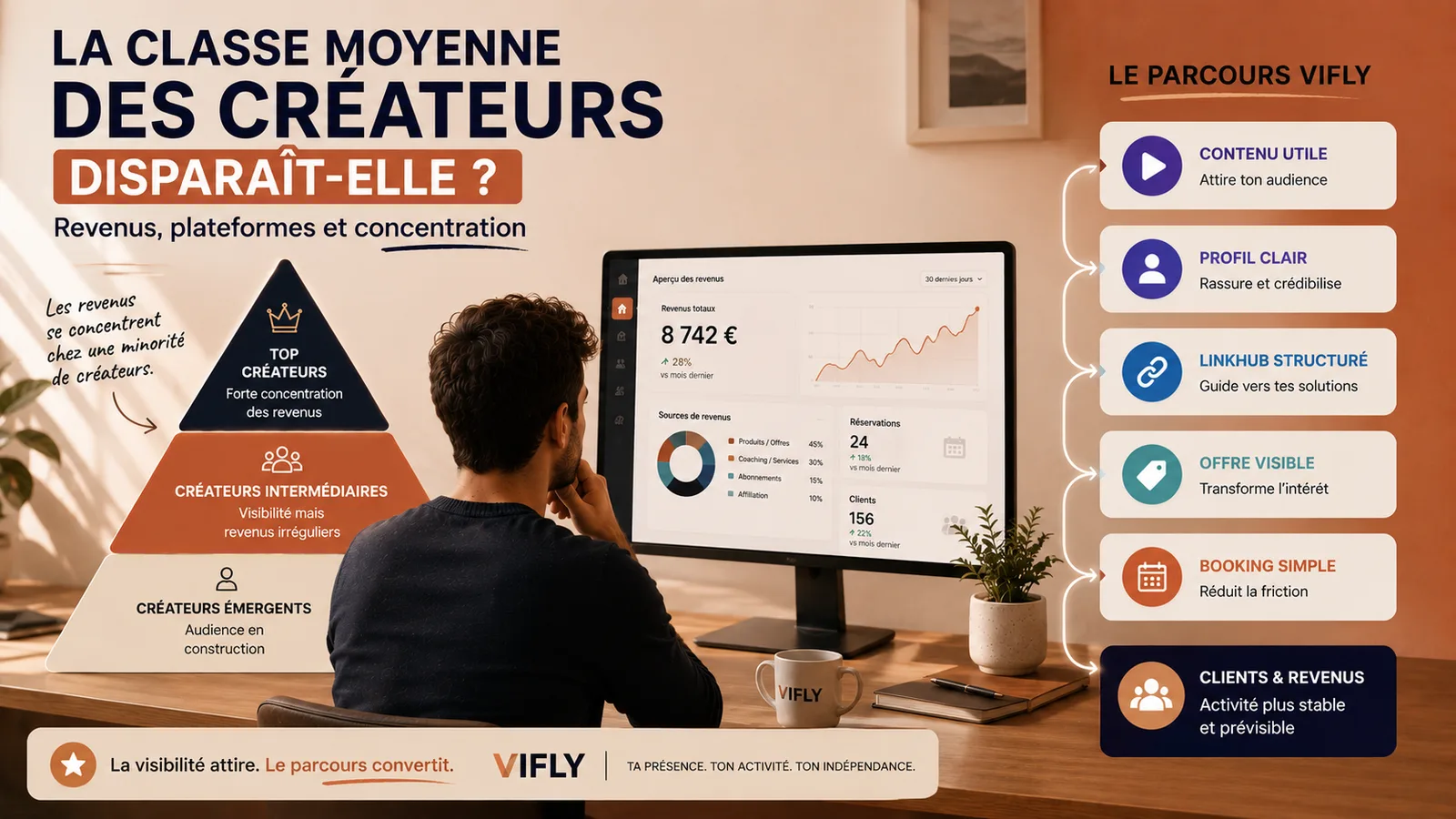
The problem: many creators have visibility, but no stable income
Many creators no longer start from scratch.
They're publishing. They have a hearing. Sometimes they make views. They receive likes, comments, messages, sometimes even requests for collaboration.
From the outside, everything gives the impression that their activity is advancing. But in fact, incomes often remain irregular.
A month, a video works. The next month, nothing. A mark responds, then disappears. A platform announces a monetization program, but conditions change. The views are rising, but the customers are not following. The audience is growing, but turnover remains fragile.
This is where the real problem of many creators in 2026 is: they managed to attract attention, but not yet to build a system capable of transforming this attention into more predictable revenues.
And this fragility becomes more visible because the creator economy is becoming professional. Budgets are increasing, brands are investing more, platforms are offering monetization tools, but revenues are not evenly distributed.
A minority of creators capture a large part of the payments, while many middle creators remain trapped between two worlds: too advanced to consider themselves beginners, but not structured enough to live calmly of their activity.
This fragile area can be called the middle class of creators.
So the question is not just: can we still make money by creating content
The real question is more specific:
how can an intermediate creator avoid relying solely on platforms, views and ad hoc collaborations to build more sustainable incomes?
The paradox: the creator economy grows, but many creators feel more fragile
The creator economy has never been so visible. Brands invest more, platforms multiply monetization programs, creative tools become more powerful, and it has never been easier to publish, sell, cash, book or animate a community.
Yet, many creators have the opposite impression: more competition, more instability, more pressure, and income that remains irregular.
This is the paradox of 2026: the market is growing, but financial security is not growing at the same pace for everyone.
CreatorIQ summarises this tension well: according to its report published in January 2026, total creator compensation is increasing but becoming more concentrated. The highest-paid 10 % of creators captured 62 % of payments in 2025, compared with 53 % in 2023. The highest-paid 1 % captured 21 % of payments, compared with 15 % in 2023. At the same time, median compensation remains limited, with a median creator receiving 3,000 dollars per campaign while the average reaches 11,400 dollars.
In other words: the cake is growing, but the larger shares are increasingly going to the same profiles.
It is this dynamic that raises a real question: is the middle class of creators disappearing?
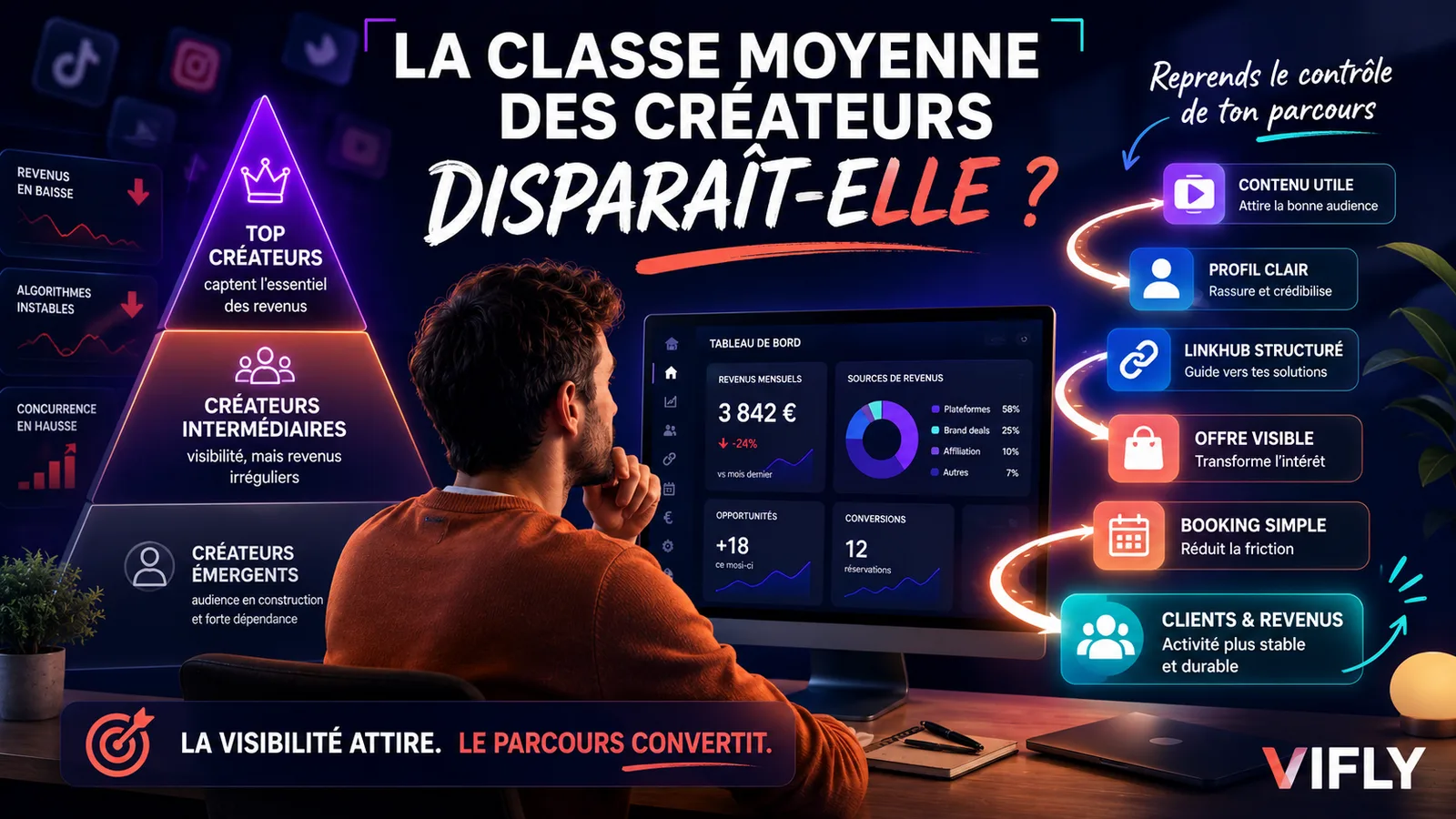
The so-called middle class of creators
The middle class of creators are not celebrities, very big influencers or personal media that run with a full team.
Rather, it is the profiles that have a real audience, expertise, community, regularity and sometimes already income, but that do not yet have sufficient stability.
There is a coach who publishes every week, a very active consultant on LinkedIn, a trainer who sometimes sells workshops, a therapist who attracts requests from Instagram, a freelancer who is beginning to be recognized, a YouTube creator who monetizes but remains dependent on views, or a micro influencer who gets some collaborations but never knows how much he will earn next month.
Their problem is not the total lack of visibility. Their problem is often more subtle: they have attention, but not yet a system.
Why income is increasingly concentrated
Brands want less risk
When budgets increase, brands do not necessarily distribute money more widely. They often seek more reliable, measurable, professional, and aligned profiles with their objectives.
The IAB indicates that U.S. advertising spending on creators is expected to reach 37 billion dollars in 2025, an increase of 26 % over a year, with a projection of 44 billion dollars in 2026. But the same report also points out that brands have difficulty identifying good creators, measuring business results and standardizing their campaigns.
This detail is important: when a market becomes more professional, it does not only reward creativity. It also rewards readability.
A creator who has a clear positioning, a well-defined audience, evidence, a professional profile, an understandable offer and a simple path becomes easier to choose from.
A creator who makes content, but whose role, target, offer or value is not understood, remains more difficult to buy.
Platforms earn, but under conditions
YouTube, TikTok, Facebook, X and other platforms offer monetization programs, but these revenues are rarely automatic. YouTube recalls, for example, that the YouTube Partner Program provides access to monetization features and advertising revenue sharing, subject to eligibility and compliance.
TikTok explains that Creator Rewards pays eligible creators based on the performance of videos that meet the program criteria. Again, this is not a guaranteed income for all creators who publish.
X also imposes significant thresholds for its Creator Revenue Sharing, including a Premium or equivalent subscription, at least 5 million organic impressions over the last three months, 500 verified subscribers, a supported country and compliance with its rules.
Even Facebook, which announced that it has contributed close to 3 billion dollars to creators through its 2025 monetization programs, remains a platform with rules, accesses, formats and programs that are evolving.
The message is simple: platforms can create revenue, but they don't always create stability.
Social income becomes more fragile
The Kajabi report 2025 State of Creator Commerce talks about an important shift: creators no longer only build audiences on social networks, they seek to build business beyond platforms. The report mentions a reported decline of 33 % payouts platforms, 36 % affiliate and 52 % brand deals, while highlighting the rise of the business creator: communities, training, coaching, digital products, newsletters, subscriptions and memberships.
These figures do not mean that collaborations, affiliation or revenue platforms disappear. Rather, they show that middle income is becoming more uncertain.
And when incomes become uncertain, the middle class suffers more than the very big creators. Largers often have a team, network, contracts, reputation, a massive audience and several channels. Intermediate creators often have enough visibility to have opportunities, but not enough structure to transform them regularly.
Key points
The creator economy does not collapse. She's professionalizing. And when a market becomes professional, creators who remain blurred become more vulnerable.
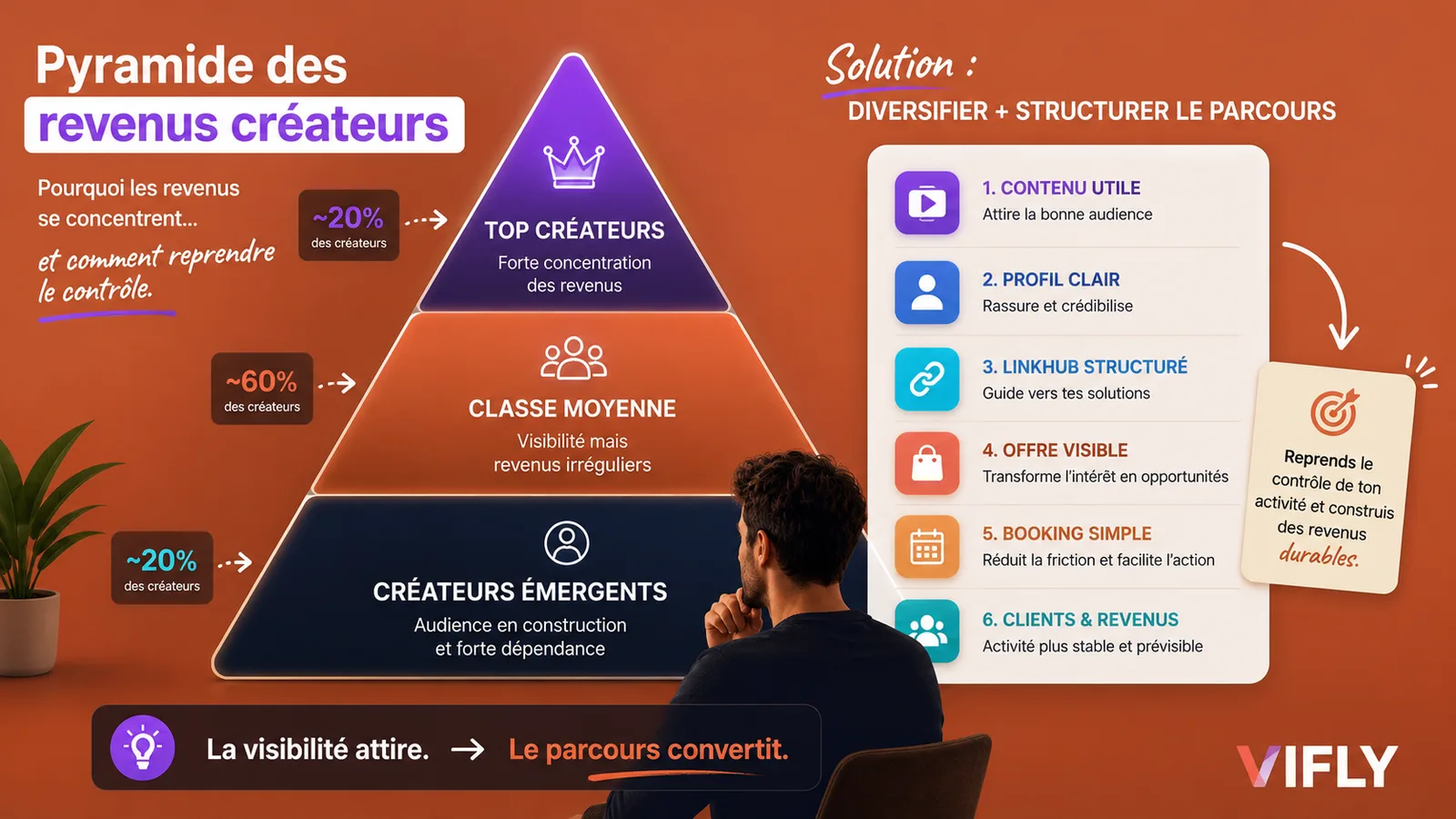
The real trap: confusing audience, income and business
Many creators still confuse three things: having an audience, generating revenue, building a business.
An audience is attention. Income is a transaction.
A business is a system capable of repeating transactions without depending on just one chance: a video that drills, a responsive brand, a favorable algorithm or an available monetization program.
This is exactly the point that VIFLY already defends in the article More views don't mean more customers. Views can create attention, but they do not automatically create customers, reservations or opportunities.
A creator can make 100 000 views and sell nothing. A consultant can 2 000 view LinkedIn and receive three qualified applications.
A coach can have a small audience, but a very clear profile, a well presented offer and a simple Booking.
The difference is not always the volume. It's often the route.
Why the middle class of creators is most exposed
It often depends on a single channel
Many intermediate creators built their business around a dominant platform: Instagram, TikTok, YouTube, LinkedIn, Facebook or X.
As long as the platform distributes well, everything seems to work.
Then the algorithm changes. Views are falling. Programs are changing. Income varies. The formats change. Brands are moving their budgets. The rules of monetization become stricter.
Article VIFLY If social networks disappeared tomorrow, what would remain of your creator business? completes this idea very well: a social account can be a powerful acquisition channel, but it must not be all activity.
She often has expertise, but a fuzzy offer
The intermediate creator is not necessarily beginner. He can create. He knows his subject. He's got returns. He sometimes has real credibility.
But his offer is not always visible.
He talks about content, advice, values, behind the scenes, inspiration, but his audience does not always understand what she can buy, book or ask for.
This is what Article VIFLY Your offer must not be perfect. It must be understandable already helps to correct: a saleable offer is not necessarily complex, but it must be readable.
It sometimes lacks a conversion system
Content attracts. A profile reassures. A guiding link. An offer clarifies. Booking reduces friction.
When these elements are dispersed, opportunities are lost.
This is where the middle class of creators can regain a lead. It does not always have the budgets of large accounts, but it can become much more structured.
What intermediate creators need to change
1. Switching from I publish to I build a course
Publishing remains important. But publishing without a course means opening a shop without a cashier, without a clear radius and without any indication to buy.
A simple route looks like this: useful content → plain profile → Structured linkHub → visible offer → Booking or purchase.
It's not an aggressive tunnel. It's a way to respect the attention of the person who just discovered you.
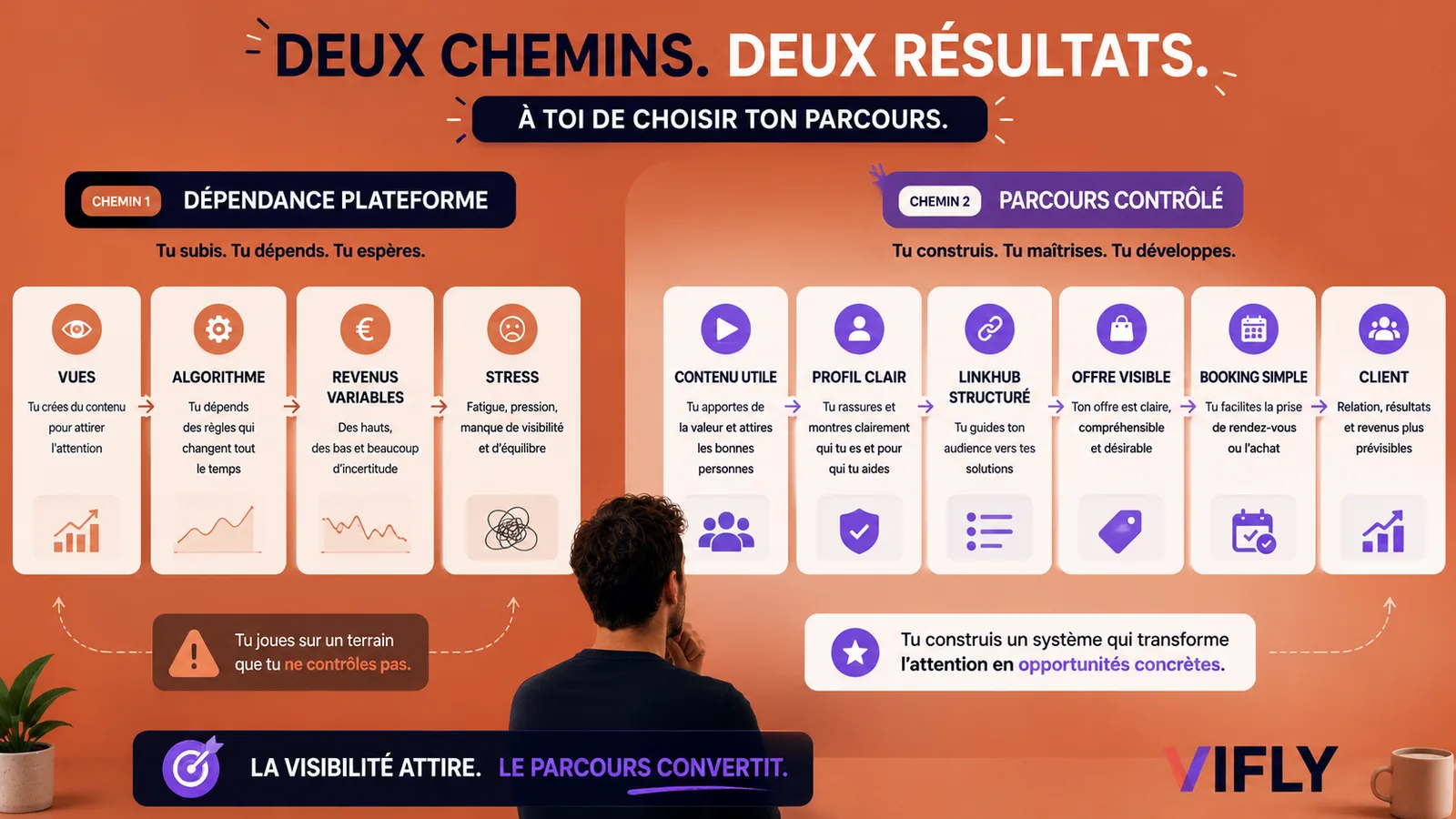
2. Creating direct income
Direct revenues do not necessarily mean starting a big training or selling a paid community.
For an intermediate creator, this can be:
- an audit;
- a board session;
- a short offer;
- a premium resource;
- a workshop;
- a diagnosis;
- mini-training;
- accompaniment;
- a reservation;
- a service offer;
- a sponsorable newsletter;
- a better package of collaboration.
The blog VIFLY already deals with this logic in Micro-influencer: how to monetize a small audience without waiting, which shows that a smaller but qualified audience can become profitable if guided by clear action.
3. Build visible evidence
The middle class of creators does not always need more content. She often needs more evidence.
Evidence can be a client case, a result capture, a testimony, a before/after, a clearly explained method, a portfolio, a demonstration, a recommendation, or even a page that simply explains how to work with you.
Brands, customers and prospects don't just want to see that you know how to publish. They want to understand why they should trust you.
4. Thinking as an independent, not just as a creator
The period when to make content was enough to create a stable trajectory is much less obvious.
The intermediate creator must think like an entrepreneur: offer, channel, conversion, customer experience, retention, proof, margin, time, recurrence.
This does not make creation less human. On the contrary, it makes it more sustainable.
Content is no longer just an end. It becomes the entry of a system.
Concrete examples according to your profile
Content creator
You make Reels or Shorts on a specific subject. You have views, sometimes a lot, but little income.
The reflex is not necessarily to publish more. The reflex is to create a simple offer linked to your expertise: an audit, a resource, a mini-training, a workshop or a page to work with me.
Then your content should guide to this offer instead of just being informative.
Coach
You publish tips, you inspire, you get messages, but requests are not regular.
The problem may come from your shift to action. If people have to guess how to book, they push back. A clear Booking can turn a vague intention into a concrete appointment.
Consultant
You have strong expertise, but your profile doesn't clearly show what you're doing, for whom and with what result.
In this case, the lever is not just content creation. It's the clarification of your positioning and your offers. One LinkHub structured can serve as a mini-commercial system: customer cases, offers, appointment making, free resource, contact.
Trainer
You sell knowledge, but your audience hesitates to buy.
The solution is not always to add more modules. It is often to make the promise more precise, the proof more visible and the path simpler. Article VIFLY Online training 2026: saturated market or real opportunity? complete this topic directly.
Independent or entrepreneur
You're not an influencer, but you use networks to attract prospects.
You're exactly concerned. The concentration of creative income shows that platform revenues are not enough to build a solid business. For you, the real challenge is to turn visibility into incoming requests, reservations or sales.
Frequent error: wanting to enter the top 1% instead of building a system
The creator economy sometimes gives the impression that it is necessary to become huge to succeed.
But this is not the only way.
The top 1 % plays a game of volume, notoriety, deals, team, personal media and sometimes celebrity.
The middle class of creators can play another game: expertise, niche, proximity, trust, direct offers and clear path.
A creator who earns a good living with 3 000 qualified subscribers, a clear service and ten appointments a month does not have the same model as a creator who depends on a million views.
Spectacular visibility should not be confused with profitable activity.
How VIFLY fits into this new reality
The question isn't just: Which platform pays best
The real question is: What do you really control in your activity
You don't completely control the scope of your content. You don't control the rules of monetization programs. You don't control the brand budget. You don't control the algorithm changes.
But you can control your profile, your ties, your offer, your evidence, your Booking and your journey.
That is precisely the role of VIFLY : help creators, coaches, consultants, freelancers, trainers and independents to structure their digital presence so as not to let their audience get lost after content.
VIFLY does not prevent platforms from changing. But VIFLY helps build something more stable around what you control.
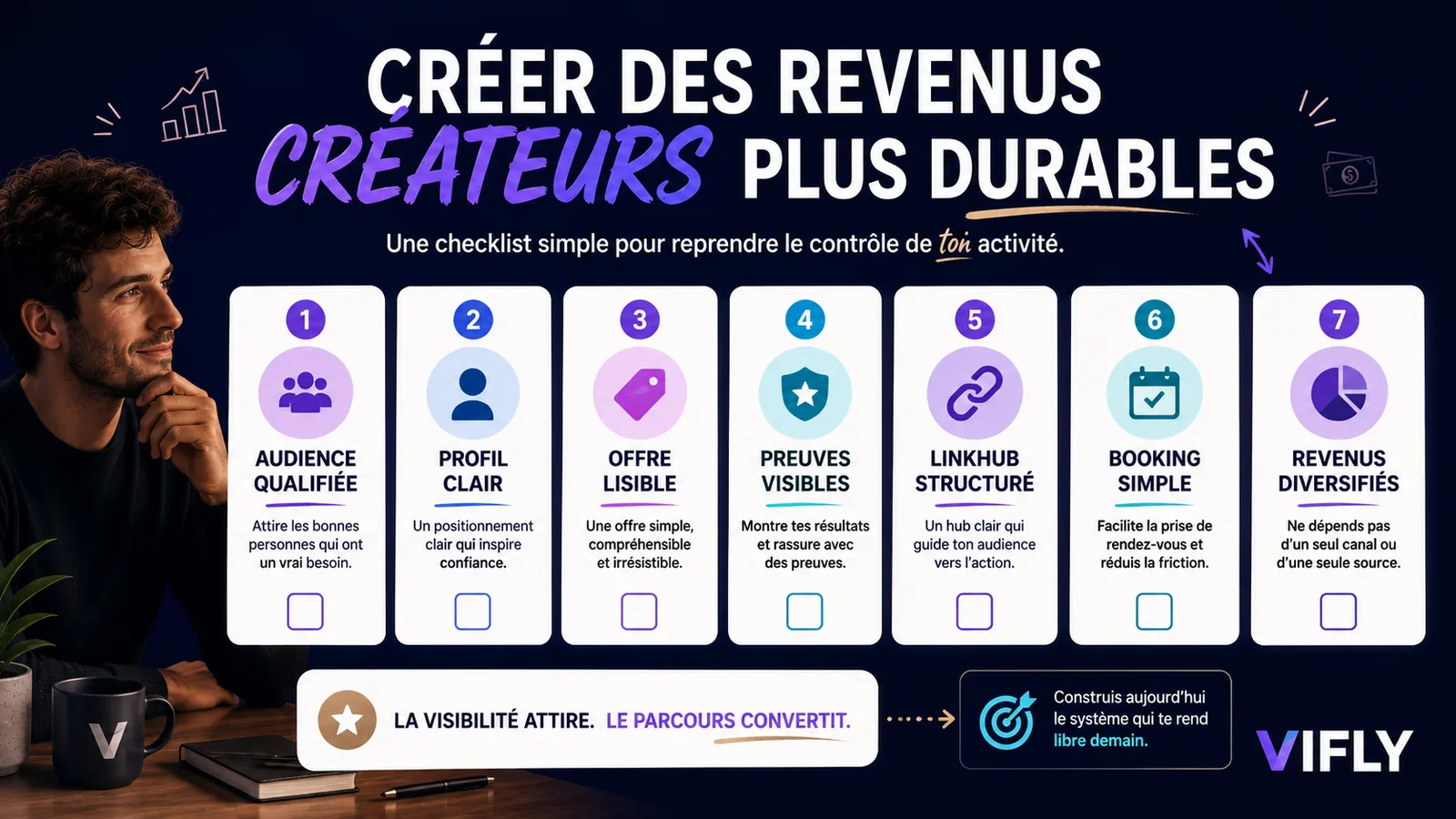
The middle class of creators does not disappear: it must change model
Creator economy remains growing. Grand View Research estimates the global market at 252,3 billion dollars in 2025, with a projection of 310,4 billions in 2026 and 1 345,5 billions in 2033.
But this growth does not guarantee that every creator will live better.
It's the whole shade.
Opportunities are increasing, but they are moving. They go to creators who know how to be useful, identifiable, credible and actionable. They go to those who do not just draw attention, but who know how to transform it.
Google holds a similar discourse on content: its systems seek to highlight useful, reliable and created content for people, not just to manipulate rankings. Google also recommends, for general search experiments, producing unique, expert-led and non-exchangeable content, while keeping SEO fundamentals.
The same logic applies to creators: what is generic becomes more fragile. What is clear, specific and useful becomes more valuable.
Conclusion: the average creator is not condemned, but the blurred creator is
The middle class of creators does not disappear at once.
But it finds itself caught in the midst of two forces: on one side, the very large creators who capture an increasing share of visible incomes; on the other, niche creators who build more direct, more controlled incomes, closer to their audience.
Staying in the middle without a system becomes dangerous. Publishing without offers becomes insufficient.
Having an audience without a course becomes frustrating. Waiting for platforms to pay better becomes risky.
The good news is that a creator doesn't need to become famous to become more stable. It must become clearer.
Clear on what he brings. Clear on whom he helps. Clear on what he sells. Clear on the next step.
Visibility attracts. The path converts.
Create a stronger course with VIFLY
If you want to reduce your dependence on platforms, start by structuring what you control: your profile, links, offers, proofs and reservations.
With VIFLY, you can centralize your universe, organize your LinkHub, present your offers and facilitate appointments with VIFLY Booking.
You don't need to wait to be in the top 1 %. You can start by making your journey clearer.
Frequently Asked Questions
Is the middle class of creators disappearing?
It doesn't totally disappear, but it becomes more fragile. Recent data show a growing concentration of payments among the best creators, while many middle creators remain dependent on irregular income, changing platforms and ad hoc collaborations.
Why are creators' incomes so concentrated?
Revenues are concentrated because brands seek more measurable profiles, platforms impose eligibility rules, and larger creators often have more evidence, teams, data, visibility and bargaining power. Intermediate creators must therefore compensate with clarity, niche, trust and direct income.
Can we live from creating content with a small or medium audience?
Yes, but rarely depending only on platform monetization views or programs. A small or medium audience can become profitable if it is qualified and guided to a clear offer: service, audit, training, premium content, subscription, Booking or accompaniment.
What is the difference between a visible creator and a profitable creator?
A visible creator attracts attention. A profitable creator knows what to do with this attention. It has a clear profile, a readable offer, a structured LinkHub, evidence and a simple next step to turn the audience into clicks, customers, bookings or opportunities.
How can we avoid relying solely on platforms?
You have to diversify your income and regain control of the course: build a list, offer a direct offer, structure your link in organic, make your profile more professional, facilitate making appointments and create visible evidence. Platforms remain useful, but they must not be the whole business.
Building stronger creative incomes
If the middle class of creators becomes more fragile, the solution is not only to publish more. We need to structure a real strategy for creator monetisation with offers, a clear path and income less dependent on platforms.
Create direct revenue with premium content
When advertising revenues or collaborations become unstable, creators must build their own income. A concrete lead is to selling private content online with subscriptions, premium content or unit sales.