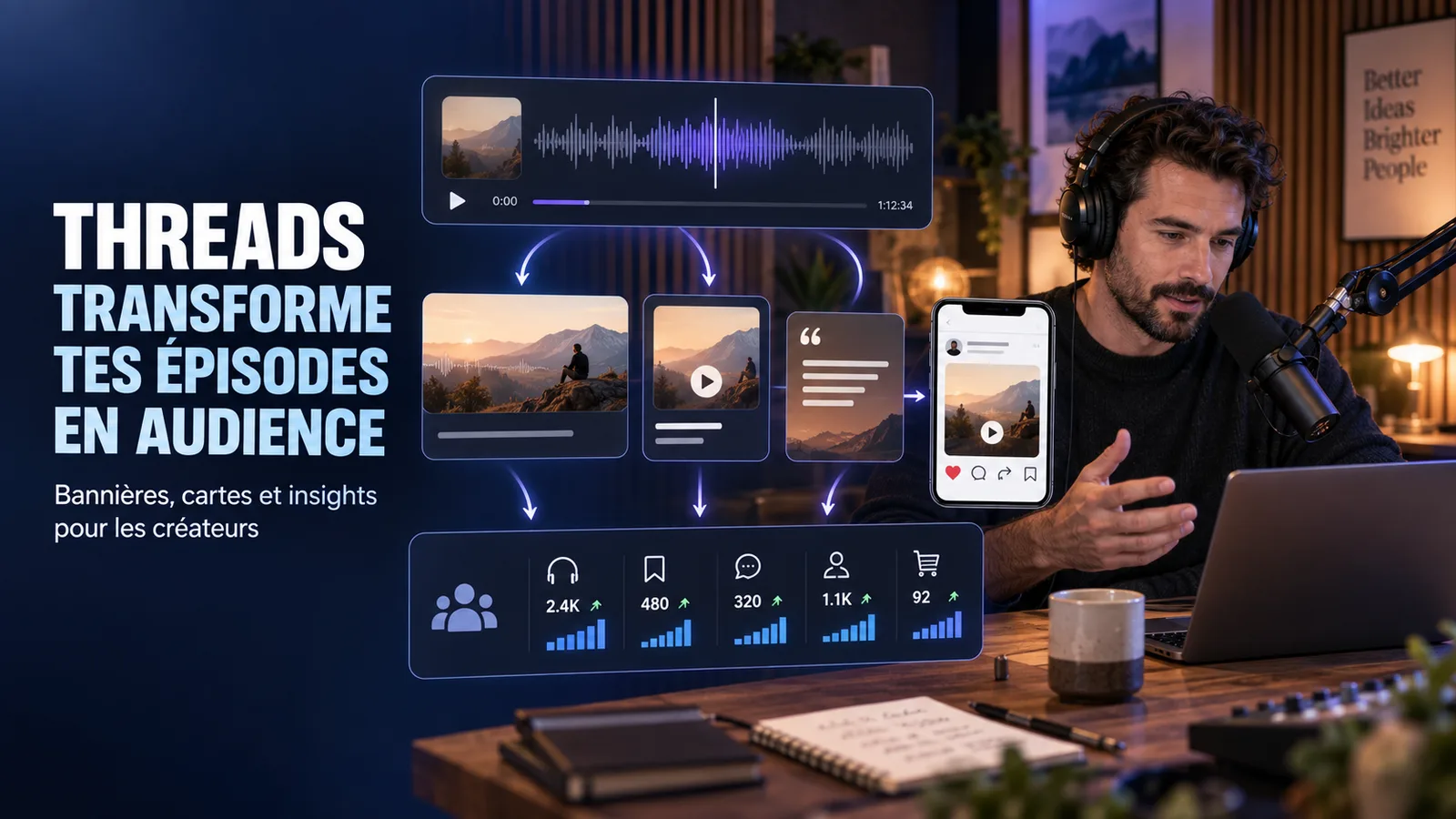
Threads has just transformed the podcast into a truly social phenomenon. Since 16 September 2026, Meta has been rolling out new tools to help creators make their shows more visible, highlight an episode, share clips or transcripts and, above all, measure the clicks and saves generated by Threads. For a creator, the implications go far beyond the podcast itself: the platform demonstrates how long-form content can be broken down into multiple entry points towards a more lasting relationship with the audience.
Information verified on 17 September 2026. Meta states that the new features are being rolled out from 16 September. The official announcement does not list any specific geographical restrictions or a country-by-country timetable. This does not mean that every account will see them immediately: as with any gradual roll-out, the actual timing may vary.
What Threads has just added for podcast creators
Meta offers a coherent set of features rather than simply a new post format. Creators can now display a podcast banner on their profile and posts, select an episode to highlight, and turn episode links into more visible, clickable cards.
Threads also adds formats designed to highlight different angles of the same episode: posts based on transcripts, videos and maps featuring a guest. For listeners, an episode discovered in the feed can be saved to be revisited later. For creators, Threads can send an automatic reminder when a new episode is available to encourage them to share it.
The most strategic new feature is probably Podcast Insights. Meta states that these statistics show the reach and engagement that Threads generates for a podcast, including clicks and saves. So we’re no longer just talking about views or reactions: creators are starting to see whether their social presence triggers action towards their content.
TechCrunch confirms the same positioning: Threads is not, at this stage, seeking to become a podcast hosting service. Rather, the platform aims to become a space for promotion, discovery and conversation around podcasts. This distinction is important: the main content can remain elsewhere whilst Threads acts as a distribution and discussion layer.
Why this development goes far beyond the world of podcasting
Podcasts are a good testing ground for understanding a problem faced by almost all freelancers: producing high-quality content does not guarantee that it will be discovered. A 45-minute podcast episode, a long video, a training course, a newsletter or a conference often contain a great deal of value, but require a significant commitment even before the audience knows whether the content is right for them.
Threads’ new tools reduce this friction by providing multiple entry points. A transcript excerpt might appeal to someone who prefers to read. A guest profile might interest someone who already knows that expert. A short video can bring a powerful passage to life. An episode card can then turn that curiosity into a click.
This is where the VIFLY perspective becomes important: Long-form content should no longer be viewed as a single post, but as a pool of assets capable of guiding the audience from discovery to action. Value lies not only in the number of posts published. It lies in the quality of the journey from the first point of contact to the next stage.
This approach follows the principle of visibility → understanding → trust → action → opportunity. Threads can generate visibility and spark conversation. However, the creator must still organise what the user discovers next: their identity, their expertise, their resources, their services and, where applicable, the option to book an appointment.
Two practical examples for freelancers and creatives
A coach turns an episode into a journey of discovery
Let’s imagine a career coach who publishes a 30-minute podcast on career change every week. Until now, she simply shared the link to the episode on her social media with a brief description. The problem is obvious: someone who doesn’t know her has little reason to immediately set aside 30 minutes to listen to her.
Using the approach proposed by Threads, it can treat the same episode as several different pieces of content. First, it publishes an extract from the transcript focusing on a key sentence. It then shares a short video taken from the corresponding section, before highlighting the full episode with a dedicated card.
Anyone interested can save the episode and come back to it later. If they’d like to find out more about the coach before going any further, a LinkHub VIFLY can centralise their podcast, presentation, resources and offering. If the episode sparks a desire to engage, VIFLY Booking could be the natural next step in booking an appointment.
The benefit, therefore, is not simply ‘publishing more’. It lies in creating multiple levels of engagement around a single piece of editorial content.
A trainer uses insights to choose the right angles
Let’s now consider an artificial intelligence trainer who hosts a monthly video programme. An episode dedicated to AI agents covers three topics: administrative automation, customer relations and content creation.
Instead of promoting the episode with a single generic post, he publishes three separate snippets on Threads, each focusing on a specific issue. Podcast Insights can then help him see which angles generate clicks and saves. If the segment on administrative automation receives fewer visible reactions but more saves and clicks, this signal may be more commercially valuable than a clip that attracts lots of comments but no follow-up action.
He may then explore this topic in more depth in a future article on the blog VIFLY, a resource, a training course or an offer. The analysis no longer stops at ‘which post got the most views?’. It becomes ‘which topic made the right people want to keep coming back?’.
The real change: measuring the shift from attention to intention
Social media has long encouraged creators to focus primarily on visible metrics: views, likes, comments and followers. Whilst this data remains useful, it does not always indicate whether a piece of content actually brings a person closer to making a decision.
A click on an episode indicates a stronger intention than a mere impression. A save may signal that a user considers the content relevant enough to return to it. None of these metrics guarantees that the episode will be listened to in full, a sale will be made or a lasting relationship will be formed, but they do help to better distinguish between passive attention and active interest.
For VIFLY, this is precisely where the value of this update lies. A content creator should not simply optimise for what the algorithm rewards in the short term. They should also look out for behaviours that indicate a user wants to continue their journey.
This distinction can influence editorial strategy. Highly viral content can attract a large but less targeted audience. Conversely, a more specialised piece of content may reach fewer people whilst generating more clicks, saves, profile visits or enquiries. The latter can be far more valuable for a consultant, therapist, trainer or freelancer.
Points to consider and things to watch out for before changing your strategy
First point to note: these features are designed specifically for podcasts. It would be incorrect to claim that all the cards, banners or statistics mentioned are available for any form of long-form content. However, the editorial approach they illustrate can be applied to a video, a newsletter, a webinar or a training course.
Second point: Meta states that the tools are currently being rolled out. The official announcement on 16 September does not provide a list of excluded countries, but the absence of any announced restrictions does not guarantee immediate availability across all accounts. Check your Threads profile before planning a schedule that relies on a specific feature.
Third limitation: a click is not a conversion. Podcast Insights helps to better measure what Threads brings to the podcast, but it does not replace an analysis of the full user journey. If someone clicks and then leaves immediately, the metric remains positive in Threads even though the overall experience has not been successful.
Fourth point to bear in mind: do not turn every episode into a barrage of identical snippets. Useful recycling involves changing the angle, the level of detail or the format. Repeating the same message ten times tires the audience. On the other hand, extracting ten genuinely different ideas extends the lifespan of the original work.
Finally, Threads remains a third-party platform. Its formats, rules and algorithms may change. It is therefore sensible to build visibility and conversations there without making it the only place where your audience can understand your creator business. A central presence such as VIFLY ensures a consistent visual reference point across the different channels.
What to do next? A six-step action plan
- Check your Threads account. Check whether the new podcast options are already visible. Don’t assume that a feature announced as being rolled out is immediately active on your profile.
- Choose just one recent long-form post. Choose an episode, an interview or a programme that contains several key ideas, rather than trying to cover your entire catalogue.
- Identify three entry points. Look for a thought-provoking quote, a practical tip and a story or a human example. Each angle should work even if the user is not already familiar with the episode.
- Assign a format to each corner. A transcript to convey the exact idea, a video to convey emotion or demonstrate something, an episode guide to lead the viewer to the full content. The aim is not to duplicate, but to adapt.
- Measure the actions that matter. Compare reach, clicks and saves. Then use your own tools to see what happens after the click: visits, sign-ups, enquiries, bookings or sales, depending on your creator business.
- Build the future of Threads. Make sure that anyone interested can immediately find a clear layout, your key content and the relevant call to action. If your creator business relies on bookings, the path might be Threads → content → LinkHub → Booking rather than a series of links with no clear hierarchy.
After a few posts, don’t just look for the format that generates the highest figures. Look for the one that most naturally guides the user towards the next step. This is often where the difference lies between a content strategy that’s merely visible and one that’s useful to the business.
Threads confirms a fundamental trend in the creator economy
Platforms no longer want to simply host isolated posts. They are gradually building tools that link content, discovery, conversation and analytics. The podcast update to Threads is particularly interesting because it does not seek to replace the original content: it organises what happens around it.
For creators and freelancers, this approach can be more sustainable than the constant race for novelty. A good episode, interview or video can serve as multiple points of engagement without losing its coherence. The editorial question is then no longer ‘what should I publish today?’, but ‘which part of my work deserves a new entry point today?’.
This change may seem subtle, but it is strategic. Creators who learn to transform a strong idea into several interconnected formats can produce less under pressure, make better use of what they have already created and, above all, gain a better understanding of what engages their audience.
FAQ: Threads’ new podcast tools
What new features has Threads announced for podcasts?
Meta has announced podcast banners on profiles and posts, an episode selector, clickable link cards, posts featuring transcripts, videos and guests, the ability to save episodes, post reminders and Podcast Insights.
Since when have these features been available?
Meta announced their roll-out on 16 September 2026. As of 17 September 2026, the announcement states that they are currently being rolled out, without specifying a precise timetable for each country or each account.
Can Threads now host a full podcast?
No. The focus of the announcement is on promoting, discovering and discussing podcasts. Episodes can continue to be hosted on the usual services.
What does Podcast Insights measure?
Meta states that Podcast Insights shows the reach and engagement generated by Threads for a podcast, including clicks and saves.
Are these tools useful if I don’t produce a podcast?
The features outlined are specific to podcasts, but the approach can be applied more broadly: extracting multiple angles from a long piece of content, adapting them to different formats, and measuring which ones drive the audience towards more engaged behaviour.
Sources
- Meta Newsroom Threads Expands Podcast Toolkit for Creators and Listeners, 16 September 2026 : official announcement of features and their roll-out.
- TechCrunch Threads’ new features let podcasters promote shows and reach listeners, 16 September 2026 : independent confirmation and context regarding Threads’ positioning as a discovery platform rather than a hosting service.