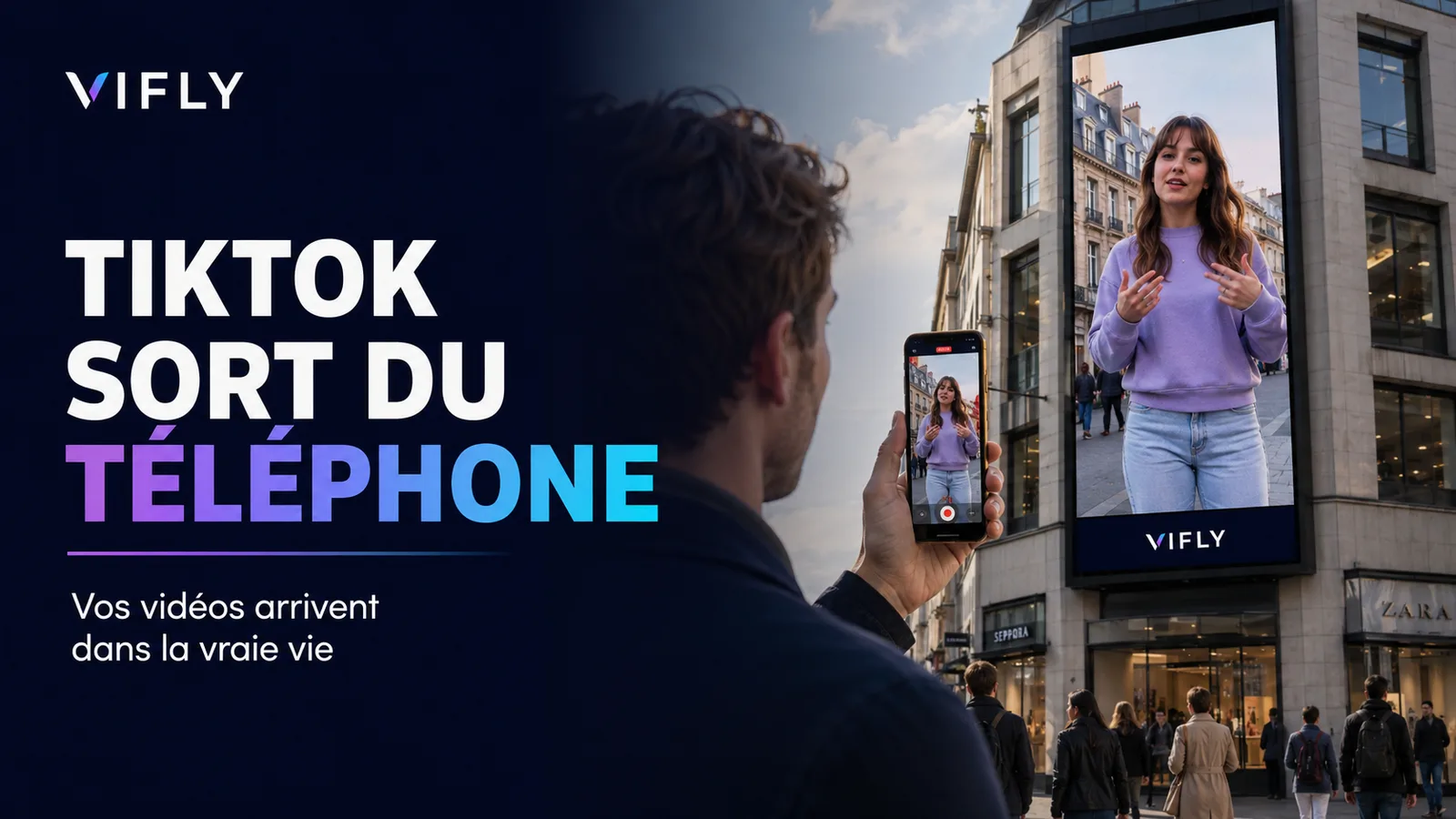
TikTok brings your videos out of your phone: creators’ content is coming to advertising screens in France
You post a TikTok video. It goes down well. A brand spots it.
Up until now, the standard procedure has been to turn this video into an advert on TikTok, possibly with your permission.
But tomorrow, that same video could also end up on a giant screen in a shopping centre, a supermarket, a pub or an outdoor advertising space.
And this is precisely where many creators risk making a mistake: assuming that a brand asking to ‘reuse a video’ is referring solely to TikTok.
Since 25 August 2026, TikTok is stepping up its programme in Europe Out of Phone, with six new partners and an expanded presence, notably in France, the United Kingdom, Belgium, Spain and Italy. TikTok aims to extend its reach beyond the smartphone and enable advertisers to extend their creator-driven campaigns to physical screens.
For creators, UGC creators, freelancers and influencers, this development raises a question far more important than that of views:
How much is your content worth when it’s no longer just for your TikTok account, but for an advertising campaign distributed in the real world?
TikTok Out of Phone: what exactly is changing?
TikTok Out of Phone isn’t entirely new.
The platform had presented the programme as early as October 2023 as a solution enabling brands and partners to extend TikTok content to screens located in venues such as cinemas, restaurants, airports, petrol stations, shops and on billboards.
The update on 25 August 2026 concerns its much broader European expansion.
TikTok announces six new partners:
- Alight Media
- DooH it
- Powerpill
- Zoom Media
- Next-Gen Media
- C-Screens
The programme is therefore intended to increase the presence of TikTok content on screens located, in particular, in:
- shopping centres
- wellness centres
- supermarkets
- bars
- universities
- outdoor TV screens
- various digital signage networks
And above all, France is explicitly included amongst the relevant markets.
Your TikTok videos will not automatically be displayed on the street
This is probably the most important point in this article.
The announcement in no way implies:
“TikTok can take any public video and automatically display it on a billboard.”
The official documentation describes, amongst other things, an approach known as Community Amplification, where partners search for relevant content and then safeguard the creator’s rights before building the final advertising asset.
In other words, any commercial use of your content in this context involves a rights clearance process.
And that is precisely why creators need to learn to better understand licensing requirements.
‘Can I use your video?’ is no longer enough of a question
A professional enquiry should provide much more detail:
Where?
TikTok only?
Instagram?
Facebook?
A website?
Advertising hoardings?
Any shops?
For how long?
30 days?
6 months?
2 years?
In which countries?
France only?
Europe?
The whole world?
What is it used for?
Organic post?
Digital advertising?
Outdoor display?
Television?
Point of sale?
What changes should be made?
Can the brand:
- Crop the video?
- Add your logo?
- change the subtitles?
- cut out sections?
- Change the music?
- Use your face separately?
These details determine the true commercial value of the content.
A TikTok video is gradually becoming an advertising asset
This is probably the most important shift in mindset for a creator. Let’s suppose a brand pays you 400 € to produce a UGC video.
She posts it on her account. Very good.
But let’s now imagine that she then wants to use this video:
- in its TikTok adverts
- in its shops
- on screens in shopping centres
- on digital displays
- for six months
- in five countries
It’s not quite the same service anymore.
Your face, your voice, your work and your credibility become part of a much wider media campaign.
The cost of producing content and the cost of licensing rights should therefore not automatically be confused.
This distinction already exists in UGC and influencer campaigns. Out of Phone simply makes it much more visible.
TikTok even recommends adapting videos to the physical world
A Reel or TikTok designed for a mobile phone is not automatically suitable for a billboard.
The official TikTok Out of Phone documentation recommends several adjustments.
Videos must be able to play without sound
Most ‘Out of Phone’ screens are silent. A video that relies entirely on a voice-over therefore becomes incomprehensible.
TikTok recommends using:
- subtitles
- posts
- visually accessible information
The content must be extremely quick to understand
For ad slots, TikTok generally recommends videos of around 10 to 15 seconds maximum.
A passer-by does not behave like a TikTok user. They do not necessarily look at the screen for 45 seconds.
The message must remain visually striking
The official recommendation highlights, in particular:
- contrast
- light branding
- immediately recognisable post
- Simple CTA where relevant
The logic therefore changes as follows:
TikTok mobile → capture the scroll.
TikTok Out of Phone → capturing a glance in a physical environment.
TikTok wants to link creator content with physical advertising
The announcement on 25 August is of particular interest to brands.
TikTok explicitly mentions two opportunities:
- the content sponsorships
- thead extension, enabling an advertiser to extend TikTok creator content to DOOH, Digital Out Of Home.
DOOH simply refers to digital advertising displays located outside the home:
urban screens, shopping centres, railway stations, shops, sports centres, etc.
The objective then becomes:
one TikTok campaign → several physical environments.
And the creator becomes the link between the two.
This template already works on real campaigns
Out of Phone is not just a product promise.
TikTok has already published several case studies.
Redken: stylists’ videos turned into outdoor displays
In a campaign for Redken by L’Oréal in the Netherlands and Belgium, the best creator videos were turned into billboards thanks to Out of Phone.
TikTok reports 2.1 million impressions on Out of Phone for this campaign, with various gains measured in terms of brand interest and awareness. These figures are taken from the TikTok case study and should not be generalised to all campaigns.
Sephora: creative content right down to the shops
In Canada, Sephora used Out of Phone Retail to display content created by influencers on large screens installed in several shops.
TikTok states that the campaign worked with a specialist partner to securing in-store usage rights the designers concerned.
This is an excellent example of the new reality:
The right to post on TikTok and the right to use your image in a shop are two distinct matters.
Dove Men+Care: TikTok even on city billboards
Dove also used creative content on digital billboards in Amsterdam and Rotterdam.
TikTok reports, in particular, an increase in brand consideration and a higher sales lift in areas combining TikTok and Out of Phone compared to TikTok alone. Again, these are results from a specific campaign, not a guarantee of performance.
Why this development could be an opportunity for small-scale creators
You might think that only the biggest influencers are affected. Not necessarily.
Brands are often looking for content that addresses a very specific situation.
For example:
a real customer showing a beauty product;
a coach explaining a feature in fifteen seconds;
a culinary creator using a product in their kitchen;
an athlete using equipment;
a local designer featured in a regional campaign.
In this context, the authenticity and relevance of the content may matter more than the sheer number of followers.
That’s exactly how UGC works. The creator isn’t just selling their audience.
He can also sell:
its ability to produce credible advertising.
Your number of subscribers and the value of your content are two different things
Let’s take two designers.
Creator A
100,000 subscribers.
Very good audience figures.
But his videos do not match the type of content the brand is looking for.
Creator B
8,000 subscribers.
But it delivers precisely the sort of authentic demonstration the brand needs.
In the case of a content campaign, the latter may well have significant commercial value.
This becomes even more true when the brand prioritises purchasing above all else:
- a face
- a testimonial
- a demonstration
- a design aesthetic
- expertise
- a format
and that it then has its own media budget to distribute this content.
Audience and content are becoming two separate commercial assets.
Creators must start negotiating usage rights
When a brand contacts you, don’t just ask:
“What’s your budget?”
Ask:
“How do you intend to use the content?”
Then clarify several points.
Duration
Example:
advertising rights for 3 months.
Territory
Example:
Mainland France and the French overseas departments.
Media
Example:
TikTok Ads only.
Or:
social media + website + retail + DOOH.
Exclusive
Does the brand prohibit you from working with its competitors?
For how long?
Changes
Can she change the design?
Renewal
What happens once the rights have expired?
This discussion is not intended to unnecessarily complicate the contract.
It protects both parts.
An ‘Out of Phone’ use case should not be treated as a simple repost
This is an important recommendation.
If you have sold:
a TikTok video + 30 days of TikTok advertising rights
and that the brand then asks:
‘Could we also display it in 150 shopping centres?’
this is a new usage.
It can justify:
- a contractual extension
- a new duration
- a new frontier
- additional remuneration
The amount obviously depends on the context, the creator, the market and the scale of the campaign.
There is no one-size-fits-all price.
But automatically accepting all uses simply because ‘video already exists’ amounts to forgetting that its commercial value stems precisely from its exploitation.
Your media kit should begin by setting out your rights and formats
This development may also lead to changes in media kits.
A traditional media kit contains:
- subscribers
- statistics
- audience
- collaborations
A more professional media kit may also specify that you offer:
- Sponsored Reels
- Sponsored TikTok posts
- UGC creation
- content for paid media
- whitelisting / advertising authorisation
- retail content
- terms of use
- content that may be suitable for DOOH
VIFLY already offers a guide on creating a professional media kit, which is particularly useful for structuring this package: Create a professional designer’s media kit.
The aim is no longer simply to say:
“Look how many people follow me.”
But also:
“Here’s what I can produce and how a brand can work with me.”
TikTok also uses AI to help brands find relevant content
Another factor is reinforcing this trend. TikTok now has a Content Suite intended for advertisers.
Its documentation explains that the tool searches for organic content related to a brand by analysing, in particular:
- captions
- hashtags
- voice
- text visible in the video
- brand mentions
TikTok then uses various signals to identify content that may have advertising potential.
This ties in with a trend we have already documented on VIFLY: brands and their tools are becoming capable of searching much more systematically the creator or content that precisely meets a need.
Read: how brands now find their creators.
For a designer, the implication is simple:
Your content must be clear, recognisable and professional even before a brand contacts you.
Just getting noticed isn’t enough: you have to be prepared to work with a brand
Imagine that a brand discovers your content today. They like your video. They open your profile.
Then she searches for:
- your work email address
- your media kit
- your UGC posts
- your portfolio
- how to contact you
And she finds nothing. Opportunities can slip away very quickly.
This is exactly where the VIFLY logic comes into its own.
A VIFLY LinkHub can serve as a central hub to bring together:
- your social media
- your best content
- your portfolio
- your media kit
- your offers
- your creator business contact details.
The code becomes:
TikTok → Explore → Profile → LinkHub → Portfolio → Contact → Collaboration.
The platform creates visibility. Your business infrastructure enables you to capitalise on it.
Booking can also be used by creators who sell their expertise
Out of Phone is primarily aimed at advertising campaigns and creators.
But the principle is broader:
the more your content circulates, the more it needs to lead somewhere.
For a consultant, coach, trainer or therapist using TikTok as a client acquisition channel, a video can generate organic reach without a brand partnership.
The visitor simply wants to work with you.
In this case, VIFLY Booking can become the natural continuation:
video → profile → LinkHub → service → booking.
VIFLY Booking is designed to showcase services and turn interest into bookings.
The message remains the same:
A view only becomes truly interesting when it can lead to an action.
How do you create a TikTok that works outside of a mobile phone?
The Out of Phone documentation offers what is effectively a new design grid.
Think ‘understanding without sound’
Before publishing, mute the sound. Is your video still understandable?
If not, please improve it:
- subtitles
- posts
- visual demonstration
Get the word out quickly
Ask yourself this question:
Can someone grasp the subject in two seconds?
Create a visual that makes a strong enough impression
On an outdoor billboard, your video is competing with:
- the street
- other panels
- people
- shops
- dozens of stimuli
The image must be immediately legible.
Keep a clean version of your content
For videos with strong commercial potential, keep:
- high-quality master
- version without protected music
- separate subtitles
- file without watermark
- rushs
- any permissions required for the people shown
If a brand contacts you six months later, you’ll be ready.
7 steps to take right now
1. Save your best content
Don’t rely solely on the file published on TikTok.
2. Identify videos with advertising potential
Ask yourself:
Could this video work for a brand even outside my profile?
3. Create a clear UGC offer
Please specify your main formats:
- demo
- testimonial
- tutorial
- facecam
- lifestyle
- unboxing
- advertising content
4. Separate content creation from rights
Your quote may include:
content production
and
rights of use.
5. Put together your media kit
You need to be able to send it straight away when a brand contacts you.
6. Centralise your online presence
Your LinkHub VIFLY should provide quick access to your content, your offers and your contact details.
7. Understand the new tools
Advertising platforms are becoming increasingly complex and AI-powered.
VIFLY AI can help you develop the right habits for using artificial intelligence to analyse, structure and prepare your creator business without blindly automating your content.
The real change: a post is no longer necessarily the end of a piece of content’s life
For a long time, a TikTok followed a relatively simple cycle:
publication → views → engagement → gradual decline.
The template is looking more interesting.
A good design could now potentially become:
organic post → TikTok advert → retail campaign → outdoor advertising → new audience.
The commercial lifespan of content is getting longer.
And when content becomes reusable, the associated rights are becoming increasingly valuable.
This is exactly the transition that creators need to understand.
Conclusion: your next video could be worth more than its views
‘TikTok Out of Phone’ doesn’t mean your next Reel will appear tomorrow on a giant screen in Paris.
That’s not the point. The real change is economic.
TikTok is building an infrastructure that enables brands to distribute creators’ content between the digital world and the physical world, and France is now one of the European markets explicitly targeted by this expansion.
For a creator, this means that a video should no longer be judged solely on:
views + likes + comments.
It may also have:
creative value, advertising value, licensing value and image value.
And these costs are not necessarily included in the initial production price.
Your next step
Before agreeing to your next collaboration, always include this question in your discussions with the brand:
“Could you please specify the required usage rights: media, duration, territory and advertising use?”
Then do three things this week:
- retrieve the original files for your ten best pieces of content;
- create a page or section clearly outlining your collaboration opportunities and your media kit;
- add this page to your VIFLY LinkHub so that a brand discovering you can immediately understand how to work with you.
Because by 2026, your video might no longer be just a piece of content.
It can become a media outlet.
And if a brand wants to display it on thousands of screens, make sure you know exactly what you’re selling him.
FAQ
What is TikTok Out of Phone?
TikTok Out of Phone is a service that enables brands and partners to extend content from the TikTok ecosystem to physical screens: digital billboards, shops, shopping centres, restaurants and other environments.
Is TikTok Out of Phone available in France?
On 25 August 2026, TikTok announced a European expansion explicitly including the France, as well as the United Kingdom, Belgium, Spain and Italy.
Can any TikTok video be shown in the street?
The announcement does not describe the automatic use of all public videos. For the Community Amplification, TikTok states that its partners source relevant content and safeguard creators’ rights before forming the final asset.
Should a brand pay me more to use my video on a billboard?
The price depends on the contract and the negotiations. However, use in outdoor advertising constitutes a different scope of operation from a simple organic post. The creator must therefore carefully check the media, duration, territory and rights granted before giving their consent.
What is DOOH?
DOOH stands for Digital Out Of Home. This refers to digital advertising displayed on screens located outside the home: shopping centres, streets, railway stations, shops, sports centres or other public places.
Should ‘Out of Phone’ videos be different from standard TikTok videos?
TikTok recommends, in particular, designing content for an environment that is often without sound, with subtitles, a quick message and excellent readability. For billboards, the platform generally recommends videos of 10 to 15 seconds maximum.
Sources
TikTok Newsroom: “TikTok Expands Out of Phone Programme across Europe”, 25 August 2026. Main official source. Confirms the six new partners and the expansion into France, the United Kingdom, Belgium, Spain and Italy, display locations and opportunities for sponsorship and DOOH advertising expansion.
TikTok for Business: “Creative guidelines for TikTok Out of Phone”, last updated May 2026. Official documentation on the format: environments often without sound, short videos, DOOH adaptation, approval processes and, above all, securing creators’ rights within the framework of Community Amplification.
TikTok for Business: “Getting started with TikTok Out of Phone”, May 2026. Official documentation confirming that access is granted via TikTok’s teams and partners, subject to verification of the brand’s, sector’s and geographical areas’ eligibility.
TikTok Newsroom: “Introducing Out of Phone: TikTok Beyond the Mobile Screen”, 17 October 2023. Original programme announcement used to explain the background and concept: bringing TikTok content to billboards, cinemas, restaurants, airports and retail outlets.
TikTok for Business: Redken / L’Oréal, Out of Phone case study. Used as a real-life example of how creators’ videos are transformed for outdoor display, and to illustrate the practical existence of the format prior to its current expansion across Europe.
TikTok for Business: Sephora Canada, Out of Phone Retail case study. A particularly relevant example regarding rights: TikTok explains that the campaign worked with a partner to source creators, manage approvals and securing in-store usage rights.