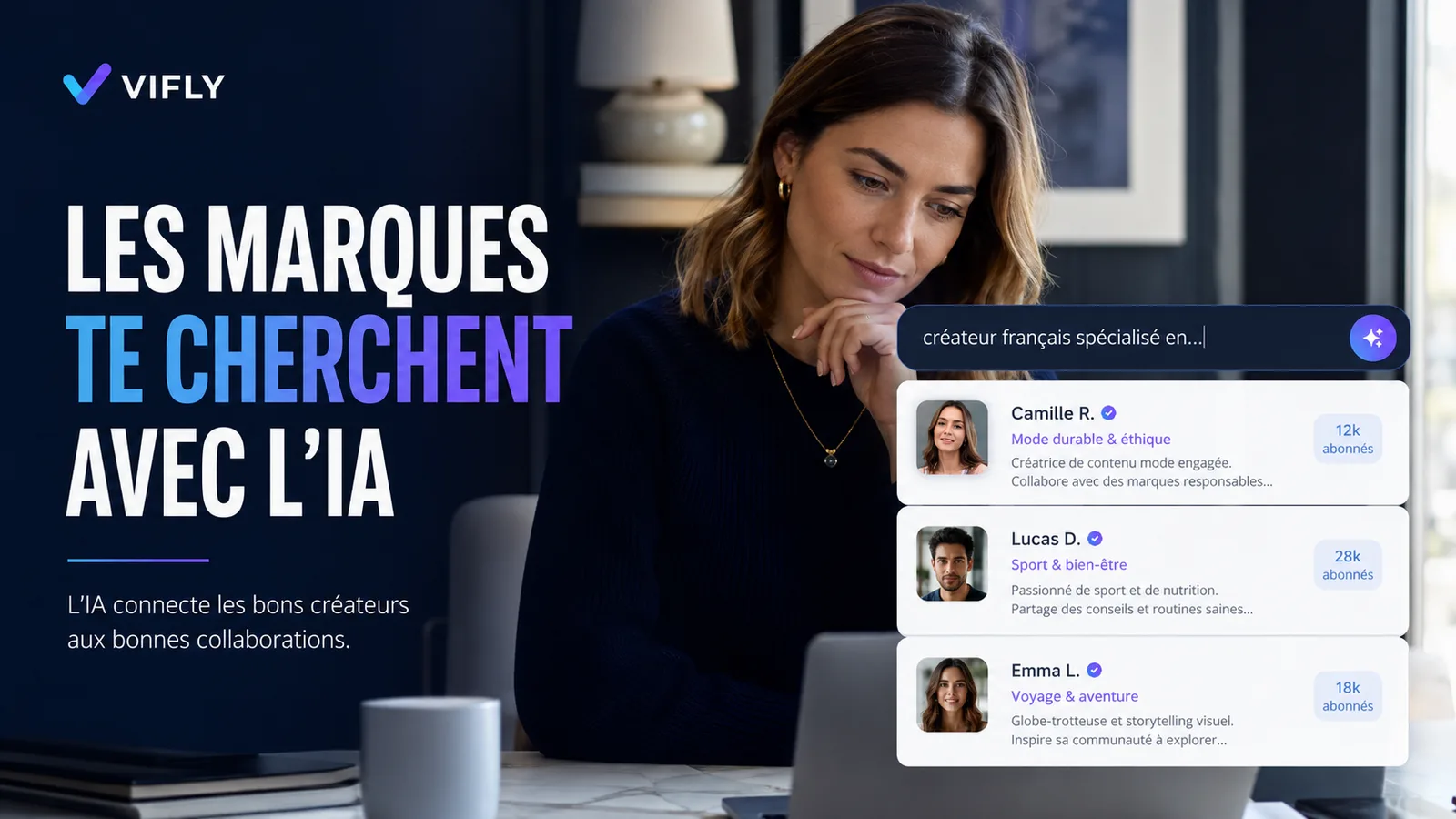
For years, finding an influencer was like searching a database.
A brand would select a platform, a category, a country, an audience size and a few statistics. It would then receive a list of profiles to analyse manually.
This mindset is starting to change.
On 18 August 2026, Featured announced Find Creators, a tool enabling businesses to search for creators simply by describing what they are looking for in natural language. The database announced covers approximately 380 million profiles notably from Instagram, TikTok, YouTube and LinkedIn.
A brand can therefore gradually move away from technical filters towards a request much closer to the one it would make to a human:
“Find me some French female entrepreneurs who talk about natural wellbeing to an engaged female audience.”
Or:
“I’m looking for marketing consultants who create educational videos for small businesses.”
For creators, the change is more significant than it seems. Because a new question arises:
If a machine analyses your digital footprint, does it immediately understand who you are?
The search for designers enters the era of natural language
The launch of Featured doesn’t come out of the blue.
Platforms specialising in influencer marketing are already developing similar systems. Modash, for example, offers an AI-powered search function capable of scanning over 380 million profiles and claims to analyse bios, captions and visual elements in particular to identify profiles that match a specific request.
The difference compared to a traditional search is fundamental.
Before: searching with filters
A brand could define:
- France
- 10,000 to 50,000 subscribers
- beauty
- minimum engagement rate.
These criteria remain useful. But above all, they describe figures.
Now: describe the ideal creator
With a natural language search, a business might potentially search for:
“French micro-creators who explain artificial intelligence in a way that’s accessible to entrepreneurs.”
Or:
“A fitness coach who publishes educational content, caters to women over 35 and has an engaged community.”
Search therefore becomes much more context-sensitive.
And this may gradually change the way a creator needs to think about their profile.
Your subscriber count won’t disappear, but your positioning becomes even more important
It would be an exaggeration to declare the death of analytics. Brands will, of course, continue to look at audience size, engagement, views, location, demographics and past performance.
But AI-assisted search adds an extra layer:
understanding the profile.
Let’s look at two examples.
Creator A: visible but difficult to understand
His bio:
Lifestyle | Motivation | Business | Travel ✨
Dream big.
DM collab.
He has 40,000 followers.
But exactly which audience does it reach?
What expertise does he have?
What sort of collaboration would be natural?
Why should a brand choose him for a particular campaign?
A person might look at several posts and eventually understand. Automated search relies primarily on the available signals.
Designer B: smaller but much more legible
His bio:
I help freelancers market their expertise more effectively using short videos.
Real Tips • TikTok • Personal branding.
He has 8,000 followers. His audience is smaller.
But its positioning is immediately clear.
For a search query looking for a content creator specialising in short-form content for entrepreneurs, it provides particularly clear signals.
This is where clarity becomes a form of search engine optimisation.
What AI can actually analyse about your profile
We must avoid taking the easy way out: we do not know exactly how each discovery engine weights each signal.
There is therefore no formula that can guarantee:
“Add these five words to your bio and brands will find you.”
However, the tools themselves do provide some clues. Modash explains that its AI-assisted search can analyse bios, captions and visuals to retrieve profiles matching a description.
This makes several elements particularly interesting.
Your bio
It should give visitors a quick insight into what you’re all about.
The topics actually covered
Describing yourself as a ‘marketing expert’ in your bio whilst posting exclusively lifestyle content creates an inconsistency.
Your vocabulary
Using the right words consistently helps to demonstrate your expertise.
Your visual content
In systems capable of analysing images and videos, the content itself can potentially serve as an additional signal.
Overall consistency
Your bio, your content and your positioning should all tell roughly the same story.
This principle actually holds true even without artificial intelligence.
A people-centred brand faces exactly the same problem when it comes across a profile that is impossible to understand.
How to make your profile easier for a brand to find
The good news is that there’s no need to learn a complicated new subject.
The initial improvements are extremely tangible.
1. Describe your creator business in one sentence
Try this structure:
I help [AUDIENCE] to [OUTCOME] using [EXPERTISE].
For example:
I help coaches and consultants turn their expertise into video content that generates leads.
Or:
I create content focusing on simple plant-based baking for families.
Or alternatively:
I explain cybersecurity in simple terms for micro-businesses and the self-employed.
A precise sentence is often better than a string of words such as:
Entrepreneur | Creator | Business | Motivation | Digital.
2. Use the words that your target market actually uses
If you’re a food photographer, please mention it.
If you’re creating beauty-related user-generated content (UGC), please state this.
If you’re a public speaking coach, say so.
If you follow freelancers on LinkedIn, make this information visible.
The aim isn’t to cram your bio full of keywords. The aim is to ensure that a human – and eventually a machine – doesn’t have to guess what you do.
3. Publish content that is consistent with your positioning
Your profile shouldn’t just declare expertise.
He owes it to demonstrate.
If you want to be recognised as an Instagram marketing specialist, your content must provide evidence:
- analyses
- tips
- user feedback
- case studies
- frequently asked questions
- methods
- contextualised results.
This is much more effective than simply adding ‘Instagram Expert’ to a bio.
Your profile should also explain who you’d like to work with
This is an element that is often overlooked.
A creator may be very clear about their content yet completely opaque from a commercial perspective. An interested brand should be able to understand this quickly:
- if you’re open to collaborations
- the formats you produce
- your world
- any references you may have
- how to contact you
- where to find your media kit.
VIFLY already has a detailed guide on how to attract brands and secure paid collaborations. It is worth noting that a brand is looking for a like-minded audience, a credible profile and a clear career path.
This is an excellent addition to this latest development:
How to attract brands and secure paid collaborations
The media kit is once again becoming strategic
AI can make discovery easier. It doesn’t sign the contract for you.
Once identified, the creator still has to convince someone. This is where the media kit remains crucial.
It may feature:
- your positioning
- your audience
- your key statistics
- your formats
- your previous collaborations
- some representative content
- your contact details.
VIFLY also offers a comprehensive guide dedicated to this step:
Create a simple and professional designer media kit
The aim is not to impress with twenty pages. It is to enable a business to answer three questions quickly:
Who are you? Who are you talking to? Why should we work with you?
Your link in your bio becomes the bridge between discovery and opportunity
Now imagine that a tool recommends your profile to a brand.
Someone opens Instagram. They like your content. They click on your link. And they land on a list containing:
Spotify. Your YouTube channel. An old project. Your shop. Another social media platform. Your favourite playlist.
But no buttons:
‘Work with me’.
Technology has made you discoverable. Your journey has just missed out on an opportunity.
That is precisely the difference between visibility and conversion.
Using your LinkHub as a professional page
A VIFLY LinkHub can centralise social media, content, offers and calls to action on a single page. VIFLY also allows you to track traffic sources and direct visitors towards priority actions.
For a designer looking for collaborations, a simple structure could be:
Work with me
View my media kit
My best content
My offers / services
Contact me
My social media
LinkHub won’t automatically boost your ranking on a creator search engine. However, it can turn discovery into a career path.
And this distinction is essential.
Booking can turn interest into an appointment
For coaches, consultants, trainers or freelancers, making contact does not necessarily lead to a sponsored collaboration.
It can lead to a contract. A company discovers a consultant through their content. They view their profile. They understand their expertise. They wish to arrange a meeting.
At this point, write:
“Send me a DM and we’ll sort out a date”
creates unnecessary friction.
VIFLY Booking enables you to showcase services, offer time slots, accept Stripe payments where necessary, and automate confirmations and reminders.
The logic then becomes:
Search → profile → trust → LinkHub → Booking → appointment.
That is exactly what it means to turn visibility into an opportunity.
AI is also changing the way content is prepared
This change does not only affect profiles.
It relates to how a creator thinks about their positioning. AI tools can help to identify:
- questions from its audience
- the angles are already saturated
- emerging topics
- the phrasing used by his prospective clients
- the inconsistencies in its positioning.
But AI must remain a tool for analysis and assistance, not a machine for churning out hundreds of generic posts.
The aim is to gain a better understanding of your market in order to create more distinctive content.
To learn how to use these tools in a structured way, the resources at VIFLY AI can complement this approach.
The principle remains the same:
using artificial intelligence to enhance the quality of thought, not to suppress the creator’s personality.
Do micro-creators have anything to gain?
Potentially, a lot.
A traditional search based primarily on audience size automatically favours large accounts. A semantic search can enable a much more specific query.
A brand might be looking for:
“Micro-creators from Réunion who write about hiking and ecotourism.”
Or:
“Chartered accountants who create content to make management accessible to French freelancers.”
Or:
“French-speaking therapists who create educational content on stress management.”
In these situations, the relevance could become much more significant. Of course, this does not guarantee that a small designer will be selected.
But this can broaden the scope of its reach. And for very specific niches, this is particularly interesting.
Warning: do not optimise your profile for machines at the expense of humans
Every new technology immediately gives rise to its own ‘hacks’. It wouldn’t be surprising to see the following appear tomorrow:
‘The 25 words to include in your bio to be chosen by AI.’
That would be the wrong conclusion. Your profile is still primarily intended for people.
Proper optimisation therefore involves:
clearer, not more robotic.
Avoid a bio such as:
Beauty influencer, skincare, France, micro-influencer, UGC, creator, brand, collaboration, cosmetics.
Although it contains many relevant terms, it is a struggle to read.
Prefer:
I test and review facial skincare products for sensitive skin.
UGC & beauty collaborations • France.
A human understands. A machine also has an explicit context.
Everyone wins.
Action plan: audit your profile in 15 minutes
Here’s what you can do today.
Step 1: Keep your subscriber count to yourself
Look only at your bio and your three pinned posts.
Can you explain what your creator business does in ten seconds?
Step 2: Describe your niche in one sentence
Complete:
I create content for ______ on the topic of ______.
If you can’t complete this sentence, your positioning probably needs clarifying.
Step 3: Check your recent content
Do your last ten posts confirm this positioning?
Step 4: Review your career history
Can a brand find:
- your contact details
- your media kit
- your references
- your offer
- your formats?
Step 5 Add a clear call to action
If your aim is collaboration:
Work with me.
If your aim is to provide advice:
Book a call.
If your aim is to make sales:
Discover what I have to offer.
Step 6: Centre
Group your entry points into a coherent space rather than leaving it up to the visitor to piece together what your creator business is all about.
Step 7 Measure
Next, take a look at what this actually produces:
- clicks
- Contacts
- requests
- bookings
- sales.
Because a better-understood profile only has commercial value if it subsequently facilitates action.
The real shift: moving from ‘how many followers?’ to ‘which creator is the right fit?’
This is probably the most interesting part of this news item. Creators’ search tools do not remove the metrics.
They simply help you ask better questions. Instead of searching for:
‘Influencers with between 20,000 and 50,000 followers’
A brand may gradually ask:
“Credible creators who speak directly to the people we want to reach.”
For creators, this development could be excellent news.
Provided it’s easy to understand. Your next collaboration might not depend solely on a video going viral.
It could begin when a marketing manager describes to an AI the ideal creator…
and that your profile matches this description exactly. The priority is therefore not to trick the algorithm.
It’s becoming impossible to mistake it for anything else.
External authoritative sources
Featured — the company behind the advert; its public website details its work in connecting experts, the media and business opportunities.
Modash — Influencer Discovery — documentation for a comparable system already capable of performing AI searches across over 380 million profiles and analysing bios, captions and images.
FAQ
Do brands really use AI to find creators?
Yes, discovery tools now offer natural language or AI-assisted search. Featured announced its new tool on 18 August 2026, and Modash also offers AI-powered search across a very large database of profiles.
Can we guarantee that an AI will recommend my profile?
No. There is no formula that guarantees a creator will appear in the results. The mechanisms vary depending on the tools and their databases.
Should you change your Instagram bio?
If your bio doesn’t clearly explain what you do, your audience or your niche, it’s worth clarifying this regardless of AI. The aim isn’t to cram in keywords but to make your positioning immediately clear.
Can small designers benefit from this?
Potentially yes, particularly for very niche searches. However, this does not mean that the metrics disappear: brands can still analyse audience, engagement and performance before making their decision.
What should you include in your bio link to attract brands?
At the very least: a way to get in touch, examples of your work and, if you’re looking for partnerships, your media kit or a page dedicated to collaborations. A LinkHub can be used to organise these various entry points.
Is a media kit still necessary?
Yes. A search engine can help with discovery, but the brand must then assess your audience, your formats, your credentials and your professionalism.