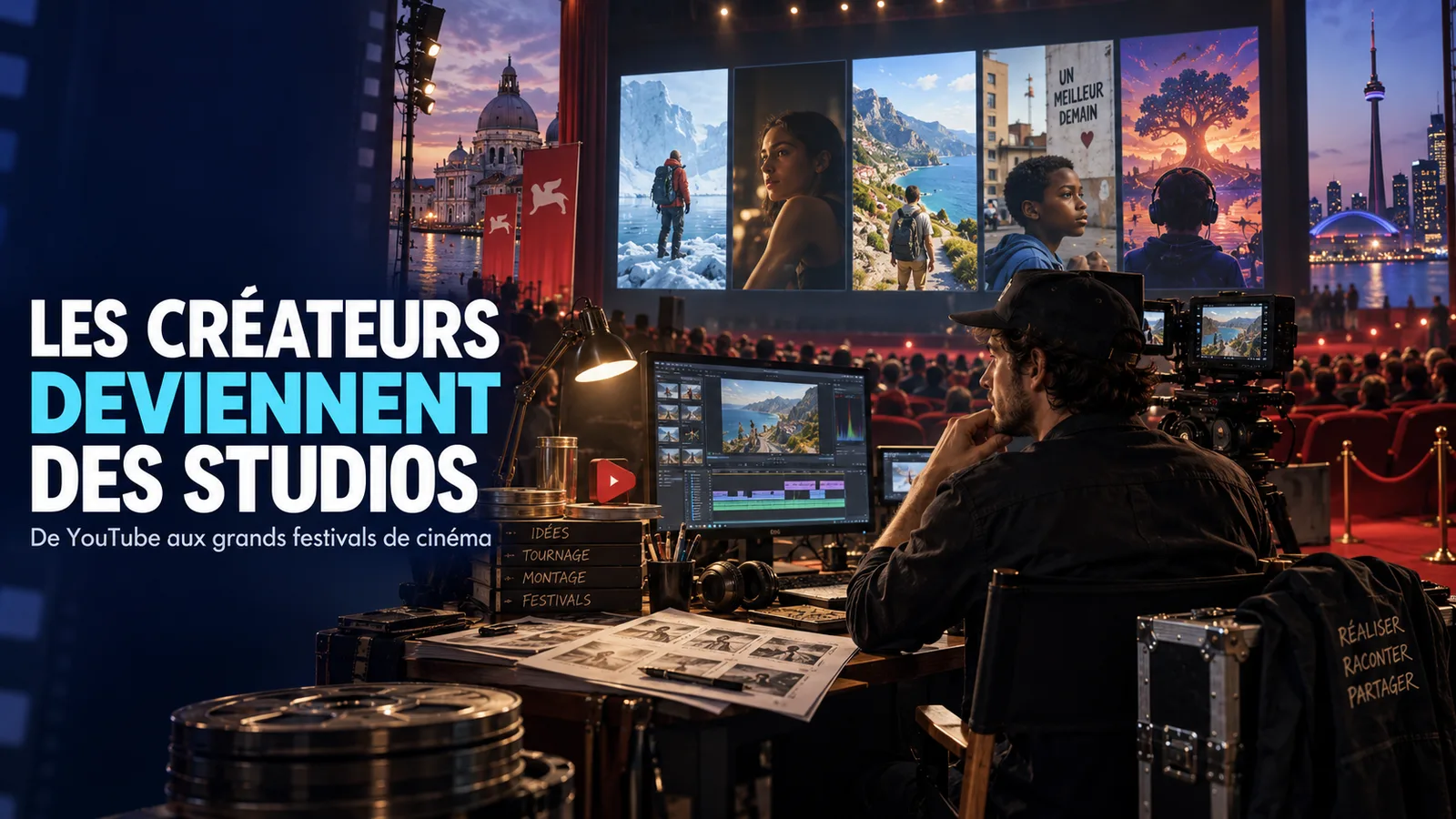
Verified on 15 September 2026. YouTube has just crossed a symbolic milestone: for the first time, the platform has presented a selection of films by independent filmmakers at two major international film festivals, the Venice Film Festival and the Toronto International Film Festival. YouTube’s official announcement was published on 14 September 2026.
This is not merely a prestige exercise. For creators, freelancers and entrepreneurs, the significance runs deeper: content created on platforms can now be viewed as editorial property capable of outliving the feed, attracting partners and building a sustainable brand.
So the lesson to be learnt is not ‘you have to make films’. It is much more accessible: a creator benefits from developing recognisable formats, regular features and editorial assets that are their own, rather than relying solely on isolated videos driven by an algorithm.
What YouTube actually announced
In an official announcement dated 14 September 2026, YouTube explained that it had showcased five productions led by creators as part of the Venice and Toronto film festivals. The platform describes these projects as ‘Creator Shows’ and categorises them across a range of genres: expeditions, international travel and interview formats.
The key point is the nature of the announcement. YouTube is not introducing a new feature available to all accounts, nor a new monetisation programme. This is an editorial and cultural initiative highlighting certain creators’ productions. It would therefore be misleading to conclude that every YouTuber can now automatically submit their series to these festivals.
On the other hand, the presence of YouTube productions at events historically associated with cinema and traditional audiovisual media shows that the boundary between ‘creator content’ and ‘media production’ is becoming increasingly blurred. It is precisely this shift in perception that deserves attention.
Read the official announcement from YouTube.
The real change: the creator becomes a media brand
For a long time, a creator’s success was measured solely by platform metrics: followers, views, likes and posting frequency. These metrics remain useful, but they no longer tell the whole story.
A creator who develops a recognisable series, a recurring concept, a method, a community or a specialism possesses something more valuable than a high-performing video: a reproducible editorial asset. This asset can then be adapted for use in episodes, newsletters, events, training courses, partnerships, products, conferences or services.
This is where the YouTube advert becomes interesting for a VIFLY audience. A creator’s transition towards a media-based approach doesn’t begin with a film camera or a huge budget. It begins when their audience can clearly answer three questions: who are they, what do they promise, and where can you find their entire world?
Google and YouTube had already sent out another signal in June 2026 with ‘Search profiles’, designed to allow certain eligible creators to bring together their accounts, websites, posts and links into an official presence on Google Search. Here again, the direction is consistent: the creator’s digital identity is becoming an asset to be structured, not just a series of posts.
See the official announcement on Search profiles.
Two practical examples for the self-employed
Example 1: a coach no longer just posts advice; she creates a series
Let’s imagine a coach specialising in career change. Instead of publishing unrelated videos every week, she has developed a series called ‘30 days to find your direction’. Each episode covers a specific stage: assessment, skills, obstacles, positioning, your offering, and taking action.
The difference may seem slight, but it changes how things are perceived. The audience no longer sees just someone who ‘posts advice’. They recognise a whole world, a method and a regular feature. The coach can then compile the episodes on her website, create a downloadable resource, offer an assessment session and link everything together from her LinkHub VIFLY.
She doesn’t need to wait for a platform to offer her greater reach: she’s already turning her content into an experience.
Example 2: a trainer turns their expertise into editorial content
An artificial intelligence trainer can post daily updates just like hundreds of other accounts. But they can also create a unique format: every Friday, they test a new AI feature on a real-world business scenario and show what works, what fails and how much time is actually saved.
After twenty episodes, he no longer has just twenty videos. He has a library demonstrating his method, his level of expertise and his ability to apply AI to real-world problems. This library can enhance his search engine optimisation, his sales pitches, his training courses and his public speaking engagements.
The content then serves as proof of expertise. And when a prospective client wants to take things further, they must be able to move easily from discovery to action via a well-structured online presence, for example from his VIFLY space.
Why this development is also important for SEO and discoverability
The creator economy relies heavily on platforms, but a sustainable strategy cannot depend on a single source of recommendations. A video might go viral for forty-eight hours and then become almost invisible. Conversely, a well-named format that is well-documented and linked to a clear identity can continue to be discovered through search, recommendations, shares and AI-powered response engines.
For VIFLY, this is the key strategic point: the rented reach must be used to build an owned presence. TikTok, YouTube, Instagram or LinkedIn can attract attention. But the creator must then channel that attention towards their name, their expertise, their offerings and their points of contact.
This involves, in particular, keeping a clear main site or page, using consistent titles for your series, publishing pages that can be found in search results, and linking content together in a smart way. The blog VIFLY follows precisely this logic: useful news only has lasting value if it becomes a structured and searchable resource.
This approach obviously guarantees neither a Google ranking nor citation by an AI. However, it does increase the clarity of the editorial ecosystem and reduces dependence on a single platform.
The limits: let’s not confuse cultural signals with new rules of the game
YouTube’s announcement is highly symbolic, but there are several important nuances to consider.
- This programme is not open to everyone. YouTube is showcasing a selection of productions; the announcement does not grant creators general access to the festivals.
- Long-form content is not automatically superior to short-form content. Shorts, Reels and TikTok remain powerful tools for discovery. The challenge is rather to link these short-form formats to a richer, more in-depth experience.
- A mediocre series doesn’t become strategic just because it has a name. The concept must solve a problem, entertain, inform or create genuine anticipation.
- Production quality is not the only competitive advantage. A small organisation can succeed thanks to a specific niche, rare expertise, close ties to the community or consistent performance.
- Platforms continue to evolve. Formats, tools and distribution rules are constantly evolving. This is why it is important to maintain independent assets: website, contact database, offers and brand identity.
In other words, you shouldn’t simply copy the big names. You need to understand the mechanism behind their move upmarket: they are gradually transforming their audience into a brand, their formats into editorial properties and their distribution into an ecosystem.
What to do next? A five-step action plan
- Define your editorial promise. Write in one sentence what your audience should regularly gain from you. A clear promise makes it easier to choose topics and helps your audience remember them.
- Create a recurring layout. Choose a format that can generate at least ten episodes without becoming repetitive: review, analysis, transformation, challenge, interview, case study or behind-the-scenes feature.
- Name and document this format. Use a consistent name, a consistent layout and a central page where readers can find the episodes. This way, you’ll start to build an asset rather than just a feed.
- Build the path after the view. Ask yourself what someone who is interested should do after viewing the page: read, sign up, book, find out about an offer or contact you. Your landing page must make this next step clear.
- Measure more than just views. You can also track profile views, clicks, sign-ups, enquiries, bookings, sales and qualitative feedback. A series with 10,000 views that generates ten relevant leads may be more valuable than a viral video that leads to no follow-up.
To bring together this path between content, brand identity and offerings, a LinkHub VIFLY can serve as a single entry point. If your creator business relies on appointments, you can also naturally extend the customer journey with VIFLY Booking. The aim is not to add links everywhere: it is to bridge the gap between the interest generated by the content and the action taken.
What VIFLY takes away from this signal
The most interesting aspect of this news is not that YouTube is seeking to move closer to the film industry. It is that the most organised content creators are no longer regarded solely as users of a platform. They can become producers, media brands and owners of formats capable of travelling from one channel to another.
For a freelancer, the scale is different but the logic is the same. Your next advantage may not come from an additional post. It may come from turning your best ideas into a recognisable series, and then turning that series into an asset that reinforces your expertise and drives traffic to your creator business.
Algorithms distribute attention. Your brand must maintain the value created by this attention.
FAQ
Has YouTube launched a new programme enabling creators to gain access to film festivals?
No. The announcement of 14 September 2026 presents a selection of creators’ works shown in Venice and Toronto. YouTube is not announcing a general programme allowing all creators to automatically take part in these festivals.
Do you need to produce long-form videos to build a media brand?
No. A creator can use the short format for discovery whilst simultaneously developing series, resources or more in-depth formats. The coherence of the creative universe matters more than duration alone.
What is an editorial asset for a creator?
This is content or a format that retains value beyond its initial publication: a recognisable series, a guide, a newsletter, a podcast, a method, a case study library, a community or a reference page.
Why centralise your content and links?
Because an audience you’ve built up on a platform needs to be able to quickly understand who you are, discover your other content and take meaningful action without relying entirely on the algorithm of the moment.
Does this trend affect small-scale designers?
Yes, in principle. A small-scale creator doesn’t need to replicate the budgets of large-scale productions. They can apply the same logic on their own scale: a specific angle, a recognisable format, proven expertise and a clear path to their business.