VIFLY IA workshops · Model to complete
Build your voice charter to work with AI
Find out what makes your style, set verifiable rules and test your charter on a draft. Modifiable template and annotated example.
Drafting VIFLY · Published on
How to build an editorial voice charter for the AI?
Texts you'd still sign. Note to whom you're talking, the gestures that make your style recognizable and the formulations that you spread. Give the AI a short charter with an example and a counter-example, then reread its changes next to your rules.
Real texts to verifiable rules
-
Observe
Reread three texts you would still sign.
-
Describe
Turn your habits into observable instructions.
-
Show
Give an example and a rewritten counter example.
-
Test
Reread the gaps and change your charter.
Finds out what makes your voice recognized in your real texts
Take three short passages that you wrote and would publish again. Choose, for example, a customer explanation, an educational post and an email. Find out what comes back in each. Are you quiet? Are you starting with a situation? How do you explain a limit or a mistake?
Turn your observations into instructions that we can check. "Your human and dynamic" is not enough to reread a draft. "Open to a specific situation, explain a gesture and give one next step," allows you to say what is missing. Also keep a counter example and explain why you wouldn't use it.
Model vote charter to be completed
Write a first version of a page. Replace the hooks with your own choices and phrases.
CHARTE DE VOIX
Public et situation — [à qui je parle et quand cette personne me lit]
Effet recherché — [ce qu’elle doit comprendre ou pouvoir faire]
Adresse — [tu, vous ou règle selon le canal]
Rythme — [structure, longueur et type d’exemples]
Mots utiles — [trois mots ou expressions que j’emploie]
Mots et promesses à écarter — [trois exemples et leur raison]
Exemple que je signerais — [une ou deux phrases de moi]
Contre-exemple — [une formulation à éviter et une réécriture]
Adaptations — [ce qui change entre email, post et page d’offre]
Contrôle final — [trois questions avant publication]
Version et date — [repère pour retrouver la charte utilisée]
Download the voice charter template in editable text (in French).
Example of a short charter for an independent photographer
Fictitious case. Lina talks to independents who don't usually pose. She plays in her guides and resumes the level of customer formality in a commercial exchange. It opens up a concrete difficulty, gives a gesture and ends with a simple choice.
Example to keep. "If you don't know where to put your hands, take something you use in your creator business. We keep the catch where the gesture seems natural to you. »
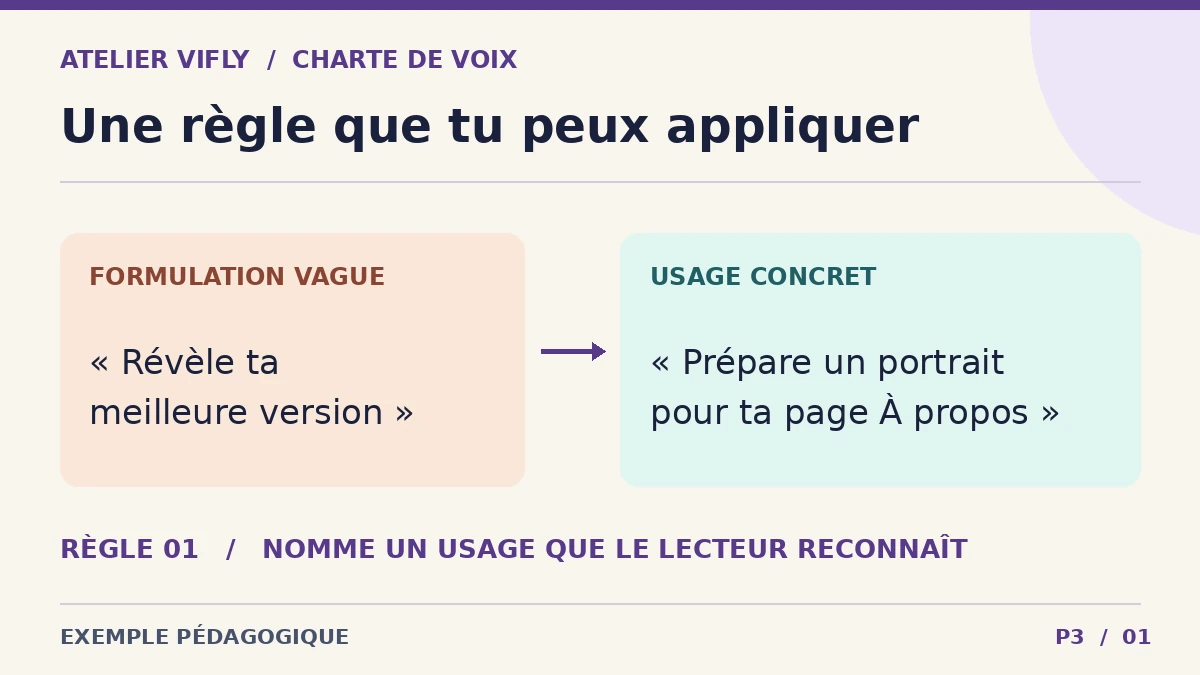
Example to be repeated. "Reveal your best version with an image that changes everything. The sentence promises an impossible effect at this stage. Proposed rewrite. "Prepare a portrait for your About page. »
Lina checks that the reader sees a situation, a gesture and a next step. It keeps the word " portrait" and specifies what it means by it according to usage. It removes guaranteed transformations and superlatives without example.
Test the charter on a draft and then evolve it
Read this text with my charter. Report the three most visible deviations by quoting the relevant sentences. Propose a correction per deviation. Keep the original facts, figures and commitments. If you hesitate about a formulation, ask a question before changing it.
Compare the assisted version to your original version. Read a speech out loud and check if you'd tell a client. Note the corrections you make several times. They give you a rule to add or clarify in the next version of your charter.
Use your own excerpts or examples of which you can share the content. Removes confidential items, identifiable details and private exchanges that are not necessary. See CNIL recommendations.
Frequently asked questions
What difference between a voice charter and a simple tone?
The tone varies with the situation. A voice charter sets landmarks that you can find in several formats, such as the way to explain a gesture or present a limit. It can then specify how the tone changes depending on the channel.
How many examples do you give to create your charter?
Starts with three written passages for different situations. Look for what comes back in all three and keep at least one counter example. Short texts you can explain are more useful than a long list of adjectives.
How can I give my voice charter to an AI?
Add the relevant rules, an example to follow and the expected result. Request to report deviations before changing the text. Then check the changes of meaning and commitment next to your draft.
Should I use the same tone in email and Instagram?
Keep the same voice markers and adapt the length, rhythm and address formula. You can play in a public guide and take back the formality of the prospect in a commercial exchange.
When to update the voice charter?
Update it when a gap returns, when your audience changes or when you add a new format. Note the date and replace examples that no longer correspond to what you publish.