VIFLY IA Workshops · Annotated review
Make your content read through the AI by separating corrections and facts
Apply three rereading passes. Identify language corrections, ambiguities and facts that require a source.
Drafting VIFLY · Published on
What can an AI control when it rereads content?
It can propose language corrections and signal ambiguous passages. A date, number or promise asks to find and read the evidence that supports it. Request three separate outputs, then validate the changes of meaning and facts before publication.
Three passes before accepting a correction
-
Correct
Checks visible agreements and formulations.
-
Clarify
Ask where the reader might lose the thread.
-
Check
Open the proof of each statement retained.
-
Validate
Read the meaning and final version before publishing.
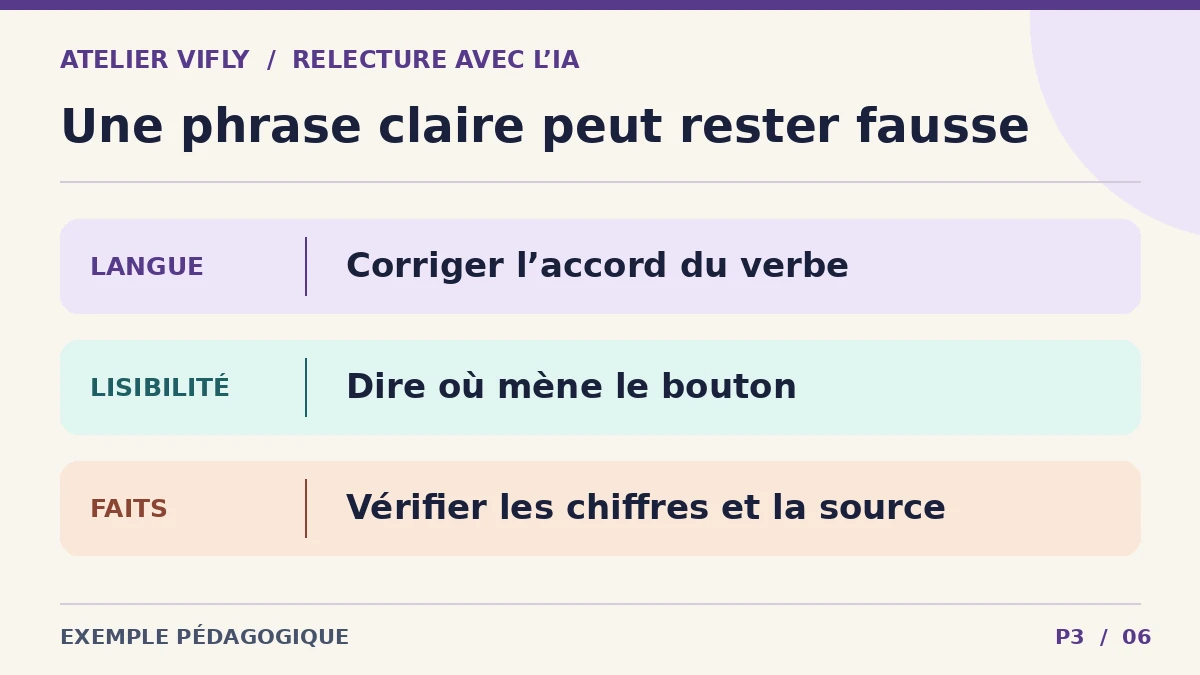
Separate correction, readability and verification
Asking "read my text" mixes several tasks. First, identify shells, chords and repeated words. Then ask where the reader might lose the thread. Finally, mark statements that require a source or control in your own documents.
A reformulation proposal can improve a sentence and change its meaning. Check the subject, action, conditions and level of certainty before accepting the correction. When IA proposes a source or a document reading, opens the original passage and controls the date, perimeter and exact meaning.
Annotated example of a draft reread in three passes
" Our slots are easier to find. The reservation takes 30 seconds and doubles the requests. »
| Pass | Useful action | Control remaining |
|---|---|---|
| Language | Correct in "Our slots are easier to find". | The agreement is corrected. The announced facility must still be supported if it is presented as a result. |
| Readability | Specify the action. "The button opens the call slots. » | Click on the button and read the destination. |
| Facts | Isolate 30 seconds" and "doubles requests". | Find the measure and its perimeter. Both digits are fictitious and should be removed from this text. |
Version retained. "On the model, the button leads to the choice screen of the niche. The prototype navigation test supports this sentence. Consult prototype control (in French).
A prompt that shows the changes before rewriting
Reread in three passes. First give the language corrections with the original sentence and the proposal. Then report the ambiguous passages and explain the difficulty of the reader. Complete with the list of facts, figures and commitments to be verified. Do not replace any fact with any hypothesis. Keep citations and references as they appear.
Before sharing the draft, remove private information that is not used for editing. A working version without confidential data is often sufficient to control the structure. See CNIL recommendations.
Validate corrections before publishing
- Compares both versions and identifies changes in direction, target or level of certainty.
- Open the sources of the maintained statements. Checks dates, units, conditions and links.
- Read the decisive passages out loud. Keep the wording that you can defend and that your reader can understand.
Resuming the complete method to verify generated information (in French).
Frequently asked questions
Can IIA correct grammar and faults?
It can report awkward agreements, repetitions and formulations. Check names, trade terms, quotations and changes of meaning before accepting corrections.
What difference between reading a text and checking its information?
Rereading can improve the form and make the message understandable. Check to find the source of a fact and read what it establishes. The correction of an agreement does not validate the following figure.
How can I prevent AI from changing my style or my facts?
Requests a separate list of proposals from the text and requires the original sentence for each amendment. Gives a voice rule and specifies that numbers, quotes and commitments must remain visible for control.
What if a proposed source is credible?
Open the original document and find the specific passage. Check the date, subject and conditions. If the passage only supports a more limited version of the statement, rewrite the sentence accordingly.
What control do you keep before publishing?
Reread the decisive passages, compare the two versions and verify the facts, links and commitments. Make sure you can explain the origin of the maintained statements and the reason for your corrections.