VIFLY IA workshops · Guide starting by trade
You start with AI? Try a job in your creator business
Choose a first simple use according to your profession. Four examples and one quick to adapt to get a result you can check.
Drafting VIFLY · Published on
What can I ask AI when we start?
Choose a task you already do and a small result you can check out. Give your job, your notes, the expected format and the limits to be respected. Start with a draft or a list of fictitious data, then compare the output to what you would have prepared.
A first request you know how to control
-
Choose
Take a common and reversible task.
-
Frame
Gives context, input, format and limits.
-
Try
Request a short exit on a mastered example.
-
Read
Compare the expected result before reuse.
Starting from a task you already do in your job
Look at a recent day of work. Finds a small task that comes back and you know the correct result. Turning three notes into a list of questions is easier to verify that a vague request like "improves my activity". For a first try, choose a result that you can read again in a few minutes.
Start with fictitious data or elements you can share. Avoid direct actions on your accounts, customer files or payments. A draft, list or plan lets you check the result before you use it.
Four first uses of AI according to your profession
| Trade | First request to try | Result control |
|---|---|---|
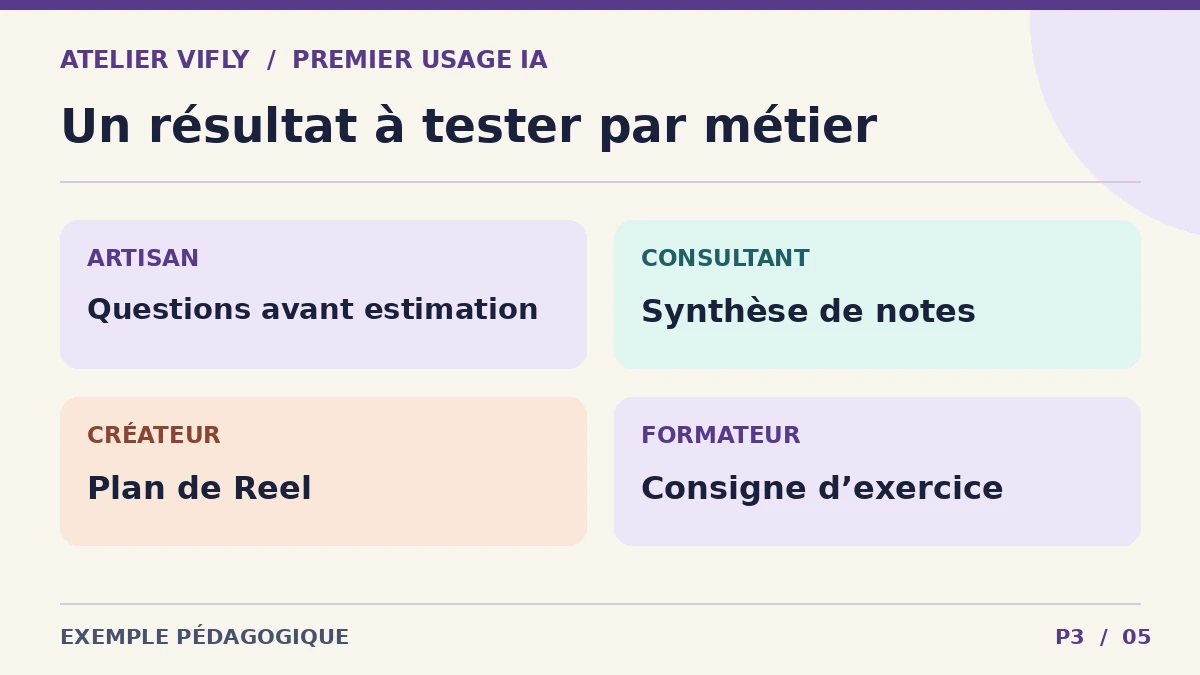
| Craftsman | Based on these fictitious notes, list the three questions required before estimating the request. Indicates the answers already known apart. | Questions relate to dimensions, quantities or time limits. No tariff must appear. |
| Consultant | Turn my notes into a decision, two actions and points still open. Keep responsible and date only if I give them. | Compare every action to your notes. Verify that a wish has not become a commitment. |
| Content creator | From this note, proposes a Reel plan with a situation, an example to film and a next gesture. | The gesture is demonstrable and no new statistics have been added. |
| Educator | Proposes an exercise instruction and two success criteria for this gesture that I can demonstrate. | The learner can produce the expected evidence with the intended equipment. |
Write your first request in four lines
Contexte — Je fais [métier] et je dois [tâche].
Entrée — Voici [mes notes, un exemple fictif ou un texte que je peux partager].
Résultat — Donne-moi [une liste, un brouillon ou un plan], avec [longueur ou format].
Limites — Garde mes faits. Signale ce qui manque. N’ajoute pas de prix, de date ou de promesse.
If the answer is too long, ask for a shorter format. If it is vague, add an example of expected output. If a detail is invented, correct your instruction first so that the missing information remains visible, and then try again.
Decide after a first reread test
Before you start, write down what you expect and what you don't want to correct. After testing, verify that the result is the task, that the data used is the correct one and that the rereading remains feasible. If you spend more time repairing the draft than preparing it, reduce the perimeter or change the task.
See how to measure time to re-read result (in French). See method for rereading without automatically validating the facts.
Frequently asked questions
What is the first simplest use of AI?
Start by turning a content you know into a short result, like three questions, a plan or a synthesis. Reading is easier when you already know the facts and the expected decision.
Do we need to know the jargon of the prompt to begin?
Describe the task as a colleague. Explains the context, gives useful elements, specifies the format and what should remain unchanged. The four lines of the guide are sufficient for a first test.
What if the AI answers too vaguely?
Add an acceptable result example and reduce demand. Instead of asking for an entire strategy, ask the next gesture or the three questions that allow us to move forward. Then reread the proposed choices.
What data should be used in a first test?
Start with a fictitious example or information you can share. If the data are private, summarize the situation without the identifiers that are not used for the result.
How do I know if I should keep this use?
Compare the result to an exit that you judge correct. Checks how long the corrections are required and whether the format is reusable. Keep usage if the reread result actually helps in the task.