VIFLY IA workshops · Trainer workshop
Prepare a training course based on a gesture you master
Turn your expertise into objective, demonstration, exercise and proof. Trainer workshop with an example module and its criteria.
Drafting VIFLY · Published on
How to prepare a training based on its expertise with the AI?
Choose a gesture you can explain and an observable result. Prepares a demonstration, exercise and criteria that allow the learner to show his or her result. Use the AI to organize the sequence and reread the announced skills from what you can actually teach.
An objective, a practice, a proof
-
Delimit
Select a gesture that you control and the prerequisites.
-
Demonstrate
Show the gesture with examples that you can explain.
-
Practice
Ask the learner to carry out the action himself.
-
Observe
Check the result with the advertised criteria.
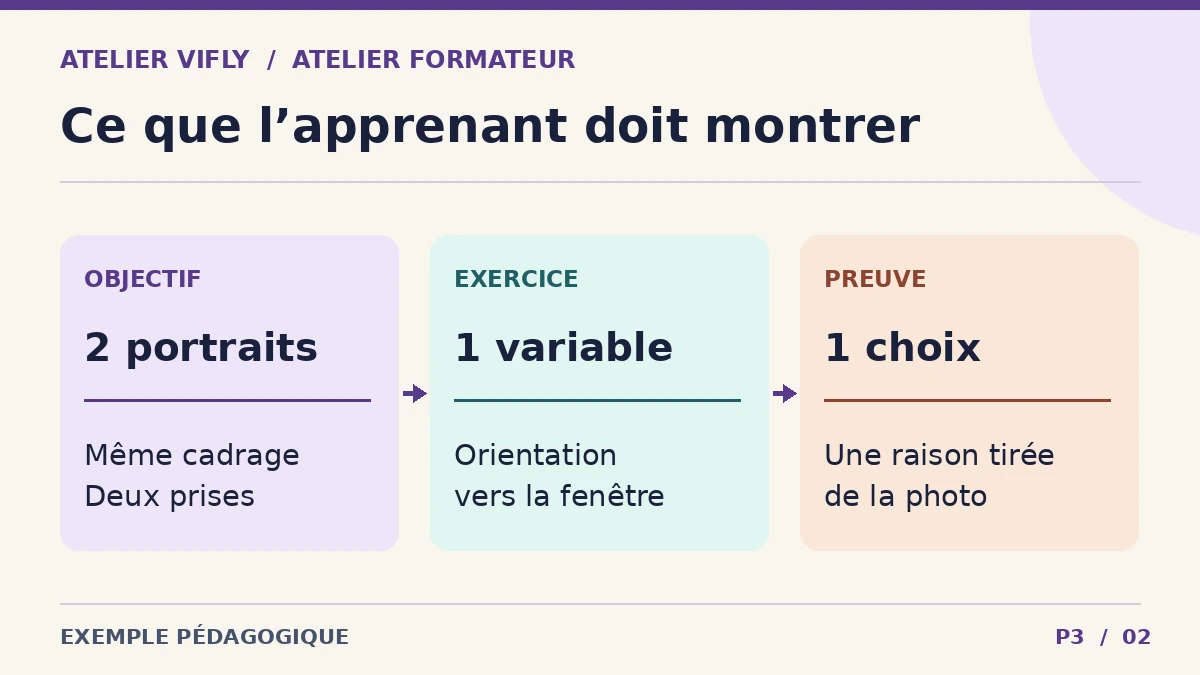
From a gesture you can make and explain
Choose an action you already realize. Gather your own examples, the mistakes you can correct, and the cases where your method reaches its limits. In this fictional workshop, a photographer prepares an introduction to the portrait on the phone. She teaches a setting that she can show and comment, the position relative to a window.
Observable objective. At the end of the session, the learner produces two portraits with the same framing, changes his orientation to the window and justifies the choice of the photo he would use. The objective says what he does and what he does. "Understanding Light" remains too broad to assess the outcome.
Build a module with demonstration and exercise
| Step | Activity | Trace to observe |
|---|---|---|
| Demonstrate | The trainer shows two positions in front of the same window. The phone remains fixed. | The learner identifies the variable that changes. |
| Practice | The learner makes two shots with the intended material and prepares the same cropping. | Two comparable images. |
| Return | The learner chooses the appropriate take to a About page and explains his decision. | A choice justified by a visible detail, such as look or cropping. |
The grid has three criteria. The framing is comparable, only one variable has changed and the reason for the choice is based on the image. If a socket is missing or the light has changed between the two, show how to repeat the test. Each activity prepares the expected evidence at the end. Read the Laval University benchmarks on learning objectives and their evaluation.
Ask for a structure at the AI and define what you teach
Here is the action I can demonstrate, the examples I have the right to use and the prerequisites. Proposes a short sequence with demonstration, exercise and return. Match each activity with observable evidence. Report the skills, references and results that are missing in my notes. Leave them open.
Reread the plan looking for passages beyond your experience. If a draft proposes a certificate, a level of control or a result that your exercise does not allow to establish, withdraw this promise. Keep the possibility of involving a qualified person if the subject requires expertise that you do not have.
Test the first module before saving the rest
Forward the session to a person from the intended audience. Ask him to repeat the exercise without further explanation in the first trial. Note the time spent, the instructions that ask questions and what it is able to show at the end. Rewrite first the instruction that blocked the expected gesture.
If you then publish the training, announce the result, prerequisites and material before detailing the number of lessons. See VIFLY guide to create and sell training. See the portrait sheet which can be used as a support for the exercise (in French).
Frequently asked questions
How to write an observable training objective?
Use an action verb, indicate the conditions of realization and specify the expected result. "Producing two comparable portraits and justifying his choice" makes it possible to see the work rendered and explain the return.
How many modules do you plan for a first training course?
Starts with a driver module that goes up to a complete result. Observes difficulties and real time before deciding on the following modules. Adds a lesson only if it helps to pass an identifiable step.
What can AI prepare for a trainer?
It can structure your notes, propose a statement or reformulate criteria. Verify that the sequence is based on a method that you control and that the documents, results or references actually exist.
How do I know if an exercise evaluates the right move?
Compare what the exercise requires with what the objective announces. If you want to observe a comparison of images, ask for two shots and a motivated choice. A definition quiz may prepare the exercise, but answers another question.
What if I don't master a part of the subject?
Delimit your module around the situations you can demonstrate. To go further, document the difficulty or associate a competent person. Clearly presents what will be covered and what the assessment allows to establish.