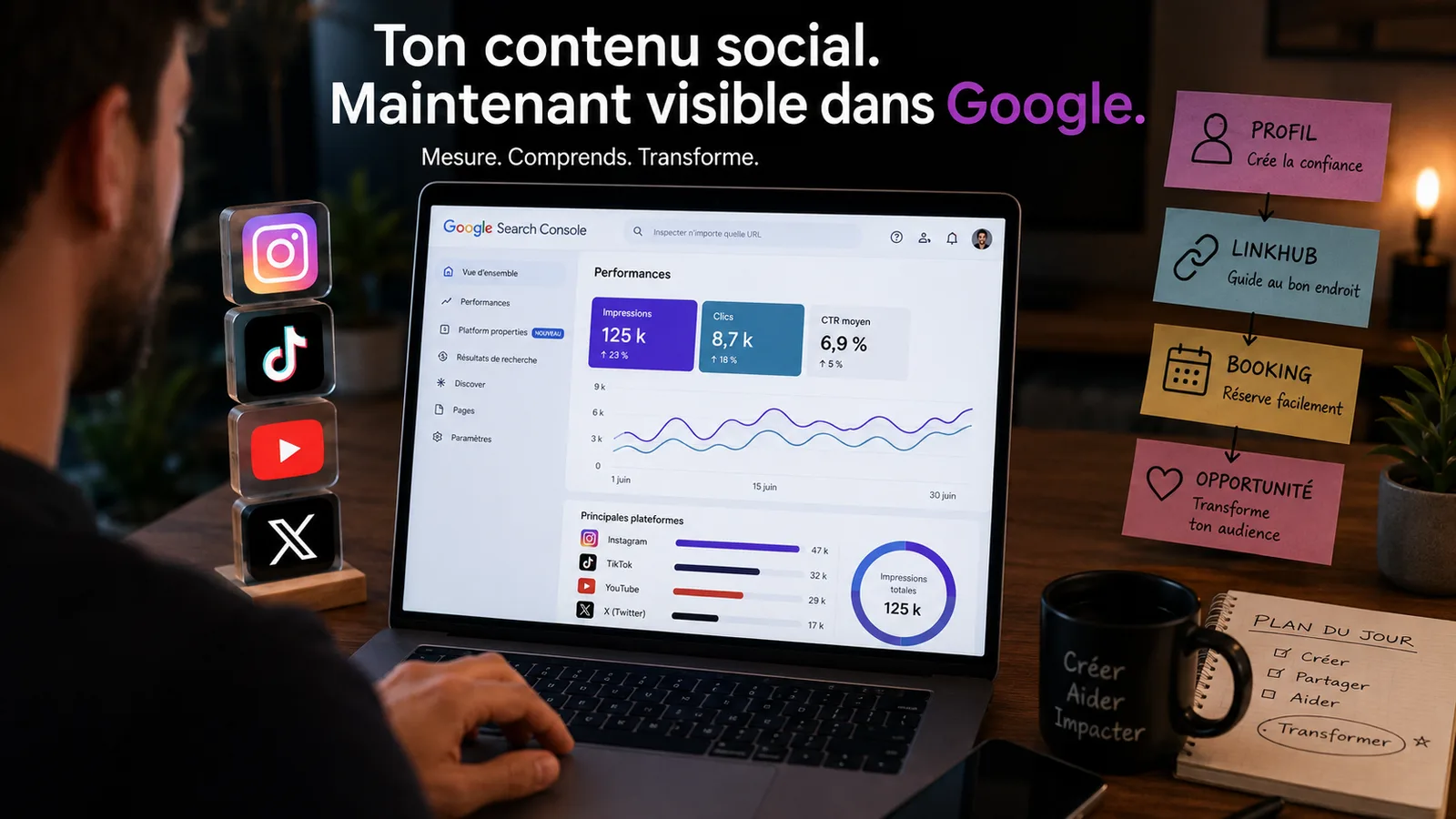
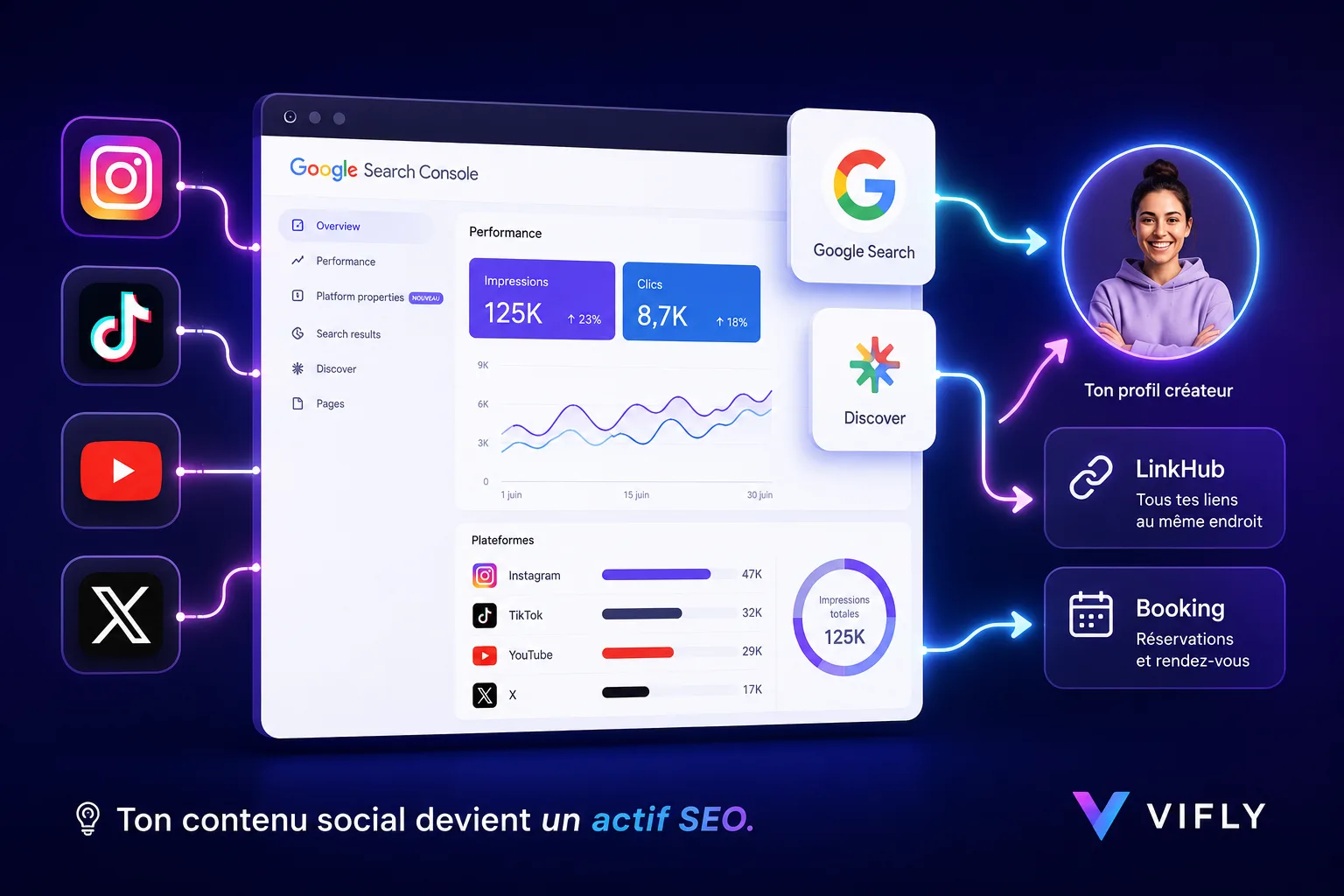
Your social content becomes an SEO asset
For a long time, a creator looked at his statistics in pieces.
Instagram on one side. TikTok elsewhere. YouTube Studio in another tab. Google Search Console reserved for website. And between all of this, a question that is often impossible to clearly link: How do people really discover me
Google has just made this question much more interesting.
On July 7, 2026, Google Search Central announced the platform properties, a new type of property in Google Search Console. The objective is to enable creators and publishers to understand how their Instagram, TikTok, X and YouTube content appear in Google Search and Discover. Google specifies that this novelty allows you to follow the requests that lead to these content, but also to see how the audience interacts with the posts concerned.
This is not a small technical development. It's a signal.
Your Reel, Short, TikTok post or YouTube video no longer only lives in its app. It can also become a gateway from Google. And if this front door leads to a blurred profile, a disorganized bio link or an invisible offer, you may discover something uncomfortable: your problem wasn't just visibility. It was the course after visibility.
Key points:
your social content becomes measurable in Google. But measuring an opportunity does not mean transforming it.
Google Search Console changes size for creators
Google Search Console has long been seen as a tool for site owners, searchers and marketing teams. Google also presents it as a tool to measure traffic and performance in Google Search, analyze queries, impressions, clicks and average position.
With platform properties, the perimeter expands.
Google no longer only looks at the performance of your site. It begins to give clearer visibility on how your content published on certain social and video platforms is discovered via Google Search and Discover. Google explains that creators and publishers use many channels beyond their own site, and that this novelty also targets creators who do not yet have a website.
This is exactly where the topic becomes strategic for creators, coaches, consultants, trainers and freelancers.
Because many are already publishing. Many make videos. Many create content. But few know how to link this visibility to a clear system: profile, proof, offer, link in bio, reservation, contact.
But if Google starts to better show how your social content is discovered, you will be able to ask better questions:
Do my content respond to real searches? Do people find me for the right subjects? Do my posts attract qualified people? Does my profile make you want to go further? Does my bio link turn this attention into action?
So the real subject is not just: How many clicks did I get
The real subject becomes:
What is a platform property?
A platform property is a new type of property in Google Search Console. Instead of following only a domain or website URL, it allows to track the performance of content published on certain social or video platforms in Google Search and Discover.
Google indicates that platform properties allow you to understand how social and video posts perform in Google Search and Discover. In particular, creators can see which requests lead to their Instagram, TikTok, X and YouTube content.
Simply says: Google gives you a window on the part of your social visibility.
This is not a replacement of the internal statistics of each platform. TikTok Analytics, Instagram Insights or YouTube Studio remain useful. But Search Console adds a different layer: discovery from Google.
And this layer is precious, because it reveals intent.
A TikTok view can come from a passive scroll. An Instagram print can come from a recommendation algorithm. A Google search often starts with a expressed need: a question, a problem, a comparison, a desire to understand, a search for a solution.
For a coach, consultant, trainer or freelancer, this shade changes everything.
Compatible platforms
At the launch announced by Google, the four platforms available are:
Instagram, TikTok, X and YouTube.
Google specifies that adding a platform property goes through Search Console: you need to open Search Console, add a property, select one of the four available platforms, then follow the verification steps displayed on the screen.
The deployment is progressive. Google indicates that platform properties become available gradually in the weeks following the announcement.
This means that not everyone will necessarily see the option immediately.
It's not necessarily a bug. It is probably a matter of deployment, account, platform and progressive availability.
Data available
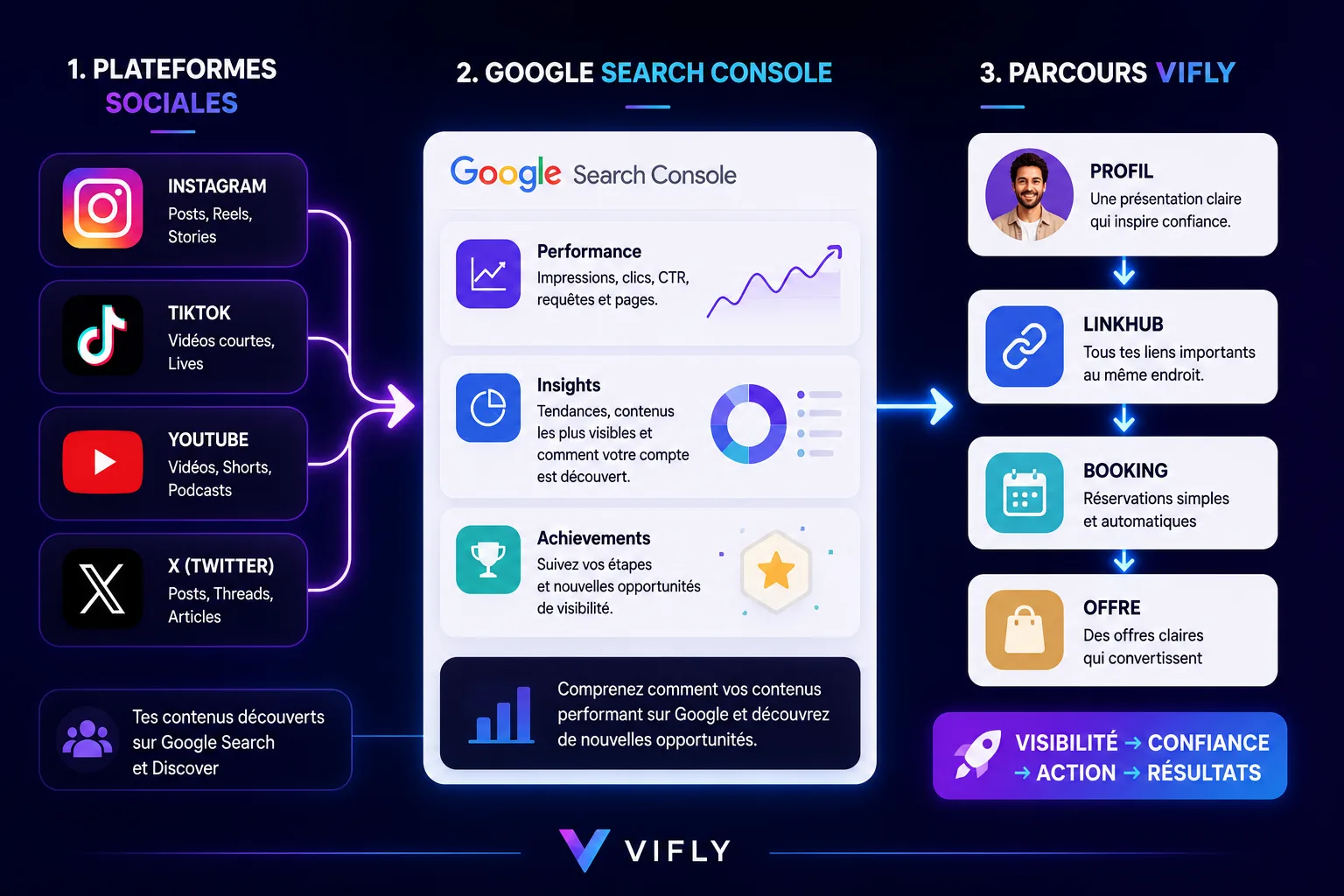
Google announces three large data blocks for platform properties:
The Performance report allows you to see additional clicks, prints and metrics. It also allows you to filter and sort data to identify the posts and queries that generate the most traffic. Google also indicates that data can be exported for analysis in another tool.
The Insights report gives a more synthetic view: recent traffic trends, top-performing posts and how people discover the Google account.
The Achievements block allows you to follow certain steps of progress, such as reaching a new click threshold from Google Search over the last 28 days.
For a creator, this data can become very concrete.
You can spot a YouTube video that attracts Google searches without having related article. You can see that a TikTok is discovered through a very precise request. You can understand that your Instagram content meets an intention that you never really worked on on your blog. You can also see that people find you, but don't go to the next step.
And this is often where the opportunity is hidden.
Why Instagram, TikTok and YouTube also become SEO topics
Social SEO is not a magic formula. Nor is it an excuse to turn every Instagram legend into a disguised blog article.
But the boundary between social content and research becomes more porous.
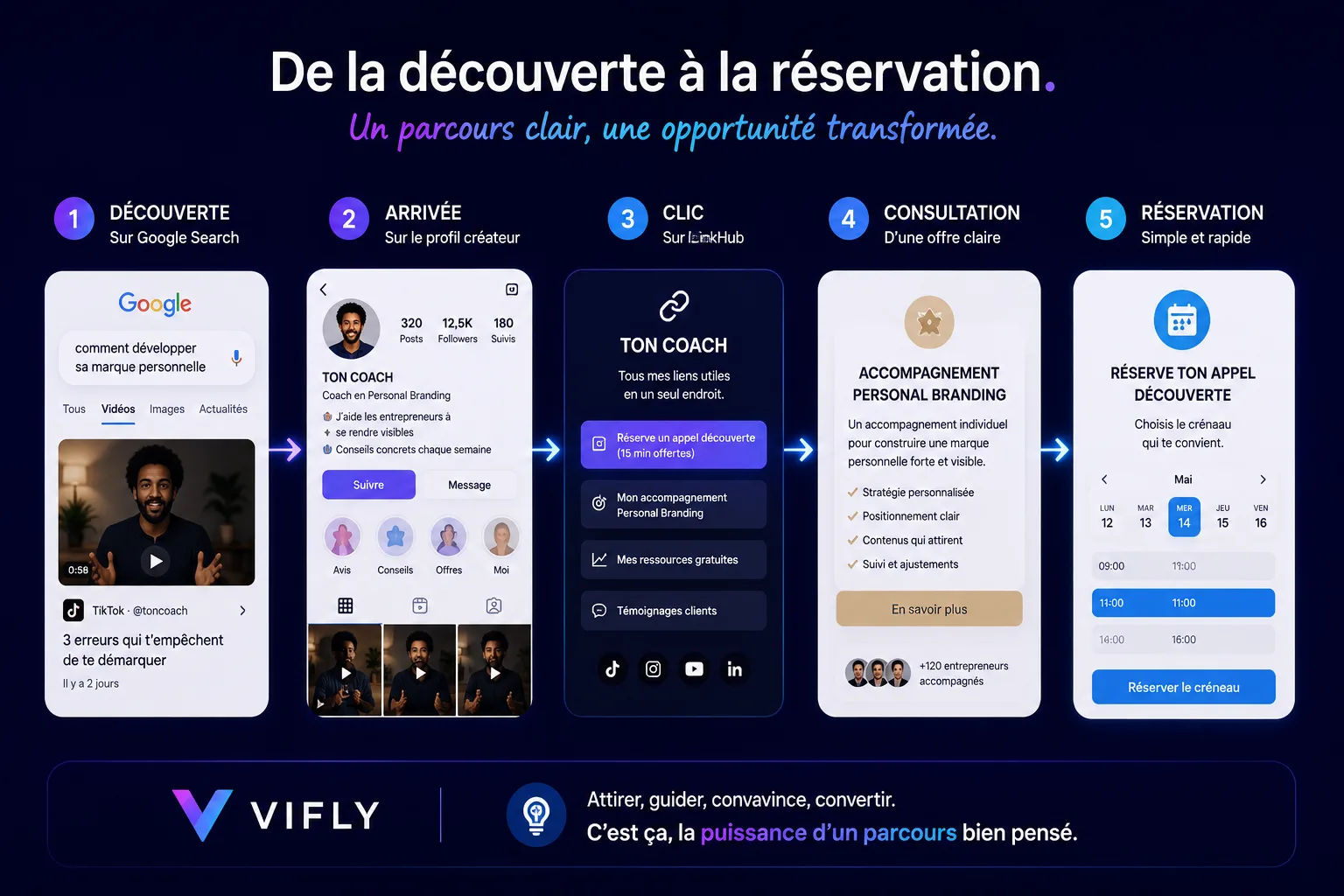
Users no longer discover creators by one path. They can see a Reel, search your name on Google, fall on a YouTube video, check your Instagram, read an article, click on your LinkHub, then book a call. Or the opposite: they can search for a problem on Google and discover one of your social content before even visiting your site.
Google had already begun to further integrate social channels into Search Console with an experience announced in December 2025, limited to certain sites and channels automatically associated. This first step was to provide a more unified view of Search performance between website and social channels.
The novelty of July 2026 goes further: it gives a type of property dedicated to social and video platforms.
For VIFLYthe message is clear: social content should no longer be treated as an isolated publication.
It must be thought of as a part of an ecosystem.
Content can attract. A profile can reassure. A LinkHub can guide. A Booking page can convert. An article can go deeper. A clear offer can trigger action.
If only one piece is missing, attention is lost.
And the more data Google gives you about this attention, the harder it becomes to ignore the loopholes of the course.
Common error: believe that more visibility is enough. In reality, more visibility on a blurred route creates more measurable losses.
What creators need to check now
The bad reaction would be to say, "Great, I'll finally follow my TikTok in Google."
The right response is more demanding:
Here's what you need to check now!
1. Check if you can add your platforms to Search Console
When the option is available in your account, open Search Console, add a property, choose Instagram, TikTok, X or YouTube, then follow the check steps proposed by Google. Google indicates that the functionality is deployed gradually, so the temporary absence of the option is not necessarily abnormal.
Simple Action: check once a week during deployment if the option appears in your Search Console account.
2. Look at requests, not just clicks
A click is a consequence. A request is an intention.
If a person finds your content with nutrition-coach weight loss beginners, this is not the same as the quick meal idea. If she finds your content with LinkedIn freelancer, it's not the same intention as how to post on LinkedIn.
Queries show you what Google associates with your content.
They help to understand whether you attract the right audience or only curiosity.
Simple Action: notes the 10 most interesting requests. Not necessarily those that make the most clicks. The ones that best match your offer.
3. Identify the social content that deserves an article
If a Short, TikTok or Instagram post gets visibility via Google, it may be an editorial signal.
This content already responds to a search. It can become a more complete article, resource page, FAQ, guide or offer page.
Example: a trainer publishes a Short on how to sell a training without huge audience. If this Short attracts impressions from Google, it can create a complete article on the subject, then link this article to its LinkHub and to a booking page for an open call.
That's where the blog becomes a social content amplifier.
Article VIFLY IA Google and SEO: what creators need to change completes this logic: creators must produce content that is more useful, more structured and linked to a real journey.
4. Analyze the profile that receives the visit
Content can be good and lose opportunity after the click.
The person arrives on your Instagram. She's watching your bio. She's looking for what you're proposing. She opens your bio bond. She doesn't understand where to click. She's leaving.
Then your problem is not visibility. Your problem is orientation.
Simple Action: look at your profile in 5 seconds and ask yourself three questions:
Do we understand who you're helping? Do we understand what you're proposing? Do we know what to do next?
If the answer is no, you don't have an algorithm problem. You have a problem with clarity.
5. Linking the best content to a logical step
Each visible content should have a sequel.
Educational content can lead to an article. Evidence may lead to an offer. Trusted content can lead to a reservation. Discovery content can lead to your LinkHub. A comparison content can lead to a call or audit.
If everything leads to link in bio but the link in bio looks like a messy list, you create a friction.
You can deepen this logic with the article VIFLY Why do your ads click... but no customers. Even if the subject is about advertising, the problem is the same: attracting is not enough if the destination does not guide.
Concrete examples according to your activity
Content creator
You publish Reels about content creation, algorithms or monetization. Search Console shows you that a Reel Instagram gets impressions on a query like how to monetize a small audience.
This signal is valuable.
You can turn this Reel into an article, create a more complete resource, add a checklist, and then link it all to tone LinkHub.
The trap would be to just say, "This Reel works well."
The real question is: How can this Reel become a gateway to my universe, my offers or my opportunities
Coach
You publish short videos about your advice, approach and customer results. A Short YouTube is starting to appear on Google for a query related to your domain.
It's an invitation to clarify your journey.
Your profile must quickly explain who you work for, your link must guide you to your accompaniments, and your reservation must be simple.
If someone is looking for a solution, discovers you, but doesn't find how to book, you lose a hot opportunity.
It's exactly the role of VIFLY Booking to facilitate online reservations : reduce the distance between interest and action.
Consultant or freelancer
You publish LinkedIn posts or YouTube videos to explain your expertise. Google is starting to give you data on the queries that lead to your content.
You can use these requests to better name your offers.
Sometimes you think you're selling the digital strategy, but people find you with Instagram audit profile, optimize bio link or improve conversion after advertising.
These words are not just keywords. These are formulations of need.
Simple Action: use the most qualified terms in your pages, offers, content titles, CTAs and LinkHub.
Trainer
You publish training excerpts, tips or short tutorials. If Google shows that certain social content attracts specific searches, you can link them to a module, guide, registration page or email sequence.
The important point: does not let useful content die in the stream.
Content that responds to research can become a sustainable asset.
Local entrepreneur or independent
Maybe you don't have a huge audience. But if your videos answer local or practical questions, Google can become a complementary source of discovery.
In this case, the clarity of your profile becomes even more important.
A person who discovers you from Google must immediately understand what you are doing, where you are doing it, how you can help it and how to contact yourself.
How to link social content, blog, LinkHub and booking
Most creators think in platforms.
I have to publish on Instagram
I have to test TikTok
I have to do Shorts
I have to write an article
But the right question isn't: On which platform do I publish
The right question is:
Social content visible in Google can become the beginning of a very simple journey:
Discovered via Google Search or Discover. Arrival on social content. View the profile. Click to a clear LinkHub. Reading an offer or an additional article. Reservation, contact request, registration or purchase.
This is what VIFLY has been defending since the beginning: the content must not remain isolated. He has to lead somewhere.
A LinkHub VIFLY well structured can combine important links without turning your profile into a maze. The idea is not to add more buttons. The idea is to create a clear hierarchy: what you want the person to understand, consult or do first.
And if your activity is based on appointments, calls, sessions, audits or accompaniments, your Booking must be visible. Not hidden in a menu. Not lost after five clicks. Not drowned between secondary bonds.
Because someone who comes from a Google search doesn't necessarily want to search.
She wants to understand. Be reassured. Do it easily.
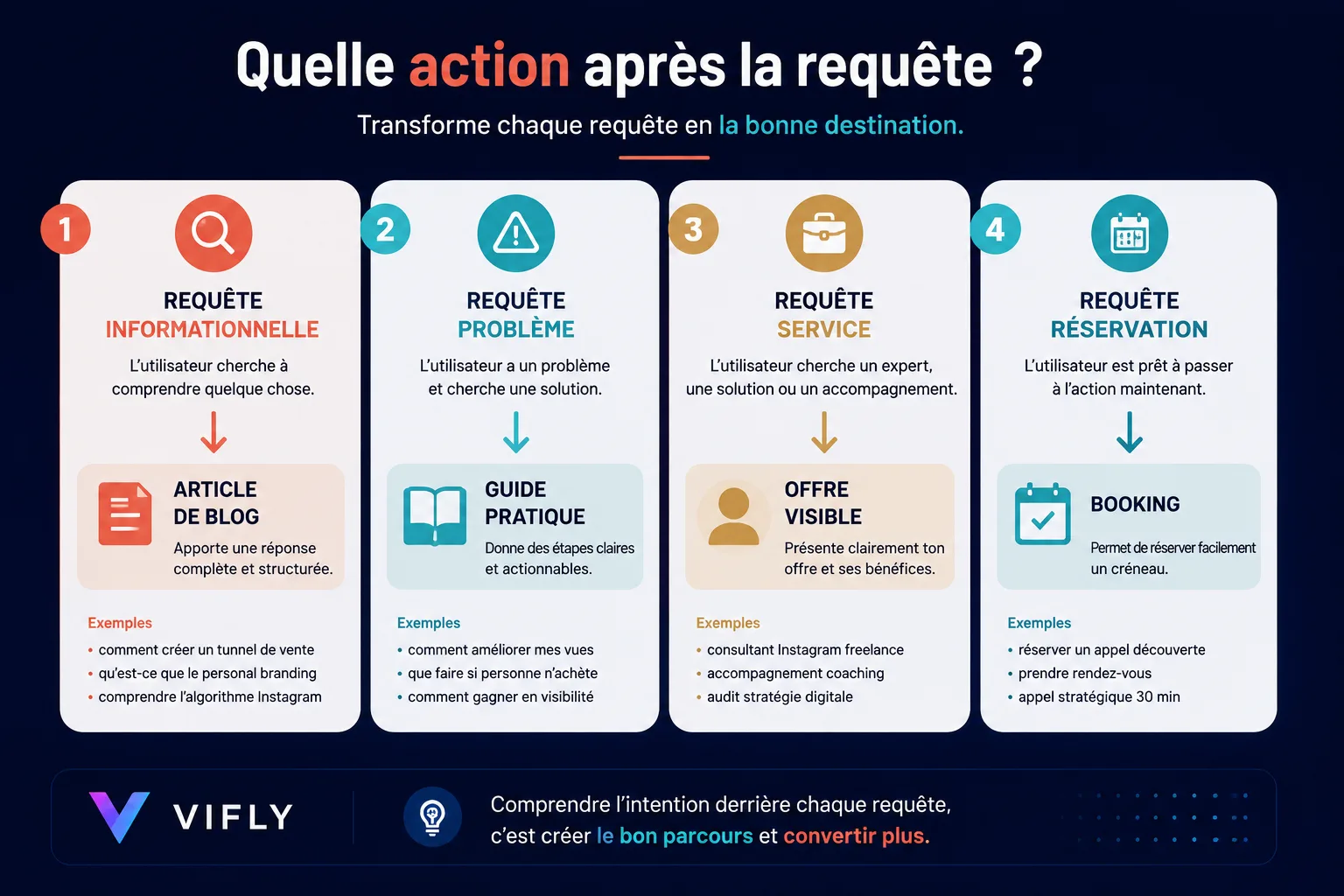
VIFLY checklist not to lose this visibility
Before you look forward to a new Search Console report, check that your ecosystem can convert this visibility into an opportunity.
1. Is your profile understandable in 5 seconds?
A visitor needs to understand who you're helping, what you're offering and why he should continue.
A bio wave can destroy a qualified visit.
2. Is your offer visible?
If your content speaks of your expertise but your offer is not found, you create frustration.
A clear offer does not need to be aggressive. It must simply be visible, understandable and related to the problem of your audience.
3. Does your LinkHub really guide?
A bio link is not a link drawer.
It's an orientation space.
Highlight what counts: your main offer, your Booking, your essential content, your proof, your contact.
4. Do your most visible content have a sequel?
If a video attracts from Google, give it a logical follow-up.
An article. A resource page. A checklist. An offer. A call discovered. A reservation.
5. Does your blog turn your best social content into sustainable assets?
Social networks are speeding up. The blog gives depth.
When social content performs, ask yourself if it deserves a long, better structured, more complete version and linked to SEO intent.
Google also reminds us that useful, unique, reliable and thought-out content for visitors remains at the heart of visibility, including in general search experiences.
6. Is your course measurable?
Data is of value only if it leads to a decision.
In Search Console, look at queries and emerging content. In your LinkHub, watch the clicks. In your Booking, look at the requests. In your blog, look at the articles that get attention.
The goal is not to collect dashboards. The goal is to better understand what attracts, what reassures and what transforms.
What this novelty does not mean
We have to stay lucid.
Platform properties do not guarantee that your Instagram, TikTok, YouTube or X content will explode in Google. They do not replace an editorial strategy. They do not transform average content into a source of qualified traffic. They do not correct a fuzzy offer.
They give visibility on part of the road. It's already a lot.
But the work remains the same: creating useful content, providing a clear perspective, structuring your profile, organizing your links and facilitating action.
Google recommends continuing to apply SEO fundamentals, including a clear technical structure and unique, useful and reliable content.
In other words: it is not because social content becomes more measurable in Google that we must forget the site, blog, structure, readability or user experience.
On the contrary.
The more fragmented the discovery becomes, the more coherent your ecosystem must be.
Conclusion: tomorrow, being visible will not be enough. You'll have to be legible.
Google Search Console that follows Instagram, TikTok, YouTube and X is not just a novelty for SEO fans.
It's a message sent to creators.
Your social content no longer lives alone in their application. They can become entry points from Google. They can reveal intentions. They can show which topics really interest your audience. They can help transform a simple post into an article, offer, resource or reservation.
But they can also reveal weakness.
If your content attracts, but your profile doesn't say anything. If your audience clicks, but your bond disperses. If people are interested, but don't find your offer. If Google is sending an opportunity, but your journey does not guide.
So the problem is not Google. It's not the algorithm. It's not the lack of views.
It's clarity!
The content attracts attention. The journey turns this attention into an opportunity.
Create a clearer course with VIFLY
If you want your Instagram, TikTok, YouTube or X content not only to be seen, but to create concrete actions, start by structuring what comes next.
With VIFLYyou can centralize your digital presence, organize your links, present your offers, make your content more accessible and facilitate reservations.
You can also create a Clear LinkHub to guide your audience or use VIFLY Booking to simplify appointment making.
Your social content becomes an SEO asset. Don't let this asset lead to a blurred path.
Sources and references
To write this article, we relied mainly on the official resources of Google Search Central and Google Search Console help. These sources are used to verify the announcement of platform properties, compatible platforms, available data types and good practices related to SEO, AI and structured data.
- Google Search Central official announcement on platform properties for Instagram, TikTok, X and YouTube
- Documentation Google Search Console on platform properties
- Google Search Console Official Presentation
- Google Search Central announcement on social channel integration in Search Console
- Google's Recommendations on Content, IA and SEO Fundamentals
- Google documentation on structured data and enriched results
FAQ – Frequently Asked Questions
Can Google Search Console really follow my Instagram and TikTok content?
Yes, Google announced the platform properties, a new type of Search Console property to track the performance of Instagram, TikTok, X and YouTube content in Google Search and Discover. Deployment is progressive.
Do you need a website to use platform properties?
Google indicates that it wants to help creators, including those who don't have their own website, to get a consolidated view of the discovery of their content in Search.
What data can be seen in these new reports?
Google mentions clicks, prints, additional metrics, queries, posts that generate traffic, recent trends, top posts and discovery data via Google.
Does this replace Instagram Insights, TikTok Analytics or YouTube Studio?
No. Internal platform statistics remain useful for understanding performance in each application. Search Console brings another reading: the discovery of these content via Google Search and Discover.
What should a creator do with this data?
It must identify content and requests that attract a qualified audience, then clarify its profile, organize its LinkHub, create additional articles or resources, make its offers visible and facilitate reservation or contact.