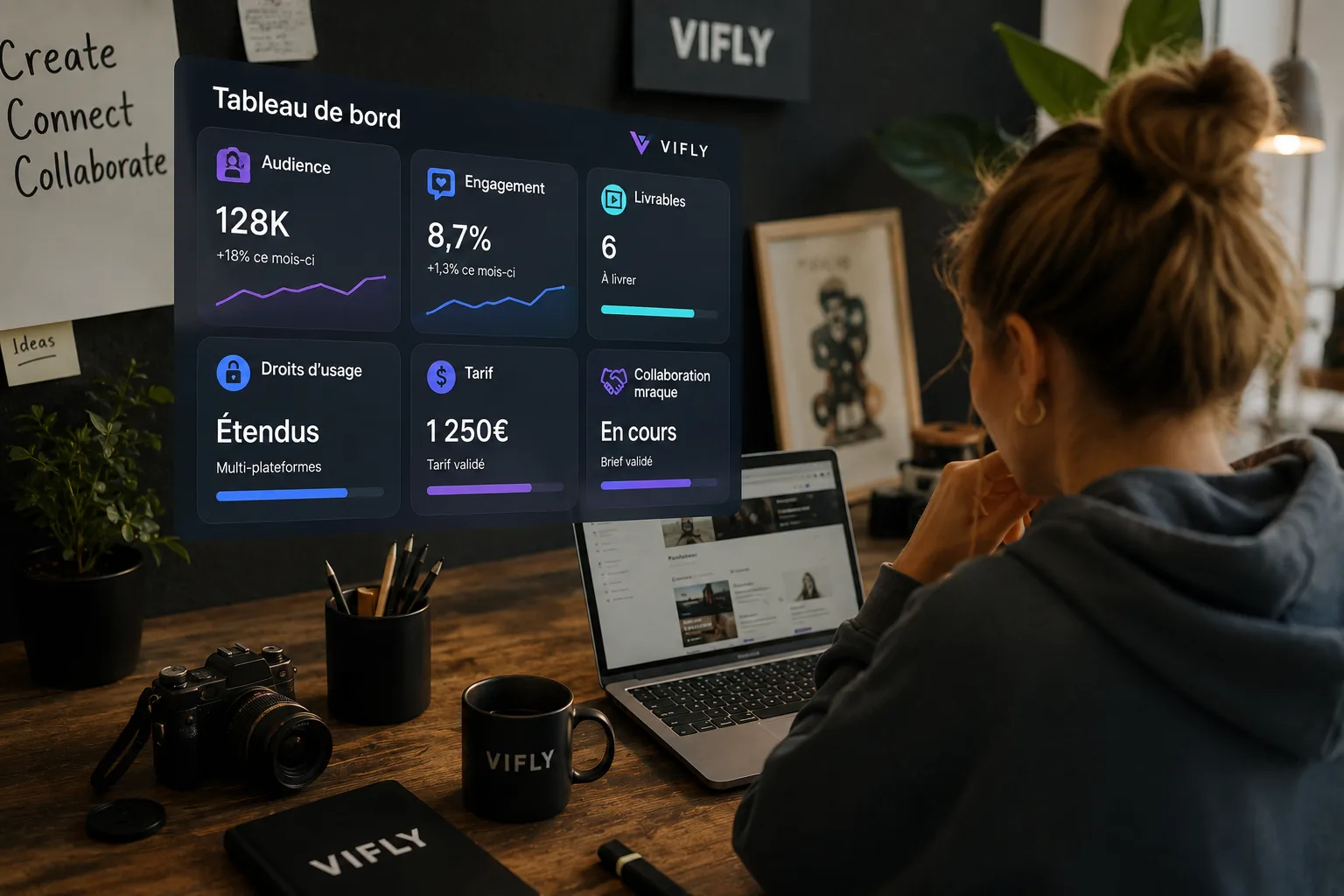
Your price depends not only on your number of subscribers
Many creators block when giving a price.
They know how to create content. They can talk to their audience. They know how to recommend a product with natural. Sometimes they can generate clicks, messages, sales or reservations.
But when a brand asks, "What are your rates?", everything becomes blurred.
Some respond too low for fear of losing opportunity. Others give a random price.
Some accept a free product while the brand asks them for real creative work. Others copy a large designer's tariffs without looking at their own value, niche or fee.
The truth is, there is no universal tariff. But there is a much smarter way to set your price.
You don't have to bill just one post.
You have to bill a full value: your time, your idea, your production, your audience, your credibility, your statistics, your rights of use, your seriousness and the simplicity you bring to the brand.
It is this logic that transforms a hesitant creator into a professional partner.

Why creators often mislead their prices
The first reflex is often to think:
I mean, I know 2 000 subscribers, so i can't ask much
I mean, I know 10 000 subscribers, so i have to have a fixed rate
This brand is known, I should accept even if it's free
If I ask too much, she'll choose someone else
These thoughts are understandable, but they lock the creator in a bad logic. A brand does not only pay for your number of subscribers. She pays what you can bring her.
She can pay:
- a highly targeted audience;
- a relationship of trust;
- a precise niche;
- a credible image;
- a capacity to popularize;
- a well-produced video;
- a creative angle;
- a natural recommendation;
- content that can be reused;
- a presence in a coherent universe;
- social evidence your audience.
A creator with 3 000 subscribers who are very engaged in a clear niche may sometimes have more value than an account with 80 000 subscribers that are very large, little engaged or poorly aligned with the brand.
This is exactly what VIFLY develops in its guide on how to attract brands and secure paid collaborations brands not only pay for views, they pay for an aligned audience, real confidence and a clear career path.
Key points
Your fare must not answer the question:
How much are my subscribers worth
He has to answer a much more serious question:
What full value does this collaboration bring to the brand
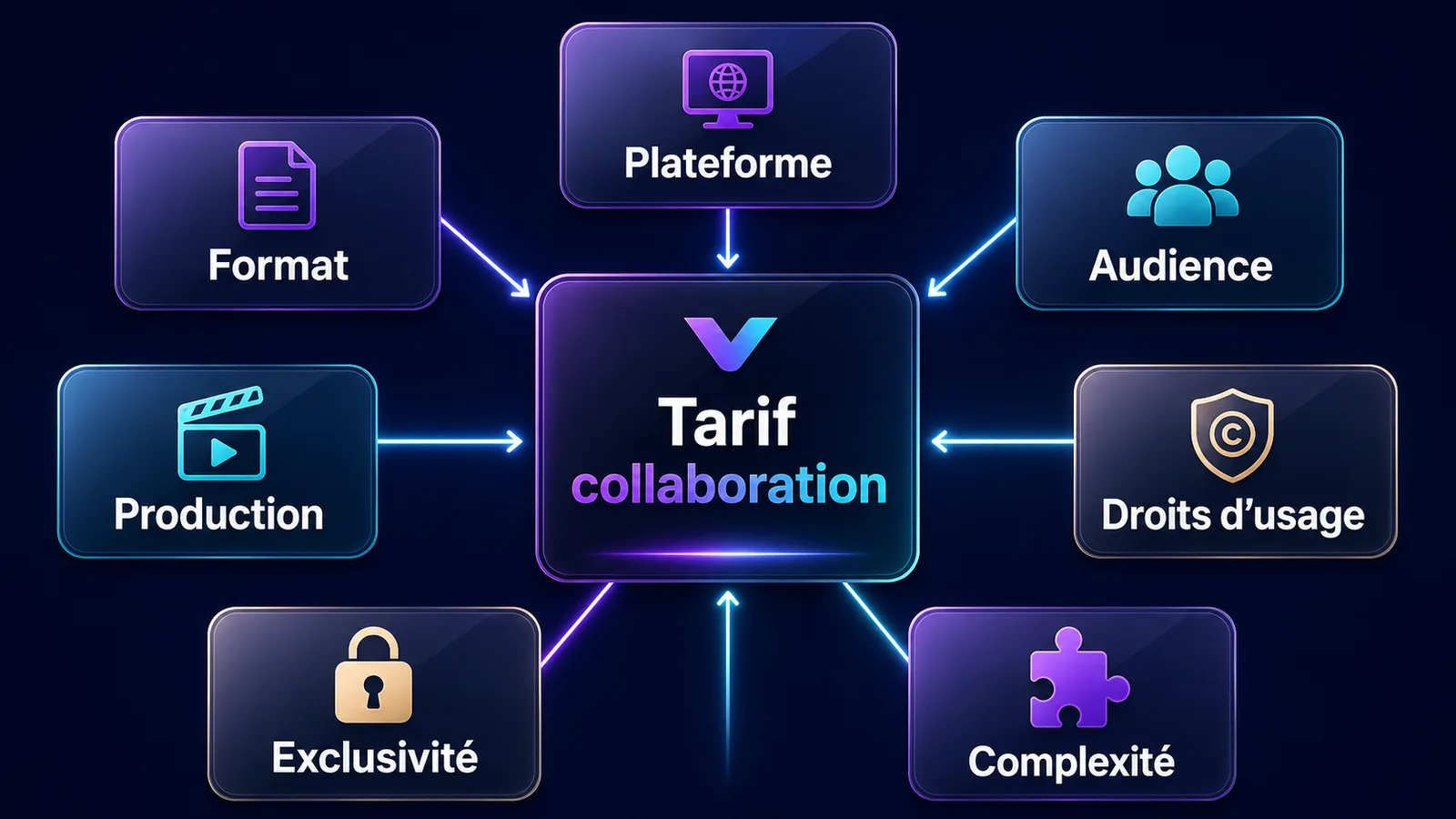
The 7 elements that must influence your price
Before giving a tariff, analyze the brand's demand. Two collaborations may seem similar in appearance, but represent a very different work.
1. The requested platform
An Instagram post, a story, a Reel, a TikTok video, a Short YouTube, a long YouTube video, a live or blog article do not require the same time, nor the same level of production.
Sponsored Reel often involves:
- search for angle;
- writing the script;
- filming;
- light;
- sound;
- mounting;
- subtitles;
- publication;
- description;
- moderation of comments;
- sharing statistics.
It's not like a simple photo story.
2. The exact format
Always ask what the brand expects.
A content may mean a lot of things:
- 1 simple story;
- 3 stories with link;
- 1 Reel published on your account;
- 1 unpublished UGC video;
- 1 Instagram carousel;
- 1 post LinkedIn;
- 1 integrated YouTube video;
- 1 blog article;
- 1 complete package with multiple formats;
- 1 content + advertising authorization;
- 1 long-term collaboration.
As long as the delivery is not clear, your price cannot be clear.
3. Your actual audience
The number of subscribers counts, but it is not enough.
Look, too
- your medium range;
- your average views;
- your commitment rate;
- the clicks generated;
- story answers;
- backups;
- sharing;
- the quality of the comments;
- the consistency of your audience with the brand;
- the location of your audience;
- the level of trust you built.
A local designer in La Réunion, Martinique, Guadeloupe or in a highly targeted French niche can be valuable for a brand that wants to reach this community exactly.
Size doesn't say everything. Accuracy is very important.
4. Your level of production
A content filmed quickly with a phone is not billed as a video thought, scripted, shot cleanly, edited with subtitles and delivered in several versions.
You have to integrate:
- preparation time;
- the script;
- shooting;
- mounting;
- alterations;
- subtitles;
- creative research;
- accessories;
- movement;
- image quality;
- sound quality;
- the validation time.
Even if you work alone, your time has value.
5. Fees for use
This is one of the most forgotten points.
If a brand pays you to publish a Reel on your account, it's one thing.
If she wants to reuse your video in her ads, on her website, in her emails, in her shops, on her networks or in sponsored campaigns, that's something else.
In this case, she no longer pays only for your publication. It also pays the right to use your image, content and creation.
The user fees must therefore be charged separately or included in a higher package.
6. Exclusive
If a brand asks you not to work with its competitors during 1 month, 3 months or 6 months, it limits your future opportunities.
This constraint must be paid. An exclusivity is not an administrative detail. It's a trade restriction.
You can accept exclusivity if it is consistent with your image, but it must be clear, time-limited and embedded in your price.
7. The level of complexity of collaboration
The more the brand requests validations, round-trips, reporting, briefings, formats, statistics, rights or constraints, the higher the price.
Simple collaboration can be quick. A highly structured collaboration can become a real project.
Your rate must follow this reality.
The simple formula to calculate your collaboration rate
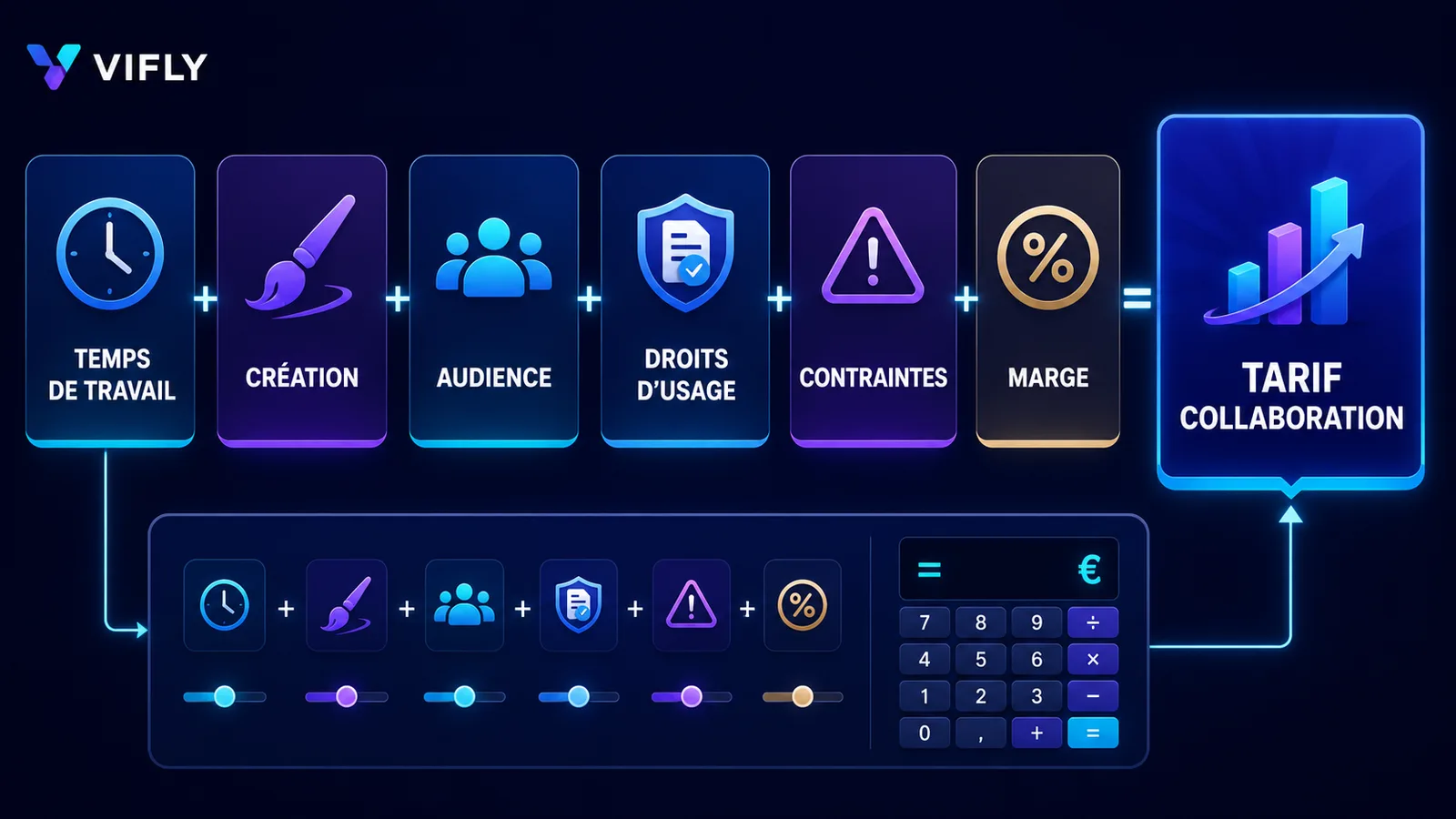
To avoid setting your price at random, you can use this formula:
Collaboration rate = working time + creative value + hearing value + user rights + constraints + professional margin
Let's see each block.
1. Your working time
You can honestly estimate the time it takes.
For example:
- reading the brief: 30 minutes;
- search idea: 1 time;
- script: 1 time;
- filming: 2 hours;
- assembly: 2 hours;
- publication and description: 30 minutes;
- exchanges with the brand: 1 hour;
- reporting: 30 minutes.
Total: 8 hours.
Even if you like to create, those hours are work. If you value your time at 40 € of the hour, the working base already represents 320 €.
It's not your final rate. It is only the base that avoids working at a loss.
2. Creation value
A brand doesn't just pay you to make a video. It can also pay you because you know how to find an angle, talk naturally to a community, make a product desirable without forcing, popularizing a complicated offer or creating more human content than conventional advertising.
This skill has value.
A creator capable of producing usable, clean, sincere and platform-friendly content brings more than mere visibility.
3. The hearing value
Your audience is part of the price, but it must not crush everything.
Analysis:
- how many people will likely see the content;
- whether these persons correspond to the mark's target;
- whether they really interact;
- whether they can click, buy, book or request more information;
- if your history shows that your recommendations trigger action.
A small but precise audience can be very interesting.
That's why Article VIFLY on how to monetize a small audience is an excellent complement: it shows that a small community can become profitable if it is qualified, credible and guided towards clear action.
4. Fees for use
Add a dedicated line if the brand wants to reuse the content.
For example:
- organic use only: included or low supplement;
- reuse on brand networks: supplement;
- advertising use: important supplement;
- website usage, email, landing page : supplement ;
- long-term use: supplement;
- unlimited use: avoid or charge heavily.
Once published content does not have the same value as content used for 6 months in advertising.
5. The constraints
Add an increase if the brand asks:
- exclusive;
- urgent deadline;
- movement;
- purchase of accessories;
- several validations;
- imposed script;
- multiple returns;
- confidentiality;
- availability on a specific date;
- detailed reporting.
Each constraint consumes energy, time or opportunity.
6. The professional margin
A fare must not only cover your time. It must also allow you to build an activity.
If you only bill at a minimum, you cannot invest in your equipment, training, tools, organization, prospecting time or professional image.
A fair price is not an inflated price. It is a prize that respects the value of work.
Practical example
Imagine a well-being designer with 8 000 Instagram subscribers.
The mark asks:
- 1 Reel published on his account;
- 3 stories;
- 1 link in story;
- statistics after 7 days;
- organic sharing right on brand networks for 30 days.
Estimated time: 7 hours.
Time base: 7 x 40 € = 280 €.
Creative value and audience: 150 €.
Organic redistribution rights: 80 €.
Management, exchanges, reporting: 70 €.
Proposed tariff: approximately 580 €.
The designer can round to 550 € or 600 €] depending on the level, history, brand and quality of the application.
It's not a universal tariff. It's a calculation method.
And it's a lot more serious than saying, "I'm 8 000 subscribers, so I'm going to ask 100 €
Fee Benchmarks: How much to ask for depending on the type of collaboration?
The rates below are practical benchmarks. They are not official rules. They must be tailored to your audience, niche, country, experience, brand, rights requested, and level of production.
Simple Instagram Story
For a simple story with mention or link, a small creator can sometimes start around 50 € at 150 €.
But if the story includes a real storytelling, several slides, a product demonstration, a link, a promo code and a reporting, the price can increase.
A story isn't just a few seconds. She can be a very direct point of contact with your audience.
Reel Instagram or TikTok sponsored
For a Reel or TikTok video published on your account, a small creator can start around 150 € at 500 €] depending on quality, commitment, production time and niche.
A more established creator, with an engaged audience and evidence of performance, can ask for more.
The video format requires more work. It must therefore be better valued than a simple static publication.
Reel Pack + Stories
A package including 1 Reel and 3 stories can be around 300 € to 900 € for a nano or micro creator depending on the level of production.
This type of pack is often interesting because it allows to combine:
- discovery;
- proof;
- reminder;
- link;
- action.
The brand gets more than just isolated content.
UGC without publication on your account
The UGC is different.
In that case, the brand doesn't necessarily pay for your audience. It pays for your ability to create content that it can use on its own networks or advertisements.
Simple UGC content can start around 150 € to 400 €.
A package of several videos can mount higher, especially if the brand wants different hooks, multiple angles, short versions and advertising rights.
Caution: if the brand wants to use your face, voice or video in advertising, the user rights must be clearly defined.
YouTube Video
YouTube is often more expensive because the production time is longer and integration can remain visible for a long time.
A short integration into a video does not have the same price as a video entirely dedicated to a brand.
Even with a small chain, you have to consider:
- writing time;
- shooting;
- mounting;
- the life of the content;
- trust with your audience;
- the depth of the subject;
- user fees.
Sponsored Post LinkedIn
For consultants, trainers, coaches B2B, freelancers or experts, LinkedIn can be very interesting.
Even with a smaller audience, a post LinkedIn can reach a qualified professional target.
The price depends heavily on:
- your credibility;
- your sector;
- the quality of your network;
- your expertise;
- the value of the product or service promoted;
- the post's ability to trigger qualified applications.
In some cases, a LinkedIn audience of 3 000 people can be more valuable than a much larger but less targeted Instagram audience.
The real trap: accept a free product for complete work
Receiving a product can be pleasant. But a product offered is not always a fair remuneration.
If the brand just asks you to test something without publication obligation, it's a discovery.
But if she asks:
- a Reel;
- stories;
- a script;
- validation;
- publication on a specific date;
- statistics;
- a right to reuse;
- exclusiveness;
- an imposed tone;
- several returns;
So this is no longer a simple gift. It's a performance.
You can accept a collaboration in kind if it is consistent with your universe, if the product has real value for you, if you're new or if you want to build your portfolio.
But don't confuse opportunity with free work.
Common mistake
Say yes too fast because a brand contacted. A brand that is written doesn't necessarily do you a favor.
It needs visibility, content, authenticity or trust.
Collaboration must be balanced.
How to present your prices to a brand without looking aggressive
The problem is not just the amount. It's the way to present it.
Don't just say:
500 €]
Explain what is included.
For example:
For this format, I propose a pack to 580 € including: angle search, script creation, shooting, editing, publication of a Reel, 3 stories, story link, reporting to 7 days and right of organic redistribution during 30 days
This sentence changes everything.
The brand no longer sees only a price. She sees a frame. She understands what she's buying.
You can also propose several options.
Example of a simple offer
Option 1 — Discovery: 250 €
3 stories with link, natural presentation, statistics at 48 hours.
Option 2 — Visibility: 550 €
1 Reel + 3 stories + statistics at 7 days.
Option 3 — Full Campaign: 850 €
1 Reel + 3 stories + 1 post or carrousel + organic right to share 30 days + reporting.
This structure helps the brand to choose. It also avoids negotiating only on price.
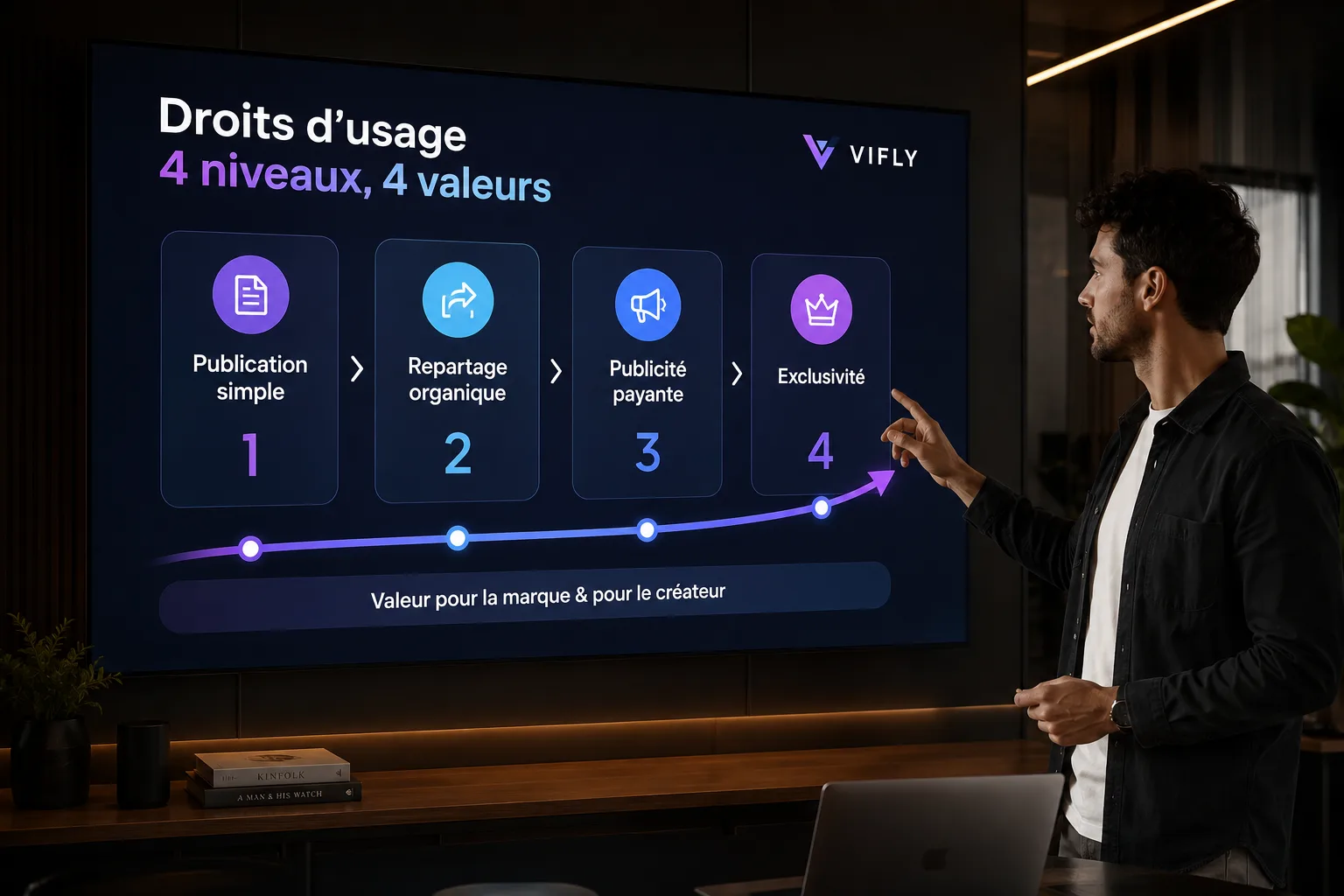
User fees: the line that can double your rate
Many creators forget this question:
What does the brand have the right to do with my content after publication
If she can only share your story post, it's limited.
If it can download your video, publish it on its accounts, use it in advertising, integrate it on its site or broadcast it for several months, it is much wider.
So you have to ask specific questions:
- Does the brand only want a publication on your account?
- Can it share the content?
- Can she use the content in advertising?
- For how long?
- On which platforms?
- In which countries?
- With or without modification?
- Will your image or voice be used?
- Can the content be mounted differently?
- Does the brand want exclusivity?
The larger the fees, the higher the rate.
Action to be taken
Before answering a brand, always ask:
Do you only follow a publication on my account, or do you also want user fees to reuse content on your own channels or in advertising
This question protects you.
She also shows you're professional.
What you need to include in your quote or proposal
Even if you start, avoid blurred chords.
A clear proposal should indicate:
- the name of the mark;
- the name of the creator;
- accurate deliverables;
- the platform;
- the planned dates;
- the number of returns included;
- user fees;
- the duration of use;
- transparency obligations;
- the duty-free tariff or any taxes included according to your status;
- the conditions of payment;
- time limits;
- the elements to be supplied by the mark;
- which is not included.
In France, the regulation of commercial influence imposes a stricter framework as soon as certain conditions are met. In particular, the official guide 2026 recalls that a written contract becomes mandatory above a threshold of 1 000 € HT, with specific information on the parties, the subject of the contract, remuneration and obligations. Even below this threshold, clarifying the agreement remains strongly recommended.
It must not scare you. On the contrary, a clear framework protects everyone.
Transparency: Payable collaboration must be identifiable
If you are paid, if you receive a product, if you receive a commission, if you benefit from a consideration or if a brand influences your content, your audience must be able to understand clearly that it is a commercial collaboration.
In France, transparency is not a detail. Commercial communication must be clear, legible and identifiable.
Platforms also have their own tools.
Instagram offers the paid partnership label. YouTube asks to report product placements, sponsorships or sleep in the video details.
TikTok asks to activate the commercial content disclosure setting when content promotes a brand, product or service.
This is not just a legal point. It's a matter of trust.
An audience can accept that a creator is paid. What she accepts much less is to feel deceived.
Key points
Transparency doesn't necessarily reduce your impact.
On the contrary, it can enhance your credibility if the collaboration is coherent, useful and undertaken.
Concrete examples according to your profile
Example 1: lifestyle creator with 5 000 subscribers
You have a local or niche audience, your stories generate answers, your Reels make between 1 000 and 5 000 views.
A brand offers to send a product and asks 1 Reel + 3 stories.
You can say:
Thank you for the proposal. For this format, I propose a collaboration package to 350 €, including the creation of a Reel, 3 stories, a link, publication on my account and statistics after 7 days. The product is supplied by the brand and advertising rights are not included
This message is simple, clear and professional.
Example 2: Coach with an engaged audience
You are a coach, you have 3 000 subscribers, but your audience is very targeted: independent, young parents, women entrepreneurs, sportsmen, people undergoing conversion, according to your niche.
A tool, training or wellness brand contacts you. Your rate must not only depend on your subscribers.
You can value your expertise, your credibility and the confidence of your audience.
You can propose:
- 1 educational post;
- 1 Reel counsel;
- 3 stories;
- 1 link to the mark;
- 1 feedback from honest experience;
- 1 live or workshop option.
In that case, you're not just selling visibility. You sell a credible recommendation in a context of expertise.
Example 3: consultant or freelancer B2B
You have few subscribers, but your audience is composed of entrepreneurs, executives, freelancers or marketing managers.
A SaaS brand contacts you.
A single well-targeted LinkedIn post can have real value if your audience matches exactly the ideal customer of the brand.
You can charge:
- strategic writing;
- publication;
- educational angle;
- business credibility;
- the comments generated;
- the possibility of a call or webinar;
- a right to share on the brand page.
In the B2B, the value is not always in the volume. It is often in the quality of the context.
Example 4: trainer or educational expert
You can propose an educational collaboration:
- tutorial;
- mini-guide;
- explanatory video;
- live workshop;
- educational carousel;
- tool demonstration;
- honest comparison;
- downloadable resource.
Here, your price must take into account the educational preparation. The brand not only pays for one appearance.
She pays for your ability to make her product understandable.
Example 5: artist or visual creator
You can be paid to integrate a brand into your artistic world, create aesthetic content, produce a visual, video, performance, illustration, staging or a series of content.
In this case, pay attention to user fees.
If the brand wants to reuse your creation, image or universe, the price must be higher than a simple publication.
How to negotiate without losing your value
Negotiating doesn't mean lowering your price right now.
If a brand says, "It's too expensive," you can answer:
I understand. To meet your budget, we can adjust the perimeter. For example, instead of the Reel pack + stories + rights to share, we can leave on 3 stories with link, or on a UGC video without publication
This answer is professional.
You don't say, "Okay, I'm down."
You say, "Okay, we adjust what's included."
It's a huge difference.
Common mistake
Lower the price without removing anything.
If you switch from 600 € to 300 € with the same deliverables, you learn the brand that your first prize was not solid.
It is best to reduce the perimeter:
- fewer stories;
- no user fees;
- not exclusive;
- no detailed reporting;
- longer delay;
- only one return included.
Your profile must justify your rate before the discussion
A brand more easily accepts a rate when your profile inspires confidence.
Before you even ask 300 €, 600 € or 1 000 €, your universe must give an impression of seriousness.
The mark shall include:
- who you are;
- who you're talking to;
- what your audience is looking for in your house;
- what formats you control;
- what collaborations you accept;
- how to contact you;
- how to see your evidence;
- how to book an exchange;
- why your profile is consistent with its purpose.
This is where many creators lose value. They have talent, but their presence is scattered.
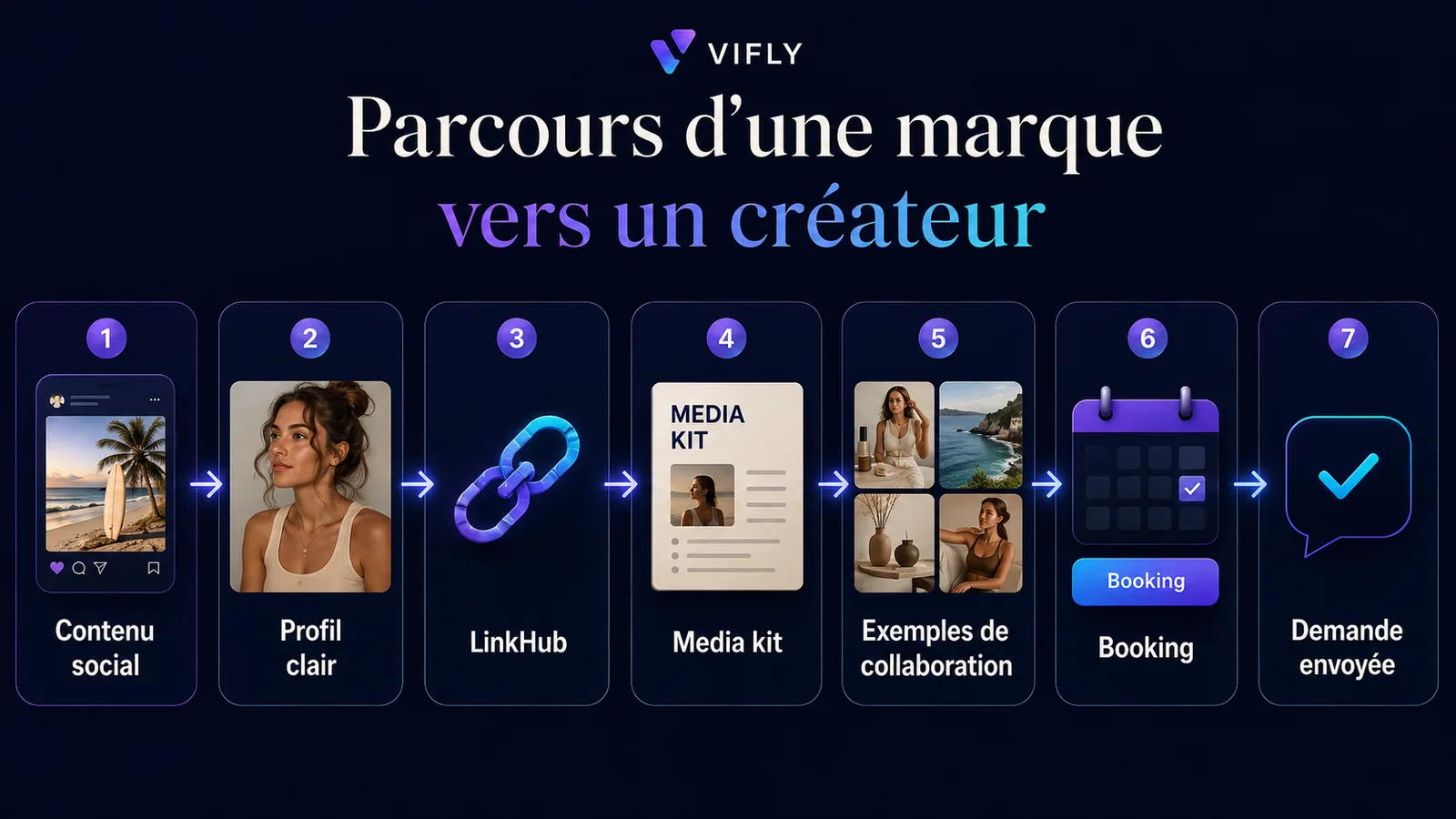
A link to Instagram. A link to WhatsApp. An old Google Drive. A media kit lost in a bio. Story evidence but not organized. No form. No clear buttons to collaborate.
An interested brand should not have to search. Your journey must be simple.
You can use VIFLY LinkHub to centralize your media kit, collaboration offers, content examples, networks, evidence, services and contact means.
And if you offer discovery calls, audits, coaching, partner appointments or exchanges with brands, VIFLY Booking can make it easier to make appointments without going back and forth in DM.
The goal is not to do more business. The goal is to become more readable.
As explained in Article VIFLY on errors of an unprofessional creative profile, a profile should not only attract an eye: it should give confidence and help the right person move on to the next step.
Your collaborative offer must be as clear as a service offer
Many creators say:
I do collaborations
But a brand wants to understand what this means in practice.
Do you propose:
- reels?
- stories?
- uGC videos?
- linkedIn posts?
- test products?
- lives?
- articles?
- photos?
- educational content?
- long campaigns?
- monthly packs?
A clear collaborative offer may look like this:
Pack Story — from 150 €
3 stories, natural presentation, link, statistics at 48 hours.
Reel Pack — from 450 €
1 Reel scripted, shot, mounted and published, statistics at 7 days.
UGC Pack — from 350 €
1 vertical video delivered to the brand, without publication on my account, organic rights 30 included days.
Partnership package — on estimate
Full campaign with multiple formats, user fees, reporting and long-term collaboration.
This clarity reassures.
You can deepen this logic with the article VIFLY on how to build a clear offer when you are independent. Even if the article talks about offers of services, the principle is the same: a fuzzy offer loses opportunities, even when it is good.
What brands look at before accepting your price
A mark does not only judge the amount.
She's watching if your rate seems consistent with:
- the quality of your content;
- your position;
- your audience;
- your commitment;
- your seriousness;
- your history;
- the clarity of your media kit;
- your ability to respect a brief;
- your level of professionalism;
- your transparency;
- your ability to create without breaking trust.
A high price without proof may seem fragile. A structured, explained and consistent price can be accepted more easily.
Prepare your evidence:
- captures of statistics;
- examples of content;
- feedback;
- testimonies;
- former collaborations;
- message captures;
- click rate;
- medium views;
- backups;
- answers in story;
- conversion if you can follow them.
The evidence does not need to be spectacular. It must be legible.
When do you have to raise your rates?
You can increase your rates when:
- your content perform better;
- your audience becomes more qualified;
- you receive more requests;
- you gain in quality of production;
- you have proof of results;
- you better control your formats;
- you offer a better framework;
- you have already worked with several brands;
- your content is reused by brands;
- you refuse more and more misaligned opportunities.
You can also increase if the demand becomes more complex. A tariff is not fixed.
It evolves with your experience, credibility, positioning and value.
When should collaboration be refused?
Not all collaborations deserve your time.
You can refuse if:
- the mark is not aligned with your audience;
- the product is doubtful;
- the demand is blurred;
- user fees are too wide;
- the remuneration is inconsistent;
- the brand wants to mask the commercial character;
- the brief forces you to lie;
- exclusivity blocks other opportunities;
- the deadline is unrealistic;
- collaboration can damage your confidence with your audience.
Poor collaboration can cost more than it does.
Your audience is your capital. Protect her.
The VIFLY method to set a price without braiding you
Here is a simple method in 6 steps.
Step 1: clarifies the deliverables
Before talking about prices, ask:
What formats do you want exactly? On which platforms? What dates? Do you want user fees
Step 2: estimates your real time
Record all necessary hours, even small tasks.
Briefing, exchanges, validations and reporting are part of the work.
Step 3: adds the creation value
Your idea, angle, script, naturalness, editing and experience matter.
Step 4: adds the audience value
Look at the relevance of your audience, not just its size.
Step 5: Bills fees and constraints
Advertising rights, exclusivity, urgency, long-term use: none of this should be automatic.
Step 6: presents a clear offer
Don't give a naked price. Give a price with a perimeter.
Example:
My price for this pack is 620 €. He understands 1 Reel, 3 stories, a link, script creation, shooting, editing, publishing, reporting to 7 days and the right of organic redistribution during 30 days. Advertising rights are not included
It's simple. That's clear. It's professional.
Checklist before sending your rate to a brand
Before answering, check:
- Did I understand exactly the deliverables?
- Does the brand want to publish only on my account or reuse the content?
- Are there any advertising rights?
- Is there any exclusivity?
- Is the deadline urgent?
- How many hours will I actually spend?
- Is the product consistent with my audience?
- Should collaboration be clearly declared commercial?
- Does my price cover my time and value?
- Do I have a simpler option if the budget is lower?
- Is my media kit ready?
- Is my LinkHub or my collaboration page clear?
- Can the brand easily contact me or book a call?
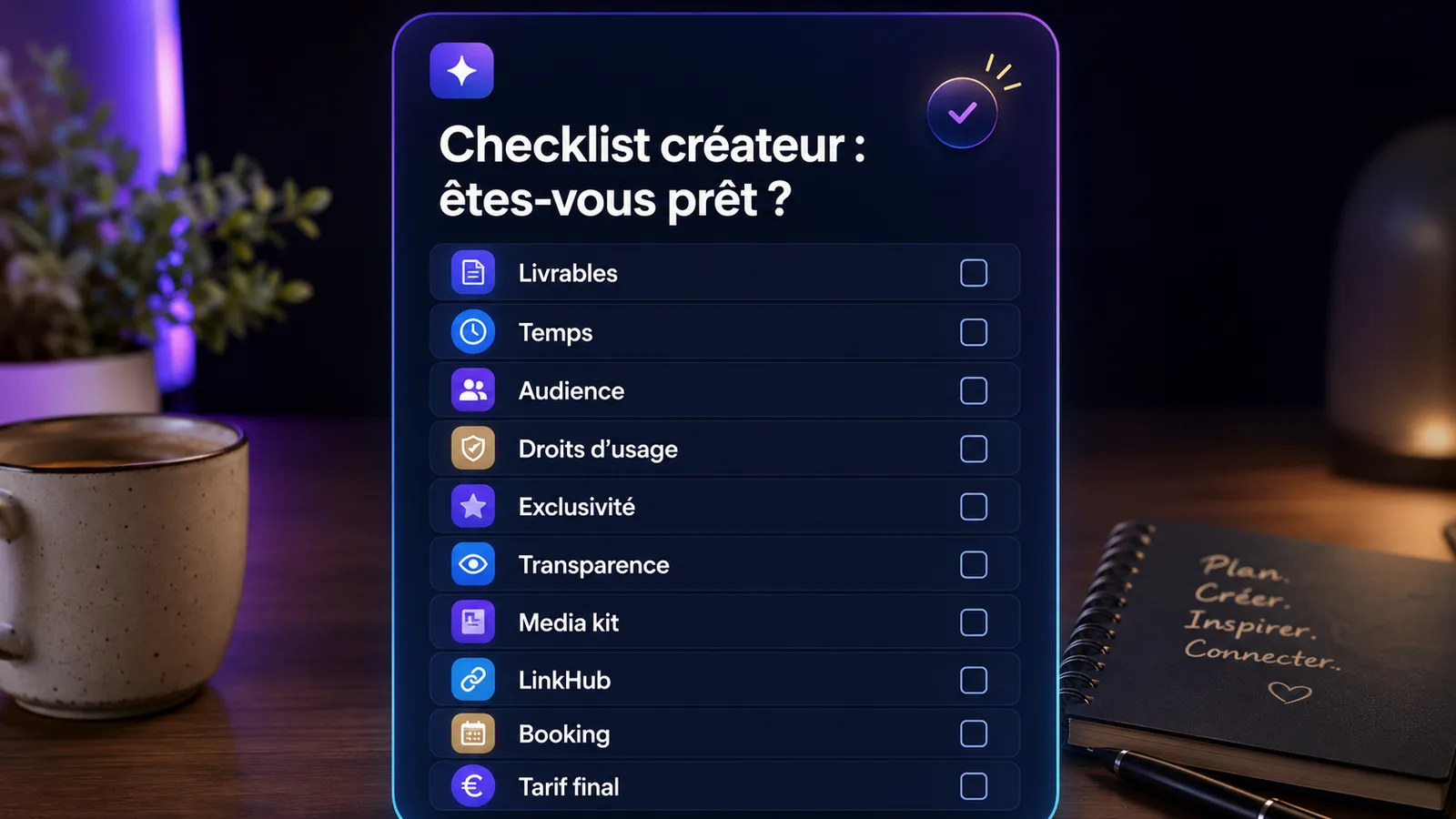
A price presented without context may seem arbitrary. Your audience, statistics, formats and results must be grouped into a media kit that helps the brand understand your value.
How VIFLY can help appear more professional in the face of brands
Setting a price just isn't enough. Your universe must also make you want to accept it.
A brand may like your content, but hesitate if your profile is blurred, if your media kit is not found, if your offers are not visible, if your bio link disperses or if no one understands how to contact you.
It's exactly the role of VIFLY.
VIFLY helps creators, coaches, consultants, independents, trainers, freelancers, artists, therapists and entrepreneurs to structure their digital presence.
With VIFLY, you can create a clearer space for:
- present who you are;
- centralize your links;
- display your offers;
- add your media kit;
- show your examples of content;
- guiding brands towards a request for collaboration;
- offer a call reservation;
- selling content or services;
- turn your visibility into opportunities.
A designer who requests a price without a frame can give the impression of improvising.
A creator who sends a clear link to his profile, media kit, examples, offers and Booking gives a different impression.
He's not just looking for collaboration. He shows that he's ready to work seriously.
Conclusion: Your fee must respect your work, your audience and your confidence
The right rate is not always the highest.
It is one that respects the real value of collaboration.
If you bill too low, you may run the risk of exhausting, trivializing your work and accepting requests that do not respect your time.
If you bill without justification, you risk losing brand confidence.
But if you can explain your price, frame your deliverables, protect your rights, show your evidence and guide the brand towards a clear path, you change your posture.
You are no longer just a creator who accepts partnerships. You're becoming a partner.
And it is this difference that makes it possible to build healthier, more professional and more sustainable collaborations.
Your audience is worth it. Your time is worth it. Your creativity has value. Your trust in your audience is valuable.
Don't brag her for fear of asking.
Structure it. Explain it. Present it clearly!
That's how you can bill more precisely, without arrogance, without malaise and without improvisation.
Create a more professional space for your collaborations
You want to give brands a clear reason to trust you?
Create your space VIFLY, structure tone Professional LinkHubadd your media kit, present your collaboration formats, show your evidence and facilitate requests with VIFLY Booking.
Your content attracts attention. But your journey must turn this attention into opportunities.
FAQ - Frequently Asked Questions
How much to charge a collaboration when we start?
When you start, don't set your rate only according to your number of subscribers. Start by calculating your working time, the format requested, the value of your audience, the quality of production and the user fees. Even with a small audience, a collaboration that requires a Reel, stories, a script, editing and statistics deserves real pay.
What price do you charge for a sponsored Reel?
The price of a sponsored Reel depends on your audience, your niche, your commitment, quality of production, creative time and fees. For a small designer, a Reel can sometimes start around a few hundred d'euros, but the price must increase if the brand requires a complex script, returns, re-use rights or advertising.
Is a product offered sufficient for remuneration?
Not always. A product offered may be acceptable for discovery, free testing or first light collaboration. But if the brand imposes specific deliverables, a date of publication, validation, reporting or user fees, it is a true performance. In this case, financial compensation is often fairer.
Should user fees be charged separately?
Yes, if the brand wants to reuse your content beyond the intended publication. A publication on your account, an organic redistribution, a paid advertisement or a use on a website do not represent the same value. The user fees must be clearly defined: duration, platforms, country, permitted modifications and advertising or not.
How to advertise its price to a brand?
Present your rate with what is included. Avoid sending only an amount. Explains deliverables, steps, fees included, timelines, number of returns and statistics provided. A brand better understands a tariff when it sees the full framework of collaboration.