
Apple didn't become Apple through advertising
Just see a black silhouette dancing on a colorful background, an extremely sober white box or a product presentation on a black background to think of Apple.
This immediate recognition is impressive. But it also feeds a misleading idea: Apple would have succeeded thanks to beautiful advertisements, some cult slogans and the charisma of Steve Jobs.
Reality is more demanding.
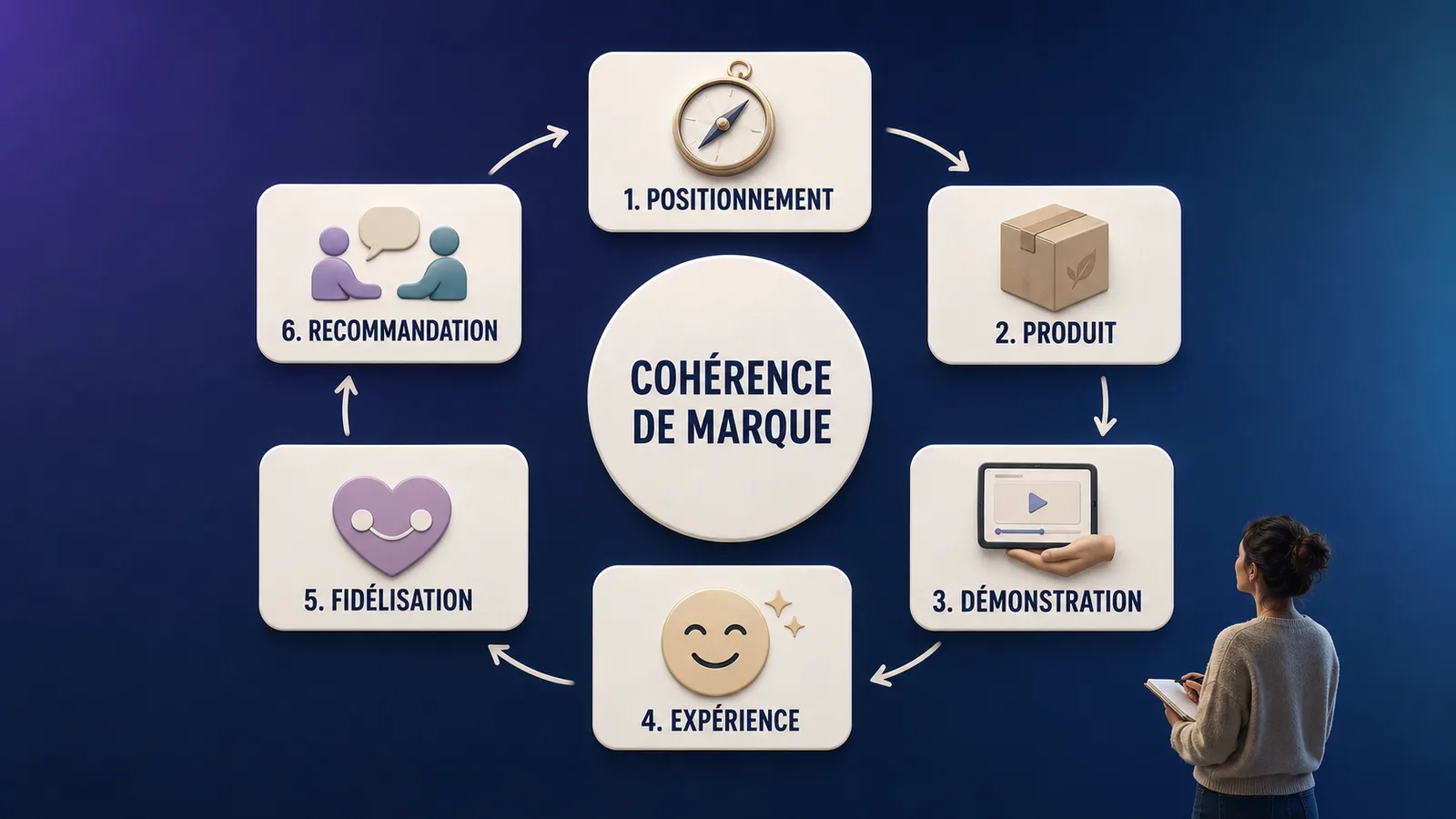
Apple has built its marketing power by aligning almost everything: its positioning, its products, its design, its words, its launches, its shops, its services, its support and even the way a customer opens a box.
This system goes far beyond communication. It turns each point of contact into confirmation of the same promise.
In its fiscal year 2025, Apple reported 416,2 billion dollars of turnover, including 109,2 billion dollars from services. The company has also spent about 19,5 billion dollars on sales and marketing. These figures show the scale achieved, but not the reasons alone. The strength of the model lies mainly in the coherence between investments, products and the experience delivered. Apple — Form 10-K 2025
Interbrand still ranked Apple first in its global ranking in 2025, with an estimated brand value of 470.9 billion dollars. However, that estimate had fallen by 3.7 % over a year: even such a powerful brand cannot live indefinitely on its image. Interbrand — Best Global Brands 2025
Key points
Apple marketing is not about making an average product more attractive. It consists of ensuring that the product, promise and experience tell the same story.

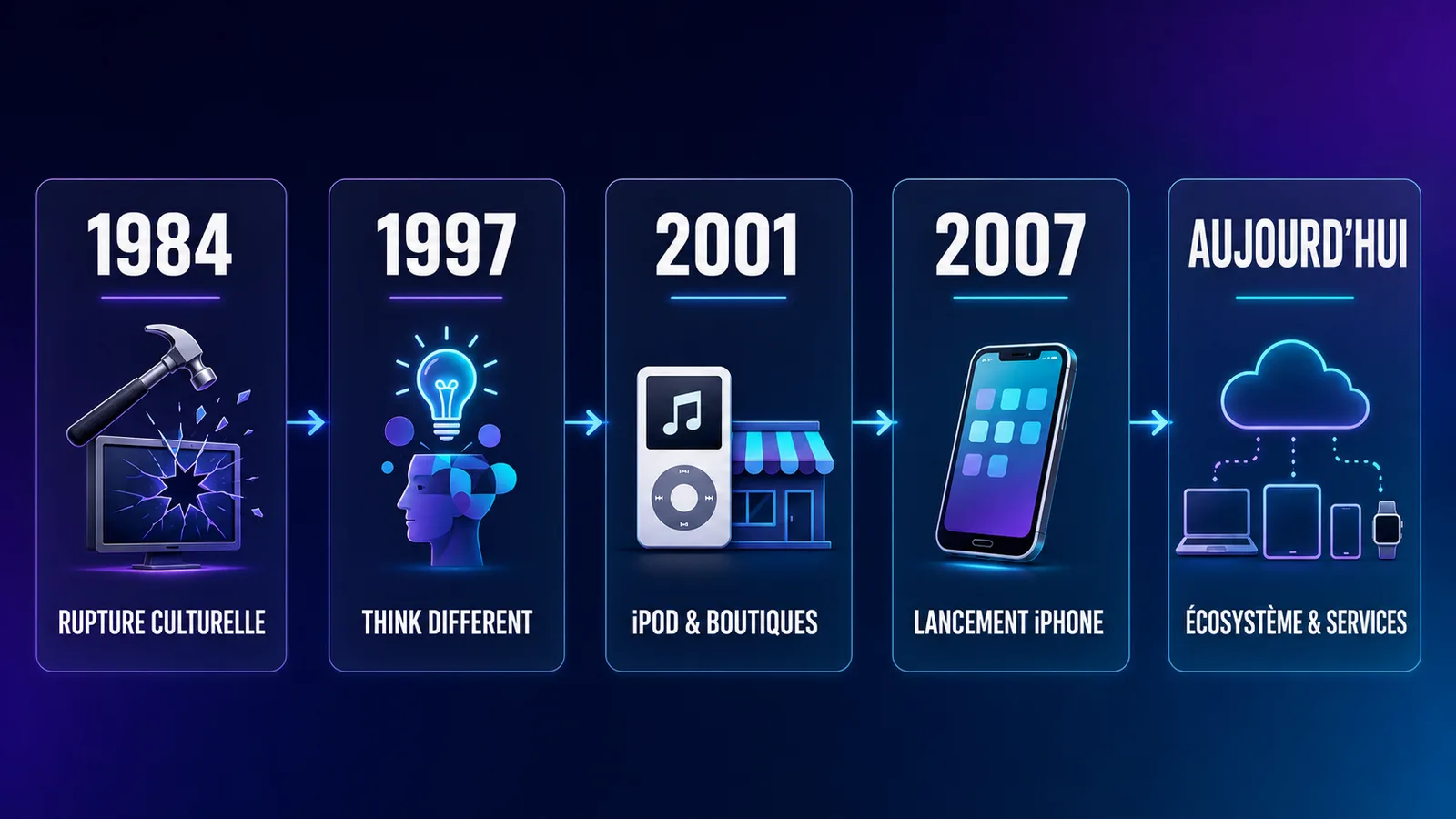
From 1984 to today: the steps that built the Apple brand
1984: Apple not only presents a computer
In January 1984, Apple broadcast during the Super Bowl an advertisement directed by Ridley Scott to introduce the Macintosh.
The product barely appears. Advertising mainly presents Apple as a liberation force in the face of a cold and uniform computer universe. It contrasts two world views: conformity and creativity.
This campaign does not explain the power of the processor, the available memory or the list of connectors. It gives the product a cultural role. Buying a Macintosh symbolically means choosing another way to think computer. Wired — Dawn of the Mac
Apple already has an essential rule: characteristics allow comparison, but beliefs allow choice.
1997:
When Steve Jobs returns, Apple is weakened and its catalogue is not readable. The company does not only suffer from an advertising problem. She also suffers from a lack of direction.
According to the historical account published by Wired, the number of product lines is then reduced from about fifteen to four. The sales channels are streamlined and the communication is refocused around a main message:. Wired — How Steve Jobs Was Able to Save the Company
The campaign created with TBWA\Chiat\Day does not immediately seek to sell a specific machine. It resettles Apple in a territory: that of creative, bold and capable people to challenge the conventions. The detailed account by one of its designers also shows that this campaign was a collective work, not the spontaneous idea of a single man. Forbes — The Real Story Behind Apple
However, it is important to avoid rewriting the story: "Think Different" did not save Apple alone. Refocusing the range, operational decisions and future products have made the promise credible.
A strong brand is not based on a powerful slogan above a confused company. It is based on a promise that the company's decisions eventually confirm.
2001: Apple turns a feature into a life scene
In 2001, Apple presents the iPod by talking about a player able to take up 1 000 pieces in a device holding in the pocket. Technical capacity immediately becomes an easy to imagine experience. Apple Newsroom — Apple Presents iPod
Apple does not hide technology. She translates it.
In the same year, the company started opening its own shops. The first two Apple Stores host more 7 700 visitors during their first weekend. Apple no longer depends solely on a third-party seller to explain its products: it can control presentation, demonstration and accompaniment. Apple Newsroom — Apple Retail Stores Welcome Over 7,700 People
Marketing then becomes physical. The store is no longer simply the place where the transaction ends. It becomes a medium in which the client can reach the promise.
2007: Launch becomes a narrative demonstration
During the presentation of the iPhone in January 2007, Apple does not start by carrying out a fact sheet. The product is presented as a meeting of three devices: a telephone, a wide screen iPod and an Internet communication tool.
Then comes the revelation: it is not three products, but one.
This construction creates tension, simplifies novelty and helps the public to measure the proposed change immediately. Apple Newsroom — Apple Reinvents the Phone with iPhone
The keynote is therefore not an ordinary press conference. It follows a progression:
- recall an existing problem or limit;
- install a wait;
- reveal a response;
- demonstrate it in a concrete situation;
- leave a simple idea that the media can repeat.
Apple does not let everyone decide the story to tell. The brand provides an understandable and easily transmissible narrative.
Today: the product has become an ecosystem
Apple's offer is no longer limited to the sale of devices. It brings together hardware, operating systems, applications, cloud services, content, payments, support and subscriptions.
In its annual report 2025, Apple identifies among its competitiveness factors design, quality, reliability, technology, security, software ecosystem, reputation, marketing, distribution and support. Marketing is therefore only a component of a wider set. Apple — Form 10-K 2025
The nine forces that explain Apple's marketing
1. Apple has a clear mental territory
A brand becomes strong when it occupies an identifiable place in the public mind.
Apple has gradually associated itself with creativity, simplicity, design, accessible innovation and some form of independence. Not all of its clients clearly define themselves as creative rebels. But this territory has given cultural coherence to the products.
The useful question for a creator or an independent is not: "What color should I use? »
The real question is: "What idea do I want to be associated with when my audience encounters a specific problem? »
A coach may want to be associated with clarity in transition periods. A consultant may occupy the simplification territory. A trainer can become the reference for an immediately applicable pedagogy.
If your content could be signed by any professional in your sector, it becomes difficult to associate with a specific idea. The VIFLY guide on the generic content trap explains how to get out of this interchangeability.
Common mistake
Copy Apple's minimalist appearance without clarifying its own positioning. A white page, an elegant font and a premium photo do not replace a strong idea.
2. Simplicity is a strategic decision
Apple's simplicity is not just to remove graphical elements.
She starts with the selection.
Fewer products to highlight. Fewer simultaneous messages. A strong hierarchy. A main benefit easy to remember.
This discipline reduces the mental burden. It allows the public to know where to look and what to understand.
Many independents do the opposite. They present all their skills, services, subjects and connections at the same level. They want to show the extent of their value, but above all produce an impression of dispersion.
Apple's lesson is not to sell only one product. It is to choose a main entrance door.
Action to be taken
Choose a priority offer, a main message and a main action. Everything else must support this hierarchy.
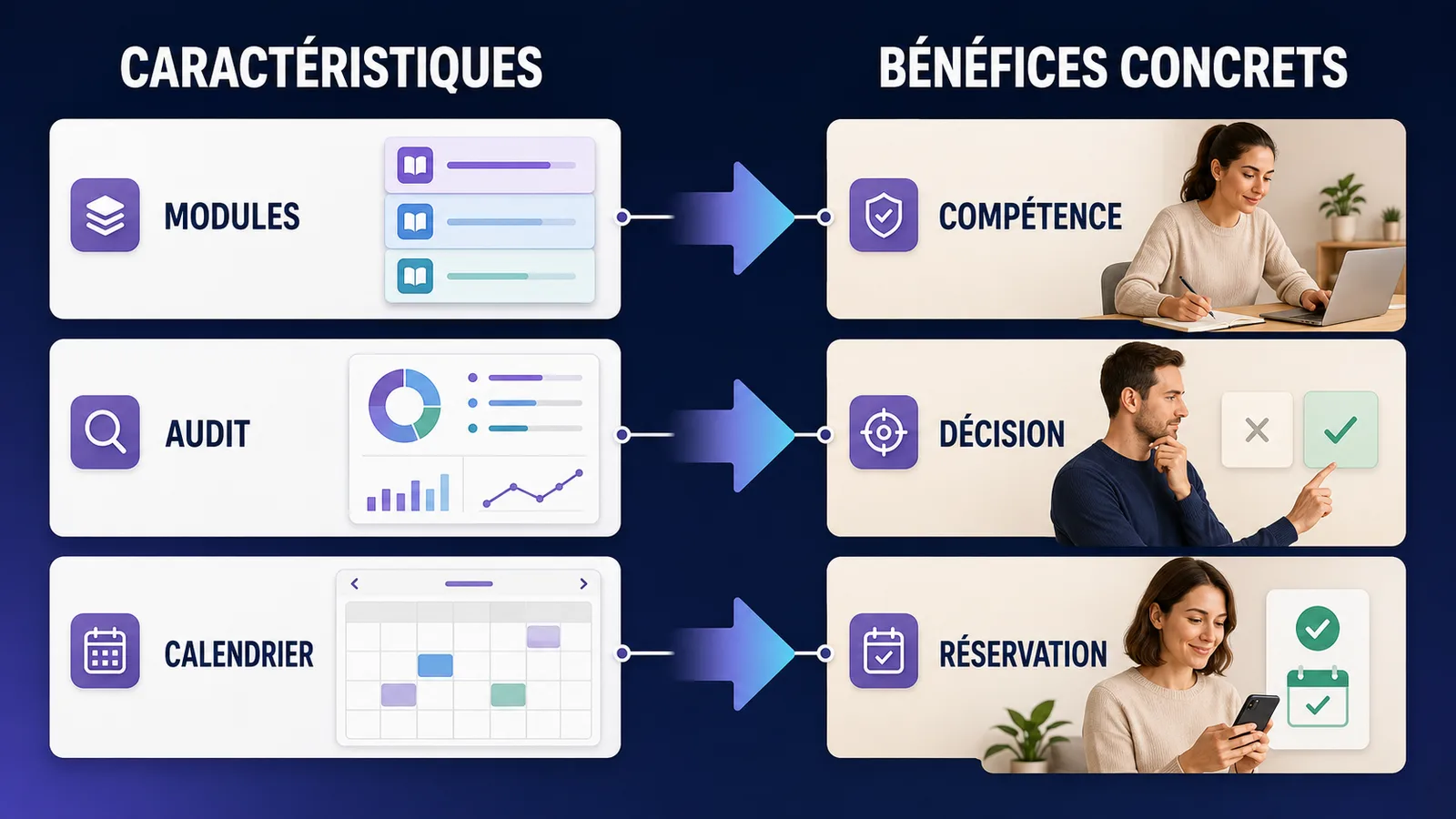
3. Apple sells a usage before detailing the technology
"1 000 songs in your pocket" is memorable because technology becomes a scene.
However, most companies start with what they manufacture:
- six video modules;
- an audit of 40 pages;
- four individual sessions;
- an automated dashboard;
- an eight-week accompaniment.
This information is useful, but it is too early. The client first tries to understand what will change for him.
A trainer not only sells eight hours of video. It helps a participant master a skill. A consultant not only sells an audit. It helps a company identify a decision or blockage. A coach does not sell a 60 minute call. It creates a framed space to move forward on a specific problem.
Article VIFLY dedicated to creating a clear offer for the self-employed helps translate expertise into an understandable proposal.
4. The product must prove advertising
Apple can communicate about simplicity because this promise is found in the use, design, interfaces and integration between its devices.
Not everything is perfect, and some users legitimately challenge some of the company's closed decisions. But the product provides sufficient evidence to support the brand story.
It is an essential difference between a built brand and a decorated brand.
Saying "my accompaniment is personalized" is not proof. Show how the diagnosis adapts the steps to the client's needs is one.
Saying "my trainings are concrete" is not evidence. Showing an exercise, a deliverable and what a participant can achieve after the session is one.
Saying "I propose a premium experience" is not enough. The response time, the clarity of the estimate, the booking page and the follow-up must confirm the promise.
Key points
Each adjective used to present your offer creates a debt of proof.
5. Apple turns launch into an event
An Apple launch focuses attention around a moment, a story and a demonstration.
The public knows that an announcement is coming. The media know they'll have a story to take over. The products are revealed in a controlled order. Demonstrations make new developments observable.
A creator or independent doesn't need a global keynote. However, it can apply the same logic:
- expose the problem before announcing the offer;
- explain why current solutions are not enough;
- reveal its approach;
- demonstrate its practical functioning;
- prepare a clear next step.
Training can be launched with a series of educational content. A consultant can present his new audit through an anonymized real case. A creator can announce premium content after showing the questions he answers.
The launch must not artificially produce emergency. He must concentrate understanding.
6. The premium price is supported by a system of evidence
Apple is not usually positioned as the cheapest option. The brand seeks to reduce the purely technical comparison by adding other criteria: design, experience, integration, support, perceived durability, reputation and continuity.
A higher price, however, does not automatically create a premium brand.
Increasing its tariff without improving the clarity of the offer, the evidence, the framework and the experience produces only more doubt.
For a consultant, coach or freelancer, a premium positioning requires:
- understandable specialization;
- honest results or evidence;
- a visible method;
- fluid experience;
- clear limits and conditions;
- follow-up consistent with the promise.
The price becomes credible when the whole reduces the perceived risk.
7. Shops prolong marketing
By opening its own stores, Apple was able to stage its products without seeing them disappear in the middle of comparable shelves.
Apple Stores allow you to discover, try, ask for help, configure a device or participate in a session. In 2017, Apple announced that it was deploying to its 495 stores of the time, with workshops around photo, video, music, code, art and design. Apple Newsroom — Today at Apple
The shop thus becomes a place of learning, service and community.
For a small digital activity, profile, site, LinkHub and booking page play a similar role. They must extend what the content promised.
If your Reel is clear but your profile is confused, the experience breaks. If your content inspires confidence but your offer is not found, the story stops before the action.
8. The ecosystem creates continuity
An iPhone doesn't live alone. It connects to other devices, applications and services. This continuity increases the utility of the whole and can also make a universe change more binding.
It would be a reduction to speak only of "enclosure". Users can stay because they really enjoy synchronizing, familiarity and reducing friction. But integration undoubtedly reinforces loyalty.
In 2025, services represented more than 109 billion dollars of annual turnover for Apple, up 14 % from 2024. This increase shows that the economic relationship does not stop at the purchase of an appliance. Apple — Form 10-K 2025
An independent person can retain a simple idea: do not think of each content, service or product as an isolated element.
A Reel can lead to an article. The article can lead to a resource. The resource may submit an offer. The offer can lead to a reservation. The appointment can lead to accompaniment and follow-up.
9. Apple turns certain beliefs into elements of differentiation
Apple publicly states that confidentiality is a fundamental right and a central value. The company then declines this position in its pages, campaigns and certain functions of its products. Apple — Privacy
A nuance must be maintained: this statement comes from Apple and must be assessed through actual practices, technical limitations and possible controversies. But from a marketing point of view, the method is clear.
A conviction becomes strong when it influences the product.
For a creator or business, displaying "human", "responsible" or "transparent" in a bio is not enough. The concrete decisions resulting from these words must be shown.
A transparent consultant explains what is included and what is not. A responsible trainer distinguishes possible results from exaggerated promises. A therapist specifies his framework and limitations. A platform that respects users really simplifies the conditions, choices and control of data.
The real Apple method: closing the gap between promise and reality
Apple's marketing is often summed up with four ingredients: minimalism, storytelling, emotion and premium price.
These elements exist, but they are not enough.
Apple's deep strength is to narrow the gap between what the brand tells and what the customer encounters.
A single-step inconsistency weakens the whole.
A creator can publish remarkable content and then lose a collaboration because his media kit is not found. A coach can inspire confidence and then impose six DM exchanges to book. A consultant may have excellent expertise but present an incomprehensible offer.
The VIFLY guide on creating a professional media kit shows how to gather positioning, evidence, offers and next step without turning its presentation into an endless brochure.
What a Creator or Independent Can Really Copy
It would be absurd to ask a freelancer to imitate Apple's global launches or invest billions in its image.
However, the principles are accessible. The common point is not style. It is the ability to transform an abstract offer into an imaginable result.
The practical eight-step method
1. Choose the idea you want to own
Complete this sentence:
"When my audience thinks of , I want her to think about my work. »
Avoids too broad notions such as "success", "inspiration" or "digital". Choose an identifiable problem.
2. Reduce the number of messages
Identify your main offer, your main proof and your main action.
If everything is priority, nothing is.
3. Translate characteristics into useful consequences
For each element of your offer, ask yourself:
"What does this actually allow my client to understand, decide, avoid or accomplish? »
4. Build a demonstration
Don't just say your method works. Shows a step, an example, a forward, a capture, a deliverable or an anonymized case.
5. Harmonize your contact points
Your content, bio, identity, offer and booking page must give the same impression.
Coherence does not require that everything be identical. She demands that nothing contradicts herself.
6. Prepare the suite after visibility
Efficient content is not a comprehensive strategy.
The guide More views doesn't mean more customers details the steps to check between view, profile visit and action.
7. Remove friction
Test your own journey from another device:
- do we understand quickly what you're proposing?
- is the main offer visible?
- are the evidence accessible?
- do we know where to click?
- can we book without endless exchange?
- is confirmation reassuring?
8. Measuring decisions, not just attention
Views, impressions and subscribers indicate an exhibition. They don't prove your course works.
Also observes:
- profile visits;
- qualified clicks;
- requests received;
- reservations;
- sales;
- recommendations;
- returns from prospects;
- points of abandonment.
Action to be taken today
Ask someone who doesn't know your activity to observe your profile for ten seconds. Then ask him three questions: "What are you proposing? Who does this address? What should we do next? »
How to apply this consistency with VIFLY
Apple's lesson is not to control everything to lock up the client. It is not to give up experience at the time when attention becomes interest.
For a creator or independent, this time often happens after a Reel, Short, post LinkedIn or recommendation.
The person opens the profile. She's looking for an offer, proof or a next step. If she finds fifteen unordered links, three different descriptions and no simple way to act, trust declines.
The LinkHub VIFLY makes it possible to prioritize content, offers, evidence and calls to action. It is not a matter of copying an Apple Digital Store, but of applying the same requirement: guide without forcing the visitor to guess everything.
For an activity based on meetings, calls, audits or appointments, VIFLY Booking allows to present the service and facilitate the choice of a niche.
The goal is not to add tools. The goal is to maintain consistency between what your content promises and what your audience can actually do.
Apple Model Limits
Apple marketing is powerful, but it must not be idealized.
The mastery of experience can be seen as a closed ecosystem. Premium positioning excludes part of the market. Minimal communication can mask the complexity of technical, commercial or regulatory compromises.
The results also do not progress evenly. In 2025, Apple recorded an overall annual growth of 6 %, but sales in Greater China were down by 4 %. The category of connected objects, home and accessories also receded. Apple — Form 10-K 2025
Even a dominant brand must continue to prove its relevance.
This is perhaps the most useful lesson: a strong brand is not a reputation acquired once and for all. It is a consistency to be maintained.
Conclusion: Do not copy Apple's appearance, copy its discipline
Apple marketing is not powerful because it is minimalist.
He's powerful because he chooses.
He chooses a main idea. It reduces distractions. It translates the technology into use. It demonstrates rather than accumulate arguments. It turns distribution into experience. It connects each product to a larger set. He seeks to make the promise coincide with reality.
A creator, coach or independent does not need Apple's budget to apply this discipline.
It can clarify its territory. Simplify your offer. Show evidence. Organize his profile. Hierarchizing his LinkHub. Facilitate reservation. Build a consistent experience before, during and after the click.
Visibility attracts a look. Consistency builds a brand.
Build a journey that meets your promise
If your content already attracts attention but your profile, offers and links are still unclear, you can create your space VIFLY.
The goal is not to look like Apple. It is to become easier to understand, choose and contact.
Frequently asked questions about Apple's marketing strategy
Why does Apple marketing work so well?
Apple marketing works because it links clear positioning with consistent products, identity, distribution and experience. Advertising attracts attention, but the rest of the system confirms the promise.
What is Apple's main marketing strategy?
Apple combines differentiation, simplicity, demonstration of usage, premium positioning, experience control and ecosystem loyalty. The brand seeks less to be the cheapest than to reduce the price-only comparison.
How does Apple retain its customers?
In particular, loyalty is based on continuity between devices, software, services, support and usage habits. This integration can bring real comfort while making ecosystem change more binding.
Can a small business use the Apple method?
Yes, provided you copy the principles rather than aesthetic: choose a clear territory, simplify the offer, translate the characteristics into benefits, show evidence and fluidize the customer journey.
Is a high price enough to create a premium brand?
No. A premium price must be supported by perceptible difference, evidence, clear presentation, fluid experience and sufficient confidence. Otherwise, the price increases the perceived risk.
Sources used for this article
- Apple — Form 10-K for fiscal year 2025
- Apple — Fourth quarter tax results 2025
- Interbrand — Best Global Brands 2025: Apple
- Apple Newsroom — Apple Presents iPod, 2001
- Apple Newsroom — Apple Reinvents the Phone with iPhone, 2007
- Apple Newsroom — First Apple Store, 2001
- Apple Newsroom — Today at Apple
- Apple — Privacy
- Forbes — History of the campaign
- Wired — Apple's recovery when Steve Jobs returns
- Wired — 1984