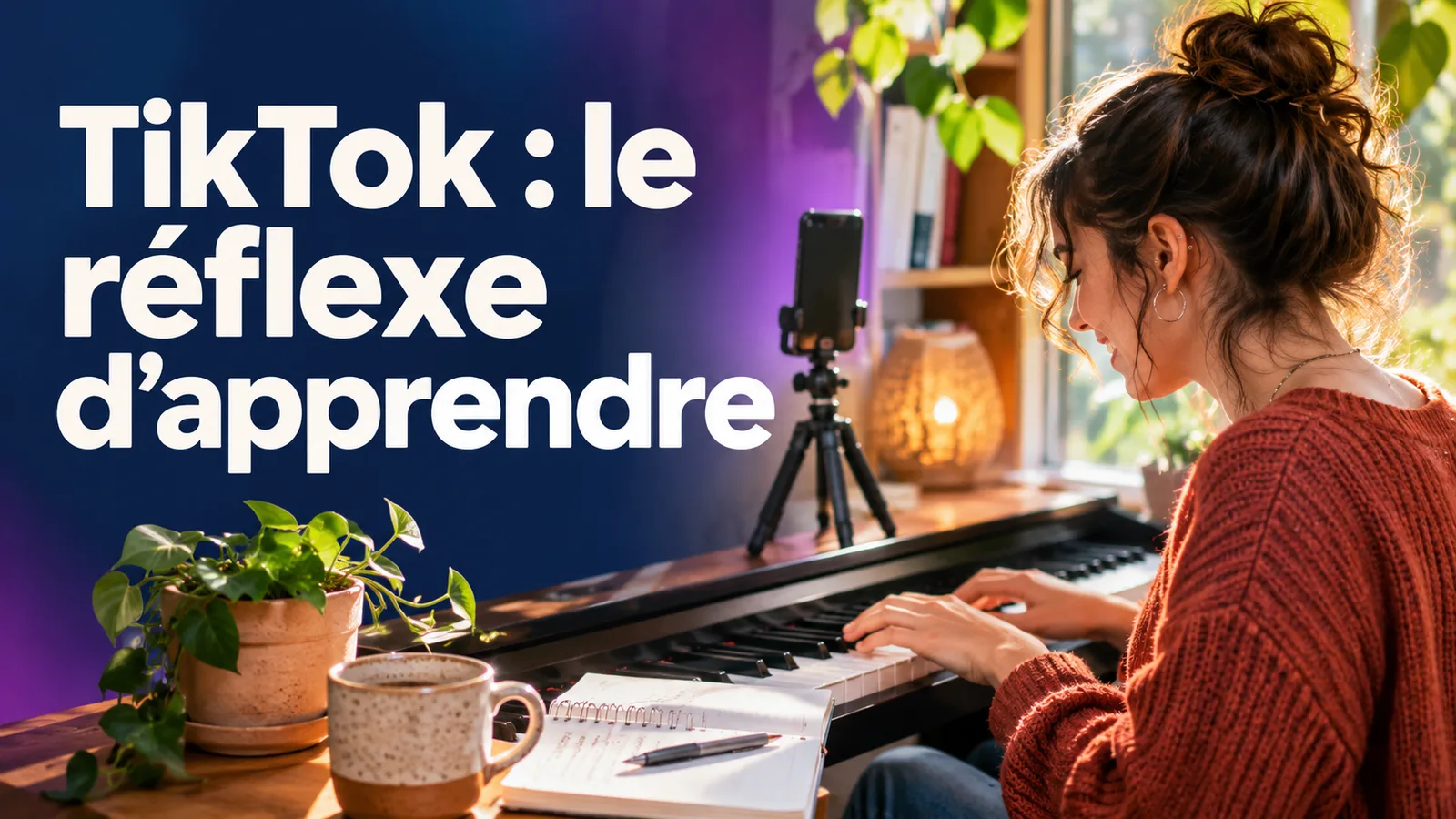
On TikTok, young people come not only to entertain themselves: they also seek ideas, methods and passions to try. In a report published on 20 November 2026, TikTok says 82 % of the 16-24 years surveyed tell them to discover new things through the platform and that 58 % place it among their first reflexes when they want to learn something. These results come from a survey conducted in four countries, including France: they do not mean that 82 % of all young French people use TikTok in this way.
The French signal is nevertheless concrete. The "tuto piano" research has progressed from 1 088 % between two six-month periods compared by TikTok; publications #Crochet of 16-24 years increased by 65 % in France. Behind these spectacular percentages, one question is of direct interest to trainers, artists, artisans, coaches and independents: how to be the right answer to a precise curiosity, rather than more content in an infinite thread? The answer lies less in an algorithmic trick than in a method: listening to questions, showing a gesture or skill, and then proposing a useful sequel. Information verified on 23 November 2026.
What TikTok actually measured in his report 2026
The new Discovery on TikTok Report 2026 n Published on 20 November, it combines a survey with internal research and publication observations. The survey, conducted by Qualtrics in August 2026, interviewed 500 persons aged from 16 to 24 years in each of four markets: France, United Kingdom, Indonesia and United Arab Emirates. The two leading numbers, 82 % for discovery and 58 % for learning, concern this set of 2 000 respondents.
The report is also based on TikTok usage data in six countries, including France, Germany and Brazil. Developments in hashtag publications compare July 2024-July 2025 to July 2025-July 2026. Research developments compare August 2025-January 2026 to February-July 2026. These windows are important: an increase in searches over six months should not be presented as an annual increase, and an increase in published videos does not automatically measure audience demand.
TikTok also indicates that close to 68 % of the young people interviewed use to discover new leisure. Sports, cinema, drawing, crochet and music draw a platform where one moves from curiosity to trial. The report gives international examples, but above all it contains local indications sufficiently precise to avoid reducing the phenomenon to a uniform global mode. The figures and their methodology can be consulted in the original PDF report.
In France, four interesting signals for niche creators
First signal: the "tuto piano" request progresses by 1 088 % in France, over the two half-yearly periods compared. This figure refers to a search, therefore an intention formulated by the user, not the simple number of videos published. It may suggest an increased interest in practical learning; However, it does not give the initial volume, the absolute number of searches, or the number of people willing to pay for a course.
Second signal: publications under #Crochet progress from 65 % in France16-24 years, from year to year. This is a production of content, not a direct measure of wool purchases or workshop registrations. For a textile designer, this is not proof that his market will double; It is an indication that a community of practice is active and that unresolved needs need to be observed.
Third signal: French "film to watch" research shows an increase of 8 527 % between the two semesters studied. The percentage can come from a modest initial base, and TikTok does not give the gross volume here. It nevertheless shows the interest of simple questions, formulated as a spectator would do: what to look at tonight, where to start in a genre, how to choose according to his tastes?
Fourth signal: publications #FigureSkating increase by 75 % in France for this age group. The lesson to be learned is not to suddenly become a specialist in skating. It is that fairly specific practices can find new communities when a passionate person shows the gestures, mistakes, progress and references that make it possible to understand the activity.
The figures do not constitute a list of profitable guaranteed niches. Rather, they recall that an audience can look for a very concrete skill, and that a creator with real experience has an advantage over generic content. To deepen the role of the formulations sought, the VIFLY guide on social media SEO explains how to make a video findable without writing for a machine.
Transforming curiosity into learning: the method that changes content
A trend explains what attracts attention. A question reveals what someone is trying to do. The difference counts: "the piano is trendy" eventually inspires a video of atmosphere, while "how to place your left hand on the piano" provides a verifiable problem, a result to show and a possible pedagogical suite. For an independent, the second approach gives more material to a useful series, even when the publication does not become viral.
The format can be very simple. Start by saying the question in the words of the hearing. Then show a single gesture or a decision, with a framing where the result is visible. Explain a common mistake, then make a short demonstration. Complete with what the person can now do and, if necessary, what is part of a more comprehensive learning process. You can propose a next step without interrupting the value of the video.
TikTok already proposed Creator Search Insights, a tool for identifying the subjects sought and, in the eligible regions, questions with few answers. Its launch dates from March 2024: the report of 20 November 2026 is not announcing a new availability of this tool. If Creator Search Insights appears on your account, use it as a clue to compare with comments and experience. If it does not appear, analyze the public research suggestions and the real issues of your clients rather than assume widespread access in France.
Another distinction is that "research value" is one of the criteria described by TikTok for its Creators' Awards Program, alongside originality, duration of reading and engagement. This does not mean that a tutorial video automatically returns money, or that the program is open to every account or territory. Research can contribute to discovery; remuneration depends on other rules and a separate eligibility.
Two concrete examples: piano teacher and textile designer
A piano teacher at La Réunion
A teacher notes that beginners always ask the same questions: what position of the fingers adopt, how to count a rhythm and how to work five minutes without getting discouraged? Rather than copying a viral video, he builds three capsules, each answering a complete question. The phone films hands and keyboard; a short oral explanation calls the problem; a demonstration shows what changes when the gesture is corrected.
He tests the titles "First left hand at the piano: error to avoid" or "Three minutes to count this rhythm" and notes the questions received, backups and profile visits. The French figure of +1 088 % is not a forecast for La Réunion: the teacher must measure the response of his own local audience. If a person wants to go further, a page VIFLY Booking can present a course discovered, its duration and conditions, then allow to choose a niche. This is the logical continuation of a successful demonstration, not a promise of customers generated by TikTok.
An artisan who teaches crochet
An artisan sells some creations and animates workshops. Faced with the French progress of #Crochet publications, it could publish more aesthetic videos presenting finite objects. Instead, she chooses a series based on beginner blockages: choose her first hook, count the stitches, catch an error, properly finish a piece. Each video answers a question that could be explicitly sought.
His goal is not to attract all crochet enthusiasts. She wants to be identifiable by people who appreciate her pedagogy and style. It thus links the series with a free mini-guide, a presentation of the workshops and a gallery of creations in its VIFLY LinkHub. A person comes to understand a technical point, discovers the world of the artisan and freely decides whether to follow it, download the resource or book. This course remains consistent even if the hashtag calms down the following month.
The viewpoint VIFLY : becoming an answer, not just a trend
The real opportunity is not to produce the next content that will make millions of views; is to become the person you find when you really want to learn something. The figures in the TikTok report are valuable because they make visible an often forgotten intention: a user can move from curiosity to trial, then to a relationship with a competent creator.
The VIFLY logic remains « visibility → understanding → confidence → action → opportunity ». A useful answer is discovered. An honest demonstration installs understanding. A coherent series builds trust. A resource, workshop, delivery or order can then follow up on this trust. This suite must not be mandatory or hidden behind a misleading promise.
Nor does this strategy involve transforming each passion into a commercial tunnel. A creator can teach to transmit, unite a community or publicize his work. Monetization becomes relevant only if an offer meets a real need and its existence is clearly presented. A small community that returns to solve concrete problems can bring more value than a peak of views without lasting interest.
It is also necessary to distinguish between the research intent and the operation of the "For You" thread. The discovery report does not announce any algorithmic changes, no ranking bonuses for tutorials and no new European rules. Article VIFLY on the thread "For You" and the questions raised by the DSA addresses a separate file. Do not mix both: a usage ratio is not an update of the algorithm.
Nuances and limitations: what percentages do not prove
The study is published by TikTok and presents its own platform from a favourable perspective. The survey results are based on responses reported in August 2026, without demonstrating that TikTok improves learning more than other media. The 2 000 respondents belong to four specific markets. 82 % and 58 % are neither an estimate of all world youth nor of the percentages specific to France or La Réunion.
Internal developments should not be confused: an increase in research measures a research activity; an increase in publications measures a creative activity. Growths of several hundred or thousands of percent can start from a very low base. The report does not communicate all the absolute values, does not directly measure the quality of what has been learned and does not prove any additional income for the creators concerned.
Educational subjects also have different requirements. Explaining a crochet stitch does not involve the same risks as giving medical, financial or psychological advice. In sensitive areas, the creator must verify his sources, specify his limits and avoid individual promises or diagnoses. Some of the population studied is minor: compliance with youth protection rules and commercial prudence remain essential.
Finally, do not confuse research and conversion success. A tutorial can be saved by thousands of people who don't want to buy anything. Conversely, an interested small group can enjoy full training. Decisions must be based on the actual observation of the audience, qualitative returns and voluntary actions, not on an isolated percentage of the report.
What to do now? Seven actions to test a useful series
- Choose a skill you actually master. Leave with a gesture, choice or difficulty that you can explain and verify. Do not pursue a niche only because its hashtag progresses.
- Collect ten questions from your audience. Use your messages, customer requests, comments and research suggestions. If Creator Search Insights is available on your account, add its indications without making it an absolute truth.
- Group these issues into three levels. Start, progress, avoid a mistake. Each level must propose an autonomous response before inviting to discover the sequel.
- Produce three short and distinct videos. A video question, visual evidence, an understandable explanation and a complete conclusion. Do not add an artificial suspense to force the next viewing.
- Ask for an explicit preference. Invite your audience to choose the next challenge. The new TikTok comment formats offer other ways to extend the dialogue, depending on the functions actually available in the account.
- Prepare a coherent destination. If a guide, workshop, service or reservation really extends the video, clearly present it in your public space. Do not make it appear that a service is free if it is paid.
- Measure for four weeks. Compare the searches that bring visits, backups, relevant questions, subscriptions and the following actions. Note also the production time: a tutorial very seen but impossible to maintain is not automatically the best format.
The conclusion is simple: TikTok does not become a universal school overnight. But the data published on November 20 show young people who explore practices, seek explanations and experience leisure, including in France. For a niche designer, the best strategy is to provide a sincere, precise enough response to be found and useful enough to make you want to come back.
Frequently asked questions
Do 82 % young French people use TikTok to learn?No. In the TikTok study, 82 % of the 2 000 young people interviewed in four countries report finding new things on the platform. The learning question gives a distinct result: 58 % say that TikTok is one of the first places they turn to to learn. The aggregate results are not exclusively French figures.
What French trend is most evident in the report?In particular, the report notes +1 088 % for "tuto piano" searches between two semesters compared, +65 % publications #Crochet over one year among the 16-24 years, as well as a sharp increase in "film to watch" searches. Absolute volumes are not provided in the synthesis.
Do we have to publish tutorials to be better ranked on TikTok?TikTok does not announce any ranking bonuses related to this report. A tutorial can meet a search request, but its performance depends on many factors and is never guaranteed.
Is Creator Search Insights available anywhere?TikTok launched in March 2024 in selected regions. Its presence depends on the access granted to the account and the evolution of the deployment. If the tool does not appear, the questions of your audience remain a relevant basis of work.
Do TikTok research guarantee sales of courses or workshops?No. A search indicates an interest, not an intention to purchase. It is then necessary to demonstrate its competence, present an honest offer and check whether any part of the hearing really wants to proceed to the next stage.
Sources
- TikTok Newsroom — Discovery on TikTok: What young people explored in 2026, 20 November 2026.
- TikTok — Discovery on TikTok Report 2026, Official PDF, methodology and detailed figures.
- TikTok Newsroom — Creator Search Insights, announcement of 13 March 2024.
- TikTok Newsroom — Rewards Program for Creators, 19 March 2024.