
To set the price of a workshop, add up your fixed costs, the cost of each participant, your work and the selling costs. Spread this budget over a realistic number of entries, then check that the price corresponds to the value of the experience for your audience. Don't just build your balance on a full room.
The trap is simple: you choose a price that seems easy to sell, then you discover that the equipment, the preparation and the costs absorb almost everything. Conversely, a high price does not become relevant simply because it covers your budget. Cost, supply and demand must be worked out together.
1. Make the job appear that you don't bill yet
Start with a budget sheet before the name of the tariff. Separate what you spend even with few registrants from what increases with the number of people. This separation then simulates several fillings.
- Fixed costs: rental, travel, preparation, animation, storage, communication and share of reusable equipment.
- Variable costs: consumables, individual support, snack or equipment rental per person.
- Sales costs: ticketing commission, payment provider fees and possible options.
- The reservation: an explicit amount for an additional consumable or a foreseeable contingency.
Valorizing your time allows you to see if the workshop really pays for your activity. This forecast valuation is not automatically your net salary: contributions, taxes, possible VAT and other charges must be treated according to your situation.
2. Start with a cautious scenario: ten bookings for twelve places
Here is a fictional example to show the method. Amounts are neither a price recommendation nor VIFLY, Mollie or PayPal rates. The example does not model a VAT to be collected or all company-specific charges.
| Post | Assumption |
|---|---|
| Rental | 80 € per session |
| Preparation, animation and storage | 180 € of work valued in the budget |
| Communication and reusable equipment | 50 € allocated to the session |
| Contingency reserve | 50 € |
| Fixed total | 360 € |
| Consumers | 8 € per participant |
| Sales costs envelope | 2 € per ticket: an assumption to replace |
| Price tested in the model | 55 € per person |
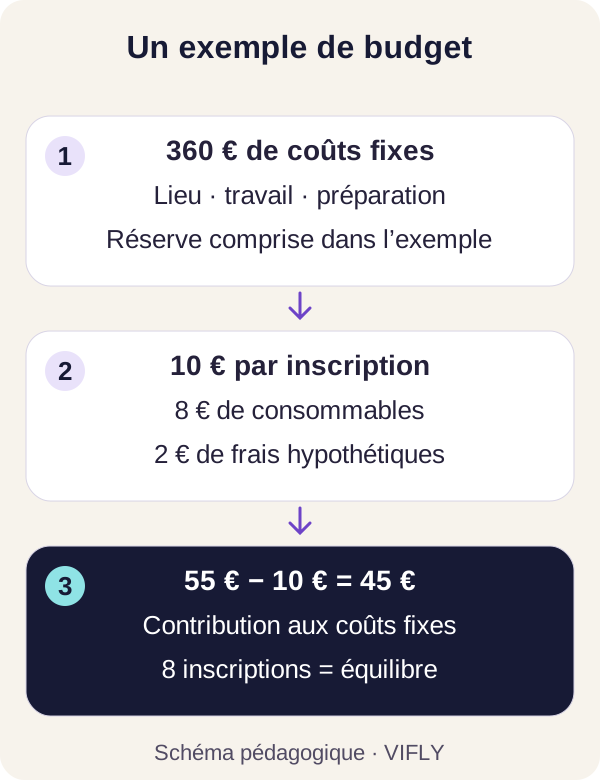
With ten bookings, the model's total budget is 460 €: 360 € in fixed costs, 80 € in consumables and 20 € in hypothetical fees. Revenue is 550 €. This leaves 90 € after these items, before the other charges and taxes excluded from this example.
The 2 € allowance only makes the calculation easier to follow. For your event, replace it with the ticket commissions actually applicable and your claimant's expenses. A commission may include a percentage, a fixed amount, a minimum or a tax; bank charges may also depend on the basket and the means of payment.
3. Look at the result before looking at the maximum capacity
In this model, each booking contributes 45 € towards fixed costs: a price of 55 €, less 8 € in consumables and 2 € in hypothetical fees. Eight bookings are needed to cover the 360 € in fixed costs.
| Registration | Income | Variable costs and costs | Result after 360 € in fixed costs |
|---|---|---|---|
| 6 persons | 330 € | 60 € | −90 € |
| 8 persons | 440 € | 80 € | 0 € |
| 10 persons | 550 € | 100 € | 90 € |
| 12 persons | 660 € | 120 € | 180 € |
The working formula is: forecast result = entry × (price - variable cost - fee per ticket) - fixed costs. It works here because the costs are represented by a simplified fixed sum. If your scale is more complex, calculate the fees for each scenario rather than apply this simplification.
Using ten bookings as your planning scenario leaves two places unsold in the forecast. It does not prove that you will make ten sales. Use previous editions, concrete enquiries or an initial check of the offer to choose a credible assumption.
4. Check what justifies the price for your audience
Your cost is a starting point. The participant, on the other hand, looks at what he will learn or live, the accompaniment, the material included, the place, the duration and the confidence he gives to the speaker.
Comparing comparable experiences: same duration, level, group size, equipment, support and services included. The price of a large group course does not automatically give the right price for a session where each person receives individual assistance.
If the acceptable price seems less than your cost, work the format: share the place, simplify a consumable, adjust the duration or review the offer. Artificially increasing the number of places can degrade the experience and reception. Don't try to solve an inconsistent budget with a larger promise.
5. Offer multiple rates only if you can explain the difference
A standard rate and a reduced rate can help different audiences participate. Define the terms and conditions of the reduced tariff and how they will be audited. A category named "member" does not automatically verify a membership.
A launch rate may be limited in time or quantity if this limit is real. Prepares its share in the budget and the average price actually received. If all registrants can get a discount, the rate displayed without a discount is not the correct forecast basis.
In our example, a discount of 10 % reduces the price to 49.50 €. Keeping the simplified 2 € allowance solely for this exercise gives a contribution of 39.50 € per booking: ten bookings, rounded up to the next whole booking, are then needed to cover 360 €. Actual fees must be recalculated after the discount.
The promo code guide explains the discounts on an order, the quotas and the amount actually sold. With a common gauge, several rates can draw in the same places without increasing the capacity of the room.
6. Separate expected profitability and available money
You can have a balanced budget and lack cash to buy the equipment before payments. Notes the payment dates of the location, suppliers and stakeholders, and the expected revenue availability schedule.
The ticket payment route distinguish the connected Mollie account from the cash managed by VIFLY. Checks, reservations, claims and bank deadlines must be included in your preparation.
Also maintains a vision of the risk of cancellation or repayment. An amount displayed as a sale is not necessarily an amount permanently available. Check your terms, commitments and costs that would remain due if the session were postponed.
Your decision sheet before publication
- My audience and the concrete value of the workshop are defined.
- I counted preparation, animation and storage.
- I separated the fixed and variable costs.
- I replaced the hypothetical costs with the scales of my journey.
- I know the result with less registrants than expected.
- I calculated the average price after discounts and invitations.
- I know when the expenses and payments will come in.
Once the price is decided, go to guide to organize the workshop and its booking page. For communication, use the instagram calendar with the price and inclusions actually announced.
Frequently asked questions about the price of a workshop
Do I have to start from the price of my competitors?
Look at their offers, but also start with your own costs and your audience. A competing price may correspond to an already funded place, a larger group or different services. It doesn't indicate your balance threshold.
Can I forget my time to make the price more accessible?
You may decide to offer some of your work, but make it appear in the budget. You will see what is a business or associative choice, and what actually pays for your activity.
Does a full room mean my price was too low?
Not necessarily. Analyses the result, returns, unmet demand and quality of support. A single workshop does not make it possible to conclude at the optimal price. Change one variable at a time and keep an understandable offer.
Price included before booking.
The vIFLY Ticket workshop page allows to present inclusions, rates and places. First consult the fees, then check your summary before opening the sales.
Sources and method
VIFLY Guide verified on 31 October 2026. All the figures in the example are pedagogical and fictional. Bpifrance Creation recommends comparing costs, demand, competition and positioning. The scales to be applied are those of the ticket Prices page and your payment contract on the date of your decision.