
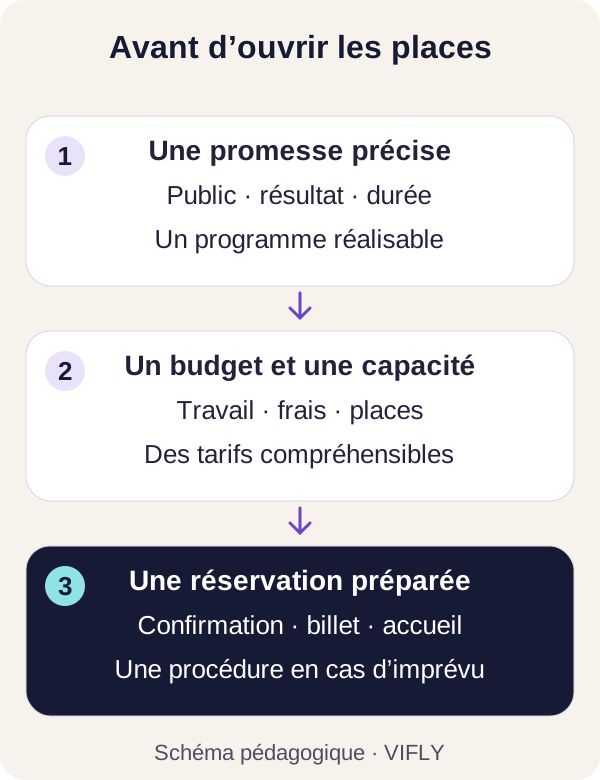
To organize a paid workshop, start with a precise promise, a workable program and an adapted capacity. Then calculate your price, prepare the booking conditions and test the course to the ticket. The communication comes after these decisions: it must lead to a page where one understands what one reserves.
A workshop for twelve people can be a very rewarding experience. It can also become difficult to manage if equipment is missing, the price does not cover preparation or participants do not know where to arrive. This guide helps you prepare these details before opening bookings.
1. Define what the participant will do or have experienced
‘Creative workshop’ describes a category. ‘Shape your first ceramic bowl in two hours, even if you have never used a potter's wheel’ describes an experience someone can choose. The second wording specifies the outcome, duration and expected level.
Write a sentence that answers four questions: who is it for, what will they do, how long will it take and what support will they receive? You can then show it to a few people in your target audience. Their questions often reveal what your offer is missing.
- The public: beginners, people already equipped, adults or age groups adapted.
- The result: an achievement, experienced method, decision or skill worked.
- The limits: which will not be dealt with and which would require another meeting.
- Prerequisites: level, personal equipment, maintenance or conditions of participation actually necessary.
Avoids an impossible promise to guarantee, including on income, health or mastery of a skill in a single session. An exact description reassures more than a spectacular result without a frame.
2. Build a program that leaves time to practice
A program is also a preparation tool. It ensures that explanations, practice and questions are kept within the announced time frame. Think about installation, storage and differences in pace between participants.
| When | Duration | What you will prepare |
|---|---|---|
| Reception and installation | 10 minutes | List of registrants, accessible material, useful instructions. |
| Demonstration | 20 minutes | A gesture or a method that the whole group can see. |
| Assisted practice | 65 minutes | Simple steps and time to help each person. |
| Trade and conclusion | 15 minutes | Questions, results and advice to continue. |
| Storage and departure | 10 minutes | Packaging, cleaning and outlet without precipitation. |
These times are an example of work, not a standard. If your workshop uses an oven, a product that needs to dry or a complex installation, explain what the person takes the same day and what they will recover later.
3. Set a capacity that you can really accompany
Capacity is not just about the number of chairs. It depends on the venue, workstations, tools, safety and the attention you can provide. Twelve people working independently on paper need a different set-up from twelve beginners sharing two machines.
Check the reception conditions with the person in charge of the place. The ticket gauge refers to tickets: it does not automatically calculate the place occupied by the team, the participants or other persons present. Keep a sales capacity compatible with your entire organization.
If several rates give access to the same places, they must share the same limit. In VIFLY Ticket for workshopsa common tonnage may limit all tariffs in addition to their quotas. Invitations must also be provided in available places.
4. Calculate your price before choosing a price that looks attractive
Count rental, consumables, travel, commissions, payment fees and your time. Preparation, animation and storage are part of the work. A full workshop is not necessarily profitable if this work has been forgotten.
Make your budget with a plausible number of entries, less than the maximum capacity. You will know what the result becomes if a few places remain empty. Also include pre-sales purchases and revenue availability schedule.
For a worked example with six, eight, ten and twelve bookings, read how to set the price of a workshop. The guide distinguishes the price paid, the fees, the cost of the session and the forecast result. It does not confuse turnover with personal income.
A launch price or promotional code can make sense if you know its cost. A ‘duo price per person’ must explain that two tickets need to be selected for two people. A ticket type's name does not automatically create a bundle of places.
5. Prepare a page that responds to hesitations before payment
A person must be able to make a decision without having to send several private messages. Put the essential information near the presentation of the workshop, then detail what deserves an explanation.
- The expected result, level and run.
- Date, start time, duration and spindle if your audience can be remotely.
- The address, entry of the place and verified accessibility information.
- The price, what it includes and any additional purchases.
- The equipment provided and what each must bring.
- The name of the speaker and a useful presentation of his experience.
- Conditions for cancellation, postponement and the way to ask a question.
A photo of the gesture or space helps to project. If the photo is illustrative, indicate it; It should not be presented as the testimony of a previous edition. For photos of participants, check the necessary permissions before broadcast.
6. Organizes bookings and information by participant
Choose a ticket from the actual route: select a fare, understand the total, book, receive confirmation, find your ticket and get an answer in case of a problem. The guide to choosing an online ticket office offers a comparison grid.
With VIFLY Ticket, the participant reserves without organizing account. You can activate information per participant, such as name, organization or a practical question. A company that buys several tickets can identify the registered persons. Collect only what serves the workshop and explains its use.
Paid sales require an eligible and activated payment path. Mollie Connect and cash management by VIFLY do not have the same method of payment. Check your file before you promise an opening date or spend the expected revenues.
An order created or a return from the provider is not sufficient to confirm a payment. Wait for the confirmed state and the ticket issued. Cancellation requests and refunds have their own follow-up; a deferral does not mean that a refund has already taken place.
7. Make a promotion that leads to one next action
Presents the gesture, mood or result of the workshop. Answer the questions "Is it for me? "Do you already need to know how?" and "What is included?". Finished with a specific invitation to consult the program and places.
Share the public page of the event, never the private link of an order or QR code. If you advertise "last places", check that it's true. A number of subscribers or views do not replace confirmed reservations.
The calendar to promote an event on Instagram link demo, answers to objections and booking page. It can be adapted to a small audience or local workshop.
8. Prepare on D-Day and plan in case of unforeseen
Before the workshop, check the published address, schedules, materials and list of registrants. Decides who welcomes, animates and answers any delays or questions. The same person cannot always explain a gesture and solve a ticket that cannot be found.
You can invite check-in staff with limited permissions in Ticket. If the venue's network is unreliable, prepare the offline reader on each device and test it before admitting participants. Its list is temporary, expires after a maximum of twelve hours and must be refreshed to include new sales or changes.
Two disconnected devices can accept the same ticket: synchronisation will flag the conflict. Plan a suitable check-in process and review the results when the network returns. The qR ticket guide code details these limits.
In case of cancellation or postponement, uses a clear message, new information and notification tracking. Explains the refund policy separately. For a workshop welcoming the public, also check the specific obligations of the place and the activity: the ticket office does not replace these checks.
The list to read before opening sales
- A person from my target understands the benefit and the level expected.
- The program lasts, with installation and storage.
- Place, equipment and sales capacity are confirmed.
- The budget remains consistent with unsold places.
- The price and conditions are legible before booking.
- Payment and receipt of messages have been tested in the right environment.
- I know how to welcome, find a ticket and deal with an unexpected.
Frequently asked questions about paid workshops
How many participants does it take for a first workshop?
First choose the number of people you can accompany correctly, then calculate your balance threshold. There is no universal ideal size. A smaller group may charge a different price or lower fixed costs.
Should the registrations be opened before you book the place?
Confirms the elements that actually condition the session before selling. If an element remains uncertain, explain it explicitly and verify that your course and your conditions correspond to this situation. Do not present as acquired a place you did not get.
Can I use the same page for several sessions?
Each session should provide an unambiguous understanding of its date and places. In the Ticket route presented here, prepare an event dated by session. For a recurring schedule or curriculum, check a suitable tool for this operation.
Is your workshop set? Prepare his reservation.
See workshop solution, then creates a page with the right rates, the right places and useful information. The preparation of the draft does not trigger any payment.
Sources and method
Editorial guide VIFLY, verified on 31 October 2026. The program and the situations described are fictional examples to be adapted. The price method is based in particular on Bpifrance Creation: costs, demand, competition and positioning. VIFLY features and fees are documented in the Ticket pages linked in the guide.